There was a lot of confusion, and some people took advantage of it to rush through, but for the most part it was pretty orderly. Which makes sense because in many parts of the world where there are no traffic lights or stop signs, people get on just fine.
The Waymo’s, on the other hand, were dropping like flies. While walking from Lower to Upper Haight I spotted a broken Waymo every handful of blocks. The corner of Haight & Fillmore was particularly bad, with 3 of them blocking traffic in both directions — in the path of both the 7 and 22 bus lines.
Well, sort of. Road injuries / fatalities in countries without these kinds of regulations are about an 3-4x higher than in those that do have them.
wow, cascading failures. I'll bet this is the tip of the iceberg.
Herd mentality also helps here. We see the first few people do this and we will follow along pretty quickly.
My own experience has given me a somewhat more-nuanced take.
At first, it's akin to the path of evil. Way too many people just zoom through intersections with dark traffic lights like they're cruising unimpeded down the Interstate, obvious to their surroundings. Some people get grumpy and lay on the horn as if to motivate those in front of them to fly through themselves.
But many people do stop, observe, and proceed when it is both appropriate and safe.
After awhile, it calms down substantially. The local municipality rounds up enough stop signs to plant in the middle of the intersections that people seem to actually be learning what to do (as unlikely as that sounds).
By day 2 or 3, it's still somewhat chaotic -- but it seems "safe" in that the majority of the people understand what to do (it's just stop sign -- it may be a stop sign at an amazingly-complex intersection, but it's still just a stop sign) and the flyers are infrequent-enough to look out for.
By day 5 or 6, traffic flows more-or-less fine and it feels like the traffic lights were never necessary to begin with. People stop. They take turns. They use their turn signals like their lives depend on it. And the flyers apparently have flown off to somewhere else. It seems impossible to behold, but I've seen it.
But SF's outage seems likely to be a lot shorter than that timeline, and I definitely agree with Waymo taking the cautious route.
(but I also see reports that they just left these cars in the middle of the road. That's NFG.)
In absence of priority roads there is also the "right before left" rule which means that the car coming from the right if they would conflict in time is the car that has priority. It's also always illegal to enter an intersection if you can't immediately clear it; that seems to work better when there are no green traffic lights to suggest an explicit allowance to drive, though.
In the States (or at least, every US state that I'm familiar with -- each one is free to make their own traffic rules, similar to how each EU member state also has their own regulatory freedoms), a dark/disabled/non-working traffic light is to be treated as stop sign.
For all drivers, in all directions of travel: It functionally becomes a stop sign.
That doesn't mean that it is the best way, nor does it mean that it is the worst way. It simply is the way that it is.
How does "you can only piss with the cock you've got" translate to German slang?
One interesting effect is that there are also often pedestrian crossings that have priority over everyone. Normally those are limited by lights, but without lights a steady stream of pedestrians stops all traffic. Seen that happen in Utrecht near the train station recently, unlimited pedestrians and bikes, so traffic got completely stuck until the police showed up.
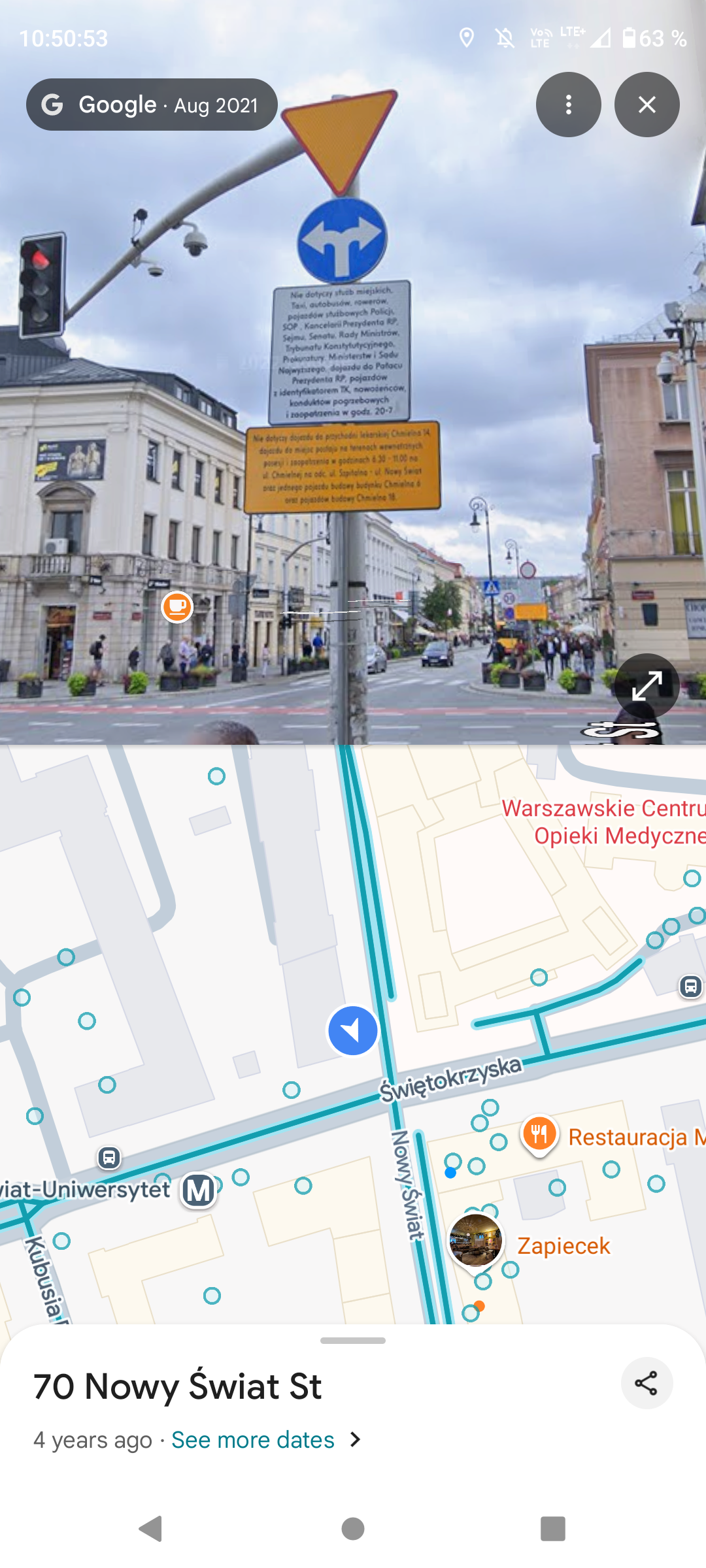
Most places in Poland have this exact setup. And I say most because I have not seen one that does not, but I am guessing they exist. Maybe some of them have bad visibility even?
If one does not respect the yield sign that does not seem a signaling problem.
Average signaling in Poland be like
What I've recently found troubling is the places that use similar signs for emissions controls. With a rental you usually have a recent enough car that you can ignore those.
Being able to distinguish between “low emissions zone, but any car from this decade can go in” and “local traffic only, you need to live in this neighborhood to enter” in a foreign language, bit me a couple of times while traveling.
But those complex multiple lanes in all directions + turn lanes...
They do break down. I think they are a breeding ground for confusion and frustration.
In contrast many years ago I lived at an intersection that had almost no pedestrians back then and a few times for a power outage limited to our building and that intersection. I enjoyed standing on my balcony and watch traffic. It mostly worked well. Cars did treat it like a intersection with stop signs. There two issues happened though. One was when there was no car already stopped and about 10%-20% of drivers didn't realize there was an intersection with lights out and just raced through it. The other ironically were bicyclists. 90% of the just totally ignored there was an intersection. That was especially scary when they arrived at the same time as one of those cars who didn't realize it either.
I’ve long been curious if people in S.F. who are used to Waymo “behavior” – including myself – behave differently when a Waymo is involved. For the most part, Waymos are extremely predictable and if you’re on the road as a pedestrian, cyclist, or car, are you more aggressive and willing to assert your turn in the road? Curious if Waymo has done a psychological study of how we start to think about the vehicles. I know many runners, for example, that’ll stride right into the crosswalk in front of a Waymo but wouldn’t dare to do that in front of other cars. Similarly, anecdotally people treat public transit vehicles differently than a civilian car: folks are more willing to let them drive even if out of natural turn.
My purely anectodotal experience is that the response is variable and culturally dependent. Americans tend to treat any intersections with a downed stoplight as a multi-way stop. It's slow but people get through. I've experienced other countries where drivers just proceed into the intersection and honk at each other. (Names withheld to protect the innocent.)
It seems a bit like the Marshmallow test but measures collaboration. [0]
[0] https://en.wikipedia.org/wiki/Stanford_marshmallow_experimen...
> Traffic Light Not Working
When a traffic light is not working, stop as if the intersection is controlled by STOP signs in all directions. Then proceed cautiously when it is safe to do so.
https://www.dmv.ca.gov/portal/handbook/california-driver-han...
Rural drivers will know to turn right and make a u-turn, but city drivers may not know that trick.
Actually there are times of day when I find it preferable that the traffic lights are down.
Presumably Waymo will make sure they can handle this situation in the future, but I'm not sure there's a really satisfactory solution. The way you're supposed to handle an intersection with no lights (treat it as a stop sign intersection) doesn't work very well when no one else is behaving that way.