I don't necessarily disagree with your thesis, but I'd be genuinely interested in reading the source on this, unless you just mean because people are bigger overall they have more muscle as a function of weight.
Dated but still relevant: https://cepr.org/voxeu/columns/evolution-bmi-values-us-adult...
This is particular relevant in the military because your fitness level is graded relative to you BMI. Hence, it is common trope one hears in the military. It is a practical question in the military. If the BMI is based on 1950's pilots and today's soldiers have a higher average BMI, then it can have an impact on promotions, fitness scores, health assessments, etc.
Just one link out of many (this is well known): https://www.military.com/daily-news/2022/09/28/new-pentagon-...
* obesity (the topic) (11%)
* drug use (marajuana in a country where it's legal in 24 of 50 states) (8%)
* mental / physical health (7%)
how much of that was just previously hidden or lied about? also it doesn't show any previous stats. So can't really draw any conclusions. also doesn't cover where the deltas were from.
Marijuana is illegal everywhere in the US under federal law. 47 states, the District of Colombia, Guam, and the US Virgin Islands have restructured their own marijuana laws to except from them use of marijuana, generally or in specific forms, for medical use. 24 of those states, D.C., Guam, and the Northern Mariana Islands have (also, except in the last case) done the same for adult (over 21) recreational marijuana use [0], as well. The federal government has an official (in the form of a restriction in appropriations laws since 2015) policy of non-enforcement for now (without waiving the possibility of future enforcement within the statute of limitations should that funding restriction lapse) of certain federal criminal prohibitions against state-authorized medical use. (However, for example, all financial institutions are required to file Suspicious Activity Reports with Treasury’s FinCEN for all marijuana-related businesses they discover to be clients, even if the businesses are exclusively involved in activities covered by that enforcement deferment.)
[0] For those interested in inverting this, marijuana use has neither medical nor adult-use exceptions under state/territorial law in only 3 states (Idaho, Kansas, and Nebraska) plus American Samoa.
https://www.cdc.gov/nchs/data/hestat/obesity-adult-17-18/Est...
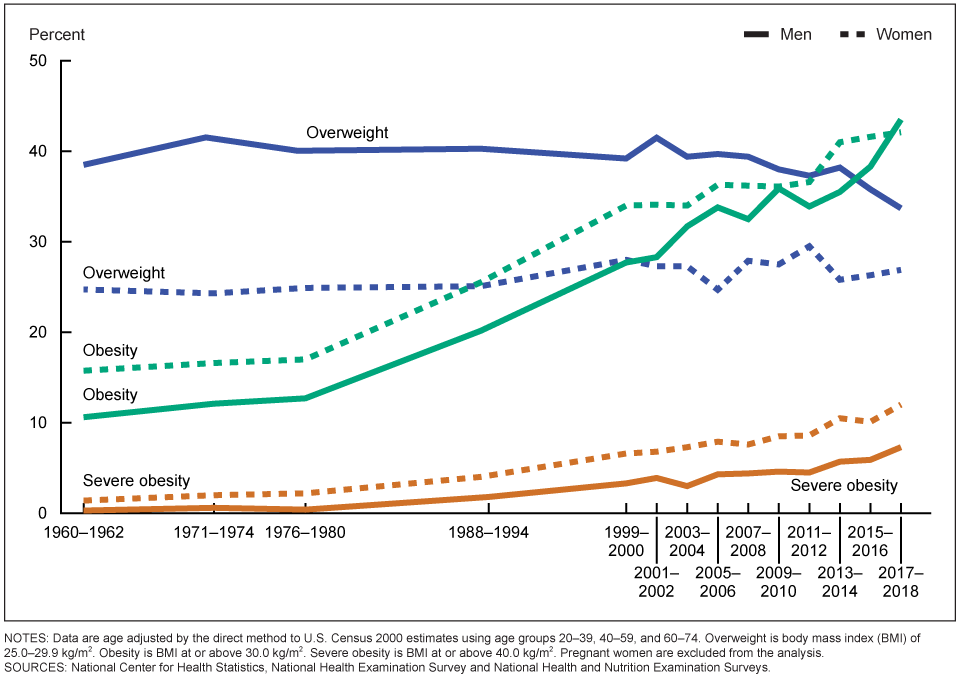
The data isn't hidden or lied about. If you think the data is fudged, go pick up a high school year book or photo album from the 1950s or 1960s and take a look at the young people.
Also as the gpgp was talking about... in many places obseity is purely based on weight / height ratio... which doesn't bring muscle into account. So all I can say is I can't really say what factors are involved.
Suburbs around the country are quiet after school as all the kids are inside physically atrophying.
This is true, but sort of a sleight of hand -- obese people that don't exercise have more muscle mass than non-obese people who don't exercise, just to carry around all of the fat. And obviously the average American, both male and female, is more overweight/obese than in 1924.
(I agree with basically everything else you say, though.)
What I could have added was a caveat that sample non-obese people from each time would indicate that 2024 people have greater average muscle mass.
Personally, a more interesting question is whether growth along the Kardashev scale leads to a greater disparity in muscle mass vs body fat. The past 100 years would seem to indicate that it is possible. That being said, it could also be a uniquely American phenomenon. My hypothesis would be that avg muscle mass among French men has still grown over the past 100 years but I don't think obesity has grown to the extreme that it has in the USA.
https://jamanetwork.com/journals/jama-health-forum/fullartic...
No? You have to compare like for like. Sedentary obese women have more muscle mass than sedentary normal-weight women, and sedentary obese men have more muscle mass than sedentary normal-weight men. (And the ratio of women to men hasn't moved very much since 1924.)
The rest of your comment is not responsive to mine.
Not true. Overweight and obese are defined on fixed scales. You can have a population that is 100% obese.
I think the former is uncontroversial but boring, and the later is wrong. I also think that people conflate the two because they want to pretend that being average is the same thing as being healthy.
And relative they are weaker in the sense that the ratio between strength and body mass is smaller than that of normal people.
And then we have the powerlifting community.
You make one specific relevant claim: "obese people don't have more muscle." (Which belies everything I've read on the subject.) So, uh, why do you think that?
https://www.timescolonist.com/local-news/wendy-the-whippet-f...
In ancient times, such as during the period of Ancient Greece and Ancient Rome, full-grown cows were significantly smaller than modern cattle. Based on archaeological evidence (bones and remains), historians and archaeozoologists estimate the following sizes: • Height: Approximately 100–120 cm (3.3–4 feet) at the shoulder. • Weight: Between 200–400 kg (440–880 lbs), depending on the breed, sex, and regional conditions.
For comparison: • Modern cattle like Holsteins (dairy cows) stand around 140–150 cm at the shoulder and weigh 700–900 kg. • Some smaller modern breeds, like Dexter cattle, resemble ancient cattle in stature, with a height of 90–120 cm and weight of 300–450 kg.
Factors Influencing Smaller Size in Ancient Cattle 1. Nutritional Limitations: Grazing conditions were less controlled, and fodder quality was inconsistent. 2. Genetics: Ancient cattle were not selectively bred for size like modern cattle. 3. Purpose: Cattle were primarily used for labor (draught animals) and small-scale milk production, rather than for meat.
Ancient cattle were functional animals suited to the agricultural practices and available resources of their time, so their size reflected these limitations.
If you look at medieval illustrations of shepherds, one thing that strikes you is just how small all the animals are. Even in relation to the medieval humans who were significantly shorter than us.
It had its advantages - for example, a leaner, smaller animal can walk long distances and won't get stuck in swampy ground. But it doesn't give you a lot of anything - hide, meat, milk... Nowadays, we have huge animals, which nevertheless have to be transported by trucks. No longer capable of walking 50 miles from the lowland to the mountains to graze.
The point is really: Classical Greek athletes were doing a lot of recognizable strength training. "Halteres" are basically stone dumbbells (in Spanish the derived word "halterofilia" is the modern name for Olympic weightlifting).
You have other examples like Bybon (https://en.wikipedia.org/wiki/Bybon) where we have an inscribed rock with a handle carved into it explicitly to use as a weightlifting feat.
This was definitely part of the culture and people knew what trained athletes looked like.
The dude won six Olympic wrestling events in a row. The seventh Olympics, he came in second. A twenty-eight year rein in one of the most practiced sports in the ancient world.
Eat your heart out, Tom Brady.
If you truly believe that, you cannot have seen many penises at all.
Regarding your specific example, I'd actually say that "a non-muscular person with various regions puffed up" is a fairly good description of what a muscular person looks like! And, further, I would be fairly confident that an ancient Greek sculptor, having observed numerous models, would be able to ramp the dials up to 12, producing a figure with a degree of outlandish magnificence never actually quite seen in real life, while still appearing anatomically accurate enough not to look weird.
As to how buff the Greeks really were, I admit we'd need a time machine.
Anecdotal: I helped my dad a few years ago do a lot of genealogy. He had pictures going back to the late 1800s for one branch of the family that just arrived from Ireland. Most of the men were shirtless and you could count every rib. There was very little muscle.
I'm not making a counter-argument to the OP's position. I'm only making a refutation of the conjecture.
Over the last year I've roughly doubled my pushup strength, with very visible resulting muscular hypertrophy in my triceps, back, and shoulders (even though I was optimizing for strength rather than hypertrophy). The total time taken over that year has been about 6 hours: three 40-second sets of pushups every two days, with 2⅓ minute breaks between sets, which I'm not counting because I can post to HN and drink yerba mate during that time. This works out to one minute per day.
There is literally nobody in the world who has less than 6 hours of free time per year, regardless of economics.
I started out doing three sets of knee pushups to failure, and once I reached ten reps I switched to real pushups; once I reach failure on the real pushups (3–5 reps in the first set, sometimes as little as 2 in the last) I continue with knee pushups until failure. This takes about 40 seconds and seems to be a good balance of intensity and safety.
I'm slightly obese (109kg) like most of the population in rich countries, and I think my state of muscular development was about average in that context. Stronger people would presumably need to invest more time than one minute per day to make further progress, perhaps as much as ten minutes or even more, but those aren't the people we're talking about.
Aerobic exercise, which should really also be part of a workout routine, is significantly more time-consuming though, and requires proper equipment. Most importantly a new pair of good running shoes every year or so to reduce wear on the joints.
So yes, even with kids or similarly demanding circumstances it should be possible to accommodate moderate exercise in most peoples lives. But the result probably won't be body-builder levels of muscular development.
One is that if you're doing 50 pushups you're probably doing endurance training rather than strength training, unless you're talking about doing 10 sets in a day. And if you're doing them every day you're going to build strength very slowly or actually decline in strength. You need recovery time to build muscle. If that's what you're after, do however many pushups every other day. You can work on your legs in between if you want. My legs are still pretty decent from when I used to commute by bicycle in San Francisco.
Another thought is that diversifying from extensor exercises into flexor exercises isn't even as hard as you make it out to be. It doesn't even require simple equipment.
You can bicep-curl the groceries.
You can do a pullup on a doorframe, if you can find a doorframe that won't break.
You can do one-arm inclined rows with a clothesline pole in your crotch. If you don't have clotheslines in your country, use a telephone pole.
Guys in prison deadlift the bed, or each other.
Kids climb trees and hang from horizontal tree branches. You can do that too.
If you lie down on your back under the kitchen table, you can grab opposite sides of the table with your two hands and lift yourself up with your biceps that way. If this isn't enough resistance, you can do archer rows that way. Putting both hands on the same side of the table may destabilize it, depending on the table.
I have a metal-framed transom over my kitchen door that's tall enough that I can dead-hang from it.
Fences and walls are commonly high enough that you can dead-hang from your hands on them too, though they may not be ideal for a pullup.
If you have a door, even a hollow-core wooden door, you can open the door, support its distal side with a wedge of wood (or newspaper) to take the load off the hinges, and then you can safely hang from the top of the door. This will not work with an aluminum screen door or a car door, but otherwise you're good.
Unless you live in the Gobi, you can tie a rope around a telephone pole or a tree, then climb the rope.
You can pull up to a ladder rung from underneath the ladder.
Playgrounds have jungle gyms.
Finding objects strong enough to hang from is a little harder than finding a floor, but still not a category that requires exercise equipment specifically built for it.
As for aerobics, for me the best aerobic exercise is dance, because running is boring and I don't care for the social dynamics of team sports, and running shoes are generally not helpful for dance. Many forms of dance are done barefoot; others usually use flat-soled shoes with no cushioning, on purpose, because cushioning dramatically impairs your balance. (I agree that cushioning is very important not just for running on concrete but even for extended walking on it.)
(Actually, swimming is even better, but I live too far from the river.)
Many, perhaps most, people in rich countries are experiencing levels of physical disability due to muscular atrophy that could be corrected by exercise averaging on the order of one minute per day. It's true that, to get body-builder levels of muscular development, you have to treat it as not just a full-time job but also a weird cult that fanatically controls your diet. In between the literally crippling levels of sedentarism so many people suffer, and eating kilograms of meat three times a day except when you're cutting, there is an enormous spectrum.
Supporting the door to protect the hinges is an excellent suggestion, since concern about the hinges is exactly why I originally hesitated from using a door! It seems creativity is indeed the true limiting factor in choosing equipment and adapting exercises.
I think I will pick up running (many acquaintances are in a runner group), but dancing is also on my to-do list.
Many thanks for your kind suggestions!
And for another argument, from a psychological perspective, we know that a healthy body in a vital component of a healthy mind - even with the development of excellent mind-silicon interfaces, we are probably a very, very long way from keeping minds healthy without a correspondingly healthy body (including muscle mass).
What is this focus on hypertrophy? The article isn't about having prominent muscles, it's clearly about being physically fit in the sense that farmers and manual laborers are fit, not in the sense that actors are fit.
Another example, from the article, that backs up what you are saying. Arm wrestling, is not a clear overall indicator of total strength or fitness. It's as much about technique, rules, psychology (through sh*t talking or facial expressions), and very specific muscle development than anything else. Doesn't show how much a person could lift or squat. Strength in one area, doesn't mean strength in another or if people in the past were "stronger".
A cat soldier is the only one who can overcome all type of obstacles and is operational under all circumstances with high efficiency.
Spartan soldiers were too efficient are were known for eating little (not until they felt full).
Modern laborers aren't even allowed to. Just because you're jacked and can install semi truck tires by hand doesn't mean your boss wants to risk the insurance or OSHA dumpster fire that could arise if you throw out your back doing so.
When I was in the US military, we all complained about the Body Mass Index standards. They were based on the WWII era "normal". Men were smaller. Less muscle mass. Shorter. If the average fit American young man tried to fit into a pilot's cockpit from the 1950's, it would feel quite cramped. Like it was built for much small people. It was.
We have certainly climbed the Kardashev scale since the 1950's. To what degree is a matter of contention. But, all would agree that we have moved up the scale.
Muscle atrophy has not been correlated with the growth. The opposite seems true. The average American, both male and female, has more muscle mass than in 1924. A 2024 person spends significantly more time on average in a gym pushing their muscles to hypertrophy than in 1924.
In addition, it is likely that the romantic picture of the average laborer "bodybuilding" is fictive and ignores how muscle atrophy and hypertrophy works. Most laborers are NOT doing activity that leads to hypertrophy. They are staying well within cardiovascular zones of muscle activation. Hence, bodybuilders as we know them are largely a modern phenomenon. And they are certainly WAY more muscular.
Seems the model that underlies this claim is built on seemingly demonstrably false premises.