Is it perfect? No, probably not. But repealing it would likely increase the budget deficit according to the CBO and put a large number of folks into a much worse situation than they are in now.
The battle over cost was left for another day.
But beyond that... has average life expectancy measurably increased because of this "extra" insurance coverage?
Has the number of medical-related bankrupcties measurably decreased as a result of the expanded coverage?
I can't find solid data but everything I've seen suggests that those haven't really changed at all.
Given that, in the grand scheme of things, has anything actually improved for us, collectively? Healthcare is much more expensive now, but maybe that would have happened regardless.
Artificially limiting the ability of new participants to enter the market on the supply side, for example, creates an artificially-oligopolistic environment without the natural competitive pressures that force pricing down.
Even worse, this in turn results in an environment that attracts people and organizations who want to exploit these government-created inefficiencies for personal profit, rather than attracting people and organizations who want to provide higher-quality and lower-cost service than their competitors.
The end result of this government intervention is artificially-high costs for abysmal service.
The situation only gets worse when government tries to intervene with even more "solutions" for the problems that government itself created in the first place.
Where on the chart did Obamacare get passed / implemented?
It was always about access, not cost. That pissed me off back then that single payer was not even on the table in negotiations. It was watered down to get it through, but I am still thankful that something got passed... I would still have a messed up rotator cuff from when I was 15 otherwise.
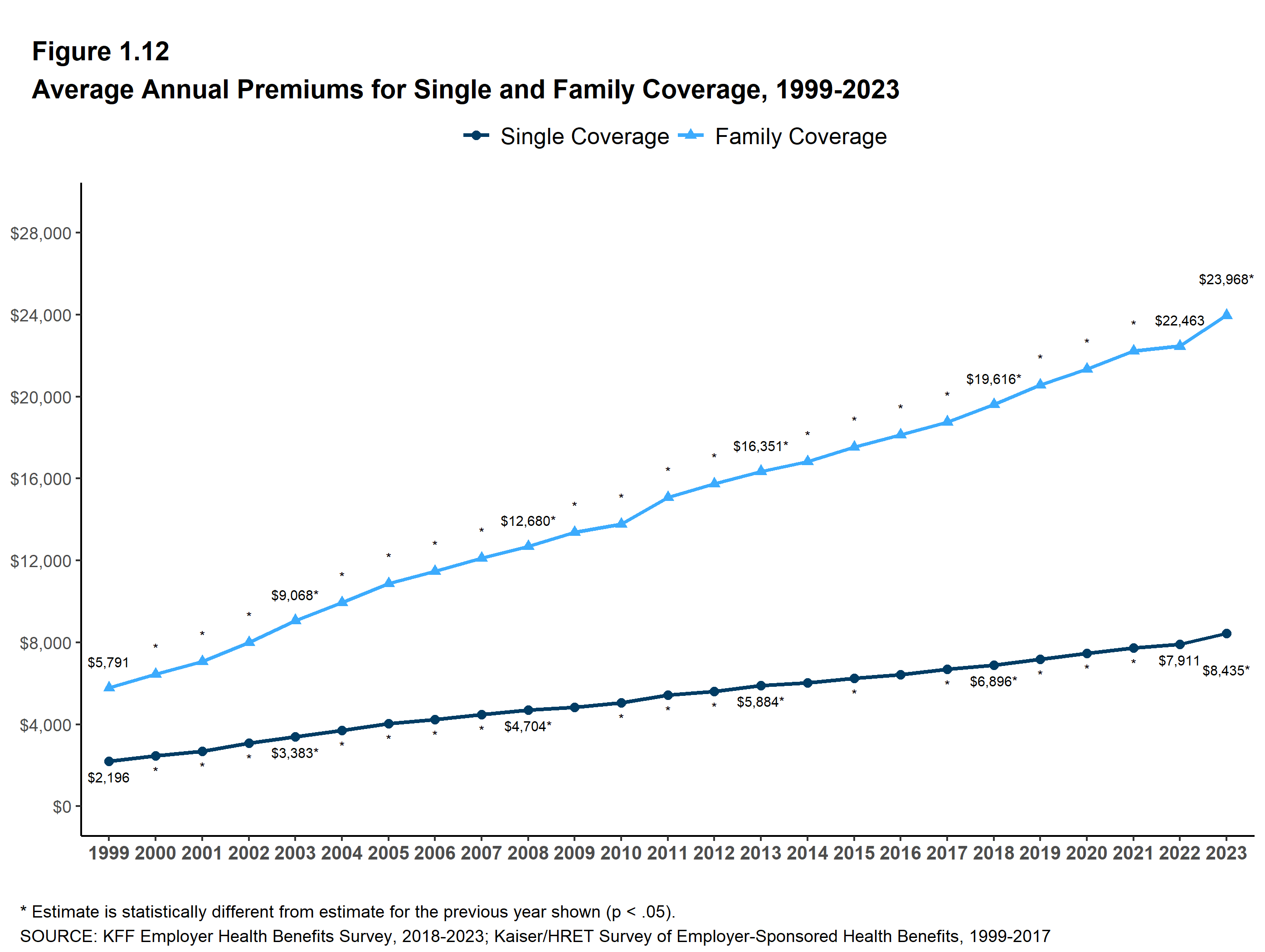
https://www.kff.org/wp-content/uploads/2023/10/Figure-1-12.p...
It should be obvious, right?
I don't deny that it sucks that health insurance is so expensive. Of course it sucks. And I have tons of empathy for anyone who is suffering under the expenses. But blaming our current costs on PPACA is just not supported by the evidence I'm seeing. If you have other evidence I should look at, I welcome it.
It is insane to me you are going to sit there and try to act otherwise.
In contrast, people with corporate policies are generally self insured so the per capital costs are lower. Really any company with more than a few hundred people is better off being self insured.
So yes it’s great for the minority that could not get insurance (outside of high risk pools) previously. But it’s purely at the expense of the healthy subsidizing them with overly expensive policies.
Its a really stupid system and of all the possible solutions they (the Democrats when they rammed it through Congress at the 11th hour) picked the one that provides the least actual healthcare and funnels the most money to insurance companies.
Linked elsewhere: https://www.kff.org/wp-content/uploads/2023/10/Figure-1-12.p...
That's a pretty straight line, with no noticeable change because of ACA.
> But it’s purely at the expense of the healthy subsidizing them with overly expensive policies.
This is how insurance works.
The US needs a proper public healthcare system. Good luck finding a way to make that happen though.
The point is not about insurance in general, it’s the isolation of the individual market from the pools of large employers.
Yes the healthy will always be subsidizing the rest, but it’s a specific subset of healthy bearing that burden. It’s not the system as a whole.
> The US needs a proper public healthcare system. Good luck finding a way to make that happen though.
Ban corporate self insured policies so that the risk pools are unified to contain everyone.
Eliminate the deduction for offering insurance. Right now the same policy is cheaper if paid by the company as its pretax dollars (vs after tax dollars for an individual policy).
There should be only state or nation wide risk pools.
The individual mandate has been gone since 2019.
They were going up before, during, and post ACA mandate, though. They've been on an upwards march alongside the underlying per-capita healthcare costs for decades. https://www.healthsystemtracker.org/chart-collection/u-s-spe... ("Total national health expenditures, US $ per capita, 1970-2022" - $2k/year --> $13k/year per person)
There were some pandemic era programs that increased the number of insured people, so it is possible things have changed since 2022. Either way, there is no evidence that the repeal of the individual mandate actually resulted in less people with health insurance.
If everyone is ensured, no matter the pre-existinf conditions, people take more risks, live more dangerously, drive a little faster, eat a bit worse, etc. Nobody ever talks about the hidden consequences of these oh so wonderful government programs.
This creates an incentive to pass laws prohibiting products and lifestyles deemed unhealthy.
I think the stigma point is definitely true, but it's not doing anything to improve things. Obeise people are looked down at by society, but in the US 70% of the population is obese and the number just keeps growing. The natural incentive system is broken by government programs. Why should I bother eating healthy and limit my diet when I can just get health insurance when I get diabetes?
Are you ok? Did you just wake up from a coma and suffering from some selective amnesia? Have you been living under a rock? Maybe you missed any and all libertarian content? Or the articles about how safety precautions give a sense of safety which result in more risky behaviors? (From bicycle helmets to OSHA stuff.) But maybe you have ran into articles about how car safety standards act as a birth-rate suppressor? No?
Spare us this "why nobody thinks of the consequences".
Premiums are going up because healthcare costs are going up, because there's a growing number of elderly, also because all services related costs are going up. (Because the Baumol effect, and so on.) Not to mention that as economic surplus grows (ie. GDP grows) people are willing and able to spend more on healthcare.
...
Check veterinary service costs and pet insurance premiums. Obama did that too?
Anecdotally, when the ACA marketplace went live, and I purchased individually, my health insurance costs decreased for a year (no subsidy)
Of course the price went down after Obamacare got passed. Can you imagine how much outrage there would have been if it had passed and everyone found out that it was going to cost them double or triple what they used to pay? The government took out some loans (using your future and your children's future taxes as collateral) and made sure they were lower. And then a year or two later when everyone stopped focusing on it and it had gotten normalized they stopped propping it up.
We've been seeing healthcare costs (and premiums, which largely have to match those) go up in pretty much a straight line since at least 1970.
Eg: 90-95% of diabetes cases in the US are Type 2 (Lifestyle related)
I would say it’s because most Americans don’t walk or bike much, food desserts are plenty, transit infrastructure sucks, overworking, and lack of time for vacation/self-care all contribute.
You are forced to have a job if you expect typical medical coverage, and making people do something they don’t want to do won’t incentivize them to take care of their health.
They all have to report yoy increase of earnings right?
So there enjoy your capitalistic health insurance. Which by the way dumps you once you are old, then I have to pay for you too despite the fact it is you who wanted a completely deregulated health insurance market.