[1] <https://maritime-executive.com/article/panama-canal-first-wa...>
This was (and is) not as much an issue with the old locks, as passage of ships there is ridiculously fast with the use of mules. With the new locks, it's mostly tug boats, and substantially bigger/slower ships obviously.
[0] Mostly on the Agua Clara side. The Cocoli side is generally fine, as the salt wedge doesn't reach the lake. Drinking/irrigation water intakes there probably have to be (or have been) moved though.
Why would you need freshwater to go through a canal that connects two bodies of water? This seems like very poor planning and infrastructure creation. why can't they pump sea water through the locks?
Here is a cross-section diagram of the canal showing the lakes:
https://www.marineinsight.com/wp-content/uploads/2018/09/pan...
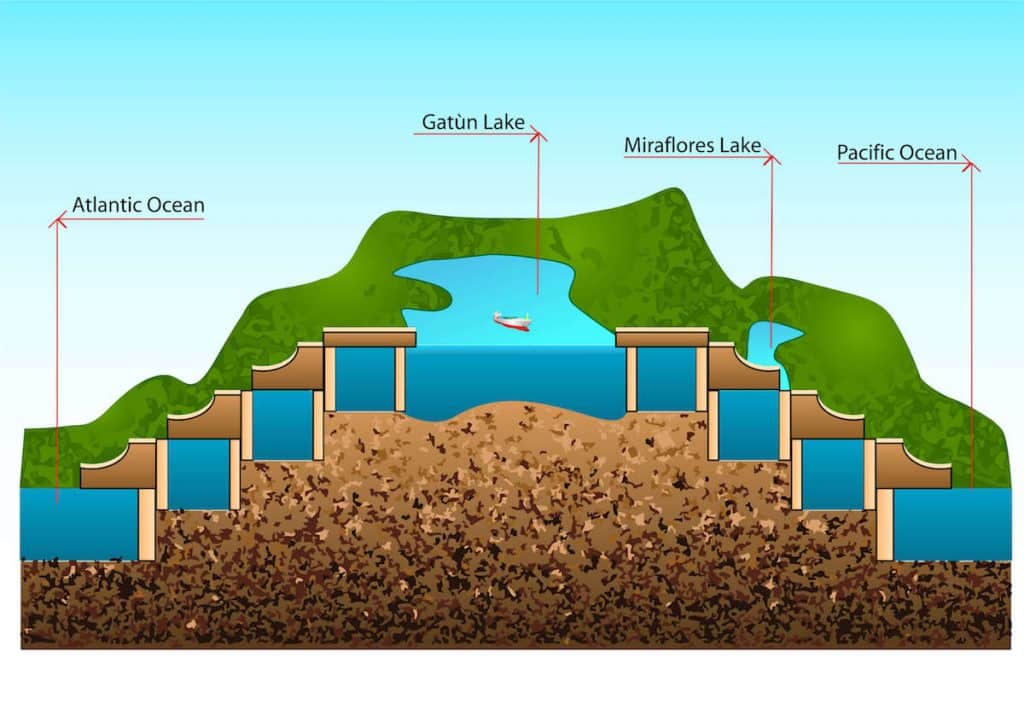
Not to mention that there are lakes in the interior part of the canal.
Calculating the approximate wattage to lift all that water 26m:
9.8 w/s * 10 0000 * 26 m * 320m * 235m
Supply and demand?
A Watt is 1 meter(lift) x 1 Newton / second. There are 30 meters of lift. Each liter is 1kg and gravity (9.8m/sec2) makes that about ~10 Newtons (9.8N due to gravity).
So you get 10^9kg x 10N/kg x 30m / 3000 sec = 100MW continuous. That's about 100, 000 horsepower. Each lock would need more than 16MW of pumping.
Solar/hydro power from the rain in lake Gatun is well over 100MW. Due to leakage it's probably 5-10x that or equivalent to a larger nuclear power plant.
m = mass of displaced water h = height of displaced mass g = gravity
And this one explaining how reservoirs can be used to trade-off water consumption for land requirements using side ponds: https://www.youtube.com/watch?v=SBvclVcesEE
Ecological concerns wouldn't just be pumping seawater into a large freshwater lake but questions of where to intake water, cross contact between the Atlantic and Pacific oceans there at a new location, etc. Not a trivial set of issues.
The new locks have added mechanisms to decrease water loss, but they do require water.
https://kids.britannica.com/students/assembly/view/68621
"Natural bowl higher than sea level" could be called a lake.
The vertical rise is about 26meters and there are 3 10meter locks (33mx300m in size) in each direction. 40 ships travel through each day (~3ksec per fill bidirectional) and each fill is ~1Billion liters or 250Million gallons in less than an hour. Lifting 1B liters through 30m would need 100MW to power 100% efficient pumps continuously for leakless locks. The solar/hydro power of rain is significant.
Also, everything in the lake would die once it was contaminated with sea water, and you would be contaminating the Pacific with Atlantic water, vice versa, or both.
Maybe dig a third reservoir adjacent to the lock mechanism, as a buffer between the two levels, to give you more flexibility with the timings.
Too little head for good efficiency.
Ahh that's what must be making the Drake Passage so angry.
That sounds like a lot until you realize the largest ships are charged up to $150,000 for a transit.
A 10% price increase is nothing to scoff at, but it's not outlandish to deal with congestion...
But once you’re talking about anything near 100% efficient pumps, you can have generators too, and a lot of that water is, in principle, recoverable. A bigger issue may be doing any of this without bringing too much salt along with the upward-moving ships.
(Hmm. How about picking up the ships, sans water? I wonder if a way to do this safely could be engineered. Sounds quite challenging.)
However, there are solutions to things like this called a "water slope" and one has been built (notably 100x smaller than needed for Panama) and they would (need to) be much quicker as well. Basically, they push a giant slug of water up hill. Notably, one could probably make this regenerative (and you could likely reuse most of the water). That's important since it would certainly be in the multiple GW of power, but it could push/pull (two moving locks up/dn) in <1000sec so traffic through the canal could be more than 5x higher. Of course it would require massive widening, completely new infrastructure (a new giant power plant), and completely new technology.
Here's video of one (and a link to the original) with an explanation. My point is not that this is easily doable, but if you're going to spend the many $10Bs of you might as well get more boats through.
Perfectly fine when you have enough fresh water, you can even somewhat optimize by using same water multiple times. But if you run out of fresh water at high point you will have trouble.
Just Google a video of a ship passing through the Panama canel
This current problem is especially bad because the dry season normally begins 4-6 weeks from now, and there will be little rainfall to re-fill Lake Alajuela (or the lake its water flows into, Gatun Lake, the backbone of the canal).
So that lake is like the small open source project that supports the weight of all internet: critical for everybody, yet neglected.
The Canal moves such amounts of money every year, not to say over decades, that preserving the lake in better conditions ought to have been easy. Now the ball of mud is exploding in their faces. It's like if "we" (collectively) never learned.
coordination dilemmas, particularly resource allocation, are The Problem
(And it's a great service to society that people have been debunking the myth of the Tragedy of the Commons which was an armchair moralist article in scientific clothing that had no empirical basis when it was published and yet got widely cited for a while because it was emotionally appealing.)
The commons were well managed by local people and enclosure was a land grab by the rich.
The Tragedy of the Commons as a historical event in Medieval England has been criticized (hard to say debunked from this one article, but perhaps there are more).
The Tragedy of the Commons as an economical/social phenomena has not been debunked.
Since 99.9% of the uses of the phrase Tragedy of the Commons are referring to the second case, I'm not sure it is helpful to say that it has been debunked.
This was what I came here for too. I'm sure someone out there is more interested in the history of the phrase than the economics phenomenon it points to, but it sure isn't me. You could rename it the Doohickey, drop any historical precedent, and I'd still be very interested if someone said the Doohickey was debunked.
You should take it the other way around: the tragedy of the commons is a myth. Of course you could cherry pick some story of bad actors misbehaving. But that's not a general rule, it's not bound by fate, and you just have to shove your foot up their face to prevent it. But in the absence of egotistic capitalist pigs, most people are reasonable in managing shared resources and that's how humanity survived for so long before inventing private property. Anedotally, that's also my experience living in collectives for a few decades: there may be abusive situations dealing with shared resources (who ate all the tomatoes?!) but that's only mildly annoying because it's the exception rather than the norm.
However, there is also the comedy of the commons and the tragedy of the anticommons for that matter. Open source for example doesn't suffer from the tragedy of the commons as much as it is suffering from the tragedy of the anticommons.
The controlling entity clearly is failing, sans charging a cutting in line fee. It's in the best interest of the rest to do something. Yet nothing. Perhaps not a ToTC but it's nonetheless a tragedy, or soon to be. And The Commons elsewhere are sure to be the ones to bear the brunt of the blow.
That doesn't sound easy at all, even getting better resourced governments to care about things that will directly affect their voters in 30 years in big ways is already very difficult.
Let alone when it's multiple steps removed and the costs are so diffusely spread out across billions of consumers.
> The Panama Canal Authority is established under Title XIV of the National Constitution, and has exclusive responsibility for the operation, administration, management, preservation, maintenance, and modernization of the canal. It is responsible for the operation of the canal in a safe, continuous, efficient, and profitable manner.[1]
Emphasis mine
If that is wrong, naive or stupid I'd like to know.
This is, by a wide margin, the most interesting "casually made" comment I'd read in a bit. Any chance you can provide slightly more details? I didn't even know there _was_ an island in the Panama Canal; nonetheless people living on it (presumably all researchers?)
https://www.marineinsight.com/wp-content/uploads/2014/10/pan...
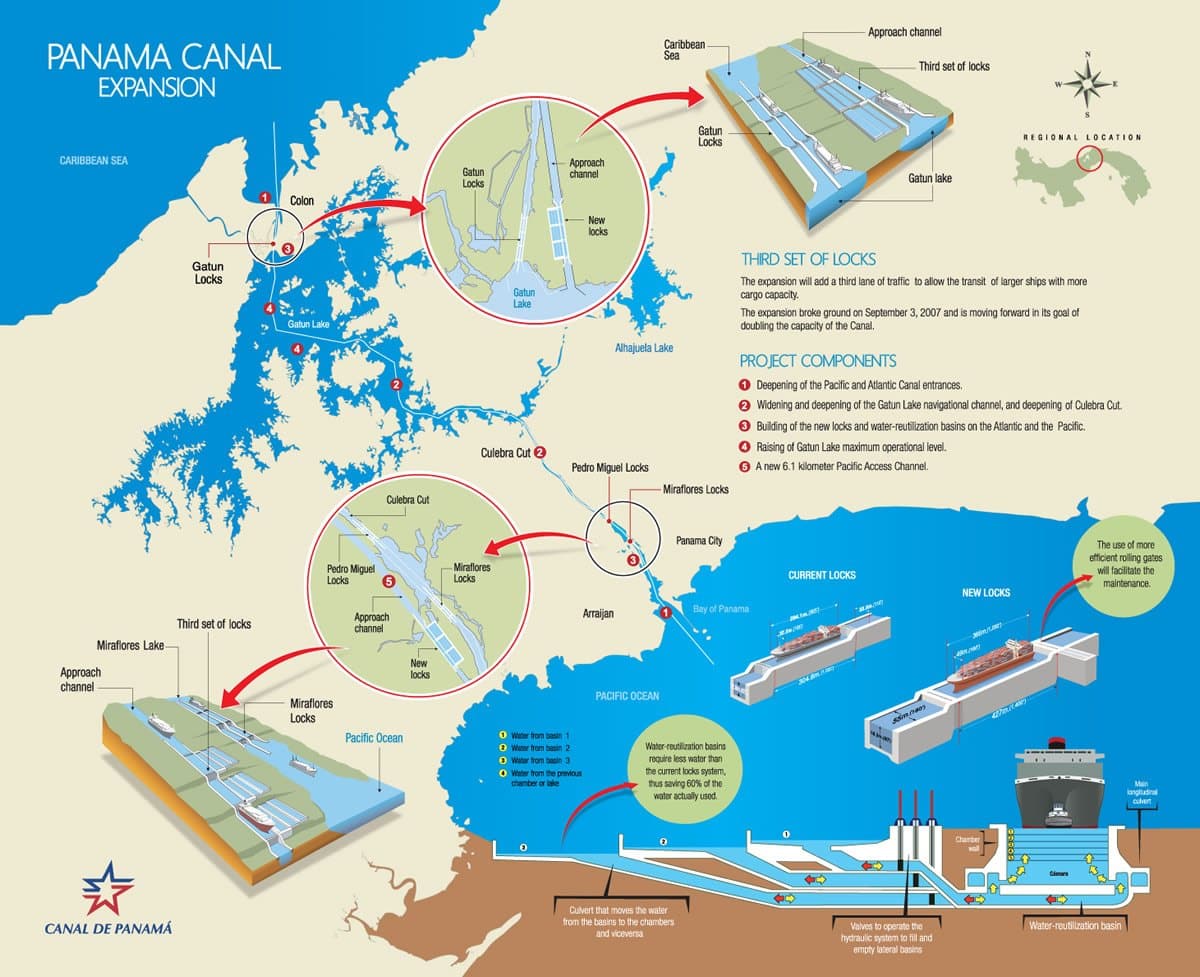
Prior to seeing the image above, I always assumed the canal was just a single passageway between a narrow spot of land. In the image you can also see the mentioned Lake Alajuela in the top-right.
https://www.openstreetmap.org/#map=13/9.2267/-79.5463&layers...
I read that the canal never got built at first because of mosquitoes. Are mosquitoes still a problem there?
It's like the universe said wait a minute, slow down. I'll tell you when that container ship can move.
- On the new locks they recycle ~60% of the water used already, it's a smart system.
- Another commenter pointed out that they have to allow fresh water through the lock system to prevent salt water contamination of the lakes.
I guess a reason they haven't retro-fitted (yet) the 60% water saving mechanism to the older locks is the scale of the engineering efford involved, plus they can charge people $4.5 million to jump the queue ;)
This article from 2003 talked about two-way traffic on the canal: https://pancanal.com/en/panama-canal-begins-tests-of-simulta...
Also, anything taking the old locks out of operation for a few weeks/months is basically a no-go. That's just too costly.
As a side note, do keep in mind that water is already "saved" a little by going up in a convoy. With the three lock chambers, you get to reuse the same water three times. Not exactly true of course because convoys start and end, but you get the idea.
> A queue of ships waiting to use the canal has been growing in recent months amid a deep drought. To manage the situation, the canal’s managing authority has announced increasingly drastic restrictions for the depleted thoroughfare. The Panama Canal Authority also holds auctions for those wishing to jump to the front of the line.
It’s in there. :)
It's the only logical explanation.
1. https://hitchhikers.fandom.com/wiki/Somebody_Else%27s_Proble....
Apparently they had a huge lake reservoir for storing freshwater that was then used to fill the locks in the canal. And then subsequently release into the ocean.
They haven't gotten the usual rainfall and this is causing serious issues.
> https://www.cnbc.com/2023/11/03/panama-canal-drought-hits-ne...