Here is a cross-section diagram of the canal showing the lakes:
https://www.marineinsight.com/wp-content/uploads/2018/09/pan...
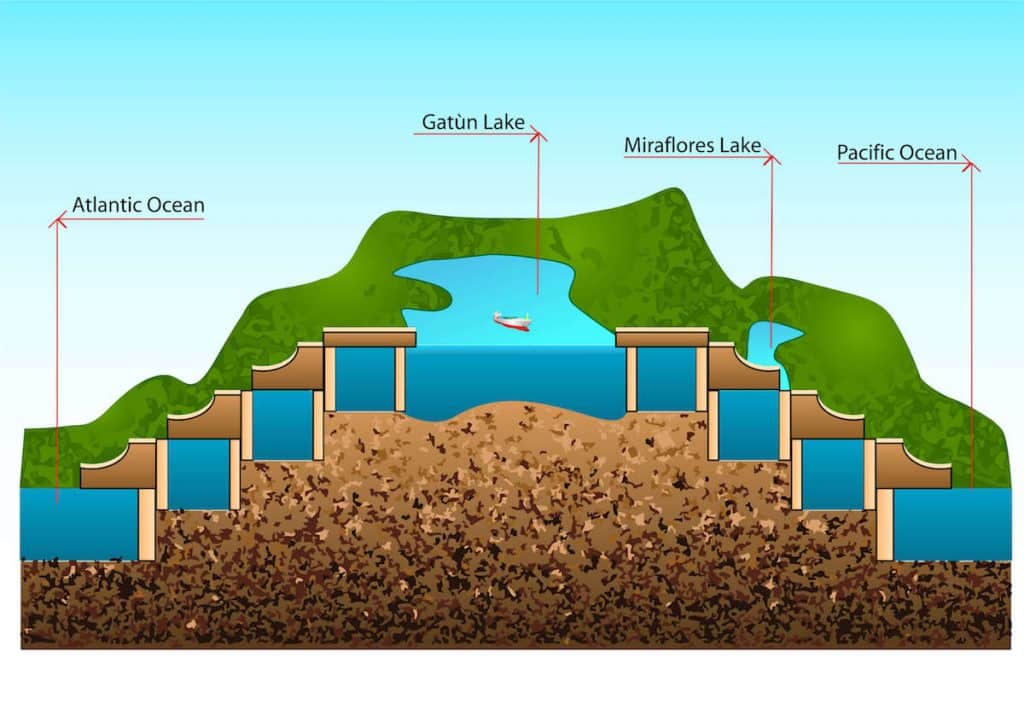
Not to mention that there are lakes in the interior part of the canal.
Calculating the approximate wattage to lift all that water 26m:
9.8 w/s * 10 0000 * 26 m * 320m * 235m
Supply and demand?
A Watt is 1 meter(lift) x 1 Newton / second. There are 30 meters of lift. Each liter is 1kg and gravity (9.8m/sec2) makes that about ~10 Newtons (9.8N due to gravity).
So you get 10^9kg x 10N/kg x 30m / 3000 sec = 100MW continuous. That's about 100, 000 horsepower. Each lock would need more than 16MW of pumping.
Solar/hydro power from the rain in lake Gatun is well over 100MW. Due to leakage it's probably 5-10x that or equivalent to a larger nuclear power plant.
m = mass of displaced water h = height of displaced mass g = gravity
And this one explaining how reservoirs can be used to trade-off water consumption for land requirements using side ponds: https://www.youtube.com/watch?v=SBvclVcesEE
Ecological concerns wouldn't just be pumping seawater into a large freshwater lake but questions of where to intake water, cross contact between the Atlantic and Pacific oceans there at a new location, etc. Not a trivial set of issues.
The new locks have added mechanisms to decrease water loss, but they do require water.
https://kids.britannica.com/students/assembly/view/68621
"Natural bowl higher than sea level" could be called a lake.
The vertical rise is about 26meters and there are 3 10meter locks (33mx300m in size) in each direction. 40 ships travel through each day (~3ksec per fill bidirectional) and each fill is ~1Billion liters or 250Million gallons in less than an hour. Lifting 1B liters through 30m would need 100MW to power 100% efficient pumps continuously for leakless locks. The solar/hydro power of rain is significant.
Also, everything in the lake would die once it was contaminated with sea water, and you would be contaminating the Pacific with Atlantic water, vice versa, or both.
Maybe dig a third reservoir adjacent to the lock mechanism, as a buffer between the two levels, to give you more flexibility with the timings.
Too little head for good efficiency.
Ahh that's what must be making the Drake Passage so angry.
That sounds like a lot until you realize the largest ships are charged up to $150,000 for a transit.
A 10% price increase is nothing to scoff at, but it's not outlandish to deal with congestion...
But once you’re talking about anything near 100% efficient pumps, you can have generators too, and a lot of that water is, in principle, recoverable. A bigger issue may be doing any of this without bringing too much salt along with the upward-moving ships.
(Hmm. How about picking up the ships, sans water? I wonder if a way to do this safely could be engineered. Sounds quite challenging.)
However, there are solutions to things like this called a "water slope" and one has been built (notably 100x smaller than needed for Panama) and they would (need to) be much quicker as well. Basically, they push a giant slug of water up hill. Notably, one could probably make this regenerative (and you could likely reuse most of the water). That's important since it would certainly be in the multiple GW of power, but it could push/pull (two moving locks up/dn) in <1000sec so traffic through the canal could be more than 5x higher. Of course it would require massive widening, completely new infrastructure (a new giant power plant), and completely new technology.
Here's video of one (and a link to the original) with an explanation. My point is not that this is easily doable, but if you're going to spend the many $10Bs of you might as well get more boats through.
Perfectly fine when you have enough fresh water, you can even somewhat optimize by using same water multiple times. But if you run out of fresh water at high point you will have trouble.
Just Google a video of a ship passing through the Panama canel
Why would you need freshwater to go through a canal that connects two bodies of water? This seems like very poor planning and infrastructure creation. why can't they pump sea water through the locks?