I’ll readily admit it’s not great data, but I think it’s a step better than drawing conclusions from a single event.
Also amazing what you can do when you have incredibly strict immigration policies (though these days it's less strict than how they treated American POWs crossing from Germany into Switzerland. Those, they murdered) that allow only rich folks in...
Switzerland has one of the highest percentage in Europe of foreigners living in its borders[1]. It is a staggering 24%. Next one down is Austria with 14.4%.
[1] https://www.swissinfo.ch/eng/business/migration-series_europ...
[2] https://www.swissinfo.ch/ger/politik/zwei-revisionen_rueckbl...
I live in Switzerland and although I am not involved in trains, what Swiss do aint magic, just simple following the rules, and rules they do. Maybe even less efficient than Germans at the end.
I really dont see any difference with Germany on the ground, yet when I look at Germany's politicians and their actions, at least the public part leaves a lot to be desired. Rather then the question becomes how come this country is actually economically so successful? Certainly not due to perfect environment for private businessess.
it's almost as if that it isn't true that it's an efficiency powerhouse
The profit in infrastructure is economic growth and optimizations of people's mobility. This can only be done by a state. A state can still mess it up but it is the only entity that can do it.
Good luck getting a "Taktfahrplan" working if you have to rely on private rail companies optimizing for every last dollar and having the locomotives catch fire blocking lines for hours. When the Fung Wah Bus breaks down for the 10th time on the way to NY it doesn't block all traffic but with rail you don't have the luxury to drive around it.
The extensive damage in the Swiss Gotthard Base Tunnel was caused by a bad wheel from a foreign rail company that cut costs to a point of running rail cars with wheels that have way too many km on them.
Does the example of Japan prove the conventional wisdom wrong?
I think this is just a cliché. There are a lot of examples in the public, the semi-public and the private sector were Germany is or became very inefficient or missed opportunities (long-distance trains, mobile phone prices and coverage, Berlin public administration, Berlin airport, Stuttgart train station, but also Deutsche Bank, Siemens, Bayer, BASF, not to speak of Quelle and Holzmann in the past).
However, one should not forget the special circumstances due to German reunification in the last 30+ years. In terms of GDP and population proportion it would be equivalent if the USA opened its border to Mexico today and gives all Mexicans US citizenship immediately. Than Mexico joins the USA 11 month later. After 10 years the USA gives up the US-Dollar for a Pan-American currency. For the 3 decades after the Mexico-USA unification the old USA transfers aprox. 2,000,000,000,000 to old Mexico. -- Perhaps this thought experiment makes it clear that it would have been more than a miracle if the high degree of efficiency that was associated with the old West-Germany could have been seamlessly continued into a reunified Germany. But allow the Germans another 34 years ...
Regarding long distance travelling (people as well as freight), Germany is also in a quite unique situation. It is in the center of major European long distance routes from every direction. In comparision even the traffic network topography of Austria and Switzerland is a lot simpler. In Austria it is North-South over the Brenner to Italy and NW-SE from Central Europe to South-East Europe. Switzerland is primarily NE-SW (Basel-Geneva) and a single major North-South train route (Zürich/Luzern-Lugano).
Just compare this map of the Swiss railway system (ignore the red lines, which are more or less only used for local transport):
https://de.wikipedia.org/wiki/Personenverkehr_in_der_Schweiz...

with that of Germany:
https://en.wikipedia.org/wiki/Rail_transport_in_Germany#/med...

This is extremely misleading. Eastern Germany had a better educational system than the west and higher female labor participation. A better example might be like if the USA opened it's boarder to Cuba, and was flooded by doctors and engineers.
My only point was to find an analogy that illustrates the approximate order of magnitude.
1) There are actually many more corridors, of which Basel-Geneva is not really an important one. St Gallen - Zurich - Bern - Geneva and Basel-Lugano are the main ones, but there are two routes between Bern and Geneva, there are trains connecting Zurich to the South East and trains connecting Bern to Visp and Sion. On top of that you have non-SBB companies like ZB.
2) The topography of the country is complex with lakes and mountains everywhere.
3) The scale is off: Germany is massive and you’re showing a map that includes the Berlin S-bahn, while only showing major connections for Switzerland, even though that mapped is 4 times more zoomed in.
Ad 2) True.
Ad 3) Perhaps a better map to support my point is this one about the core Trans-European freight train network: https://en.wikipedia.org/wiki/Trans-European_Transport_Netwo... Of course this map is limited, as it does not cover passenger transport and does not show transport volume. However, the fundamental topological problem of the network in Germany should be quite apparent as there are a lot of options were traffic is changing directions and a congestion in a specific place may easily spread to other hubs. -- It is perhaps no coincidence that Europe's two largest marshalling yards are in Germany: Maschen Rangierbahnhof[1] near Hamburg and Mannheim Rangierbahnhof[2].

Ie their skilled labor force is shrinking and these are the knock on effects of having too small of families.
A tunnel in Munich takes from idea to building at least 40 years. 8 miles of regional train extension takes 3 decades (building start date not known yet). Funny thing is that most of the track is already available. That’s the new real Germany. Not the one we knew from the movies.
Doch, Alter. The German federal government and at least 3 top parties are completely captured by the auto industry, so we're tearing down neighborhoods to extend urban freeways in Berlin: https://en.m.wikipedia.org/wiki/Bundesautobahn_100
And the FDP scored the transport ministry in the traffic-light coalition, so of course there announced a plan to extend a bunch of highways: https://www.cleanenergywire.org/news/plans-fast-track-expans...
I really wish cargo trains could just pass underground via tunnelling tech. They are obscenely loud, and given the mountain-valley nature of the villages in the Rheinland, their sound travels very far in the night, and often echoes around.
Conveniently, my connecting train is also usually sufficiently delayed so that I do not miss it.
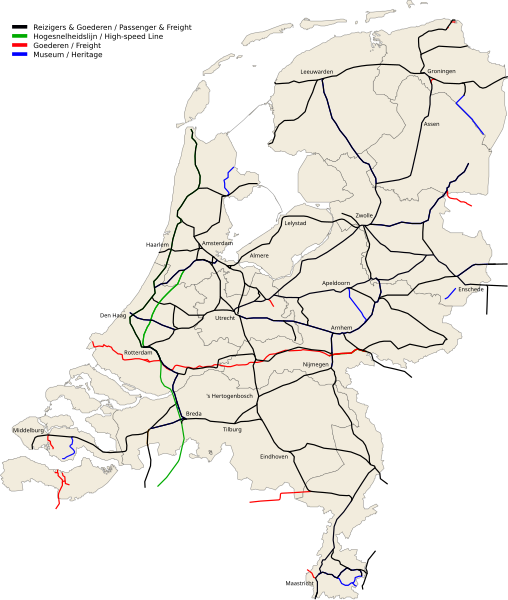
And this is the German rail network: https://upload.wikimedia.org/wikipedia/commons/0/08/Bahnstre...

Germany has almost 14 times as many rail stations as the Netherlands, and over ten times as many rail kilometres.
This is a bit similar to how a 14-core processor doesn’t give you 14 times the performance of a single core if the cores have to communicate with each other.
If what you say is true and Germany is uniquely more interconnected than other European countries (which I don’t buy, btw), then you still have cause and effect backwards: the interconnection makes the impact of delays worse, it doesn’t cause them. The delay ultimately happens in a single place and then has knock-on effects, but the place it starts is usually inside Germany.
It's not just German trains. The Swiss are rather strict about train punctuality (more than 2 min is not accepted if memory serves), and if an international train would cause delays, the Swiss put on their own train on regular schedule and halt the tardy train at the border.
[0]: https://company.sbb.ch/en/the-company/responsibility-society...
And the same is happening with the Brenner tunnel in Austria again. Italy and Austria are about to start constructing the last remaining sections, to be finished in around 2034. While Germany has not build anything, and is still discussing where they are going to build the tracks and expect the construction not to be finished before 2040, likely even later.
Edit: more detailed dates
So now, the German trains stop at the first Swiss station, when they finally arrive, and people gave to switch trains.
Germany is also years behind on their commitment to getting cargo on trains. Switzerland built a rail tunnel especially for trans-European traffic, but Germany is apparently incapable of getting cargo onto trains.
It ought to be mortally embarrassing for the supposed industrial powerhouse of Europe. But that's OK, they are building more autobahn.