News for hackers. Stuff that matters.
Re:Pythagorean Theorem Found on Clay Tablet 1k Years Older T... by saithound on Thursday October 05, 2023 @12:00AM (#37774781)
Every group who ever managed to build a building with a rectangular foundation figured out the relation between the side lengths and the diagonal. The Egyptians used Pythagorean triples to measure right angles way before the birth of Pythagoras.

But that's not a theorem, just an observation. It becomes a theorem when you prove (i.e. explain why) this relationship always holds, based on more evident things. The Babylonian tablet mentioned in the article doesn't seem to do anything like that, whereas the Greeks definitely did (we don't know whether Pythagoras himself did it, as no writing of his survives, but later Greeks knew how to do it, and attributed it to Pythagoras).

Re:Pythagorean Theorem Found on Clay Tablet 1k Years Older T... by WalterBright on Thursday October 05, 2023 @12:13AM (#37774841)
> Every group who ever managed to build a building with a rectangular foundation figured out the relation between the side lengths and the diagonal.

I don't see why that was necessary. You can get pretty far with eyeballing it and custom cutting to fit.

Re:Pythagorean Theorem Found on Clay Tablet 1k Years Older T... by saithound on Thursday October 05, 2023 @12:34AM (#37774936)
A "you" can, and for many individual "you"s that's the best one can do.

But groups of people, "they", who all build a lot, tend to have a few people who make these observations, and then the observations proliferate, because they are both way easier to use than the alternative hack-work, and yield much more aesthetically pleasing results. Especially in the stone age when you nornally don't have easy access to anything at all with a right angle (unlike in modern construction) and you build stuff out of clay bricks, where minor inaccuracies inevitably add up and make your life much harder down the road. Tying together three pieces of string with prescribed ratios, pull it tight was a very easy way to get a right angle compared to anything that came before.

It's necessary in the sense that stone age construction is so much easier if you know about it, and so much harder if you don't. Those who didn't come up with it didn't do such construction, because doing difficult things is harder than doing easy things.

Re:Pythagorean Theorem Found on Clay Tablet 1k Years Older T... by dylan604 on Thursday October 05, 2023 @12:51AM (#37775014)
>A "you" can, and many individual "you"s presumably did that, to general satisfaction

I was chatting with the person that was in charge of marking the fields for the local youth soccer league. I volunteered to help one weekend, and one of the first things he asked was if I knew what a 3/4/5 triangle was since it was the only way to know you'll be squared. I never did figure out to what level he was dead panning his joke or if he was even meaning for it to be a joke. Either way, I laughed.

Re:Pythagorean Theorem Found on Clay Tablet 1k Years Older T... by xxs on Thursday October 05, 2023 @04:39AM (#37776231)
3/4/5 is considered a wood working trick - that many beginners would not know (according to youtube, at least)
Re:Pythagorean Theorem Found on Clay Tablet 1k Years Older T... by dylan604 on Thursday October 05, 2023 @09:51AM (#37778607)
I learned it in geometry in like 10th grade. No wood involved.
Re:Pythagorean Theorem Found on Clay Tablet 1k Years Older T... by WalterBright on Thursday October 05, 2023 @04:13AM (#37776055)
You can easily accurately lay out a large square without knowledge of Pythagorean Theorem.

1. lay out a straight line 2x in length.

2. find midpoint (easy by drawing an arc with a string from each end point. Basic compass & ruler technique.

3. draw another arc from the midpoint, of radius 1x. Try different spots on the arc until it is equidistant from each of the endpoints of the line.

4. voila! an accurate right angle. Laying out the rest of the square is now trivial.

Re:Pythagorean Theorem Found on Clay Tablet 1k Years Older T... by gregjor on Thursday October 05, 2023 @04:36AM (#37776209)
I think you mean bronze age.
Re:Pythagorean Theorem Found on Clay Tablet 1k Years Older T... by saithound on Thursday October 05, 2023 @12:38PM (#37780779)
I don't think I do. I'm fairly confident that the people of the chalcolithic did enough large scale construction (and pottery and watching the night skies and so on) to have figured a whole lot of empirically accessible geometry out.

The _article_ happens to be about written sources from the Bronze Age Babylonians, which lets us glimpse at their accumulated knowledge. But there's no reason to believe this knowledge was particularly new at their time, and this was a clay tablet equivalent of an arXiv preprint.

Re:Pythagorean Theorem Found on Clay Tablet 1k Years Older T... by fsckboy on Thursday October 05, 2023 @01:10AM (#37775105)
> I don't see why that was necessary. You can get pretty far with eyeballing it and custom cutting to fit.

i'm not saying at all that I know the answer, but eyeballing and cutting is good for a patio, but on a ziggurat or pyramid scale it seems you don't do so much eyeballing or cutting, and more planning how much material and how many slaves you're going to need for how long, and where to put the doors so the passageways will meet up, that sort of thing.

Re:Pythagorean Theorem Found on Clay Tablet 1k Years Older T... by WalterBright on Thursday October 05, 2023 @04:07AM (#37776010)
I've seen many Mayan structures in Mexico, and they all look like they were eyeballed.
Re:Pythagorean Theorem Found on Clay Tablet 1k Years Older T... by posterboy on Thursday October 05, 2023 @09:12AM (#37778157)
I'm currently in a brick build house which has a good ten percent slope, because the earth sank, but it hasn't collapsed. I'm pretty sure its not older than a hundred years and I'm amazed it still stands because it sure wasn't designed like this.
Re:Pythagorean Theorem Found on Clay Tablet 1k Years Older T... by rebolek on Thursday October 05, 2023 @05:55AM (#37776667)
Please, stop this slave nonsense. Pyramids were built by highly skilled workers, it was prestigious job.
Re:Pythagorean Theorem Found on Clay Tablet 1k Years Older T... by PawgerZ on Thursday October 05, 2023 @09:36AM (#37778434)
I remember reading about the worker homes and tombs, and I know that skeletal records also showed the workers had much muscular strain. So, it's impossible to deny that there were skilled laborers working on the pyramids, but just because some of the laborers were proven to be skilled and not slaves, doesn't mean slaves weren't used.

The scale doesn't seem right to me. I still can't fathom how that much could be done without using slave labor. If I remember correctly, they layed a block like every 6 minutes for 20+ years.

Do you know how many tombs of laborers were found, or where I could find more aobut that information? I'm very novice when it comes to Egypt

Re:Pythagorean Theorem Found on Clay Tablet 1k Years Older T... by danjc on Thursday October 05, 2023 @04:30AM (#37776160)
I built a tree house for my kids. I didn't exactly eyeball it but my amateur technique and planning left me having to do a lot of compensation for things being out of square.

Everything becomes a custom cut, often in multiple dimensions and all earlier errors cascade all the way to the end.

Re:Pythagorean Theorem Found on Clay Tablet 1k Years Older T... by berkes on Thursday October 05, 2023 @06:15AM (#37776787)
> Everything becomes a custom cut, often in multiple dimensions and all earlier errors cascade all the way to the end.

Unrelated, but that sounds exactly like many software projects I've been unfortunately part of.

Re:Pythagorean Theorem Found on Clay Tablet 1k Years Older T... by ReptileMan on Thursday October 05, 2023 @05:20AM (#37776485)
Ancient Mesopotamian laws sometimes flayed people alive for incompetent or corrupt work. Those types of mild punishments are good incentive to use the right angles. Pun intended.
Re:Pythagorean Theorem Found on Clay Tablet 1k Years Older T... by WalterBright on Friday October 06, 2023 @08:39PM (#37798018)
Money works a lot better than flogging.
Re:Pythagorean Theorem Found on Clay Tablet 1k Years Older T... by sn41 on Thursday October 05, 2023 @01:02AM (#37775070)
Proofs are of course the gold standard. But even if others discovered the rule, their contribution should not be held to be trivial.

A modern analogy: today, people are very happy to use LLMs and Transformers without anyone "proving" that they work. Right now, philosophically, they are at the level of empirical observations (perhaps not even that). Does that mean that today's AI researchers should get no credit when at a later date? I am not sure. Empirical discovery of a rule is also no trivial thing.

Re:Pythagorean Theorem Found on Clay Tablet 1k Years Older T... by saithound on Thursday October 05, 2023 @01:30AM (#37775193)
Yes, when people in the 4000s write clickbait holonet articles about how the Master Theorem of Neural Network Scaling was not actually invented by the Muskovites of Mars, but was found written on an Ancient American tablet containing the works of Hoffmann et al., I hope somebody will offer substantial corrections.

That's not in any sense a value judgment of the empirical work done at DeepMind. Nor does it dtop anybody from writing a better article which explains tha the Babylonians (and many others) used the empirical observations underlying the theorem, while explaining that this did not constitute mathematical proof.

Re:Pythagorean Theorem Found on Clay Tablet 1k Years Older T... by outrun86 on Thursday October 05, 2023 @02:17AM (#37775423)
Found on an ancient tablet as the work of Schmidhuber et al. but ok
Re:Pythagorean Theorem Found on Clay Tablet 1k Years Older T... by Turing_Machine on Thursday October 05, 2023 @01:08AM (#37775097)
Pointing out that it's not a theorem doesn't mean it's been trivialized.

If there's no proof, it's not a theorem, by definition. That doesn't make empirical observations worthless -- far from it!

Re:Pythagorean Theorem Found on Clay Tablet 1k Years Older T... by geraneum on Thursday October 05, 2023 @01:14AM (#37775117)
From the article:

> Pythagoras is immortally linked to the discovery and proof of a theorem that bears his name – even though there is no evidence of his discovering and/or proving the theorem.

Simply quoting. It seems like

> Greek definitely did

is not a universally held belief.

Re:Pythagorean Theorem Found on Clay Tablet 1k Years Older T... by saithound on Thursday October 05, 2023 @01:23AM (#37775160)
Your quote from the article does not suggest what you seem to think it suggests.

The Greeks definitely were able to prove the Pythagorean theorem, and the Greeks definitely though Pythagoras specifically knew how to prove it: e.g. Proclus II states this in writing explicitly, as does Euclid 300 years later, and numerous ancient sources inbetween. It would be hard for this not to be the consensus. We can't know if Pythagoras really did, simply because we have no surviving writings directly from Pythagoras - as I stated explicitly in my previous post.

Re:Pythagorean Theorem Found on Clay Tablet 1k Years Older T... by geraneum on Thursday October 05, 2023 @02:15AM (#37775414)
You are actually right. You didn’t claim that the Greek did it first and that is what I doubted in the first place. I misread your comment.

That fact that the Greek could prove the theorem at some point is not unlikely even without evidence. It’s as likely as others doing it well before them.

Re:Pythagorean Theorem Found on Clay Tablet 1k Years Older T... by fsckboy on Thursday October 05, 2023 @01:15AM (#37775122)
> Pythagorean triples to measure right angles ... But that's not a theorem, just an observation. It becomes a theorem when you prove (i.e. explain why) this relationship always holds, based on more evident things. The Babylonian tablet mentioned in the article doesn't seem to do anything like that

according to the article, this Babylonian tablet does come closer to theorem than you are suggesting. They weren't using Pythagorean triples, rather they figured out that the diagonal of a unit square is the square root of 2, and knew how to calculate that:

1 + 24/60 + 51/602 + 10/603 = 1.414213

Re:Pythagorean Theorem Found on Clay Tablet 1k Years Older T... by hyperthesis on Thursday October 05, 2023 @01:31AM (#37775195)
Agree it's closer but still an instance.
Re:Pythagorean Theorem Found on Clay Tablet 1k Years Older T... by fsckboy on Thursday October 05, 2023 @02:10AM (#37775386)
depends on the method they used to come up with the formula. It's not obvious that the sum of a "more complicated than you can do in your head" series of fractions would be either the square root of two or the the diagonal of a square, let alone both. This is a fragment of a single clay tablet. If they had a systematic method of coming up with this convergent series, there might have been a stack of tablets showing square root of three, five, etc. It seems pretty highly suggestive to me.
Re:Pythagorean Theorem Found on Clay Tablet 1k Years Older T... by ssener2001 on Thursday October 05, 2023 @04:46AM (#37776270)
I agree.Obtaining this formula by observing is more difficult than obtaining it by proving it. Besides, it is an issue that is already needed in field work. If you have pen, paper and a good number system, it shouldn't be too difficult to find the formula with shapes.
Re:Pythagorean Theorem Found on Clay Tablet 1k Years Older T... by loa_in_ on Thursday October 05, 2023 @07:19AM (#37777159)
I imagine back then things like number systems and methods of proving were just made up as they go.
Re:Pythagorean Theorem Found on Clay Tablet 1k Years Older T... by lazide on Thursday October 05, 2023 @10:16AM (#37778908)
Clay tablets and a stylus also less convenient than pen and paper.
Re:Pythagorean Theorem Found on Clay Tablet 1k Years Older T... by KMag on Thursday October 05, 2023 @11:55AM (#37780244)
That entirely depends on how close you are to high-clay-content muddy bank with a growth of reeds vs. how close you are to the nearest convenience store/office supply store.
Re:Pythagorean Theorem Found on Clay Tablet 1k Years Older T... by lazide on Thursday October 05, 2023 @03:40PM (#37783288)
Did I just find a new metric to put on my rental house evaluation checklist? Maybe! Haha
Re:Pythagorean Theorem Found on Clay Tablet 1k Years Older T... by posterboy on Thursday October 05, 2023 @07:26AM (#37777221)
Proof by construction, the Curry-Howard correspondance.
Re:Pythagorean Theorem Found on Clay Tablet 1k Years Older T... by dclowd9901 on Thursday October 05, 2023 @02:46AM (#37775557)
3,4,5
Re:Pythagorean Theorem Found on Clay Tablet 1k Years Older T... by orra on Thursday October 05, 2023 @03:14AM (#37775695)
> It becomes a theorem when you prove (i.e. explain why) this relationship always holds, based on more evident things. [...] whereas the Greeks definitely did (we don't know whether Pythagoras himself did it

Wait, really? I thought the proofs back then were geometric, so only proved specific instances. And so it wasn't until algebra, maybe trig, was discovered it was properly proven?
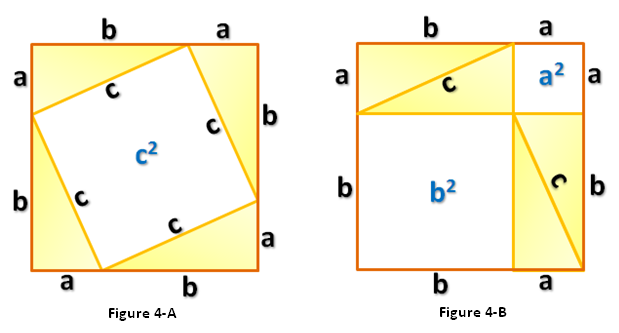
Re:Pythagorean Theorem Found on Clay Tablet 1k Years Older T... by n4r9 on Thursday October 05, 2023 @03:18AM (#37775720)
There are fully valid geometric proofs, eg http://mathandmultimedia.com/wp-content/uploads/2010/02/pyth...
Re:Pythagorean Theorem Found on Clay Tablet 1k Years Older T... by orra on Thursday October 05, 2023 @01:05PM (#37781143)
Despite labels $a$, $b$, $c$, I don't see how it's fully general. At best you could say it works for similar triangles, if you have that concept.

But I don't see how it proves anything if $a$ were say doubled, and $b$ kept the same.

Re:Pythagorean Theorem Found on Clay Tablet 1k Years Older T... by n4r9 on Monday October 09, 2023 @06:55AM (#37819028)
I'm not sure what you mean, sorry. It's definitely fully general. It demonstrates that:

* For any real positive values $a$ and $b$

* let $T$ be the (unique) right-angled triangle with non-hypotenuse sides of length $a$ and $b$

* then $a$^2 = $b$^2 = $c$^2

* where $c$ is the (unique) length of the hypotenuse of $T$.

You could give me the instance

  $a$ = 2, $b$ = 3
and it will prove it for this case. Then you could later double $a$ and give me the instance

  $a$ = 4, $b$ = 3
and it will prove it just as easily for this case.
Re:Pythagorean Theorem Found on Clay Tablet 1k Years Older T... by usrusr on Thursday October 05, 2023 @03:28AM (#37775774)
Why would you need numbers for right angles? You need a straight line and a string.

But I agree with the second paragraph: there's a huge difference between a procedure that is handed down as part of "this is how we estimate a building protect" and a theorem that is declared universal truth and base for all kinds of other theorems. Even if they are exactly the same thing.

Re:Pythagorean Theorem Found on Clay Tablet 1k Years Older T... by detourdog on Thursday October 05, 2023 @06:20AM (#37776814)
How useful are universal truths compared to getting shit done?

I only see theorems as useful for complex societies. The son of a gem dealer would have the time to work out universal truths.

The reputation of everyone doing it without numbers would reveal the pattern of the universal truth.

Finally this looks like it was all done using cuneiform.

Which brings up questions of notation and the language to describe a square root.

Re:Pythagorean Theorem Found on Clay Tablet 1k Years Older T... by usrusr on Thursday October 05, 2023 @08:06AM (#37777549)
Getting shit done is the antithesis of progress because it goes hand in hand with "if it was good enough for my father, it will be good enough for me, who are you to disrespect (the methods of) my father!"
Re:Pythagorean Theorem Found on Clay Tablet 1k Years Older T... by detourdog on Thursday October 05, 2023 @08:14AM (#37777603)
I agree but dying for ideals isn’t much progress.

Progress is a luxurious goal.

Re:Pythagorean Theorem Found on Clay Tablet 1k Years Older T... by empath-nirvana on Thursday October 05, 2023 @09:08AM (#37778126)
What everyone is talking past here is that the Babylonians discovered what engineers call a "rule of thumb", and engineering is focused on getting things done using rules of thumb. The best possible rule of thumb is a mathematical proof or a scientific discovery, but it's by no means necessary. .

Observing that something always holds and even having a formula for it is not the same thing as having a proof, and the proof is what makes it mathematics and geometry and not "just" engineering. The babylonians had a rule of thumb -- the greeks discovered the theorem -- and more than that, they seem to have invented the mathematical/geometrical proof as a concept, along with formal logic.

Without that mental framework, it's hard to say that the babylonians proved anything or had any theorems at all, only collections of rules of thumb. It's quite likely that lots of babylonians sort of independently and intuitively understood _why_ it must be true, but they don't seem to have ever written it down.

Not that there's anything wrong with having rules of thumb -- it's a huge achievement to even notice and collect and teach those things, all the stuff around you is built relying on them.

I encourage everyone to watch this series of videos.

https://www.youtube.com/watch?v=_ivqWN4L3zU

Re:Pythagorean Theorem Found on Clay Tablet 1k Years Older T... by detourdog on Thursday October 05, 2023 @05:38PM (#37784610)
I think what you might be touching on is that the "rules of thumb" may have been so integral of the culture as to be hidden.
Re:Pythagorean Theorem Found on Clay Tablet 1k Years Older T... by ordu on Thursday October 05, 2023 @09:17AM (#37778212)
> How useful are universal truths compared to getting shit done?

As I understand Greeks invented proofs because "universal thruths" they exported from Babylon and Egypt sometimes explicitly contradicted each other.

I believe such contradictions may be a great nuisance when you try to get shit done.

Egypt and Babylon were sufficiently "complex" societies for proofs, but their tradition treated mathematics as a bunch of useful facts about numbers and shapes. New generation just memorized them. We should think it worked for them in most cases, and when it didn't work it was not so often for them to start thinking a lot of reforming mathematics. Plus they were indoctrinated by the math they learned (authority of a teacher is above of anything else, i suppose) and to reform math was not a natural idea for them.

Re:Pythagorean Theorem Found on Clay Tablet 1k Years Older T... by andrewflnr on Thursday October 05, 2023 @06:59AM (#37777047)
I've personally worked on a project where we used a 3-4-5 right triangle to lay it out on the ground. Straight lines alone do not get you right angles.
Re:Pythagorean Theorem Found on Clay Tablet 1k Years Older T... by rcxdude on Thursday October 05, 2023 @07:08AM (#37777092)
You can get right angles with a straightedge and compass, both of which you can make on a construction site with string and pegs in the ground. It's just an instance of bisecting the angle. Which is more convenient in practice is situational.
Re:Pythagorean Theorem Found on Clay Tablet 1k Years Older T... by KMag on Thursday October 05, 2023 @12:06PM (#37780398)
Right. The big problem with accurately bisecting a 180 degree angle is you need to have access to points rather far in both directions from both points. If you want an accurate right-angle corner near the edge of a property that's flanked on two sides by fences, rivers, busy roads, etc., then you might not have convenient access to one of the anchor points needed to perform your bisection. (Or semi trucks snagging your rope might be inconvenient.)

The nice thing about Pythagorean triples for drawing out foundations is that you don't need access to any ground outside the foundation of your building. Being integers, you also don't need any measuring device apart from some rope. You just pace out a bit under 1/3 of the shortest side (or a bit under 1/5 the longest side, whichever is shorter) (call this an "'bout-right") length of rope. You then use your 'bout-right to make a 3'bout-right, a 4'bout-right, and a 5'bout-right piece of rope. Pull the three ropes tight in your perimeter, and you've got your right-angle for your foundation.

Re:Pythagorean Theorem Found on Clay Tablet 1k Years Older T... by andrewflnr on Thursday October 05, 2023 @06:19PM (#37785000)
Fair, I didn't realize they were using the string as a compass.
Re:Pythagorean Theorem Found on Clay Tablet 1k Years Older T... by mauvehaus on Thursday October 05, 2023 @08:36AM (#37777794)
You can certainly get close enough with straight lines. If you create a parallelogram, you can get it square by making the diagonals the same length.

And if you can determine that the diagonals are the same length, you have what you need to get close enough to a parallelogram in the first place.

Re:Pythagorean Theorem Found on Clay Tablet 1k Years Older T... by chriswarbo on Thursday October 05, 2023 @03:56PM (#37783489)
IIRC, straight lines alone will give you projective geometry (which also has points, but they're the meet of two lines).

> If you create a parallelogram

Parallelism requires affine geometry, which you can't get just with straight lines (and their meeting points). Here are couple of explanations:

- We can also get projective geometry by using great-circles on the surface of a sphere (e.g. "equators" at different angles around the Earth), instead of straight lines on a flat plane: both situations give rise to exactly the same theory. Parallelism doesn't exist on the surface of a sphere, since all great-circles will meet at two antipodal points, so projective geometry (which describes great-circles as well as straight lines) cannot be used to construct/ensure/check that two sides of a quadrilateral are parallel.

- Alternatively, consider that projective geometry is invariant to changes in perspective, whilst parallelism is not. For example, we can get two straight lines by tracing over a photo of train tracks. If the photo was taken top-down, then the lines we traced will be parallel; but if the photo was looking along the track then our traced lines will converge (in the photo, they "meet" at the horizon). Projective geometry (and hence straight lines) can't distinguish between these two scenarios, due to this invariance.

> And if you can determine that the diagonals are the same length

If we extend our straight-line setup with some way to determine parallelism, we still wouldn't be able to compare the lengths of the diagonals, since they go in different directions. Projective geometry + parallelism is affine geometry, which can only compare lengths in the same direction. Essentially, parallelism allows us to translate: we can use this to compare two line segments by translating one so they share a common starting point, then seeing whether the other end has landed closer or further than the first line's. The latter comparison only makes sense if all the points end up colinear (i.e. the original segments were parallel, unlike a pair of diagonals).

To compare the diagonals we also need some form of metric, e.g. like the distance between a pair of compasses.

Re:Pythagorean Theorem Found on Clay Tablet 1k Years Older T... by skypanther on Thursday October 05, 2023 @09:26PM (#37786256)
I took a course at the university of Buffalo in the early 80s about pre-roman examples of Pythagorean geometry in henge monuments and early structures. Basically the class was watching slide shows of the professors vacations across Europe and his photos of old ruins. Then he'd show us a line drawing of the structure and pick out what at times seemed random points that created 3-4-5 triangles. He'd exclaim 'see? They knew about the Pythagorean theorem before Pythagoras!' Our only graded assignment was to write a paper where we "discovered" a similar example. I picked a picture of some random ancient church and "found" the right triangle in it's foundation. I got an A. Definitely just an "observation" no theorum involved.