Re:Pythagorean Theorem Found on Clay Tablet 1k Years Older T...
by n4r9 on Thursday October 05, 2023 @03:18AM
(#37775720)
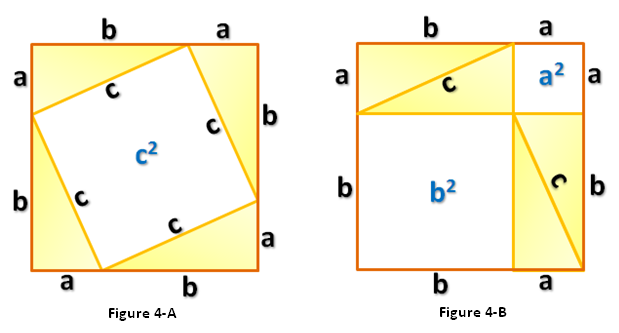
There are fully valid geometric proofs, eg http://mathandmultimedia.com/wp-content/uploads/2010/02/pyth...
Re:Pythagorean Theorem Found on Clay Tablet 1k Years Older T...
by orra on Thursday October 05, 2023 @01:05PM
(#37781143)
Despite labels $a$, $b$, $c$, I don't see how it's fully general. At best you could say it works for similar triangles, if you have that concept.
But I don't see how it proves anything if $a$ were say doubled, and $b$ kept the same.
Re:Pythagorean Theorem Found on Clay Tablet 1k Years Older T...
by n4r9 on Monday October 09, 2023 @06:55AM
(#37819028)
I'm not sure what you mean, sorry. It's definitely fully general. It demonstrates that:
* For any real positive values $a$ and $b$
* let $T$ be the (unique) right-angled triangle with non-hypotenuse sides of length $a$ and $b$
* then $a$^2 = $b$^2 = $c$^2
* where $c$ is the (unique) length of the hypotenuse of $T$.
You could give me the instance
$a$ = 2, $b$ = 3
$a$ = 4, $b$ = 3
Wait, really? I thought the proofs back then were geometric, so only proved specific instances. And so it wasn't until algebra, maybe trig, was discovered it was properly proven?