https://en.wikipedia.org/wiki/Atrocities_in_the_Congo_Free_S...
Begium was brutal in the Congo. Their brutality continued all the way to the mid 20th century, when Belgium (with US help) tortured, murdered, dismembered, and dissolved in acid, the body of the recently independent Congo's prime minister Patrice Lumumba. Belgian police commissioner, Gerard Soete who participated in the dismemberment kept two teeth and two fingers from Lumumba as souvenirs. The single tooth, that could still be found, was repatriated last year, to the Democratic Republic of the Congo, where a state funeral was held.
https://www.bbc.com/news/world-africa-61838781
Belgium's motivation was to continue to steal everything they could from the Congo. The US motivation was specifically to steal the Congo's uranium which was used to produce US nuclear weapons starting from the Manahattan project through the 1950s.
Even Gilley, the author of your post, acknowledged that hands were cut off of the dead in order to account for the ammunition used, though he emphasizes that the practice predated the establishment of the Congo Free State. That's also a claim that Hochschild makes in the book itself:
> Although some Congo peoples, like the Pygmies, were admirably peaceful, it would be a mistake to see most of them as paragons of primeval innocence. Many practiced slavery and a few ritual cannibalism, and they were as likely to make war on other clans or ethnic groups as people anywhere on earth. *And traditional warfare in this part of Africa, where a severed head or hand was sometimes proof of an enemy killed in battle, was as harsh as warfare elsewhere.* In the far northern Congo some women were maimed, as still happens today, by forced clitoridectomies, a practice no less brutal for being a cultural initiation rite.
One doesn't preclude the other. Beyond that, there's a great deal of historical evidence that supports the use of severed hands to account for ammunition used, and also evidence that severing the hands of the living was not unknown. There are diary entries from missionaries, photographic proof from multiple photographers, and more.
As Hochschild points out in his response[0] to Gilley, "the regime's own Manuel du Voyageur et du Résident au Congo, has detailed instructions for state officials about how to take hostages." The sheer amount of documentary evidence of atrocities in the Belgian Congo is quite clear. We also have diary entries and written reports from some of the perpetrators themselves, including Charles Lemaire, whose quotation Gilley took issue with.
If you really want to talk about "manipulative and deceptive" narratives "driven by a certain political agenda," you probably shouldn't be quoting Bruce Gilley. His reputation for his rather flawed defenses of colonialism, the most famous of which[1] was fiercely criticized even by fellow conservative academics.[3] And while some of the response to that article could be labeled as more emotional than about his specific claims and practices, plenty of ink has been spilled criticizing his arguments. Gilley is quite explicit in his defense of colonialism and his arguments for the return of a neo-colonialism today. For those arguments to hold any sway, he pretty much has to find a way to explain away colonialism's sordid history of atrocities and exploitation. At the very least, extraordinary claims such as Gilley's require exceptional documentation he has not provided.
0. https://www.theamericanconservative.com/the-ghost-still-haun...
1. https://www.nas.org/academic-questions/31/2/the_case_for_col...
2. https://www.cato.org/commentary/case-against-case-colonialis...
I’m curious to explore this when I’m back at a PC.
As opposed to, what? The destitution that comes with independence? It seems to suggest the colonized people were savages killing each other before the British stopped by so generously.
In Winston Churchill's case there is a lot of evidence which suggests that due to WW2 priorities he let a few million people in India starve. In any case he did not have any love for Indians and considered them to be inferior race anyways.
Just because famines have happened in India before, no way does that mean that the damage due to certain famines in British empire could've been reduced especially given that India was the crown jewel in British empire providing so many inputs to the British industrial empire.
It all boils down to the survival of the fittest. Yesterday Europe, today Russia and tomorrow China. No one can stop that
Not exactly the fittest nor really that into survival (suicidal masochism would be a better description)
The West can't even handle China's junior, North Korea.
Maybe because “the West” doesn’t want to “handle” North Korea (whatever that means)?
I’m sorry but I really don’t understand what are you trying to say..
I don't but the ongoing war is for more land
>> Maybe because “the West” doesn’t want to “handle” North Korea (whatever that means)?
NK is propped up by China to distract USA and it's allies. As planned it's worked and USA has no answer to that problem and yet makes bold promises to Taiwan.
I'm just trying to say that strongest country wins no matter what. It's nothing to do with morals. Better strengths ones country in good times.
I don’t think more land per se is the objective.
> As planned it's worked and USA has no answer to that problem
What problem is that? I don’t think US pays that much attention to NK.
From that perspective US has been much more successful than China. The existence of Taiwan as an independent state is a much, much bigger issue for for them than NK is for US.
> I'm just trying to say that strongest country wins no matter what.
Wins what? We’re not living in a grand strategy video game.
Americans in general (and the US mainstream media in their coverage) frame deaths emanating from the US (and it’s close allies) as collateral damage, killed terrorists, eliminated insurecctionists or mistakes or just even ignore it by omissions. From other countries that are not “allies” they are victims or murdered innocents or massacres or genocides etc… Just look at the favorable coverage of Madeleine Albrights death who said in her very own words that she owned to killing 500,000 Iraqi babies and children and said it was well worth it.
https://www.newsweek.com/watch-madeleine-albright-saying-ira...
https://en.m.wikipedia.org/wiki/Gallic_Wars
https://en.m.wikipedia.org/wiki/Battle_of_Bibracte
https://jacobin.com/2022/01/sanctions-financial-assets-afgha...
Churchill could likely have saved 100’s of thousands, but I seriously doubt he could have dropped deaths to zero in the middle of WWII. England was forced to ration food domestically, they didn’t have some great surplus to distribute. That 50,000 tons mentioned could have saved lives but wouldn’t have even come close to solving the problem.
That’s the nuance of history, people could have done more which would have helped though not actually solving the problem. All those shipments sunk by U-Boats were destroying part of a finite pool of food produced which had already shrunk as economies mobilized for war. Eventually you simply hit a breaking point.
All this lays the culpability at the door of the British for the Bengal famnine.
Which just leaves a <20 year window where a famine was possible. And British India had plenty of gaps of that size.
I won't say it's literally zero evidence that famine was much more frequent under British rule, but its not very strong given the obvious confounder.
If you are trying to argue self-governance can also cause famines, this isn't an example to be used.
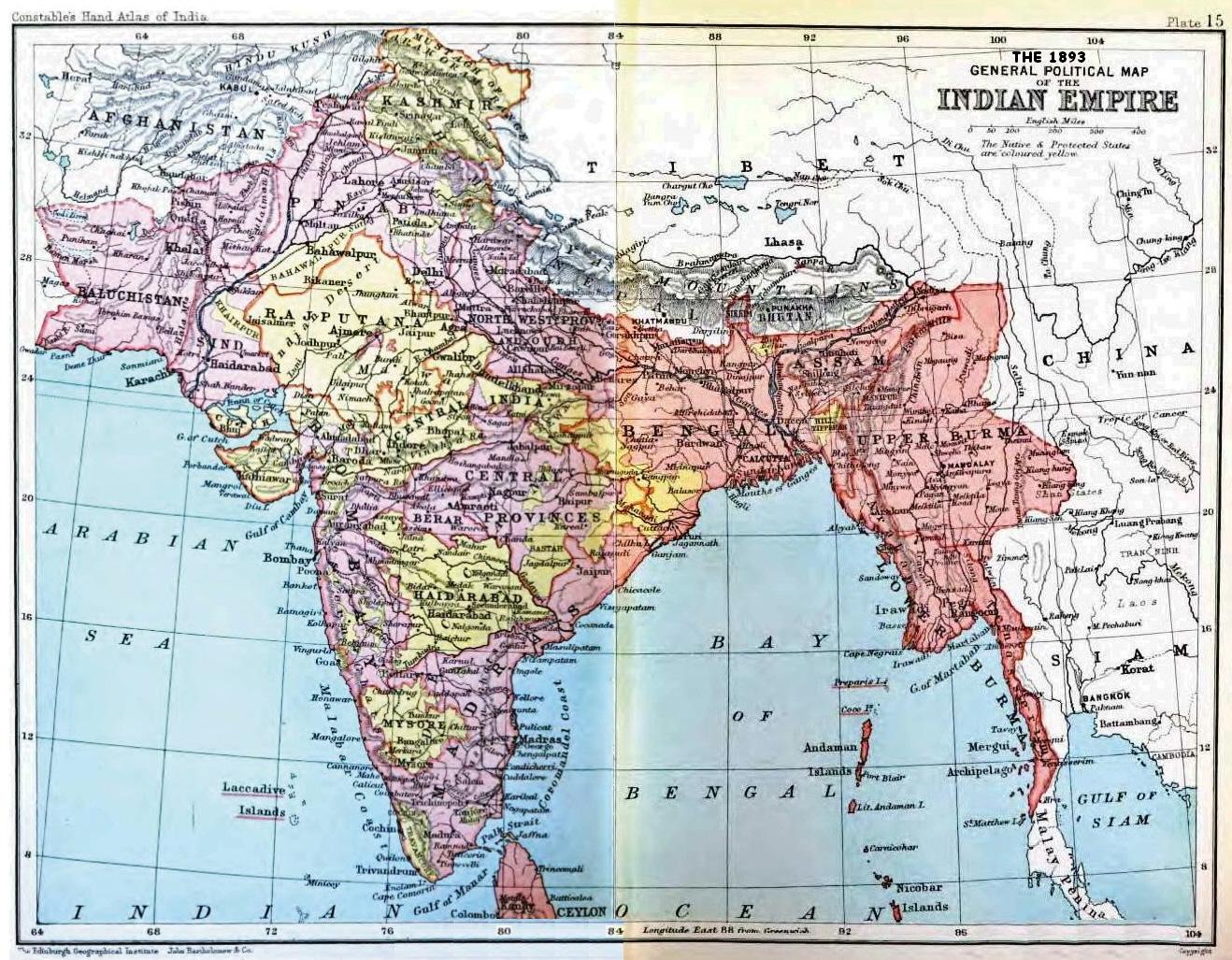
Bangladesh was part of British Indian Empire and the Bengal region is partly in it.
There are plenty of clear cut bad guy moments in history, falsely equivocating and saying "it's complicated" is a way to undermine critique.
Quoting from the book:
>The "rice denial" policy saw soldiers confiscate and destroy rice deemed surplus; according to one journalist, thousands of tons of rice were thrown into the water in east Bengal.[8] The "boat denial" policy saw 46,000 boats able to carry more than ten passengers confiscated; bicycles, carts and elephants were also taken.[9] One civil servant said the policy "completely broke the economy of the fishing class" in Bengal.
The answer seems an resounding yes - https://en.m.wikipedia.org/wiki/Churchill%27s_Secret_War#:~:....
Isn't this true of every wartime famine throughout history? My understanding is that famine and hunger were pretty standard during wartime as armies would "forrage" (a lovely euphemism for theft, murder and rape).
> In 1942, as a result of the Japanese conquest of Burma that began that year, the colonial government in India introduced a "denial policy" in Bengal, a scorched earth policy designed to deny Japan access to food and transport should it invade Bengal. Mukerjee attributes the "scorched earth" approach to Churchill, who reportedly urged it on 14 November 1941.[7] The "rice denial" policy saw soldiers confiscate and destroy rice deemed surplus; according to one journalist, thousands of tons of rice were thrown into the water in east Bengal.[8] The "boat denial" policy saw 46,000 boats able to carry more than ten passengers confiscated; bicycles, carts and elephants were also taken.
The analogy would be if the US had sufficient control of Ukraine, and removed and destroyed infrastructure in east Ukraine so that the Russians cannot use it if they capture that territory.
One sign that famines are man-made is if the nation involved is a net food exporter for the duration, regardless of historical frequency and/or natural conditions, because then it's basically unarguable that policy decisions are being made that are leading to starvation: the Great Famine in Ireland is the most common example of this, even though it's contemporary to the potato blight.
The Bengal famine was indeed at least partly man made, but the men who made it were the Japanese and German dictators who were trying to take over the world. Lest we forget the Japanese were attacking India at the time, as well as interdicting shipping routes, and had occupied the regions that would normally have been able to export food to Bengal to relieve famine. Britain meanwhile was being bombed on a daily basis and was fighting for its own survival. It is absurd and offensive to the British to blame them for a famine worsened by a war they didn't start, and which if they had lost would have certainly led to far worse catastrophes in India.
Presumably, since you are defending the actions of the British, you don't actually have any skin in the game - you're not like, a Bengali, who's grandparents starved as children. So I'm curious - why are you so strident? It's obviously not 'absurd' or 'offensive', from a cursory glance at the facts, to conclude that this is an anthropogenic famine.
If you want to argue against the preponderance of obvious facts, you have to do a bit more work, and start with the recognition that you're departing from the normal and prima facie understanding of what has occurred. You can't just try and browbeat people into counterintuitive conclusions with a mass of forceful and cherrypicked assertions.
> "From the beginning of the 11th to the end of the 16th century, on the territory of Russia for every century there were 8 crop failures, which were repeated every 13 years, sometimes causing prolonged famine in a significant territory. The causes of the famine were different, from natural (droughts, crop failures, low rainfall in a certain year) and economic and political crises; for example, the Great Famine of 1931–1933, colloquially called the Holodomor, the cause of which was the collectivization policy in the USSR..."
https://en.wikipedia.org/wiki/Droughts_and_famines_in_Russia...
It's historically undeniable that Churchill had no qualms when it came to actively destroying resistance to colonial rule, and complete indifference to the fates of the Indian subcontinent's people is no surprise:
> "Churchill suggested that chemical weapons should be used “against recalcitrant Arabs as an experiment.” He added “I am strongly in favor of using poisoned gas against uncivilized tribes to spread a lively terror” in Iraq."
https://english.alarabiya.net/special-reports/winston-church...
Source: https://www.theguardian.com/world/2019/mar/29/winston-church...
> The Bengal famine of 1943 was the only one in modern Indian history not to occur as a result of serious drought, according to a study that provides scientific backing for arguments that Churchill-era British policies were a significant factor contributing to the catastrophe.
> Mukerjee has presented evidence the cabinet was warned repeatedly that the exhaustive use of Indian resources for the war effort could result in famine, but it opted to continue exporting rice from India to elsewhere in the empire.
> Rice stocks continued to leave India even as London was denying urgent requests from India’s viceroy for more than 1m tonnes of emergency wheat supplies in 1942-43. Churchill has been quoted as blaming the famine on the fact Indians were “breeding like rabbits”, and asking how, if the shortages were so bad, Mahatma Gandhi was still alive.
> Mukerjee and others also point to Britain’s “denial policy” in the region, in which huge supplies of rice and thousands of boats were confiscated from coastal areas of Bengal in order to deny resources to the Japanese army in case of a future invasion.
- Japanese invasions caused rice exports from Myanmar and Singapore to halt.
- A cyclone devastated crops, forcing farmers to consume their seed corn.
- The Japanese meanwhile were bombing coastal cities and using submarines to interdict shipping. Anticipating Japanese invasion, the British stockpiled food for the troops.
- They also exported food for troops elsewhere.
- This led to hoarding, shortages and price inflations which triggered famine.
- Britain, far from not caring, distributed 110 million free meals, but the scope of the economic chaos meant it wasn't enough.
The idea that Churchill actively (as in deliberately) caused the famine isn't supported by history. It's a modern invention by the same sorts of people who assert that only white Americans had slaves, and other historical re-interpretations designed to extract concessions from rich westerners.
The reality is far simpler and closer to what people would expect. Churchill didn't want there to be a famine in India, nobody did. The cause was the Axis attempt to take over the world and the fight-to-the-death that this led to.
Any attempt to attack Churchill or the British over what happened must, to be intellectually rigorous, reflect on the alternative. Churchill was indeed a racist but compared to Hitler, Churchill's views were nothing. If the Nazis had won the Battle of Britain not only would the British population have been enslaved in forced labor camps, thus ending any question of it aiding India, but the Empire would have come under direct Nazi control and D-Day would have been impossible.
With Hitler's full attention and resources on the eastern front it's possible that the Third Reich would have survived and become stable. If that had happened then, given Hitler's views and India's absolute economic weakness in comparison to what a unified Nazi Europe would have had access to, the full scale extermination of Indian and African populations could have followed. Only a major new front by the USA would have been able to stop it. This sort of hypothetical holocaust of Africa is a minor plot point in The Man In The High Castle.
So when people complain about the allocation of food in WW2, it seems like they're forgetting how badly things could have easily turned out in alternative timelines.
Most probably redirecting resources spared Germany 2 atomic bombs since it allowed for a defeat before they were needed, but that is also conjecture.
Are you serious? You think, Americans who believe chattel slavery in the US was one of the foremost abominations in human history is trying to extract monetary concessions from rich people? That is some seriously twisted thinking from your part.
The legacy of slavery and Jim Crow is unparalleled, legacy of that is hurting people even to this day, trying lessen the impact of slavery in the US is offensive.
The debate around culpability is vast, nuanced and cannot be settled with reductionist claims like "Churchill was the reason millions died".
It would be wise to read the comment more carefully before replying. I explicitly did not accuse or suggest anyone of having an agenda, unlike the person I responded to.
> The debate around culpability is vast, nuanced and cannot be settled with reductionist claims like "Churchill was the reason millions died".
I had stated "Churchill's active role in causing the famine" and linked to a guardian article headlined "Churchill's policies contributed to 1943 Bengal famine". There is plenty of supporting evidence supporting both statements in the linked article. If you disagree, I'd be happy to see your supporting evidence, as opposed to unsubstantiated accusations of reductionism.
>It was ultimately special wartime factors that caused this difficult situation to become a disastrous famine. Fearing Japanese invasion, British authorities stockpiled food to feed defending troops, and they exported considerable quantities to British forces in the Middle East. They also confiscated boats, carts, and elephants in Chittagong, where the invasion was expected.
That said, seeing rate of famines increase as technology for food production improved is a pretty glaring.
Churchill (and arguably capitalism more broadly) were absolutely extracting food from India in a way that hurt the Indian people.
England is blameless for their imperial involvement in the Irish and Indian famine - the Soviet Union and PRC are communist evil when a famine happens in their countries.
I should also note this Ukrainian Holomodor junk people are babbling about (which Walter Duranty and the New York Times at the time said was not happening) was before the English-enabled Indian famine.
I'm a (non Soviet style) communist, and it's frustrating to me to see both communist and capitalist posters say, "my side did nothing wrong, yours is the killer". Both communist and capitalist regimes have caused famine. We need to observe both and feel comfortable with the idea that even things we agree with sometimes do evil.
In contrast, the famines in the USSR and PRC weren't caused by invasion. They were caused by the collectivization of agriculture for ideological reasons.
You're talking as if England had not invaded and subjugated India. Gandhi was in prison during World War II due to noncooperatiom with the English invaders, and Nehru and the then big tent Congress party had the same policy. Bose actually went to Japan as he wanted the Japanese to come into India and drive out the English invaders.
What was the Dust Bowl famine in the US at the same time but policies of "agriculture for ideological reasons"?
This is very deceptively phrased. It suggests that there was no famine in India before, and somehow Britain caused that problem to arise for the first time.
Other famines in India:
1. 1335-1342
2. 1460
3. 1520
4. 1555
5. 1629-1632, the biggest famine in Indian history
6. 1655
7. 1682
8. 1702-1704
The rule of the East India Company started in the 1750s. Famines continued up to the green revolution.
The way the article presents famine as some sort of direct consequence of one set of empires being replaced by another suggests that the article has an agenda that goes beyond history.