News for hackers. Stuff that matters.
Re:In the past, I've had students call my problem sets “emot... by deskamess on Tuesday January 17, 2023 @07:18PM (#34421487)
Pretty much most senior level/grad algorithm classes are like this. They introduce a framework for solution and then give you about 2-3 example lecture problems that they walk you through. 2-3 weeks after being introduced to 5/6 frameworks its Exam day. You are given unique word problems that, in the eyes of someone experienced like a prof or PhD student, is trivial. But you are struggling with 1 week of homework experience to fit a word problem into one of the frameworks you studied. There just was not enough time dedicated to dissecting how to parse word problem, look for patterns, map it to a framework. It was basically left to the student to figure it out in 1 week based on 3-4 homework problems. On exam day you are just emotionally devastated looking at the problem not knowing where to start - you keep throwing various framework structures on the problem hoping some hints of a solution bounce back at you.

But there are smart people who get all this stuff "easily" (previous practice, exposure). The rest of us walk out of the exam wondering how many trucks hit us.

Re:In the past, I've had students call my problem sets “emot... by marmetio on Tuesday January 17, 2023 @07:31PM (#34421621)
This is a problem all across engineering. Professors and textbook authors are so concerned about reserving problems to grade you on that they forget to teach the material in the first place.

Imagine trying to learn a spoken language without lots of input and very little speaking practice.

Re:In the past, I've had students call my problem sets “emot... by TheOtherHobbes on Wednesday January 18, 2023 @05:29AM (#34425210)
Many professors don't care about teaching. I've had conversations with physics/math/engineering academics which go "Those who are smart and motivated will get it, and I don't care about the rest."
Re:In the past, I've had students call my problem sets “emot... by blackbear_ on Wednesday January 18, 2023 @06:45AM (#34425636)
I believe that a lot of this cynicism comes after years of teaching and seeing that most students do not really care about the topic and do not want to put in more than the minimum effort required to pass. You don't realize how easy it is to tell apart those who are interested from those who are not until are on the other side.
Re:In the past, I've had students call my problem sets “emot... by njbooher on Wednesday January 18, 2023 @07:52AM (#34426066)
Plenty of new faculty are more interested in research than teaching too.
Re:In the past, I've had students call my problem sets “emot... by martopix on Wednesday January 18, 2023 @08:17AM (#34426255)
The system is unfortunately unfair to everyone, in the sense that it's an unfair expectation for people to love and be good simultaneously at teaching and research. I met many people that want to do research (because of passion or because that's what gets you a career) and are bothered by teaching; I've also met people, including myself, who prefer teaching to research, and it's unfair that neither of these groups can express their skill properly.

I predict that in the future there will be more of a separation of careers, especially at the bachelor level, where having an instructor that knows the state of the art of research is not so necessary (although I'd argue that they should have a PhD). This is already happening a bit, say, in the UK, especially in fields like CS where courses are required also in other degrees curricula.

Re:In the past, I've had students call my problem sets “emot... by karmelapple on Wednesday January 18, 2023 @10:12AM (#34427561)
Talking with my partner just now, it seems like some universities in the USA practice this now. Some colleges at Iowa State University seem to have professors that have very low research expectations, and they typically teach the 100 and 200-level classes. Those teachers seemed to have packed lecture halls, since those profs truly care about teaching and don’t have the stress of constantly producing papers from a large lab.
Re:In the past, I've had students call my problem sets “emot... by njbooher on Wednesday January 18, 2023 @10:35AM (#34427937)
Those are adjunct professors. They typically aren't paid well.
Re:In the past, I've had students call my problem sets “emot... by yodsanklai on Wednesday January 18, 2023 @08:04AM (#34426159)
> Plenty of new faculty are more interested in research than teaching too.

Partly, because they're evaluated on research.

Re:In the past, I've had students call my problem sets “emot... by njbooher on Wednesday January 18, 2023 @08:05AM (#34426171)
But are being paid by tuition revenue, from people who expect them to teach.

The US needs more national labs for people who want to do research but don't want to teach.

Re:In the past, I've had students call my problem sets “emot... by zem on Wednesday January 18, 2023 @02:29PM (#34431715)
and better pay and tenure options for people who don't want to do research but are good at and put significant amounts of work into teaching.
Re:In the past, I've had students call my problem sets “emot... by njbooher on Wednesday January 18, 2023 @02:53PM (#34432076)
I agree. I was envisioning that after we shipped the people who don't like teaching off to national labs that the universities would just focus on teaching and could pay those people better.
Re:In the past, I've had students call my problem sets “emot... by loudmax on Wednesday January 18, 2023 @08:09AM (#34426192)
Agreed, but part of the teachers' job is to impart that curiosity and interest onto their students. That is hard to do, and only the very best teachers actually manage to do this.
Re:In the past, I've had students call my problem sets “emot... by gadders on Wednesday January 18, 2023 @08:54AM (#34426590)
Yeah, maybe when your younger than 16 or 18. If you're at Uni you're an adult and it's on you to study.
Re:In the past, I've had students call my problem sets “emot... by Savely on Wednesday January 18, 2023 @09:58AM (#34427371)
If so, why have teachers at all? Give those freshmen adults a syllabus in the beginning of the semester and conduct exams at the end. ”Those who are smart and motivated will get it, and heck with the rest.”
Re:In the past, I've had students call my problem sets “emot... by gadders on Wednesday January 18, 2023 @10:08AM (#34427494)
They still have a role in explaining the material and answering questions, but it's not their job to motivate students to study their subject.
Re:In the past, I've had students call my problem sets “emot... by xboxnolifes on Wednesday January 18, 2023 @05:01PM (#34433752)
Seems unnecessary, we have books.
Re:In the past, I've had students call my problem sets “emot... by gadders on Friday January 20, 2023 @10:14AM (#34454164)
They're not very interactive.
Re:In the past, I've had students call my problem sets “emot... by freejazz on Wednesday January 18, 2023 @12:05PM (#34429432)
They aren't teachers, they are professors.
Re:In the past, I've had students call my problem sets “emot... by marmetio on Wednesday January 18, 2023 @08:56AM (#34426621)
They're basically saying that learning happens through self-study, which is true. The issue is when they don't evaluate if they've provided adequate materials for that.

Professors used to be the givers of information back when it was unrealistic for everyone to have a book. School selected for students who could learn by only being told once. That was fine because the economy was agrarian and few people needed education anyway.

Nowadays, we have computers and a knowledge economy. "Teaching" doesn't have to be much more than making sure that students have the right things on the computer.

Re:In the past, I've had students call my problem sets “emot... by causi on Wednesday January 18, 2023 @09:18AM (#34426830)
Yep. My introductory physics course in college started with 29 students and ended with 4.
Re:In the past, I've had students call my problem sets “emot... by treeman79 on Wednesday January 18, 2023 @07:16AM (#34425820)
Took an art class for fun. Been a programmer for 20 years.

Final exam the instructor put a bunch of glass vases up for us draw.

We had never covered glass or anything transparent. Teacher was quite surprised when this was pointed out after everyone struggled for 3 hours.

She was generous on grade.

Re:In the past, I've had students call my problem sets “emot... by Mixtape on Wednesday January 18, 2023 @09:19AM (#34426842)
Something like this happened to me this past Fall. I took an undergrad fundamentals of networking course that was honestly fairly surface-level and simple, but the professor put a significant focus on developing the proofs for the course concepts through homework rather than in-class lectures. In theory that's fine, but the issue was that in a time-sensitive setting (i.e. assignments or exams) it became extremely stressful to just not understand where to begin with certain problems. Combine that with the fact that, in my experience, proofs often lead to understanding of a concept rather than the other way around and you had a lot of people going into office hours basically asking for a solution.

I would be very interested to see a study on the relationship between time costs sunk into learning a concept through proofs and students' understanding of the concept as compared to when a proof is simply provided. I'd hypothesize that letting students discover the reasoning behind things on their own would be more likely to develop a deeper understanding, but I question whether there's enough time in a single semester to drive a curriculum that way.

Re:In the past, I've had students call my problem sets “emot... by themitigating on Tuesday January 17, 2023 @07:47PM (#34421789)
"But there are smart people who get all this stuff "easily" (previous practice, exposure)."

I believe you meant to say "(studying)"

Re:In the past, I've had students call my problem sets “emot... by marmetio on Tuesday January 17, 2023 @08:03PM (#34421982)
I doubt that. If the materials are limited, then by definition there's less to study. You can choose other things to study, but it's a gamble whether it will be useful.
Re:In the past, I've had students call my problem sets “emot... by LarryMullins on Tuesday January 17, 2023 @08:18PM (#34422140)
There are different sorts of studying. To some people, studying means downloading the lecture notes, reviewing their own class notes, getting the slide deck from the professor.. To other people, studing means they actually crack open the assigned texts (which many students didn't bother buying in the first place.)
Re:In the past, I've had students call my problem sets “emot... by hahajk on Tuesday January 17, 2023 @09:13PM (#34422609)
And then to others it means spending going out and building things using concepts they're learning, not because they want to pass the course but because they're obsessed.

I just started as a teacher, I don't know if that kind of obsession can be cultivated in students through a specific environment or if it's something they bring with them into the class. Or if even trying to bottle that lightning alienates less willing students.

Re:In the past, I've had students call my problem sets “emot... by eli_gottlieb on Wednesday January 18, 2023 @08:41AM (#34426480)
You're in grad-level classes where there are assigned textbooks? Bless!
Re:In the past, I've had students call my problem sets “emot... by IIsi50MHz on Tuesday January 17, 2023 @07:57PM (#34421909)
Prior practice/exposure does not have to be "study".
Re:In the past, I've had students call my problem sets “emot... by tnel77 on Tuesday January 17, 2023 @08:55PM (#34422451)
Sometimes. There were certain topics that I didn’t have to do any studying for and others that took a lot of effort.
Re:In the past, I've had students call my problem sets “emot... by fshbbdssbbgdd on Tuesday January 17, 2023 @11:42PM (#34423509)
Yeah, I had a similar experience. I was bad at some areas no matter how hard I worked, and good at others. To me this seems like solid evidence something like “aptitude” exists. Although, it doesn’t answer questions of nature vs. nurture, whether those different skills result from different experiences earlier in life.
Re:In the past, I've had students call my problem sets “emot... by xyzzyz on Tuesday January 17, 2023 @08:30PM (#34422241)
> But there are smart people who get all this stuff "easily" (previous practice, exposure).

Or, simply by virtue of being more intelligent. Life is not fair, and some people do have it easier than others, without having to pay for it with extra study time.

If you are pursuing a research career, and you observe other students putting similar amounts of effort, but obtaining much better results, understanding things more quickly and getting better ideas, you should probably just drop out. Not everyone can be world class athlete, and not everyone can be a world class researcher, and refusing to accept it will often lead to wasted years and wasted potential: many people who are not smart enough to do top research often can achieve great success in eg. corporate world or startups, or achieve higher family goals and do it earlier (most people will be made more happy by their children than by publishing a mediocre paper that nobody will read). Being hell-bent on following a particular dream can bring a lot of misery.

Re:In the past, I've had students call my problem sets “emot... by chitowneats on Tuesday January 17, 2023 @08:34PM (#34422275)
Same thing with passing a football or nailing a technical ice skating routine. You can either do it, or you can't. Practice helps but is not a panacea, unfortunately. Find another occupation, friend. You are owed nothing.
Re:In the past, I've had students call my problem sets “emot... by progman32 on Tuesday January 17, 2023 @08:38PM (#34422305)
Or a better teacher. The limiting factor isn't necessarily the student.
Re:In the past, I've had students call my problem sets “emot... by chitowneats on Tuesday January 17, 2023 @08:40PM (#34422324)
So we should ensure equal opportunity to ice-skating lessons, in perpetuity, for all humans? Just in case?
Re:In the past, I've had students call my problem sets “emot... by eyelidlessness on Tuesday January 17, 2023 @08:59PM (#34422488)
Yeah dawg! That sounds like basic decency that doesn’t cost much to anyone who’d be harmed. Also it’s a general principle of meritocracy. You can’t merit anything without access to merit it!
Re:In the past, I've had students call my problem sets “emot... by chitowneats on Tuesday January 17, 2023 @09:01PM (#34422511)
LMFAO do you have any idea how much it costs to operate an ice-skating rink? How about in a place like Los Angeles, California? Apparently not.

Or you're trolling me. In that case, well done friend.

Re:In the past, I've had students call my problem sets “emot... by eyelidlessness on Tuesday January 17, 2023 @10:32PM (#34423134)
Your objection was to equal opportunity to lessons. We’re not talking about operating ice skating rinks for the public. We’re talking about allowing all people to be taught by teachers.
Re:In the past, I've had students call my problem sets “emot... by progman32 on Tuesday January 17, 2023 @09:10PM (#34422583)
No, I find that position rather absurd. I'm not talking about entitlement. I was reacting to a train of thought started two posts up:

> There just was not enough time dedicated to dissecting how to parse word problem, look for patterns, map it to a framework. It was basically left to the student to figure it out in 1 week based on 3-4 homework problems.

My position is that, perhaps, it is counterproductive to tell people who have some trouble in this environment to "find another occupation" based on such a limited measure of performance. We've never defined what the occupation is in this exchange, so perhaps I'm just unintentionally talking past you. I'm certainly biased. The autodidacts I've worked with (who intentionally dropped out of the rigid, unforgiving environment of academia) have been among the biggest contributors on teams I've participated in. In environments more suited to them, they learn just as fast as folks with a more traditional background. In these instances, the occupation was fine. The teacher needed to be swapped out.

Re:In the past, I've had students call my problem sets “emot... by robertlagrant on Wednesday January 18, 2023 @05:34AM (#34425243)
> In environments more suited to them, they learn just as fast as folks with a more traditional background. In these instances, the occupation was fine. The teacher needed to be swapped out.

You're assuming it's the teacher's fault. That will be true in some cases, but it may impossible to tell at the time. What will be true in others is that the person (like me) was far more motivated by work than academia, and university at the age of 18 wasn't appropriate.

Re:In the past, I've had students call my problem sets “emot... by whywhywouldyou on Tuesday January 17, 2023 @08:42PM (#34422354)
Sometimes this is true. But sometimes the limiting factor really is the student.

In my own experience I've seen fellow students put in less than half the effort I did (I watched them copy homework assignments in groups 30 minutes before class, spend a lot of time trying to track down last years exams, etc etc), and then have the nerve to complain afterwards that the exams were too hard.

Re:In the past, I've had students call my problem sets “emot... by xyzzyz on Tuesday January 17, 2023 @08:47PM (#34422398)
I’ve seen fellow students put a quarter of time on studying that I did (they spent the rest studying all the other advanced stuff that I didn’t even have time to look at), and get top scores on exams and effortlessly explain everything to us mere mortals. Life simply is not fair.
Re:In the past, I've had students call my problem sets “emot... by WalterBright on Tuesday January 17, 2023 @09:20PM (#34422658)
Me too. Hal Finney (that Hal) was in the dorm room next to mine at university. He could ignore class for an entire semester. Just before exams, he would pick up the textbook, spend a couple hours on it, and ace the test.

Again and again.

While Hal was one of the nicest, easy going guys I can remember, his intelligence was so far off the charts there was no way to compete with that.

Of course, sometimes I wish I was as smart as Hal, as musical as George Harrison, as handsome as Tom Cruise, as cool as Steve McQueen, but all one can do is just be glad that nature produces such people now and then. I have no desire to tear them down to my level.

Re:In the past, I've had students call my problem sets “emot... by SoftTalker on Tuesday January 17, 2023 @08:49PM (#34422414)
Yes, it's a combination of passion and ability. The super-achievers in any field have both.
Re:In the past, I've had students call my problem sets “emot... by haswell on Tuesday January 17, 2023 @09:03PM (#34422529)
Even the NFL needs backup quarterbacks. There are examples in almost every profession that highlight the value of a spectrum of capability.
Re:In the past, I've had students call my problem sets “emot... by chitowneats on Tuesday January 17, 2023 @09:11PM (#34422591)
Backup quarterbacks in the NFL is actually the worst possible example you could've given here. How many of those do you think they need relative to the population ? What level of play do you imagine they have to exhibit?

Unflagged remix yayy yayyyeee

Re:In the past, I've had students call my problem sets “emot... by haswell on Tuesday January 17, 2023 @09:22PM (#34422677)
The point is that even in the NFL, there's a wide and very visible gap between the top and bottom levels of quarterback play, and that's taking into account that these players (including the backups) are already considered the best of the best.

I only mentioned the NFL because I was riffing on your comment about throwing footballs, but agree that it's generally a stretched analogy. The extreme scarcity at the top of most professional sports and the resulting lack of utility/career viability outside of the big leagues doesn't compare well to most vocations.

The argument also assumes the only reason someone plays football is to play in the NFL. I invested significant time learning to skate because I enjoy it, not because I think I'll become a professional hockey player.

Re:In the past, I've had students call my problem sets “emot... by cvwright on Tuesday January 17, 2023 @09:59PM (#34422919)
Backup NFL quarterback is a pretty damn elite job. There are what, 50 or 60 of them in the world? Vs dozens of NCAA div 1 starters who graduate every year.
Re:In the past, I've had students call my problem sets “emot... by bglazer on Tuesday January 17, 2023 @08:51PM (#34422432)
Hard disagree on the idea that research should be the exclusive domain of some special tier of “top” research. Certainly there are varying degrees of aptitude for the skills of research. That said, there are infinitely more questions than there are geniuses. Many of these questions are of pressing importance for humanity. I’m very glad there are people working on them who didn't quit because they failed a problem set.
Re:In the past, I've had students call my problem sets “emot... by TheOtherHobbes on Wednesday January 18, 2023 @05:59AM (#34425371)
Working on them does not mean they will be able to solve them, or even to contribute to solving them.
Re:In the past, I've had students call my problem sets “emot... by eyelidlessness on Tuesday January 17, 2023 @08:54PM (#34422446)
> Or, simply by virtue of being more intelligent. Life is not fair

…

> If you are pursuing a research career, and you observe other students putting similar amounts of effort, but obtaining much better results, understanding things more quickly and getting better ideas, you should probably just drop out.

That seems drastic even without accounting for untold ways people enter any stage of life with disadvantages. I mean, I don’t know what I’m talking about in terms of research, just a fairly demanding professional life for >20 years. But dropping out isn’t the first and only advice I would give anyone who feels they aren’t performing as well as they perceive their expectations or just the performance of their peers.

Re:In the past, I've had students call my problem sets “emot... by xyzzyz on Tuesday January 17, 2023 @09:51PM (#34422877)
In your professional life, you are encountering people who are already heavily preselected, most recently by the hiring process, earlier by hiring and promotion processes of their previous companies, yet earlier by graduation requirements of their school, earlier by admission requirements, etc. People who should drop out, have already dropped out long before they met you, so you don't meet those very often, and thus the advice to drop out is not the one that you often give, but in fact this is the advice that most people have to hear before they ever meet you.
Re:In the past, I've had students call my problem sets “emot... by eyelidlessness on Tuesday January 17, 2023 @10:29PM (#34423109)
I’m certain you’ve misguessed important aspects of my professional life. I’m also certain there are many people I’d love to work with and see have a chance to succeed. Some get this advice before I have a chance to intervene, which is bad. Many just get discouraged before anyone could sway them so blatantly at all, or don’t even have the opportunity to try.

Your point was intelligence, right? How intelligent is it to just categorically exclude people based on their disadvantages? How intelligent is it to presume every systemic thing that came before you was right? How intelligent is it to encourage everyone to think the same way you do on the subject and discourage anyone from being more willing to take chances with people they feel more comfortable mentoring or training than you do?

Re:In the past, I've had students call my problem sets “emot... by imtringued on Wednesday January 18, 2023 @07:46AM (#34426020)
What if the genius drops out because he thinks there is an even smarter person that doesn't actually exist?
Re:In the past, I've had students call my problem sets “emot... by jrm4 on Tuesday January 17, 2023 @08:57PM (#34422472)
Genuine question.

Does this kind of "weeding out" actually have any value in the real world, or is it just gatekeeping slash carnival-prizes?

Re:In the past, I've had students call my problem sets “emot... by xyzzyz on Tuesday January 17, 2023 @09:05PM (#34422543)
Yes, of course. Some people will produce valuable research, and others will produce worthless papers nobody will ever read. The society is funding the entire activity, so it has vested interest in ensuring that as much money goes towards the former as possible, and as little as possible towards the latter.

This is to me so obvious, that framing this in terms of “carnival prize” is literally incomprehensible. Research careers are not prizes or sinecures, they are positions of trust and responsibility. Scientists are paid for the value they are expected to produce, and if they produce less value than someone else would have in their position, they shouldn’t be there in the first place.

Re:In the past, I've had students call my problem sets “emot... by anthomtb on Tuesday January 17, 2023 @09:09PM (#34422572)
> Research careers are not prizes or sinecures, they are positions of trust and responsibility. Scientists are paid for the value they are expected to produce, and if they produce less value than someone else would have in their position, they shouldn’t be there in the first place.

And getting into these positions of trust and responsibility should be based on your own definition of "smart enough", correct?

Re:In the past, I've had students call my problem sets “emot... by xyzzyz on Tuesday January 17, 2023 @09:45PM (#34422835)
If you read what I said with even a modicum of good will and charity, you'll observe that I recommended that people who don't keep up drop out on their own initiative, instead of being culled by "my own definition of smart enough". I was offering advice, not demanding some explicit policy be introduced and maintained. If you aren't fit to cut it, you'll drop out at some point anyway, and it's best for you if you drop out sooner rather than later: you'll be much happier to have dropped out at 24 than be denied tenure at 3rd tier school at age 38, failing to build wealth and start a family up till that point.
Re:In the past, I've had students call my problem sets “emot... by anthomtb on Wednesday January 18, 2023 @12:13AM (#34423649)
So...not correct.

But how then, do you decide when to drop out? Trying to judge yourself based on the study habits of your peers strikes me an exercise in imperfect information. I would suggest talking to the professor who gave you "emotionally draining" questions and trying to determine what fundamental knowledge you may lack. But perhaps you have more relevant experience you can share.

Re:In the past, I've had students call my problem sets “emot... by xyzzyz on Wednesday January 18, 2023 @01:02AM (#34423867)
My experience is that I dropped out after getting Master’s degree, after realizing that while I can graduate and then get a postdoc job, I am simply not able to produce as high quality output as some of my colleagues. In hindsight, and especially looking at some of my other colleagues who didn’t drop out but should have, I made a great decision, and I am very happy to have done so.

I think that telling everyone that they can achieve anything they want is doing them a huge disservice. If you talk to actual grad students or post docs, most of them are actually quite unhappy and unsatisfied at their careers. They constantly fell insecure and unstable, and they in fact are so. This is much less common among top ones, because they quite clearly see that they are ahead of others.

In short, if you don’t feel confident that you can succeed in academia/research, leave before the academia chews you out. If you are confident you can succeed, you are probably wrong, but at least you’ll be much healthier psychologically throughout.

Re:In the past, I've had students call my problem sets “emot... by imtringued on Wednesday January 18, 2023 @07:38AM (#34425974)
This sounds like a very good way to get stuck at a local optimum because everyone is trying to get the next 2% improvement instead of heading for the global optimum which might require backtracking.

Economics for example, isn't lacking Keynes style geniuses, it is lacking pluralism. People are calcified in their stances and teachings and even Keynes said that there is not a lack of new ideas but the opposite, the problem is getting rid of the old ones.

Re:In the past, I've had students call my problem sets “emot... by Mezzie on Wednesday January 18, 2023 @09:45AM (#34427181)
One advantage is making sure that those on the quicker end of the bell curve don't have their time wasted. Not just in classes, but later on with their colleagues: If you know everybody can make the same jumps you can, then you can explain your thought processes without having to jump back and remind people of things. In addition, this helps everybody see each other as colleagues and peers rather than creating a weird situation where some people who are nominally on the same level end up being teachers or tutors rather than peers. It also helps create and set norms around what information people should know or be able to find as opposed to 'John can't search a database' or 'Cindy shows up without knowing first order logic and derails our presentation asking about it every slide'.

Not providing some kind of weeding out/gatekeeping is a great way to disincentivize the talented because then they spend their careers as teachers or hand-holders instead of what they actually want to do + they end up frustrated having to slow down.

Re:In the past, I've had students call my problem sets “emot... by haswell on Tuesday January 17, 2023 @09:01PM (#34422507)
> and you observe other students putting similar amounts of effort, but obtaining much better results, understanding things more quickly and getting better ideas, you should probably just drop out

I'm sorry, but even if this is true under some circumstances, this seems like terrible general advice, and only matters if your only goal is to reach the top echelons of your field. That doesn't mean there is no room for "average" researchers. This is a binary mindset that ignores the value of the discipline and seems like gatekeeping with no apparent benefit.

And struggling relative to your peers can happen for many reasons unrelated to core intelligence.

Re:In the past, I've had students call my problem sets “emot... by WalterBright on Tuesday January 17, 2023 @09:09PM (#34422578)
My career advice is usually:

1. draw a circle around the things you enjoy doing

2. draw a circle around the things that pay well

3. draw a circle around the things you're good at

The intersection is your best career path.

I tried to be a musician. Epic failure. I tried sports. Catastrophic failure. I tried sales. Monumental failure. Persisting in those endeavors as a career is akin to beating my head on a rock.

People are different. Viva la difference.

Re:In the past, I've had students call my problem sets “emot... by progman32 on Tuesday January 17, 2023 @09:21PM (#34422669)
This is a good starting point. I suspect some of the disagreements in this comment section stem from the difference in mindset between people for whom classwork either directly applies to or closely resembles their intended career path, and others for whom a lot of classwork (like my statistics courses) appear simply as a rigid gate to gaining access to their best career.

Perhaps a solution to the problem is better societal acceptance of trade schools, but at least in my area a university degree is a surer shot. Even if the degree is just a tool to then go do something completely different.

Re:In the past, I've had students call my problem sets “emot... by WalterBright on Tuesday January 17, 2023 @09:25PM (#34422702)
I also reject the idea that everyone has the same ability. They don't. Everyone is different.

I find when doing a collaborative project, partnering with someone just like me won't work. I need to find someone with complementary skills. Someone strong in the areas I'm weak in, and vice versa.

Re:In the past, I've had students call my problem sets “emot... by progman32 on Tuesday January 17, 2023 @09:48PM (#34422860)
Agree! In fact I quit a previous job because I felt I was part of a clone army. I'm just not convinced that academic performance is as a strong predictor of ability as our reliance on this indicator suggests.
Re:In the past, I've had students call my problem sets “emot... by SilasX on Tuesday January 17, 2023 @09:33PM (#34422756)
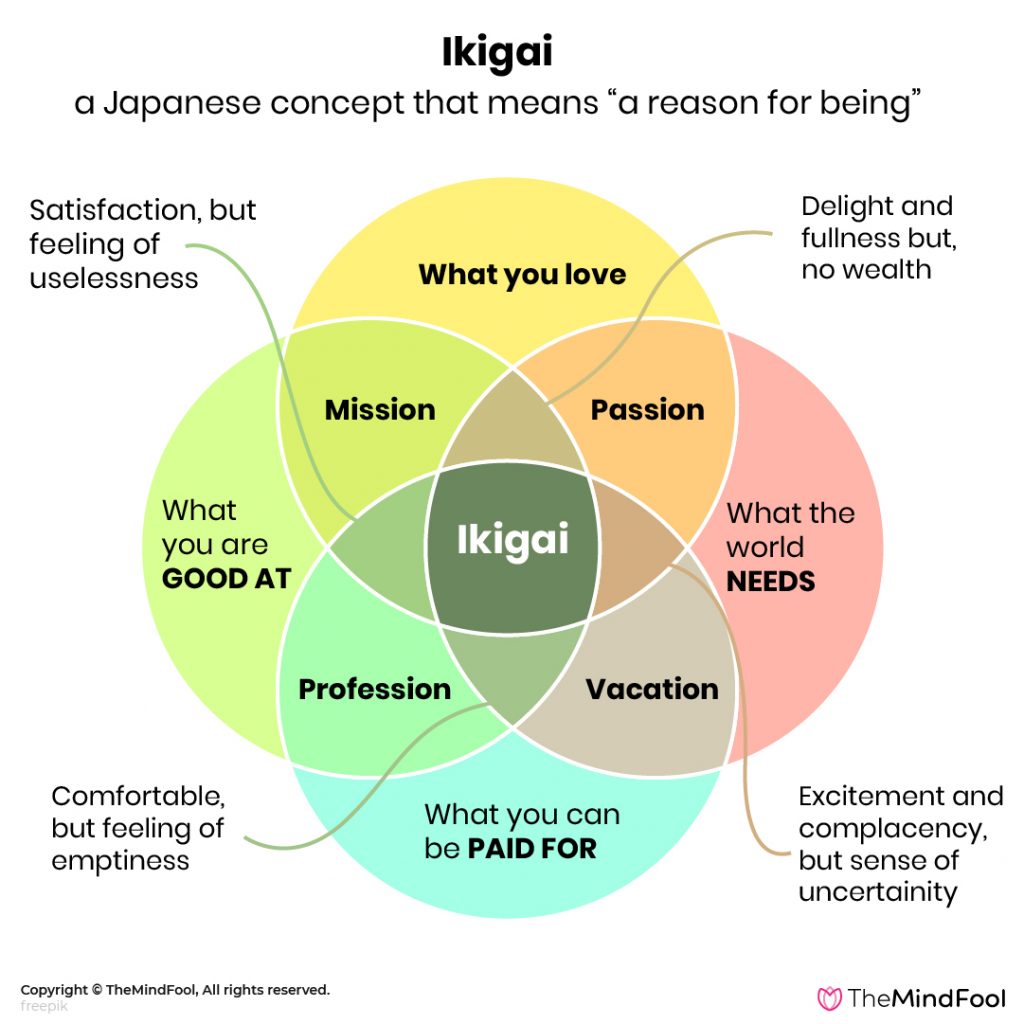
You might add a fourth circle for “what the world needs” (or, a more relaxed standard, “what is not actively harmful/promoting negative sum games”):

https://themindfool.com/wp-content/uploads/2020/09/Ikigai_do...
Re:In the past, I've had students call my problem sets “emot... by satvikpendem on Tuesday January 17, 2023 @10:00PM (#34422928)
My thoughts exactly, I was wondering, is this not just ikigai?
Re:In the past, I've had students call my problem sets “emot... by dtech on Wednesday January 18, 2023 @04:38AM (#34424948)
I was very confused by the "Vacation" overlap, but it turns out that's a typo and should be "Vocation".
Re:In the past, I've had students call my problem sets “emot... by mattejade on Tuesday January 17, 2023 @10:19PM (#34423043)
I’d argue that this sort of career choice intersection is actually not helpful for most.

Here’s why. For most people, there are plenty of things in this world that they’ve never tried that they’d enjoy the hell out of — especially if they get past an initial learning curve. There are plenty of things that they’ve never committed to long enough to know they have a serious aptitude for it (for example, it took me 5+ years of learning music to realise I’m a brilliant improviser, just because most early music training doesn’t even touch on it).

In my opinion, if someone isn’t sure what career to choose, the solution actually is: go out and try more stuff. A lot more stuff. Do something long enough that you get past the initial learning curve.

Once you’ve collected enough real world experience and data, then you can make an intersection of “what you’re good at”, “what you enjoy” and “what pays” — but you probably won’t even need to, since this is a trivial exercise compared to actually gaining that data in the first place.

Re:In the past, I've had students call my problem sets “emot... by TheOtherHobbes on Wednesday January 18, 2023 @05:33AM (#34425236)
No one has time to try all the things. A broad education - which would give everyone experiences and not just academic theory - would offer that, but we don't give people broad educations.

The only people who can afford to explore and dabble are the very rich. Everyone else is on a treadmill from middle school onwards.

Re:In the past, I've had students call my problem sets “emot... by ZoomZoomZoom on Wednesday January 18, 2023 @02:23AM (#34424266)
Sounds good in theory. For many, though, there won't be any intersection (which has any representation in job offerings).

Only persistence and perseverance through failures builds the necessary skills and the right attitude for the thing you need to do. "Career" can be a secondary thing.

Re:In the past, I've had students call my problem sets “emot... by jauco on Wednesday January 18, 2023 @02:30AM (#34424291)
Hah! When I took the first steps on my career path I wasn’t good at anything, had no idea what I really liked because I hadn’t had the opportunity to try most stuff and the top paying jobs of today didn’t even exist.

I know you are a smart person, but this advice will hold young people back.

Try stuff. Don’t sweat it. You’ll fail and you’ll succeed and you won’t know which is which until years later when you tell a story about your life and force it into a narrative.

Re:In the past, I've had students call my problem sets “emot... by krageon on Wednesday January 18, 2023 @04:21AM (#34424883)
Every child knows what things they like and are good at. It might not map exactly to a career path but it's not like career skills live in some sort of magical vacuum that you can never see until you try them.
Re:In the past, I've had students call my problem sets “emot... by simiones on Wednesday January 18, 2023 @04:57AM (#34425043)
How many children are aware that they would enjoy actuarial finance? How many are aware that they would be good at arguing patent law?
Re:In the past, I've had students call my problem sets “emot... by horns4lyfe on Wednesday January 18, 2023 @09:56AM (#34427327)
Do they enjoy math? Are they good at persuading others to side with them in arguments? Those aren’t non-transferable skills.
Re:In the past, I've had students call my problem sets “emot... by simiones on Wednesday January 18, 2023 @10:27AM (#34427809)
So if they enjoy math, they are as likely to enjoy actuarial finance as they are to like research into category theory or machine learning? If they are good at persuading others to side with them in arguments, they are as likely to enjoy patent law, criminal law, marketing, or politics?

There are some common skills, but all of these professions are extraordinarily different and require completely different aspects of those skills, and entirely different additional skills.

Re:In the past, I've had students call my problem sets “emot... by setr on Wednesday January 18, 2023 @05:12AM (#34425135)
Liking dinosaurs and Jurassic park is not the same as liking archeology, especially as a job. Most children have no idea what they’d be getting into, and if they like something, it probably has little to nothing to do with the actual work/job/goals.
Re:In the past, I've had students call my problem sets “emot... by another2another on Thursday January 19, 2023 @10:45AM (#34441528)
This is why the 'bring your child to work' days can be so great, they can get a sense of what a real workplace is like, other than some abstract place you go to when you finish education.
Re:In the past, I've had students call my problem sets “emot... by ilyt on Wednesday January 18, 2023 @06:25AM (#34425520)
The problem starts when things you enjoy/do well don't fall into "pay well"
Re:In the past, I've had students call my problem sets “emot... by imtringued on Wednesday January 18, 2023 @07:25AM (#34425887)
They don't pay well because everyone else enjoys them too.
Re:In the past, I've had students call my problem sets “emot... by WalterBright on Wednesday January 18, 2023 @02:05PM (#34431341)
Yes, it is hard to have a career eating ice cream.
Re:In the past, I've had students call my problem sets “emot... by haswell on Wednesday January 18, 2023 @07:56AM (#34426099)
This is highly dependent on upbringing.

I grew up with extremely religious and controlling parents. I spent most of my childhood believing I’d go to hell if I didn’t dedicate my life to the god the church worshipped.

This had a huge impact on what I believed about myself at that age, and I’m still actively working against the indoctrination in my 30s through therapy.

I still wonder how things might have gone if I pursued some form of research. I have evidence now to believe I might have been good at it, but haven’t convinced myself the cost to pivot makes sense at this stage of my life.

My story is not unique, and church/religion are just one implementation of a form of parenting that works hard against your claim.

Re:In the past, I've had students call my problem sets “emot... by FredPret on Wednesday January 18, 2023 @08:24AM (#34426330)
I grew up loving engineering-related activities without knowing that "engineering" was a word, or even a profession
Re:In the past, I've had students call my problem sets “emot... by FredPret on Wednesday January 18, 2023 @08:22AM (#34426310)
That's true - to draw a circle around what you enjoy, what you're good at, and what you get paid for, you have to actually try it for a while first
Re:In the past, I've had students call my problem sets “emot... by WalterBright on Wednesday January 18, 2023 @02:09PM (#34431396)
There are a lot of people who select a major only to discover upon graduation that the pay for it is minimum wage.

Everybody has activities that they enjoy.

Re:In the past, I've had students call my problem sets “emot... by FredPret on Thursday January 19, 2023 @03:42AM (#34438100)
That information is a simple Google search away though.

There are also lots of opportunities to pivot besides the default job in your field. Eg, gardening doesn’t sound promising, but call it “landscaping”, run it as a business, and you can earn more than a doctor.

Re:In the past, I've had students call my problem sets “emot... by chopin on Wednesday January 18, 2023 @06:17AM (#34425476)
Very often, 1. and 3. overlap well.

On the top of my head, the only thing for where there is almost no overlap for me is playing piano.

Re:In the past, I've had students call my problem sets “emot... by poulpy123 on Wednesday January 18, 2023 @06:49AM (#34425654)
unfortunately for me that's an empty set
Re:In the past, I've had students call my problem sets “emot... by j7ake on Wednesday January 18, 2023 @08:18AM (#34426264)
Problem is these circles are dynamic and often unknown.

What you’re good at depends on how much you know, practice, and inherent talent. First two changes over time, third one is an unknown variable. You also don’t know when you should give up. Should Einstein have given up science after he couldn’t get a faculty job and had to work in the patent office?

Things that pay well depends on economic situations that can change dramatically. See the cryptocurrency world.

Things you enjoy doing also change. Many stories here show that making a career doing things you enjoy can suck the enjoyment out of it.

Re:In the past, I've had students call my problem sets “emot... by bradlys on Wednesday January 18, 2023 @08:54AM (#34426585)
I don’t really enjoy coding, software engineering, or the bullshit work dynamics around it.

But they keep paying me hundreds of thousands of dollars (sometimes more) every year - so I do it anyway.

Re:In the past, I've had students call my problem sets “emot... by maxerickson on Wednesday January 18, 2023 @05:14PM (#34433889)
But doctor, I'm not good at anything!
Re:In the past, I've had students call my problem sets “emot... by mock-possum on Wednesday January 18, 2023 @10:50PM (#34436493)
same - also good to keep in mind that you don't have much control over category 2, but you can make decisions that'll improve your options on both both 1 and 3.
Re:In the past, I've had students call my problem sets “emot... by xyzzyz on Tuesday January 17, 2023 @09:35PM (#34422763)
> That doesn't mean there is no room for "average" researchers.

The "average" researchers are doing disservice themselves, the people funding their research, and actually good researchers.

They are doing disservice themselves, because they would have most likely enjoyed much higher success at some other career or lifestyle. An "average" researcher at age 35 is rather poor, his or her life is rather unstable and precarious, family goals are likely unmet, their scientific output is too mediocre to be a source of pride, and generally they are not very happy. Talk to them and you'll find out.

They are failing the funders, who hoped for quality output, but got worthless crap. Finally, they are failing quality researchers, who more and more eschew academia, and instead enter industry, where they can make >3x times as much money putting less effort into something that's typivally less socially valuable than high quality research.

> This is a binary mindset that ignores the value of the discipline and seems like gatekeeping with no apparent benefit.

The benefit is not wasting lives on worthless activities, and getting more useful research output. I do agree, though, that this is not "apparent", and is often hard to see even in hindsight. If you follow science news, however, you will find many people wondering why science productivity has fallen so much in last 50 years, despite funding being greatly increased in absolute terms. One of the reasons here is that we have many more people doing science that simply shouldn't be involved in it.

> And struggling relative to your peers can happen for many reasons unrelated to core intelligence.

Sure, but so what? If you cannot keep up with your peers during graduate studies, why should anyone expect you to keep up when you're actually expected to produce valuable research? Some people might not be able to keep up, because e.g. they spend half of their time caring for their disabled child. This is not their fault, but for the institutions and (usually) taxpayers who pay them, why should they care? Why wouldn't they prefer to instead employ someone who'll be able to spend more of their energy on research, and produce more valuable output?

Yeah, it means that some people through their bad luck will be denied their dream career, but, again, my point is that life isn't fair, and the research careers are not prizes to be handed out to people who deserve them in some moral sense: they are public service.

Re:In the past, I've had students call my problem sets “emot... by GuardianCaveman on Wednesday January 18, 2023 @03:20AM (#34424546)
Not wasting lives on worthless activities? Is a bench player in the nba or someone who bounces between minor and major leagues wasting their life because they’re not Lebron James? Or are they getting paid to do something that they’re pretty good at but certainly not great at? Sorry you can’t score 30 points a night, maybe just go find fulfillment with your family…
Re:In the past, I've had students call my problem sets “emot... by kace91 on Wednesday January 18, 2023 @03:40AM (#34424689)
Man, this mindset really seems like a recipe for a miserable life.

We are not machines whose output must be optimized over anything else, for the joy of our investor overlords.

Do what you enjoy doing, and if you don’t happen to be the best out of 7 billion people then congrats, you’re statistically normal.

Re:In the past, I've had students call my problem sets “emot... by wnolens on Wednesday January 18, 2023 @08:09AM (#34426191)
Amen.
Re:In the past, I've had students call my problem sets “emot... by YeGoblynQueenne on Thursday January 19, 2023 @05:06AM (#34438600)
You're right about mediocre researchers and their career satisfaction, and you're right to say that there's too many people pursuing research careers who shouldn't, but on the one hand you 're saying that some people are talented and special and on the other hand you're saying that the people who do well in life are those whose circumstances other than their talent (e.g. caring for a disabled child) enable them to make a valuable contribution to science.

So, someone who is talented and special, can nevertheless fail to make a valuable contribution because of their other circumstances. That's not life being unfair in handing out talent to everyone, that's the organisation of society being dysfunctional. Who knows what groundbreaking discoveries we are missing because the next Einstein or the next Darwin is a single mother of two living on benefits, in some inner city ghetto? If talent is not cultivated, it never yields fruit.

There's unfairness, and then there's the incompetence and pretentiousness of people who hold the keys to the treasury. I think the concern is mainly with the incompetence, and when people complain about unfairness, often it's the incompetence that really bothers them. After all, you can't do anything about unfairness, we really can't all be Albert fucking Einstein. But we should really be able to do a lot more about the incompetence that keeps most people from reaching their true potential.

Btw, I so disagree with you about what school results tell you about kids' talents, but that's another discussion I guess.

Re:In the past, I've had students call my problem sets “emot... by intended on Tuesday January 17, 2023 @10:23PM (#34423080)
I feel Arguing on the basis of the scenario provided is participation in a rigged fight.

Intelligence isn’t Unimodal, the smartest people aren’t necessarily the most productive, persistence is its own quality, and in a small percent of scenarios - insight would be the opposite of current practice.

Re:In the past, I've had students call my problem sets “emot... by flappyeagle on Wednesday January 18, 2023 @12:34AM (#34423740)
Sometimes this advice is spot on. Depends on how competitive the field is.

Medicine? Plenty of average doctors.

Jazz musician? Everyone who does it for a living ranges from amazing to genius and being just very good gets you nowhere professionally.

Re:In the past, I've had students call my problem sets “emot... by yesenadam on Wednesday January 18, 2023 @04:50AM (#34425011)
> Jazz musician? Everyone who does it for a living ranges from amazing to genius and being just very good gets you nowhere professionally.

Band leaders and/or singers can be, and quite commonly are, very average, and get regular work. They can be pretty bad and work a lot if they're also very good at marketing themselves. (source: am a jazz musician)

Re:In the past, I've had students call my problem sets “emot... by rednum on Wednesday January 18, 2023 @05:47AM (#34425310)
Genuine question: What in your opinion are the differences between a great and an average band leader? I've been making music as hobby for most of my life, and band leading is a topic I think about a lot - but it seems for many musicians I meet is not even on the radar.
Re:In the past, I've had students call my problem sets “emot... by yesenadam on Wednesday January 18, 2023 @05:01PM (#34433748)
Hi. Good question! That could take a book to answer. I meant to just refer to their level of purely musical skill though, thanks for the chance to clarify.
Re:In the past, I've had students call my problem sets “emot... by theGnuMe on Tuesday January 17, 2023 @09:17PM (#34422639)
Some of the best scientists were and are unconventional late bloomers.

Real science isn’t exam based. I’ve found that those who get the top grades at top schools can utterly fail to develop any novel research. In fact it’s a huge problem. Many grants proposals are largely ‘me too’ derivative works.

This is why grad school hinges not on grades and exams but on actual research.

Re:In the past, I've had students call my problem sets “emot... by xyzzyz on Tuesday January 17, 2023 @10:10PM (#34422985)
> Some of the best scientists were and are unconventional late bloomers.

Sure, but that's beside the point. The funding is limited, and, what's even worse, if we spread it too thin, best scientists will leave to make millions on the wall street instead. At some point, a decision must be made as to who gets to proceed in the research career, and who is cut. Sometimes the apparent mediocrities will turn out to be late bloomers, and cutting them would be a net loss.

However, and this is critical, you do not know who will be a late bloomer until they actually are. Late bloomers do not know that either, of course. In practice this means that when it comes to make a decision, you, and every other reasonable person, will pick someone who looks good on paper over someone who looks mediocre, but has a chance of becoming a late bloomer.

Doing otherwise would be reasonable only if mediocrities tended to have on average better output in the long term than people who look good on paper, but that would only cause us to revisit what the metrics of what makes one look good on paper, because they would clearly then be wrong. They aren't: by and large, people who do well in exams tend to do better in actual research than people who suck at exams, even though the exams don't actually resemble actual research much.

In short, when you bring up potential loss of cutting late bloomers, you should not forget about best scientists who never became one, because they were outcompeted by a mediocrity who never became a late bloomer.

> Many grants proposals are largely ‘me too’ derivative works.

Yes, and to me this is a sign that too many people are involved in research. If we suffer from deluge of mediocre, derivative work, we should make the standards higher and put more wood behind fewer arrows, not push more mediocrities into the career.

Re:In the past, I've had students call my problem sets “emot... by theGnuMe on Wednesday January 18, 2023 @08:03AM (#34426149)
I disagree. Many phds go into industry which makes technological progress faster.

While Funding for some research is limited but it is in our interest to train more scientists rather than less.

The millions on Wall Street are applied physicists and mathematicians. This is a weird claim to make about being the best. Their research is easily computerized or you spend billions building particle accelerators.

Science is not zero sum.

Re:In the past, I've had students call my problem sets “emot... by Galanwe on Tuesday January 17, 2023 @09:42PM (#34422816)
> Or, simply by virtue of being more intelligent. Life is not fair, and some people do have it easier than others

I'm really not convinced this is the case when reaching higher level education.

My experience is that "being smart" is an advantage for the first years - say up to bachelor - at which point there is no magic: if you don't work, you won't get your exams.

This is in part because most exams will test not only your raw understanding, but also your practical experience at solving quickly/intuitively all the little pieces leading to the solution. And that can only be achieved in time if you're comfortable with this mental gymnastic, which comes with practice.

> If you are pursuing a research career, and you observe other students putting similar amounts of effort, but obtaining much better results, understanding things more quickly and getting better ideas, you should probably just drop out

Come on... I am a firm believer that exams test skill sets that are only partially correlated to being actually good at job X - even if X is fundamental research.

Re:In the past, I've had students call my problem sets “emot... by xyzzyz on Tuesday January 17, 2023 @10:15PM (#34423022)
> My experience is that "being smart" is an advantage for the first years - say up to bachelor - at which point there is no magic: if you don't work, you won't get your exams.

Yes, if you don't put in the effort, you won't achieve very much, but this doesn't mean that being smart is not an advantage. It is, both early and late. It is clearly advantageous to both be smart and put in the effort over just putting in the effort. In fact, if you read my comment carefully, you'll observe that I explictly pointed that out, here:

> and you observe other students putting similar amounts of effort

Next,

> I am a firm believer that exams test skill sets that are only partially correlated to being actually good at job X - even if X is fundamental research.

Again, if you read my comment carefully, you'll observe that I never mentioned exams. I discussed

> obtaining much better results, understanding things more quickly and getting better ideas,

which is what you do in actual research, not just exam studying. I would really appreciate it if you read what I say more carefully, and respond to what I'm actually claiming, instead of what you incorrectly believe I am.

Re:In the past, I've had students call my problem sets “emot... by poulpy123 on Wednesday January 18, 2023 @07:06AM (#34425752)
Actually you can find people that are really "smarter" that others, who get things noticeably quicker, even in research. Although as you note, being smarter isn't enough at university level.

But in any case they are a too small sample to make the modern science work, and most of the scientists are, well, average people maybe "smarter" than the average people but not by very much. What makes the difference is interest, motivation and opportunities.

And I say that as a former scientist that decided he wasn't smart (and interested) enough but who met many non-scientist smart people in his life

Re:In the past, I've had students call my problem sets “emot... by yowlingcat on Tuesday January 17, 2023 @10:18PM (#34423042)
Experimental technique development and pushing the cutting edge of current state of the art techniques is a phenomena you can see everywhere in human society. It is there in every field of creative endeavor humans engage in, which I would say research is one of. Not only would I say that research isn't special, but I would also say that, just like every other field of creative endeavor that doesn't intrinsically bring a lot of money, those who write the checks (and those who focus on currying their favor) call the shots and sit at the center of influence networks and control the flow and direction of creative production.

It's not that I disagree with your fairly broad conclusions (that intrinsic variation in human capability exists) but I don't know if you are accurately describing intelligence, academics, the corporate world, or any of the things based on how you are interrelating them in your comment.

I take issue with what I see to be a lot of odd presumptions in your comment:

(1) the concept of general human intelligence (which maps cleanly across all capabilities) is only realistic

(1a) it can be be cleanly measured

(1b) it can be used to neatly order disciplines by practitioner intelligence, and

(1c) it is immutable

(2) the bounded class-like environment usably maps performance to a capability to successfully conduct research in an unbounded academic research environment, and

(3) some suitably generic conception of "intelligence based capability" exists which can accurately rank various fields of theoretical or applied research skills

(4) that if you rank these fields of research by the intelligence level of its average practitioners, academic research requires world class intelligence, higher than what is demanded by startups and the corporate world, with starting a family dead last

I think each of these assumptions are very optimistic, and the conclusion, that not everyone is meant to be world class, is trivially correct enough to be empty. Of course not everyone is meant to be world class; that is the definition of world class, that its individuals rank first in the world. It doesn't tell you anything about how people get there, or what you can actually do to influence your ability or that of someone else to get there.

In every one of the fields you actually talked about (athletics, research, startups, corporate world), it's not enough to just have raw biological ingredients for high performance. It is a combination of:

a) raw biological ingredients in the candidate to have capacity for some specific mastery

b) exposure, growing up, to what that specific mastery looks like

c) oversight, tutelage and mentorship by senior practitioners with demonstrated world class specific mastery

d) a cohesive strategy guiding a playbook of tactics (likely designed in combination with c) to keep rate of skill improvement consistently high enough to efficiently approach

e) intentional, consistent, effective practice by the candidate

f) a pipeline of high value opportunities to develop in the course of pursuing mastery

As with research, these are the raw ingredients necessary for success in any field of creative endeavor humans engage in. The vast majority of these factors do not include the biological "raw intelligence" -- and it's not that it's useless, it's that it is necessary but insufficient. And so you can and will often see practitioners with differentially somewhat less raw chops and somewhat more tenacity or discipline outperform and develop better mastery than practitioners with the converse. Plenty of geniuses failed to achieve anything with that genius besides misery and zero outcomes.

It takes a lot more than just being smart to truly be world-class at anything in 2022.

Re:In the past, I've had students call my problem sets “emot... by xyzzyz on Tuesday January 17, 2023 @10:49PM (#34423255)
> Not only would I say that research isn't special, but I would also say that, just like every other field of creative endeavor that doesn't intrinsically bring a lot of money, those who write the checks (and those who focus on currying their favor) call the shots and sit at the center of influence networks and control the flow and direction of creative production.

I definitely agree, but at the same time, those who call the shots did not get there by accident either.

> I take issue with what I see to be a lot of odd presumptions in your comment:

> (1) the concept of general human intelligence (...)

Sure, this concept is not perfect. However, do we have any better alternative than using it, along with past performance, for the purpose of predicting future performance? The answer is, to anyone who pays attention, clearly "no". It is easy to criticize and to repeat platitudes about late bloomers and the like, what is harder is to make an actual hiring decision, when the goal is to maximize quality of the output of the research group. At some point, if you can't cut it, your research career will be over, and if that's to happen, it's really best for you if that happens sooner rather than later.

> (2) the bounded class-like environment usably maps performance to a capability to successfully conduct research in an unbounded academic research environment, and

Where did I said anything about "class-like environment"? If you read my comment carefully, you'll observe that I discussed "obtaining much better results, understanding things more quickly and getting better ideas", not getting higher scores on exams.

It is worth mentioning, though, that people who get higher scores on exams also tend to enjoy better success in an unbounded academic research environment.

> (3) some suitably generic conception of "intelligence based capability" exists which can accurately rank various fields of theoretical or applied research skills

> (4) that if you rank these fields of research by the intelligence level of its average practitioners, academic research requires world class intelligence, higher than what is demanded by startups and the corporate world, with starting a family dead last

You're constructing a complex strawman to respond to a very simple advice of "if you're not cutting it in academia, better quit early rather than later, and don't expect that you can make it through hard effort alone". My advice in no way implies these "odd presumptions".

> In every one of the fields you actually talked about (athletics, research, startups, corporate world), it's not enough to just have raw biological ingredients for high performance. It is a combination of: (...)

Indeed, and if the field is professional football, and you tell someone that "if you're not cutting it professional football, better quit early rather than later, and don't expect that you can make it through hard effort alone", this is in no way controversial, in fact it is rather common sense. When the activity is intellectual, rather than physical, however, people tend to react more emotionally, or allow their ideology to overshadow some hard facts about human existence.

Re:In the past, I've had students call my problem sets “emot... by yowlingcat on Wednesday January 18, 2023 @08:35PM (#34435659)
* * *
Re:In the past, I've had students call my problem sets “emot... by xyzzyz on Wednesday January 18, 2023 @11:18PM (#34436651)
> After all, he might have gone pro but he wasn't even in the top half nevermind the top quartile.

No, he was deep in the top percentile of players. By the time you even get to NFL draft, you're clearly one of the best ones. Even the last draftee will make millions of dollars. To make your analogy meaningful, instead of comparing top 250 players, compare top 10,000 ones. If you're not in top 10,000 football players, should you stop striving for career in professional football? Hell yeah.

> Let's take another biological example, which is weight training. (...) What would you say to someone who said "if you're not cutting it at the gym, better quit early rather than later?"

This is another false analogy. People who go to the gym do this for their own personal benefit, not to make a career out of it. These are completely different scenarios. I'm not telling people that they should quit learning stuff for their own personal benefit, only to quit dreaming about the research career if they are unlikely to succeed in it.

> Is it really the case that you have found a cheat code and one true metric to determine whether a human will reach academic significance or not?

You really are unable to resist strawmanning, aren't you? Can you quote exactly what made you think I claim that? Can you honestly engage in what I actually say?

Re:In the past, I've had students call my problem sets “emot... by yowlingcat on Thursday January 19, 2023 @04:38PM (#34445985)
* * *
Re:In the past, I've had students call my problem sets “emot... by watwut on Wednesday January 18, 2023 @02:49AM (#34424385)
> and you observe other students putting similar amounts of effort, but obtaining much better results, understanding things more quickly and getting better ideas, you should probably just drop out

Sorry, but that would be just dumb. The starting point matter awful lot. I remember multiple things that were super difficult to me and I was slow, until I learned some missing piece and it clicked. Then I became good.

Initial struggle does not mean anything. There is such a thing as talent, but fixing your preexisting knowledge and calculating exercises will move you up into "it is not an effort to learn further" category awful often.

Re:In the past, I've had students call my problem sets “emot... by cycomanic on Wednesday January 18, 2023 @03:58AM (#34424778)
Funny thing, as a researcher myself one thing the main thing that makes you successful in my experience is a high frustration threshold. While there are some truly brilliant people, even then run into roadblocks, dead ends etc.. It makes sense you are venturing out into the unknown (that's what research is really), not giving up when getting stuck is what makes people achieve something.
Re:In the past, I've had students call my problem sets “emot... by kwhitefoot on Friday January 20, 2023 @01:12PM (#34457204)
Didn't Einstein say something like the reason he worked out General Relativity first was that he stayed with the problem longer rather than that we was actually smarter than all the others in the field?

And there is Edison's aphorism, something like "Invention is 1% inspiration, 99% perspiration."

There is plenty to do for those who are not the absolute smartest.

Re:In the past, I've had students call my problem sets “emot... by Gatsky on Wednesday January 18, 2023 @05:17AM (#34425160)
You're getting some flack for this comment, but others have said similar things: https://www.google.com.au/books/edition/_/__CnDwAAQBAJ?hl=en...

"I took six undergraduate mathematics courses. Until my junior year I encountered no one who seemed to have a greater aptitude for mathematics than mine. It had always been my easiest subject in high school, and I had been chided there by a classmate for writing my final exam with a fountain pen. Before I discovered physics, trigonometry and differential and integral calculus were my greatest intellectual pleasures. But my final mathematics course as an undergraduate was differential equations and the instructor gave me only a B. I'm sure he recognized that I was competent — I had worked every problem in the book — but he had to give the A's to the obviously brilliant students, who were now closing in on me. If I had decided to become a professional mathematician, as I easily could have, I would have made the traumatic discovery that there were many people my age who were far more talented mathematically than I could ever be.

The world of mathematics and theoretical physics is hierarchical. That was my first exposure to it. There's a limit beyond which one cannot progress. The differences between the limiting abilities of those on successively higher steps of the pyramid are enormous. I have not seen described anywhere the shock a talented man experiences when he finds, late in his academic life, that there are others enormously more talented than he. I have personally seen more tears shed by grown men and women over this discovery than I would have believed possible. Most of those men and women shift to fields where they can compete on more equal terms. The few who choose not to face reality have a difficult time."

Adventures of a Physicist, Luis W Alvarez

Re:In the past, I've had students call my problem sets “emot... by haswell on Wednesday January 18, 2023 @11:13AM (#34428581)
What he’s describing here is quite a departure from “quit as soon as you notice your peers are better than you”.

Being intellectually honest with yourself is still important, but if that’s what the parent comment was advocating, it did so poorly.

Re:In the past, I've had students call my problem sets “emot... by xyzzyz on Wednesday January 18, 2023 @11:31AM (#34428880)
Note that I said “you should probably drop out”, not “you need to drop out as soon as you notice others are better”. This shows that there is hardly a way I could have advocated it better, as people like you, or others in this thread (read their responses to me and mine to them) will misread it anyway, and instead argue against a straw man.

Additional reason is that if I hedged my opinion and tried to predict and answer to all possible critiques, the comment would be way too long and nobody would read it anyway, including the pre-written response to the point they made in reply.

Re:In the past, I've had students call my problem sets “emot... by haswell on Wednesday January 18, 2023 @01:39PM (#34430931)
The "should probably" is not the issue nor does it exonerate the advice.

It's the recommendation with no inkling of acknowledgement that other factors exist beyond a naive comparison of oneself with their peers.

The ethos of HN is generally to explore the depths of an issue in favor of making sweeping generalizations. This is one of the key things that separates discussion here from other places that shall not be named.

Knowing that many younger students and folks earlier in their careers participate here, that comment wasn't going to remain unanswered for long.

I don't think it would be terribly difficult to reframe what was written to provoke thought about intellectual honesty with oneself without unnecessarily leading others astray or losing all nuance in the process.

Re:In the past, I've had students call my problem sets “emot... by YeGoblynQueenne on Thursday January 19, 2023 @05:13AM (#34438664)
>> The ethos of HN is generally to explore the depths of an issue in favor of making sweeping generalizations.

Gosh, talk about sweeping generalisations. I mean, come on, it's not like HN users are some cohort of highly educated philosphers or mathematicians, the majority here spend most of their day battling the newest javascript framework and probably come to HN just to clear their mind of the impossible dreariness of modern-day web programming. Our dang wants this place to be all about intellectual curiosity but most users just want to vent and argue a bit, right?

I learned a phrase in French recently: "se jeter des fleurs aux fesses". Means throwing flowers onto one's bum. It is very evocative, I believe. Let's refrain from doing that. Think of the flowers.

And most people on HN also probably post on reddit anyway so.

Re:In the past, I've had students call my problem sets “emot... by haswell on Thursday January 19, 2023 @09:07AM (#34440387)
> Our dang wants this place to be all about intellectual curiosity but most users just want to vent and argue a bit, right?

https://news.ycombinator.com/newsguidelines.html

Re:In the past, I've had students call my problem sets “emot... by TrackerFF on Wednesday January 18, 2023 @05:55AM (#34425349)
Sometimes, or maybe many times even, it boils down to lack of prerequisite knowledge. Most classes simply do not hammer down how important prerequisites are, and how easy it is for students to get stuck simply because they haven't read enough of the required topics.

Of course - if you are a very high-IQ individual, you sheer intellect can get you by. I know such people, that have been able to solve problems without previous knowledge, simply by going at it with logic and pattern recognition.

But if you're average, that's not going to be the case.

I've been a TA, and seen students jump from severely underperforming, to becoming A students - because they finally understood something / had the "Aha!" moment in something which kept them back.

Re:In the past, I've had students call my problem sets “emot... by imtringued on Wednesday January 18, 2023 @07:22AM (#34425864)
You know it is completely normal to not know things?

According to you we should just let old people do everything because they got to spend more time on this planet and never let inexperienced young people do anything even if that means they never gain experience.

Re:In the past, I've had students call my problem sets “emot... by defrost on Wednesday January 18, 2023 @07:27AM (#34425900)
You may want to reread the comment you're replying to.

Paraphrasing what they said as "According to you we should just let old people do everything" is completely incorrect.

Their comment was more in line with "if your peers, whether younger or older, are learning faster than you, maybe this career is not for you".

That is certainly something to discuss further - but it is not the comment you made it out to be.

Attention to detail is a useful trait to develop.

Re:In the past, I've had students call my problem sets “emot... by tristor on Wednesday January 18, 2023 @11:12AM (#34428547)
> you observe other students putting similar amounts of effort, but obtaining much better results, understanding things more quickly and getting better ideas, you should probably just drop out.

I had the opposite experience when I went through college. I was the one that was so far ahead of everyone else, and I realized that college was a complete waste of my time and my money (I was working and sold many of my things to pay for college out of my own pocket so I wouldn't take debt). I went and cold-sat three certification exams, started applying for contract jobs, and dropped out of college as soon as I had a reasonable offer.

I had originally intended to stay in academia and do research, but I realized it was going to be an absolute grind and I wouldn't be able to connect with my peers socially or intellectually. I found a place in industry, put myself out of my comfort zone and grew a lot, and I definitely do not regret ditching academia and going into industry.

Re:In the past, I've had students call my problem sets “emot... by opportune on Tuesday January 17, 2023 @11:14PM (#34423363)
I did well in Algorithms courses (I took 4-5 and TA’d the intro class). I also studied math on top of CS. Imo a lot of the problem that CS students face in algorithms is due to not having a mathematical background.

Even though you are introduced to concepts like invariants, induction, and propositional logic in a discrete math class, IMO it takes more exposure and practice to get to the point where these concepts get useful in algorithms. In mathematics, and algorithms, a proof is not typically just applying invariants and propositional logic - it also requires more open ended thinking and (usually) applying patterns seen in class/coursework to solve problems. And even if not asked to formally prove correctness or complexity, knowledge of these concepts makes reasoning about algorithms a lot easier.

Most CS students at the point of taking intro algorithms know how to do some basic coding, know data structures, and if not also pursuing mathematics, have knowledge of calculus (useless) and discrete math. Unless the discrete math course was very rigorous and had a lot of coursework, taking Algorithms at that point is like walking into the deep end with floaties on - you might survive, but you’re not really ready.

In Algorithms, like in competitive programming and software interviews, you also need to have a list of all the different data structures, algorithms, and strategies you know well enough that you can ask yourself if X data structure or Y pattern is appropriate for the task. IME this is often not suggested for people studying Algorithms but it should be. Even if you don’t fully get a problem, you can probably get most of the way by identifying the general approach you should use.

Re:In the past, I've had students call my problem sets “emot... by qsort on Wednesday January 18, 2023 @03:25AM (#34424586)
This.

There's a lot of babbling about how coding is the limiting factor, but it really isn't. What people struggle with is solving the problems in their head. Writing the actual code after you've done that is almost trivial.

Another angle is how you need to think in abstract terms in the solution space. Most people whose knowledge of algorithms is weak think like: "okay, the problem says the word 'array' so I probably need a quicksort here". People who are successful think like "if this array were sorted, I could search an element in O(lg n) time instead of O(lg n). Can I solve the problem with this additional hypothesis?".

It's almost like being a chess player: when you're weak you come up with moves and hope they work, when you get stronger you look at a position and come up with plans and reasons why certain moves will or will not work.

The top-down mode of thinking is how you write a solution but not how you come up with one, the actual process is more "inside out", you find out stuff thinking about the problem and then you connect the dots.

Part of it is just experience and wit, but much can be thought, and formal mathematics helps the most.

Re:In the past, I've had students call my problem sets “emot... by deskamess on Wednesday January 18, 2023 @07:21AM (#34425858)
> strategies you know well enough that you can ask yourself if X data structure or Y pattern is appropriate for the task. IME this is often not suggested for people studying Algorithms but it should be. Even if you don’t fully get a problem, you can probably get most of the way by identifying the general approach you should use.

My experience exactly when taking such a course. This type of knowledge would have improved the QoL quite a bit.

Re:In the past, I've had students call my problem sets “emot... by Mezzie on Wednesday January 18, 2023 @09:51AM (#34427269)
I have no formal math background but I did take some propositional logic classes and more than a decade later they remain by far the most useful courses I ever took. I'm really surprised that they're not standard/easily skippable in CS curricula.
Re:In the past, I've had students call my problem sets “emot... by guntherhermann on Wednesday January 18, 2023 @03:35AM (#34424655)
This describes some of my CS modules experience down to a tee. Overall I had a great time and I look back on the whole experience fondly, but those few modules where nothing clicked, nothing made sense and the examples given never fit the work I had to do...

This was before the days of YouTube where you could look and study up hundreds of videos on the topic to finally find the one that clicks, which is a remarkable thing to have access to.

I'm not clever, but I am deeply resolute, and having an unyielding attitude to obstacles is what has gotten me this far in my career.

Re:In the past, I've had students call my problem sets “emot... by krageon on Wednesday January 18, 2023 @04:19AM (#34424874)
This matches my experience of an IT education in university perfectly. 90% of my class just didn't get it at all and the remaining 10% had a lot of experience in the field already (there were a small amount of extremely smart folks as well of course - they needed no background). Kind of defeats the purpose of teaching, but it does serve to weed out the folks that can't pick things up very fast. I think that is one of the goals of high-level schooling.
Re:In the past, I've had students call my problem sets “emot... by winReInstall on Wednesday January 18, 2023 @04:27AM (#34424911)
But we have machines for that? Data access and repetition in itself is worthless. Refinement, and gaining new data from old recipes is the actual value. Why construct a machine, that basically selects for the wrong value, creating a reproduction academia, instead of a innovation academia. Why weed out what was your original value proposition? It seems very strange.
Re:In the past, I've had students call my problem sets “emot... by ianai on Wednesday January 18, 2023 @04:47AM (#34424994)
Because they don’t believe in the value proposition they’re selling. Instead of forming students into high quality output they’re taking in students and pushing out anything but already high quality students.

The need to have seen something before a class to have a chance at passing it well is fundamentally wrong.

Re:In the past, I've had students call my problem sets “emot... by krageon on Wednesday January 18, 2023 @04:48AM (#34424995)
Absorbing and applying knowledge fast is a requirement for surviving in academia. Having classes that weed people out is not a bad thing. That's what I was saying - I don't see how this is pure reproduction, this is novel application of existing ideas. That's how innovation can start.
Re:In the past, I've had students call my problem sets “emot... by lll-o-lll on Wednesday January 18, 2023 @07:22AM (#34425866)
Nah, I don’t buy this at all.

I’ve never been a fast knowledge absorber, but that just meant I required a bit more time on my own, struggling with the content. Still managed to get max grades at undergrad university (didn’t go further because, well money). Also never stopped me from excelling in all work positions so far in life. If anything, a bit of struggle helps you go deep, and deep is much more valuable than fast but shallow (in my opinion).

Not professional advice, YMMV etc.

Re:In the past, I've had students call my problem sets “emot... by krageon on Wednesday January 18, 2023 @07:51AM (#34426061)
I did have classmates that operated like this, but they all failed out. Perhaps it depends on the university :)
Re:In the past, I've had students call my problem sets “emot... by lll-o-lll on Wednesday January 18, 2023 @08:15AM (#34426239)
Rude. I was never below the top 1-2% of students in my classes (quarter of a century ago now, getting old). Depending on when you graduated, I’d hazard a guess that my course work was at least as challenging, if not more so. I don’t really have any insecurities about my intelligence, but I’ve also lived long enough to realise that intelligence is just like being pretty. It’s nice; you get stuff for free, but you didn’t earn it in any way. It doesn’t make me “better” than others, just lucky.

And I’m also old enough to realise that it’s starting to slowly decline and won’t be getting any better. Fluid intelligence that is. Good thing I went deep over my career, because that depth can’t be replaced by the younger set with their superior fluid intelligence. Knowledge, experience, and dare I say it, a bit of wisdom. Struggling a bit to really understand things has served me well in life.

Re:In the past, I've had students call my problem sets “emot... by deskamess on Wednesday January 18, 2023 @07:11AM (#34425786)
> but it does serve to weed out the folks that can't pick things up very fast.

I do not believe that is a desired goal or outcome. Why eliminate people who learn thoroughly but slowly?

Re:In the past, I've had students call my problem sets “emot... by cbeach on Wednesday January 18, 2023 @07:34AM (#34425952)
I agree it’s horrible to discriminate on personality types.

As a counterpoint, though: in software jobs, the ability to pick up things fast is commercially valuable. As a hiring manager, if school grades helped me identify extremely smart folks who pick up things fast, then those grades are a useful tool.

Not all jobs are the same, however, and so other hiring managers might set a lower bar for grades. But it’s important that we have these tools, in addition to the various other ways we evaluate candidates.

Re:In the past, I've had students call my problem sets “emot... by martopix on Wednesday January 18, 2023 @08:20AM (#34426295)
> I think that is one of the goals of high-level schooling.

But it really shouldn't be, except after every effort to accompany people who struggle more has been made

Re:In the past, I've had students call my problem sets “emot... by greggman3 on Wednesday January 18, 2023 @06:48AM (#34425650)
I forgot where I heard this but "It's impossible to remember what it was like not to know something". This generally means all kinds of things are obvious to someone that knows a topic. They're so obvious they're invisible, forgotten about, and therefore you don't even think to teach them.
Re:In the past, I've had students call my problem sets “emot... by deskamess on Wednesday January 18, 2023 @07:28AM (#34425906)
That's a great quote! When you know, you know; if you don't it can feel helpless.
Re:In the past, I've had students call my problem sets “emot... by KMnO4 on Wednesday January 18, 2023 @06:53AM (#34425675)
I found a lot of things needed time to sink in. I would struggle to wrap my head around the exam content and stress myself out. Then the class would finish and I wouldn’t see the content for another semester, where I’d either be helping another student study or it would come up in a related course.

Suddenly, my brain would just “get” it and I’d know exactly how to start.

Re:In the past, I've had students call my problem sets “emot... by tgv on Wednesday January 18, 2023 @08:01AM (#34426138)
What did you think? They were going to give your your diploma because you're such a nice person?
Re:In the past, I've had students call my problem sets “emot... by raducu on Wednesday January 18, 2023 @01:11PM (#34430490)
> who get all this stuff "easily" (previous practice, exposure)

I've graduated in Eastern Europe, my experience might be different, but I CONSTANTLY heard my peer bitching&moaning about the materials to be hard. I found them to be "easy", as in easy to score 7/10 to get to 9/10 you'd have to apply yourself or be smart and to get to 10/10 you'd really have to apply yourself.

Granted, I did have "previous practice" -- meaning I was highly interested in programming and electronics. There were some infamous professors that made things "hard" for students -- those were the reaaaly boring, ultra-math-heavy-showoff-pricks I'm glad they had a car accident and died.

I still remember I didn't even bother going to the course of such a prick professor after course 3, just repeated the course the next year with a much more down-to-earth professor, and my blood still boils when I think how much fun I had just studying opams mathematical circuits with the second professor's materials and how bad the first prick-professor made us feel with his showoff maths. I didn't even go to the second professors in-person courses, I could tell from his study book he was a down-to-earth guy and his interest was conveying cool stuff to his students and not how much of math guru he was.

So when things were "hard" it was usually because the professor was an actual showoff prick and not because of an unfortunate missunderstanding on his part about our capabilities as students.

Those pricks know very well what they're doing and how scared students are about them and how many they are failing, they just get off on that stuff.

Re:In the past, I've had students call my problem sets “emot... by musicale on Wednesday January 18, 2023 @08:01PM (#34435414)
> about 2-3 example lecture problems that they walk you through

My thinking on this may be evolving. I used to think that you would learn more figuring out things for yourself. There may be something to that, but now I am thinking that having a more relaxed learning curve with many worked examples (not just a few) will help more students succeed with the course material.

Students who have seen the material before will be bored, but the examples and gradual learning curve are intended for those who are seeing and learning the material for the first time.

In my own experience, I find that many problems require a particular, often subtle or non-obvious, trick or insight to solve. This can result in wasting a huge amount of time until you are fortunate enough to discover it, assuming you actually do. These sorts of problems, especially on exams, are beloved by instructors because they produce modal distributions that make it easy to pick winners and losers and/or sort students into grading bins. They're hated by students because they tend to reward prior knowledge or experience - or sheer luck - rather than effort in the current course.

I wonder if the author is making a mistake trying to put research-like questions into a problem set, even one intended for early doctoral students. (Imagine putting students in competition with each other on research problems - that would seem to be isolating, cruel, and bad for a research group!) I would certainly hope that the exams are more reasonable.