1. draw a circle around the things you enjoy doing
2. draw a circle around the things that pay well
3. draw a circle around the things you're good at
The intersection is your best career path.
I tried to be a musician. Epic failure. I tried sports. Catastrophic failure. I tried sales. Monumental failure. Persisting in those endeavors as a career is akin to beating my head on a rock.
People are different. Viva la difference.
Perhaps a solution to the problem is better societal acceptance of trade schools, but at least in my area a university degree is a surer shot. Even if the degree is just a tool to then go do something completely different.
I find when doing a collaborative project, partnering with someone just like me won't work. I need to find someone with complementary skills. Someone strong in the areas I'm weak in, and vice versa.
https://themindfool.com/wp-content/uploads/2020/09/Ikigai_do...
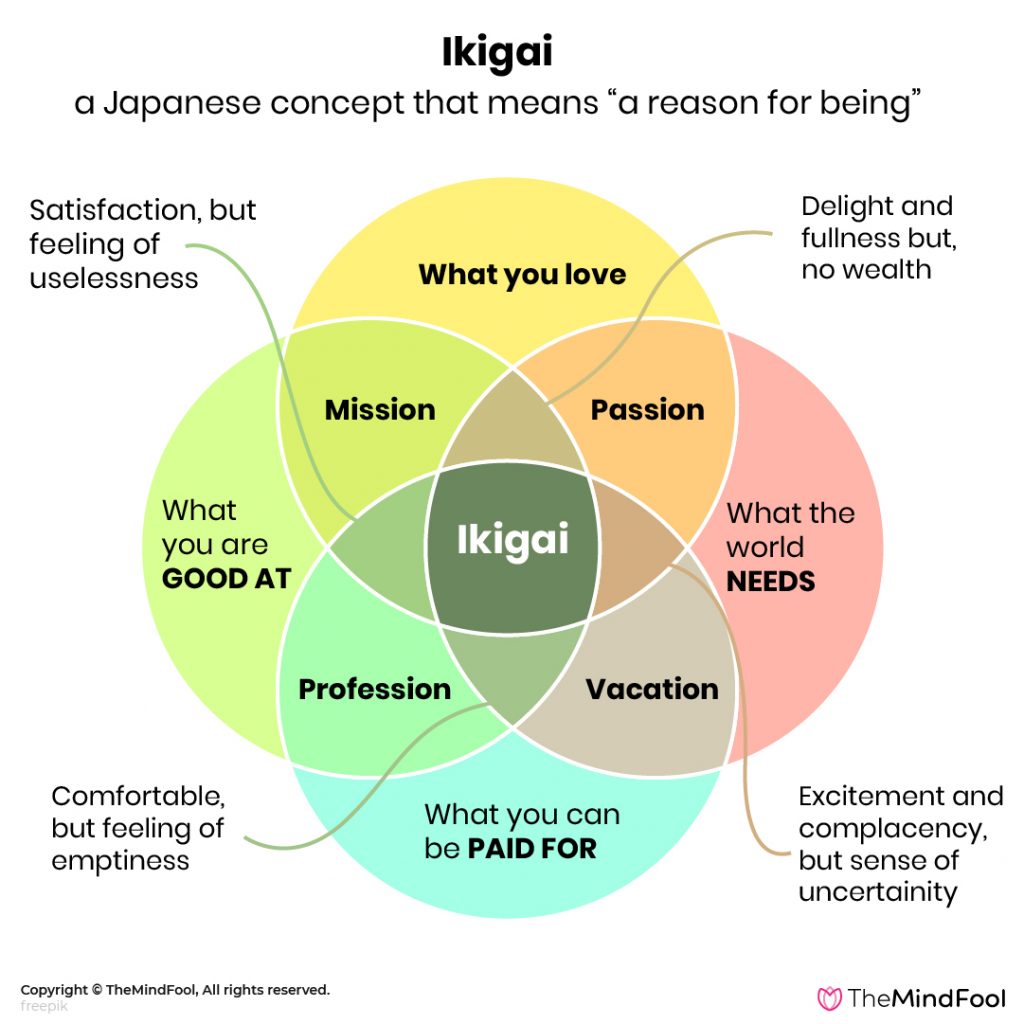
Here’s why. For most people, there are plenty of things in this world that they’ve never tried that they’d enjoy the hell out of — especially if they get past an initial learning curve. There are plenty of things that they’ve never committed to long enough to know they have a serious aptitude for it (for example, it took me 5+ years of learning music to realise I’m a brilliant improviser, just because most early music training doesn’t even touch on it).
In my opinion, if someone isn’t sure what career to choose, the solution actually is: go out and try more stuff. A lot more stuff. Do something long enough that you get past the initial learning curve.
Once you’ve collected enough real world experience and data, then you can make an intersection of “what you’re good at”, “what you enjoy” and “what pays” — but you probably won’t even need to, since this is a trivial exercise compared to actually gaining that data in the first place.
The only people who can afford to explore and dabble are the very rich. Everyone else is on a treadmill from middle school onwards.
Only persistence and perseverance through failures builds the necessary skills and the right attitude for the thing you need to do. "Career" can be a secondary thing.
I know you are a smart person, but this advice will hold young people back.
Try stuff. Don’t sweat it. You’ll fail and you’ll succeed and you won’t know which is which until years later when you tell a story about your life and force it into a narrative.
There are some common skills, but all of these professions are extraordinarily different and require completely different aspects of those skills, and entirely different additional skills.
I grew up with extremely religious and controlling parents. I spent most of my childhood believing I’d go to hell if I didn’t dedicate my life to the god the church worshipped.
This had a huge impact on what I believed about myself at that age, and I’m still actively working against the indoctrination in my 30s through therapy.
I still wonder how things might have gone if I pursued some form of research. I have evidence now to believe I might have been good at it, but haven’t convinced myself the cost to pivot makes sense at this stage of my life.
My story is not unique, and church/religion are just one implementation of a form of parenting that works hard against your claim.
Everybody has activities that they enjoy.
There are also lots of opportunities to pivot besides the default job in your field. Eg, gardening doesn’t sound promising, but call it “landscaping”, run it as a business, and you can earn more than a doctor.
On the top of my head, the only thing for where there is almost no overlap for me is playing piano.
What you’re good at depends on how much you know, practice, and inherent talent. First two changes over time, third one is an unknown variable. You also don’t know when you should give up. Should Einstein have given up science after he couldn’t get a faculty job and had to work in the patent office?
Things that pay well depends on economic situations that can change dramatically. See the cryptocurrency world.
Things you enjoy doing also change. Many stories here show that making a career doing things you enjoy can suck the enjoyment out of it.
But they keep paying me hundreds of thousands of dollars (sometimes more) every year - so I do it anyway.
The "average" researchers are doing disservice themselves, the people funding their research, and actually good researchers.
They are doing disservice themselves, because they would have most likely enjoyed much higher success at some other career or lifestyle. An "average" researcher at age 35 is rather poor, his or her life is rather unstable and precarious, family goals are likely unmet, their scientific output is too mediocre to be a source of pride, and generally they are not very happy. Talk to them and you'll find out.
They are failing the funders, who hoped for quality output, but got worthless crap. Finally, they are failing quality researchers, who more and more eschew academia, and instead enter industry, where they can make >3x times as much money putting less effort into something that's typivally less socially valuable than high quality research.
> This is a binary mindset that ignores the value of the discipline and seems like gatekeeping with no apparent benefit.
The benefit is not wasting lives on worthless activities, and getting more useful research output. I do agree, though, that this is not "apparent", and is often hard to see even in hindsight. If you follow science news, however, you will find many people wondering why science productivity has fallen so much in last 50 years, despite funding being greatly increased in absolute terms. One of the reasons here is that we have many more people doing science that simply shouldn't be involved in it.
> And struggling relative to your peers can happen for many reasons unrelated to core intelligence.
Sure, but so what? If you cannot keep up with your peers during graduate studies, why should anyone expect you to keep up when you're actually expected to produce valuable research? Some people might not be able to keep up, because e.g. they spend half of their time caring for their disabled child. This is not their fault, but for the institutions and (usually) taxpayers who pay them, why should they care? Why wouldn't they prefer to instead employ someone who'll be able to spend more of their energy on research, and produce more valuable output?
Yeah, it means that some people through their bad luck will be denied their dream career, but, again, my point is that life isn't fair, and the research careers are not prizes to be handed out to people who deserve them in some moral sense: they are public service.
We are not machines whose output must be optimized over anything else, for the joy of our investor overlords.
Do what you enjoy doing, and if you don’t happen to be the best out of 7 billion people then congrats, you’re statistically normal.
So, someone who is talented and special, can nevertheless fail to make a valuable contribution because of their other circumstances. That's not life being unfair in handing out talent to everyone, that's the organisation of society being dysfunctional. Who knows what groundbreaking discoveries we are missing because the next Einstein or the next Darwin is a single mother of two living on benefits, in some inner city ghetto? If talent is not cultivated, it never yields fruit.
There's unfairness, and then there's the incompetence and pretentiousness of people who hold the keys to the treasury. I think the concern is mainly with the incompetence, and when people complain about unfairness, often it's the incompetence that really bothers them. After all, you can't do anything about unfairness, we really can't all be Albert fucking Einstein. But we should really be able to do a lot more about the incompetence that keeps most people from reaching their true potential.
Btw, I so disagree with you about what school results tell you about kids' talents, but that's another discussion I guess.
Intelligence isn’t Unimodal, the smartest people aren’t necessarily the most productive, persistence is its own quality, and in a small percent of scenarios - insight would be the opposite of current practice.
Medicine? Plenty of average doctors.
Jazz musician? Everyone who does it for a living ranges from amazing to genius and being just very good gets you nowhere professionally.
Band leaders and/or singers can be, and quite commonly are, very average, and get regular work. They can be pretty bad and work a lot if they're also very good at marketing themselves. (source: am a jazz musician)
I'm sorry, but even if this is true under some circumstances, this seems like terrible general advice, and only matters if your only goal is to reach the top echelons of your field. That doesn't mean there is no room for "average" researchers. This is a binary mindset that ignores the value of the discipline and seems like gatekeeping with no apparent benefit.
And struggling relative to your peers can happen for many reasons unrelated to core intelligence.