And there are very few things like Wikipedia that both have the benefit of being dominant and not monetized. Are there any other examples at all?
I'm willing to incur some hosting costs for a beta period but I won't fund the service for long without revenue if the hosting costs are prohibitive as I'm not really interested in selling it later for someone else to monetize with ads.
Delicious once sold to yahoo! For 15 million, bought for 35k.
https://news.ycombinator.com/item?id=14463102
Delicious spending twice as much as pinboard in running costs in 2017.
There are some detailed blog posts from the time about running costs somewhere.
This doesn't always work though and can lead to a frustrating half hour of searching that ends in disappointment.
I have yet to find a solution for this.
One solution is I screenshot all the sites i visit, extract their colors, and create a searchable index. Nice side project idea I guess.
Sue Dumais from Microsoft Research and her team wrote a seminal paper on this entitled "Stuff I've Seen".
It is surprising that modern browsers innovate so little - for example they do not have a mode that searches only URLs you have previously visited, which would obviously massively help with known item search.
What's worse, they don't have a useful list of those URLs anyway[0], not anymore - both Chrome and Firefox have some ridiculously short and (AFAIK) not configurable window of browsing history. At this point they could do away with the history tab completely, as it's perfectly calibrated to be useless: the links are dropped just as they cross the threshold between "likely still have it open in a tab" and "what was that thing I saw the other day?".
--
[0] - Locally. I'm sure Google has it on their servers, but it's meant to help advertisers, not users.
I so badly want an extension to store all my phone and computer browser history, just URLs and Page Titles for all time so I can search it. How does this not exist? Much less be built in... Page text would be even better, but all I know that have attempted this have failed.
Allows you to search your history or bookmarks by page content, not just title.
The problem is with when it doesn't work: when it's the least convenient and the most irritating. For popular content it doesn't matter if you forget a precise word used there, you'll get to it soon enough. But for specific, niche content - which is the most valuable to me most of the time - even if you get all the keywords right you might not find what you're looking for on Google. The reasons range from the keywords being too generic to the site being no longer online and it's really frustrating when it happens.
OneTab and bookmarks are not an answer because they don't save the content. I tried Joplin + Web Clipper which does, but it works on a single-tab basis, and when I have 200 tabs open sending them all to Joplin manually takes ages... and then Joplin slows down to a crawl when you're done.
Reminds me though I have also experienced “I swear there is a word that sounds like “bla” that means xyz” and spend 30+ min trying to find it in dictionaries and it just doesn’t exist. Funny how the mind works.
https://chrome.google.com/webstore/detail/wayback-machine/fp...
WARNING: archiving can be habit forming.
Now the issue to me is how to convince folks it is worthwhile
I highly recommend the Sidebery addon (Firefox). Not just tree style tabs, but tree style tabs with customizable panels so you can sort everything out quite tidily. I'm able to manage hundreds of tabs without mess, and prune through them on a weekly basis seeing what needs to be bookmarked or can be safely forgotten.
So if you have 700 tabs and 600 of them you haven't opened in a month, you'll see them and it might make a difference in your habits. It also makes it easier to surf your open tabs when you're bored, rather than surfing randomly and adding new tabs.
I have a hard time closing out what is essentially my thought process to finding a solution or doing research. Along the way I close out dead branches. What remains is either a solution or where I have left off. I think my mental barrier is what it represents: my time capital sunk. The issue is working around this many tabs and managing it; a time sink in itself to fix.
Started documenting completed solutions in Obsidian and I've found that if I can't get over my lazy barrier to even enter it in, it's probably not important. Just have to keep working on improving and refining the way I think and approach this.
does research get you to have so many open? How do you manage it all? I've only just started using Sidebery but I try to keep my tabs at a reasonable 100-200 open.
Then I can just keep commenting to myself. It seems to help break up topic binges that I go on. Plus I like with GitHub it’s all markdown-based so I can throw images, files and whatever else I need in a session in there to keep it all encompassing.
I have a Python script which I can use to kill all chrome.exe so that next time the machine boots, chrome offers me to restore the tabs which where open before the crash.
I only use this when I know that the tabs are really important and I need to continue using them the next day. Else Chrome starts with a single custom startpage which contains links and as well as views to Jira projects (like a to-do list via the Jira API). And during the day I bookmark all tabs I find important and clean up. But it's usually around 4 windows with each around 10 - 20 tabs which accumulate during the day, in addition to dedicated browser profiles which serve specific purposes, like email or developer consoles.
My current solution is that, through a stroke of luck and a lot of pent up frustration, I've managed to habituate the following behavior:
WHEN I notice I've been procrastinating for too long, OR I'm getting anxious about so many "open loops" in the browser, OR I lose track of specific tabs I know are open and spend more than two seconds looking for it, THEN I find the last Actually Important tab (usually somewhere between the third and the tenth from the left), right-click on it, select "close tabs to the right", and confirm the closure of 100-200 tabs.
I do this a few times on a typical week; because its habituated, I do it fast enough that the FOMO of "but I actually wanted to read that, and that, and that" doesn't have time to kick in.
feel free to try it out:
https://addons.mozilla.org/en-US/firefox/addon/tabist/
https://chrome.google.com/webstore/detail/tabist/hdjegjggiog...
I like exhaustive deep dives so will explore as many sources as I can find, until my attention wanes, or I find a solution.
Have signed up for Readwise beta which will hopefully help me to add a layer to store/consume information before it info gets committed to Obsidian. Other link/article aggregators have not been successful for me as it just becomes another repository to manage.
Will have to look into sidebery, haven't seen that before!
I've used OneTab (and then switched to BetterOneTab). Been using it for about 5 years or so. I have dozens of exported "backup" files, because after a certain amount of saved tabs, the extension stops working. You can't save any new ones. I've lost maybe 100 tabs so far by adding them to OneTab only to discover I was at my limit and nothing got saved. It then stops allowing deletions (they come back after refreshing the extension page). So I have to export my hundreds or even thousands of tabs, uninstall the extension, and then reinstall it. And then I keep hoarding.
I have a real bad case of digital tsundoku. Even as I type this, I have roughly 80 links from HN opened, two dozen or so Twitter tabs, probably 30 YouTube tabs, and then a healthy heap of other miscellaneous sites. I know I will never get through this infinite backlog. Even if I were to squirrel myself away and do nothing but open each tab, digest its contents, and move on to the next, it would probably take me years. And I would be so burnt out I wouldn't be digesting well enough. Plus, most of that information is probably, at least slightly, outdated.
...Oh well, time to open up another dozen 3-hour long YouTube "mini" docs about niche subjects I have no engagement in.
Arc is just better for me in terms of staying organized. Everyone seems to have their own favorite feature, but "Spaces" are the killer feature for me.
https://tabula.civitat.es/images/2023/01/06/8krQ.png
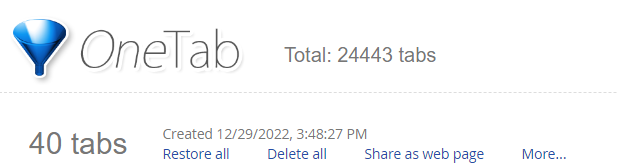
I may have a problem.
Repeat next morning.
...the restoring part doesn't happen.
Except I can hit restore all...
What ends up there is what I know isn't important enough to bookmark, but I kinda feel like I should read. Having OneTab makes me feel like it's ok to close the tabs, knowing full well I'll never, ever look for most of them again...
It's an comfort blanket.
I know I'm fooling myself, and I'm perfectly happy with that.
How do you achieve that?
• A single floating window acting as an opener*
• windows are always arranged in the case of tiling wms.
• In the case of Firefox user.css can help u remove the tab bar entirely. And opening in windows rather than tabs can be configured.
• I built my own window fuzzy searcher for finding windows.
The effect is compulsory need to close windows asap but keep a couple of windows forever that are actually for doing work. In my case :
• newsboat > firefox. • Cmus > firefox. • Aerc > firefox. • Irssi > firefox.
The list goes on and on.
The benefit is this: every job has it’s own window.
Note that still it is 100% the case that when not in “production/building” mode the default is consuming. This setup merely helps heighten awareness to the fact.
Hope it helps!
* lf, ranger, nnn are all good choices.
I feel this deeply
The compromise I found was just to dump them into my bookmarking service. If I really really need to find that thing again, it's saved somewhere. 99% of the time it's just digital ephemera and I try to let it go and close the tab.
(the x in the numbers is because the display overflows haha)
I usually have max 100 open, but I reboot all the time (for power mgmt reasons) and use OneTab so that seems to solve my hoarding tendencies. That and keeping searchable local notes / using history / bookmarking the really good ones that I'll also never read.
To me they're just different organisational methods that work well in different contexts.
https://addons.mozilla.org/en-US/firefox/addon/tab-session-m... is absolutely crucial.
I think it could be solved better browsers history. One idea - star pages - not adding to favorites, just marking them so that you could browse history of those separately. It could also show list of the latest stars in the new tab window for example.
Currently bookmarks, in firefox at least, as far as I can tell, cannot be even browsed by date.
I can not read them from there too and they won't take up resources from my computer =)
This really spoke to me - I find it to be a really positive way of framing the frustration I often feel with myself when I just can't get focused on work. Because at the end of the day, the clicking through links or reading up on something tangential to the result I want is driven by the same things that make me want to be creative in the first place.
I recently read The Millionaire Fastlane - which is a book I have seriously mixed feelings about - but one of the things that I thought was good in it was the advice to focus on being a producer rather than a consumer. I like this framing of the dichotomy, thanks for sharing your thoughts!
Being productive is important, though. The Billionaire Fastlane, however, will tell you that you need a broader view to come up with a great idea.
After all the (healthy) idea behind learning and information aggregation in the first place would be that you learn all that stuff to be better prepared towards taking the right (intelligent and educated) actions.
So there might be an individual balance that you have to find/develop and keep up. The trivial solutions at the edges never seem to satisfy.
Overall, I enjoyed the book, and thought some of the advice in there was really good. One thing I thought was valuable was something I think you're getting at in your post - which is that ideas that have the potential to make big money quickly have a combination of scale and reach and magnitude.
As a younger guy, I thought that the way people got rich was to get a good job and save lots of money (think doctor, lawyer, engineer). But as I entered the workforce I started to understand that actual rich people I encountered almost exclusively got wealthy through owning or being pretty high up in a business.
One thing that reading Millionaire Fastlane helped me crystallize is that serious wealth creation isn't an inherent property of all businesses, and that plenty of self owned businesses don't pay as well as a regular job, and even create more work for their owners than a job would. And that businesses that can create real wealth (read: "can make someone rich") have to have that scale and reach.
Overall I felt the read was worth my time, even if there are some things about it that I didn't love.
Happy to know other have this problem.
ps: to Mozilla Firefox team, kudos on handling that much .. I've used firefox with 1200 open tabs (all kinds of complexity) and it still work ok on my old machine. That said one can notice a clear change in lag after 300-400 but well I won't complain :)
So, anyway, counting what's open right now and what I've filed away, I'm at nearly 700 tabs. Some of them will be reused but the vast majority of essentially junk food for the brain.
That doesn't include the untracked but presumably insane number of things I actually did read but didn't keep open in a tab or file for later (just as it ignores the several hundred unread books on my Kindle while not counting the vast number of digital and physical books I do read).
I could handwave and spout unfounded theories about dopamine or "conditions" or anything you like, but ultimately, after decades of this, in my case it's what happens when my focus is on consuming rather than producing (ex: when I'm not engaged in something like a zettelkasten process), while allowing my insatiable curiosity and love of learning to remain undirected.
In short, you've got to manage that stuff. Or, at least, I do,