> as fast as any 20 year old. I I certainly hope so. Though I think it's more likely that Knuth can be as fast as other 20-year olds, but not as the 20-year old of himself.
(Sometimes I joke about how my hands know emacs, not my brain - but if someone asks me what keys I hit for something, my fingers move and then I work backwards from that.)
(And if you're collecting correlations - I have no musical performance talent at all and have spent maybe 10 hours total poking at musical keyboards - for me, typing is all typing, I expect musical keyboarding is a related but parallel thing, not the same thing.)
I'm still one month into switching to a macbook, and I now dread cutting and pasting. Oh, and typing "pipe", too.
I wonder how long it will take my 40+ years old brain and hands to get their act together...
Shrug, I guess ?
I prefer the concept of international standardisation to an American layout in pretty much all areas, with the exception of the keyboard layout; ANSI layouts are far more friendly - for programming, at least. Not just the enter key but the left shift too.
First there’s the cognitive overhead involved with the task itself, as opposed to letting your fingers do the work while you think about real stuff. Second, when you’re slow at typing, typing becomes the bottleneck more often, and your brain is sometimes idling waiting for your typing to catch up. Your brain has the hard part; it should always be the bottleneck. Third, typing fast gives you more options, because you don’t consider “how long will this take me to type out?” when considering different approaches to some immediate challenge. If opening a REPL and evaluating something is going to take you five minutes, you might not do it.
I suspect your friend was a fast worker despite being a slow typist. If he learned to touch-type, he could always have spent the same time thinking as he does now then less time and effort actually typing it.
However, sometimes I have the opposite desire. I can type on a normal keyboard at 80-90 wpm. On an iPhone I'm probably 1/4-1/3 of that. However, I probably spend 60-90 minutes a day reading/writing emails from my phone. Sometimes going slower allows you go to faster.
> Your brain has the hard part; it should always be the bottleneck.
Or maybe not. Lots of famous people (particularly physicists) talk about the importance of letting the mind wander i.e. the opposite of making sure it's the bottleneck.
I'm a slow phone typist but it's still easy to do. My brain can still think of the next thing to write, or wander.
Also great on the harpsichord and piano.
I'm constantly perturbed and interrupted when some app window just 'hangs' for a few seconds (some garbage collection going on, probably?). I can't pinpoint any one thing, just... everything seems relatively slow in 2022 compared to, even 10 years ago, and certainly 20. Applications weren't always phoning home to check things during bootup, which I suspect happens a lot now. Our computers are dozens of times faster than in the 90s, and, computationally, some things get done much faster, but others - around UI, it seems - apparently regress.
Ironically, the old apps that just "hang" for a while during initialization handle this better, because they don't process input at all, so it all just gets queued.
If I'm in windows I use virtuawin with alt+1, alt+2, etc for switching desktops. Not nearly the same, but works so much better than the builtin crap Windows has.
Paradoxically, I don't use alt+tab in windows to switch between programs. I used to do that, but then around XP (I think) they added the ability for programs to inject themselves into the alt+tab list. That means it's no longer completely consistent, which means I now have to think and check what alt+tab actually does so it stopped being any faster than just using the mouse.
So now if I need to flip between them quickly I'll either put them on different monitors (I use 3) and/or put them on different desktops. The combination makes me effectively as productive without the use of alt+tab. And it feels similar-ish to i3, so it's a bit comfortable in that respect as well.
NOTE: Anyone thinking virtuawin is like i3, it's not. It's just the best virtual desktop on windows (imo of course). Nothing on windows comes close to i3.
VSCode has a pretty bad latency problem, and it's the reason I stay away and use Notepad++ or VS2022. Sublime if on Mac.
I use git on the command line. My largest bitch is when it says "invalid command. you typed 'statsu', the closest command to this is 'status'"
Kill me now - it's a non-destructive command, and you KNOW what I was trying to say!
Those mishaps don't happen in IDEs.
[1] https://www.health.harvard.edu/healthy-aging/what-does-it-ta...
Well, the editor wars are over folks.
More seriously, Don Knuth is a treasure. One of the coolest things about computing science is how all the greats in the field are either alive, or within the living memory of people who are.
Like the 5th picture down you can see him standing (he uses a standing desk!) and if you blow up the screen, you can see part of an emacs window on the left hand side. I believe he also was using emacs shell windows as well, but not 100% sure.
Direct Link: https://d2r55xnwy6nx47.cloudfront.net/uploads/2020/04/DK_VC_...

I can't emphasize enough how incredibly nice and welcoming he is. He is bursting with enthusiasm for computers, and my wife and his wife had to almost restrain him so he would sit for his pictures, because he would start talking to me again about computer related stuff.
He's got Xeyes on the right, and the shell windows could conceivably be Emacs too, but if so, he's customised them to remove the minibuffer.
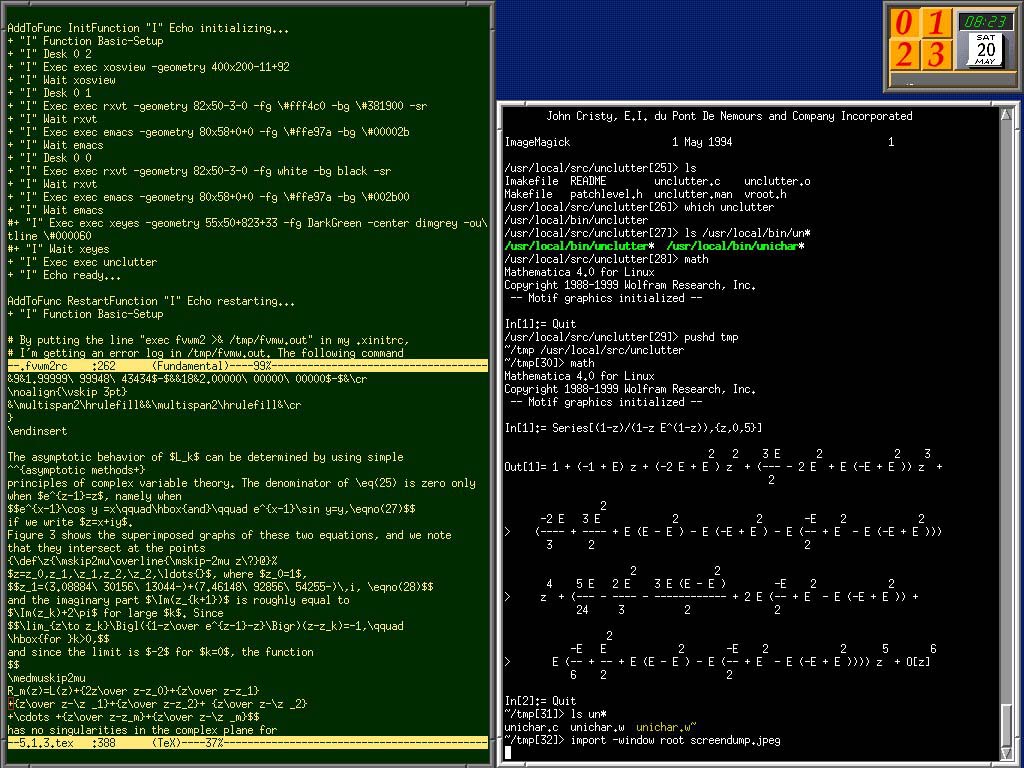
the only mistake you won't be able to correct from observing screenshot is the "look like org-mode" thing. it's https://www-cs-faculty.stanford.edu/~knuth/programs/color-mo... minor mode which lets you highlight arbitrary lines in a buffer.
Great quote and great insight. Understanding how the brain works and is stimulated augments communication. Especially important for dry, theoretical subjects.
The Emacs window is held in a frame. The operating system calls that frame a window, but that's not what Emacs calls it.
https://www.emacswiki.org/emacs/WindowsAndFrames
As to why Emacs calls everything something else, well, Emacs was first. As to why Emacs doesn't change its names, well, have you ever tried to change Stallman's mind?
(Sorry have to run …)
He had recently been working on 3:16 and showed us some of the original calligraphy that he had at home at the time.
What a lovely man, as well as being a multi-talented genius.
I started talking to him about some of the latest AI research and he mentioned the papers authors, he had already read them! Not only is he still very productive at 84, but he has not ossified into one particular subject but he continues to keep abreast of other related fields.
He also played his huge pipe organ for us, he was gracious, humble, down to earth, truly a treasure. I only wish he could live another hundred years, selfishly so I could see Volumes 5, 6, and 7 of Art of Computer Programming finished.
I should not with some sadness that COVID hit not long after and that year we lost a number of other luminaries in the field like Jon Conway.