Like the 5th picture down you can see him standing (he uses a standing desk!) and if you blow up the screen, you can see part of an emacs window on the left hand side. I believe he also was using emacs shell windows as well, but not 100% sure.
Direct Link: https://d2r55xnwy6nx47.cloudfront.net/uploads/2020/04/DK_VC_...

I can't emphasize enough how incredibly nice and welcoming he is. He is bursting with enthusiasm for computers, and my wife and his wife had to almost restrain him so he would sit for his pictures, because he would start talking to me again about computer related stuff.
He's got Xeyes on the right, and the shell windows could conceivably be Emacs too, but if so, he's customised them to remove the minibuffer.
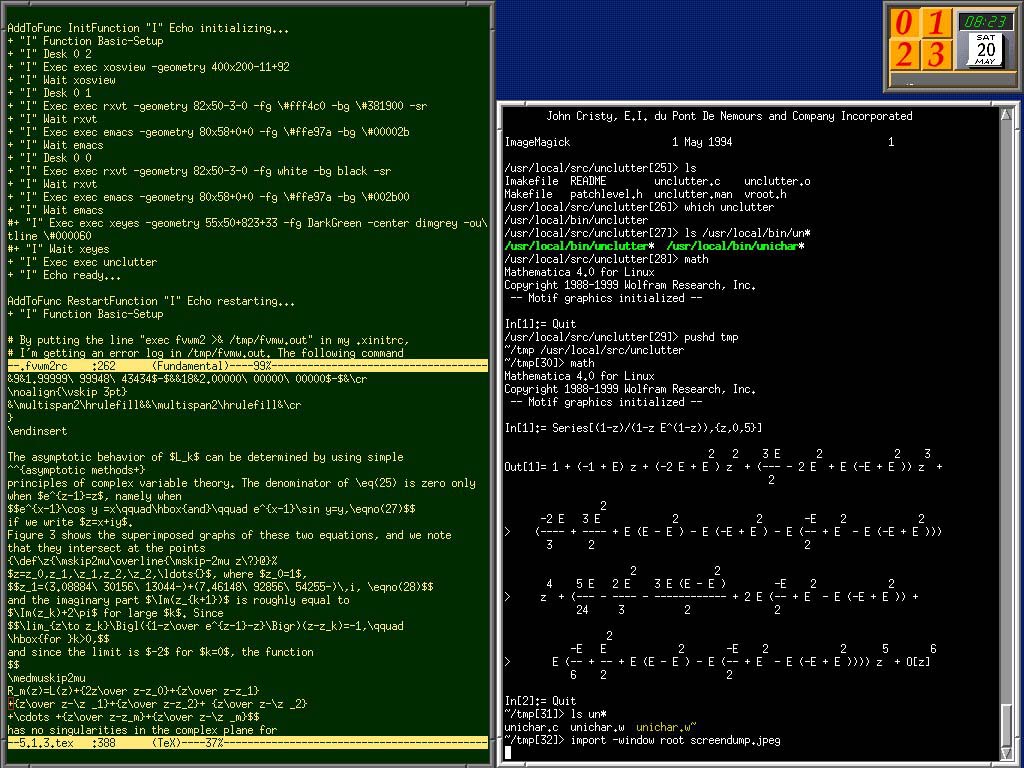
the only mistake you won't be able to correct from observing screenshot is the "look like org-mode" thing. it's https://www-cs-faculty.stanford.edu/~knuth/programs/color-mo... minor mode which lets you highlight arbitrary lines in a buffer.
Great quote and great insight. Understanding how the brain works and is stimulated augments communication. Especially important for dry, theoretical subjects.
The Emacs window is held in a frame. The operating system calls that frame a window, but that's not what Emacs calls it.
https://www.emacswiki.org/emacs/WindowsAndFrames
As to why Emacs calls everything something else, well, Emacs was first. As to why Emacs doesn't change its names, well, have you ever tried to change Stallman's mind?
Well, the editor wars are over folks.
More seriously, Don Knuth is a treasure. One of the coolest things about computing science is how all the greats in the field are either alive, or within the living memory of people who are.