It's also difficult (impossible) to curb demand for housing if housing is far and away the best investment you can possibly make, both in the short, medium, and long-term.
Unfortunately, so many people in the west have their net worth tied up in their homes that policies directly targeting property values is political suicide.
The best case scenario at this point for our future society is interest rate hikes causing a housing crash, then while prices are in the dumpster, put in legislation that prohibits the behaviours that have contributed to this cycle of housing mania: AirBNB/individual landlords, corporate investment in housing a la BlackRock, etc.
This is extremely dependent on a lot of factors. When you are an upper-middle class tech worker renting a luxury condo, your landlord will absolutely be responsive and helpful. I've been in those condos and they're great.
But I wasn't always able to afford to live in nice condos. When I lived in a cheap ground-floor unit and my bathroom started spewing feces out of the toilet and bathtub because the building's main sewer line was clogged due to the individual landlord fucking up a DIY fix, my individual landlord decided to ignore my calls because I was being annoying, and then I had to fight them through my local tenancy dispute board to reclaim the money I spent on hiring a plumber over a holiday weekend.
So yeah... it depends.
In my own experience: For corporate landlords, being a poor grad student or a tech worker didn't seem to make a difference; I was still treated like I didn't exist. In several instances there were serious issues with my unit that were affecting my health, and they were ignored. Individual landlords were awesome people -- fast and responsive to issues big and small, and even did things to make my stay better.
Seems that many results vary, but I suspect that when there's no human connection, you'll get a lot of bad stuff going on
Turned our cap for gas was just sitting on pipe. All the gas pipes were hand done (badly) and against code.
So permanent brain and nerve injuries for while family and hundreds of thousands in hospital bills.
Screw them.
Unless you're saying all the plumbing was only finger tight and they never used a wrench, which is just so wrong it didn't even originally cross my mind as what you're saying as done by hand. You're gonna need a good pipe wrench to get your gas connections tight.
When housing becomes a bad investment, very few people will spend their money and time building new ones.
The demand for housing depends on demographics, it has nothing to do with it being a good or bad investment. But whether it is a good or bad investment has a lot to do with demand for housing.
How did you get “prohibit individual landlords in favor of large corporations managing rental stock” from the upstream criticism of the forces driving both individual and corporate investment in housing-as-appreciating asset.
Housing might be the topic that dooms U.S. may way way down the road. But the GDP damage and opportunity cost lost annually is substantial.
There should be a form of buy in from the government at some point -- kind of keep your house and get tax credit and we are moving on.
Or we reach the point of a literal revolution on the topic, where people ask for houses instead of bread.
With the population numbers in decline in the west (especially Europe), will there be enough demand in the medium and long-term for housing?
citation needed? genuinely curious - are there studies about long-term returns from housing vs. other asset classes (namely public equities)?
https://seekingalpha.com/article/4242070-in-long-run-house-w...
> This mix of comparable returns (Finding 1) with lower volatility (Finding 2) leads to one of the research's most puzzling, but fascinating, discoveries: over the very long run (circa the last century), housing earned a superior risk-adjusted return than equities. Sharpe ratios for the asset summarise this fact; note too that the pattern is consistent across countries.
1) while not beating the S&P, historical returns on real estate are pretty good and less volatile
2) There are a number of significant tax advantages to home ownership
3) you can't live inside a stock. Building equity instead of paying rent is a good thing
4) you can rent it out, making it pay for itself while accruing value as long as you are willing to add your own labor
It's hard to put that all into a chart since (2) and (3), and (4) are personalized and partially mutually exclusive and the tax landscape is always changing.
That depends heavily on your goals. I hear this a lot, but it always reads to me like people think equity just magically happens when you buy a home (with a mortgage). No, you have to put money into it monthly, and a portion of that goes to pay of principal, which builds equity.
Whether or not putting that money into a large, fixed, illiquid asset (versus stocks/bonds) is a good idea... well, it depends. Personally, if I could get an interest-only mortgage with a reasonable interest rate (for my primary home), I would probably go for it. I personally don't care all that much about building equity, and I'd rather free up that cash for other investments.
Of course, many people would use the option of an interest-only mortgage in order to buy even more house than they can afford, instead of for the purposes of freeing up cash, and then end up in dire financial straits, as we saw in the 00s.
Also, re: paying rent vs. building equity: yes, I do have a larger space than when I was renting, but I am also paying more than my last rent, in property tax + mortgage interest + HOA dues. That's money that's just as equivalently "thrown away" as if I was just renting. I don't regret this decision, but let's not pretend that renting is throwing away money, and owning is perfect use of money.
That's the main reason why housing market is what it is.
I feel like you're missing that you have to put money into a place to live monthly anyway and in the past decade the equity is built up through home value appreciation. My area has been seeing 7-10% increases for quite some time. That equity increase far outstrips what principle I'm paying off.
And yet most retail investors loose money. My family managed to lose money both by investing in bonds and by investing in index fund - quite of an achievement. They never lost money in real estate.
The reason should be obvious -> most people understand what is a house and how it works, they understand the city they live in and good VS bad areas. Most people don't udnerstand the stock market.
Surely there are markets where flipping houses is extremely profitable, but it's not all markets.
Rapid population decline. The coronavirus helped in this regard.
Now before downvoting, understand that exactly this has been the strategy of canadian government to keep property prices up.
is this the ususal government=Communal=socialist=communist brain bug? They are totally different things!
UK has social housing managed by local government, it's been very succesfull and desirable.
Communal apartments are a type of buildding.
Community housing might is 'normal' housing run by an independant charity, you are not against individual people running charities, are you?
Cohousing is a community of independant houses built around a shared space, that originated in denmark.
Which one are you railing agianst here?
Also why should someone be 'investing' in newbuild Apartments they won't live in, what value does that bring to the economy? They are not contributing anything other than speculation.
it funds their construction and land acquisition
What is the basis for claiming any more funding is required for their construction and aquisition? This 'investment' only drives up real estate prices, and as a result ever more money will be required for future land aquisitions. It is literally a system that easts itself.
I long ago concluded that the only way to escape high housing costs is to leave high cost of living places. No reform large enough to make a real dent is politically feasible, and in some overpriced cities the sheer amount of construction that would be required to ease demand is itself problematic.
My generation (late gen-X / early gen-Y) was all about moving to cool cities and living where you want, but I don't think this works anymore. If you move to a place like New York or San Francisco without the move bringing with it a job that pays more than the real estate cost increase, you will never be able to accumulate wealth. Much of your surplus will be eaten by rent and you'll never be able to get on the ownership side where you can accumulate home equity because the rent won't let you gather a large enough down payment or buffer. (The prices are so high even a 5% down payment can be pretty sizable and you won't get a loan on decent terms for less than that.)
When these hipster urbanism trends got going the market was very different. It was right after the great urban crime wave of the early 1990s. Urban real estate was underpriced and going urban was seen as very contrarian, even bizarre and frightening. Going downtown meant affordable housing with nearby walkable stuff, cool old architecture (including those old school warehouse lofts... try getting one now!), and cool people. The underpriced real estate and semi-abandoned old buildings also provided a ton of "marginal space" for wild parties, underground performances, art, and all kinds of cool stuff.
Then the prices went absolutely crazy starting in the early 2000s and exploding after the re-inflation of the housing market post-2008. The core problem is that price signals didn't work. There should have been an urban building boom as more people urbanized, but a combination of NIMBYism and bad zoning largely prevented it. Demand went up and supply did not and grade school economics tells you the rest.
Personally I think the value proposition is gone now. Not only are the prices nuts but the cool stuff that provided a big part of the draw is all priced out. If I were 20 I would stay away from inflated real estate markets.
The only exception might be moving to one of them for a short while to build your career and then leaving. That may still make sense. But don't plan to settle there unless you land a massively high paying job. E.g. I would not stay in the SF Bay Area for less than $350k/year. If you're not in a field with high earning potential just forget about those places.
I'm seeing a quiet trend these days of artists and other creators working in areas that don't pay as handsomely as tech moving to small towns, and not even necessarily the "hot" cool ones. There are a few small towns in the Appalachian region that have become little artist havens.
Money printing is what caused the initial rise in prices. But we aren’t printing money anymore, so that would be a one off. Super tight labor market is what will create the self-fulfiling cycle of prices up => higher wages => prices up. I think the Fed is trying to create unemployment, so that it breaks the ability to demand higher wages, and stops the cycle.
It’s a ugly process that the fed should have started a year ago. The conspiracy theorist in me thinks Powell’s decision might have been influenced by the fact that his mandate was up for renewal by the Biden administration, who didn’t want to hear about inflation risk and tighter monetary policy at the time.
This is the current view of most people I talk to but I’m skeptical that rising wages is the cause here given what prices we are seeing rise the fastest. If rising wages were the cause, I’d expect to see a different mix than what we are seeing. For example, costs of groceries are rising faster than going out to eat even though eating out requires lots of labor. There are lots of these examples, but to me the prices that are rising don’t seem to line up with past examples of wage fueled inflation. It seems supply is still an important issue and a lot of the supply constrained resources are going to be difficult to suppress demand for.
I’m worried about this narrative that inflation goes into some unstoppable cycle and the only way to stop it is to intentionally cause a recession. If rising wages isn’t the main cause it will take a lot of damage to successfully curb inflation, but people will justify the suffering as necessary to prevent a greater evil.
I don’t think there is great evidence that inflation leads to some unstoppable cycle. The only historical examples of hyperinflation are ones that were caused by deep underlying issues in a country’s economic viability or cases where a country owed an extraordinary amount of debt in a currency they did not control. Yet somehow it seems many are under the impression that we are doomed to the same fate despite sharing none of those same characteristics. This believe will be used to justify killing labor power, which means the burden is on the lower rungs of society yet again. A shame, especially since we haven’t seen strong labor power in quite a long time and were just starting to.
Or rates will eventually cause demand destruction to the current levels of supply - which we have seen a bit of. But you're right, this was definitely not the typical inflation event. If inflation is defined as too much money chasing too few goods, supply chain issues from covid absolutely led to an acute too few goods situation. And a war, leading to sanctions on Russia certainly didn't help the energy supply.
Why this matters (just my theory): previously all that new money went to banks, the stock market, VC, etc., not so much directly to consumers. So we saw the stock market explode, but not so much for the price of eggs. Now we have supply chain shortages and people itching to spend, so we're seeing CPI explode.
Raising interest rates won't help now (again, my theory), because they do nothing to discourage consumers from spending, other than maybe to slow housing or other purchases requiring loans. In fact, I can't get a better return from current interest rates (actually I can still get approximately 0) than prices continue to rise, so I'm incentivized to keep spending.
The Fed needs to convince people to start saving/investing (stop spending), otherwise nothing will change (for the better...)
You may be confusing money supply with inflation. Inflation measures price levels. We haven’t had “ridiculous inflation” since 2008. (In the early parts of the crisis we actually deflated.) CPI is a good measure of inflation, albeit one among many.
No, it isn’t. Your original comment [1] decries people misusing words. Inflation is a measure of real economy price levels. That’s what it means.
We have other words for prices of financial assets: indices. You want to talk about multiple expansion, risk premium compression and easy money in finance. That is fine! Lots of people are intelligently doing so! But they go further by discussing concepts, not muddied nomenclature.
> don't include security prices in CPI because it's not politically expedient to let the poors know they're getting priced out
Or because someone saying inflation is fine because while the price of bread doubled the stock market halved would get shot.
ZIRP era and QE did lead to some substantial asset inflation but was not considered to be problematic to many at the time.
They won't, but the Fed has to do them anyway. That's the nasty situation we're in: current inflation is mainly being caused by supply shortfalls, which can't be fixed by interest rates short of massive demand destruction with a recession, but if the Fed doesn't do anything we could transition to a regime where the inflation is expectations-driven instead. That's the really bad kind of inflation which becomes self-reinforcing and hard to stop without completely Volckering the economy.
There are no easy answers here, but doing it is better than not doing it.
This wouldn't be good for the economy at all, of course.
https://news.yahoo.com/news/blogs/lookout/fed-official-heckl...
And confiscating hard currency and implementing capital controls.
Some countries implemented capital controls in the crisis. Some haircut depositors, which is akin to (but still quite distinct from) seizure. Neither happened in America.
Now they could completely fail at bootstrapping those things, which yes, it will definitely grind to a halt. But any day now for the past 60-70 years Cuba was supposed to grind to a halt and well, they are still chugging a long. Maybe with lawn mower engines in their cars, but they still manage to get to point a from point b without walking.
Currently population might look like it's growing but in fact things are going the opposite way since most countries have much fewer young people than before which yields also fewer young people in the future, according to Peter Zeihan.
This is how numbers work? Also, the statistic is a price index. Inflation is calculated off those indices. And most contracts considering inflation link to price levels, not their deltas.
To the degree there is fuckery it’s in how the media reports inflation. One or two arcane statistics are taken as a barometer of reality in every state, for every product, across income levels.
Inflation is a measure of year-over-year price increases. How else would you measure it?
It isn’t.
How much additional productive work do we realistically expect people to be able to supply, from age 67 to age 70?
So, in a way, what the OP suggests will have a double “advantage”: people working longer, i.e. less pensions to pay, and people dieing sooner as they retire, so, again, less pensions to pay. Of course, it would suck massively for the common man, but that’s not an issue anymore, as nobody seems to care for the common man any longer.
Or to send kids back into coalmines.
You want a non-sadistic solution? Healthcare increases labour supply - or reduces labour supply that is sick or disabled.
Actually do we need to increase labour supply? the past couple of decades had little growth in salary becauae labour had no bargaining power. Now corporate profits are record high. A big renegotiation is about to happen and it will be good for labour
Easiest way to make citizens of a country vote for anti-immigration parties is to significantly increase immigration.
Western way of life is unsustainable and no amount of immigration will change that. To govern is to predict and the west needs to prepare itself for a post industrial, post energy hungry era.
Since 1975 productivity has grown >200%, but wages didn't. So average Joe has not seen benefits of anything really.
adding humans to the economy is good. the pie gets larger. more tax revenue. etc etc etc
Second, people crossing the southern border will never be large enough to affect the US labor market. Only increasing legal immigration can have meaningful effect on the labor supply.
The actual maximum benefit retirement age for Social Security is already 70.
The misleadingly named “full retirement age” is 67, but I don't think squeezing three more years out of the non-disabled elderly is going to do as much good for the industries where demand exists as you think.
EDIT: Also, proposing an immediate increase to the retirement age is probably the easiest way to lose one’s next election in most US constituencies; there's a reason why the increases adopted in 1983 had a phase in starting 17 years after they were passed.
I think it's incredibly cruel that they have to work at all at their age. If my mom hadn't planned her retirement well and people tried to put her back to full-time work, I would eat the cost of taking care of her needs if the state didn't. I mean she was really struggling to do her job at the end.
Easiest way to solve that problem is to increase capital gain taxes significantly.
If you do mean that people already retired but not yet 70 have their benefits cut off until they reach 70 there are a couple problems with that.
1. It would be political suicide.
2. It would be very hard to deal with the logistics. First, a large number of the people who it forces to un-retire will no longer be living where the jobs are. Your plan will tank the market for housing in retirement communities making it impossible for many to sell their houses to move back to where the jobs are.
Second, a large number of them won't be capable of doing the jobs they did before, due to age or due to their skills being out of date. Many will need retraining, or will have to take jobs in fields they have no experience with.
Dealing with all that would be a lot of work, with many reluctant to put in that effort when the workers that you do manage to get are just going to be temporary.
If you have the same rate as before of people coming into the labor force and slow the rate of people exiting the labor force, the effect on the labor force is...what, again?
However I feel like forward looking legislators could have passed gradual increases on future generations. If we know life expectancy is gradually going upwards, why not increase the retirement age incrementally based on cohort?
‘We’ actually did exactly that, over a 20 year period that just finished in 2020, under a law passed in 1983. (‘We’ also phased in increased incentive for delayed retirement past the nominal “full retirement age” at the same time, so that the actual maximum retirement age of 70 has substantially higher benefits—+24%-+32% depending on birth year—than the nominal “full retirement age” .)
Although I guess I should amend my lamentation to say that 'we' did but it wasn't nearly enough and it took them way too long to start.
https://upload.wikimedia.org/wikipedia/commons/3/32/Alterspy...
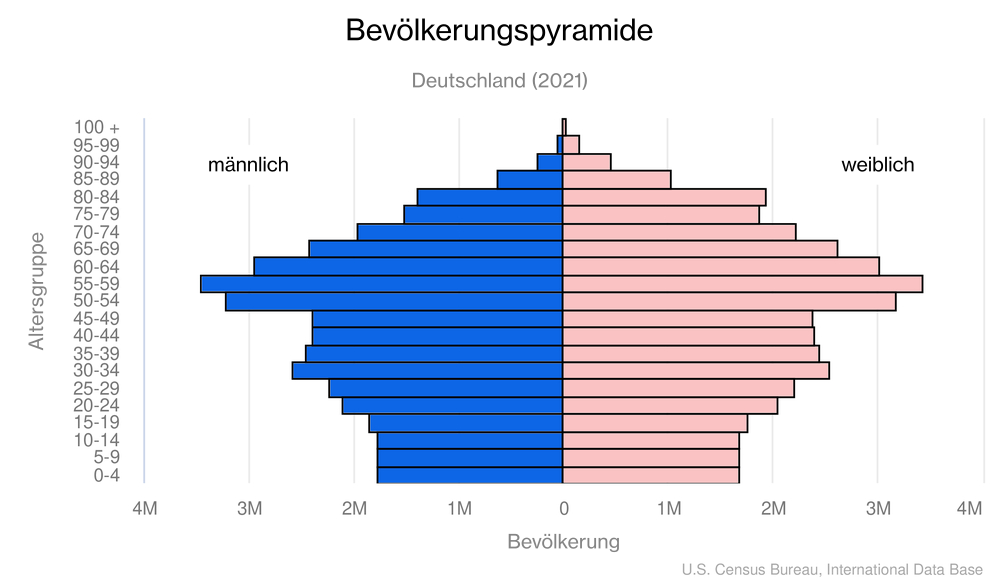
The bulk of people are at an age now, that they'll retire soon or are retiring. Even though we already import tons of young people (look at the amount of young males vs females - 50% of young people here have a migration background), I can't imagine we can import enough young laborers from other countries, and Germans don't reproduce nearly enough - which is understandable considering how things are going.
Also I do wonder if life expectancy increases are translating directly into the possibility of more "productive years". I wouldn't be surprised if some of the life expectancy increase is due to medical procedures that extend life at the expense of quality of life. People in these situations wouldn't be working anyway.
We need to massively cut corporate taxes, investment taxes, regulations, and all manner of things to increase supply. The government has been attacking business for so long we are in quite the hole.
Who got the first corporate handouts when COVID decimated travel?
Individual actors will act in their best interest according to the incentive structure in place.
You say price gouging, I say protecting society from itself.
1) Increase prices until demand matches supply.
2) Price controls, usually leading to empty shelves.
3) Rationing.
1 is preferrable in 99% of cases. 2 is always the worst. 3 is needed during extraordinary times, such as when a country is in an all-out war.
The wheat, the trucks, the oil and the labour that make every Oreo have increased in price. (We have amply-documented wheat, energy and logistics shortages worldwide.)
Also, nobody needs Oreos. The concept of “price gouging” is economically illiterate, but the nonsensicality squares when applied to literal candy.
Input costs may rise by x cents but the companies mark up prices by 5x because they can, not because they have a shortage.
Gas prices are way higher than they should be but it’s not all the reasons the oil companies like to point to. They simply point to supply to distract from price gouging. The house is even trying to get the government to investigate that.
Taking contrived narrow minded interpretations of comments and glaringly ignore rather apparent facts and then alluding that the original comment is “nonsensical” and “illiterate” makes your comment seem that it lacks substance and just wants to resort to debate using insults rather than actual facts and context.
These are the same thing. Fuel is a competitive market. If people are paying a premium and producers aren't undercutting each other, it's less likely a conspiracy than math.
The crack spread, i.e. "the differential between the price of crude oil and petroleum products extracted from it," has risen, but not much more than crude [1][2][3]. Given fuel, labor and shipping costs flow gap the traded price of gasoline to the price at the pump, that's not an unreasonable increase.
Pumps aren't making much money. Refineries are doing well. And primary producers are making off like bandits. To the degree intermediaries are profiting it's because people are paying a premium to ensure supply. A hallmark of a shortage.
> house is even trying to get the government to investigate that
It's an election year and people swallow tripe.
Gasoline is unusually transparent in that its primary (crude), intermediate (gas) and final (gas after transport + tax) forms are publicly priced. You can add up numbers to see who's making how much more than whom. If you find a way to take the RBOB, ship it to your town and pay the taxes while undercutting the local gas stations, I'm all ears--there is a thriving market of private petrol shipment for commercial use.
> alluding that the original comment is “nonsensical” and “illiterate”
Never my intention. Price gouging describes short-term, localized increases in prices of essentials. If Oreos prices are increasing nationally, it's not price gouging. Because it's widespread. And they're Oreos.
What it might be is profiteering. But both profiteering and price gouging are closer to philosophy than economics. They're used when we perceive prices to be unfair, with the moral definition of fairness being invoked more than an economic one.
To the degree we can define either, it's a sustained jump in profits following some calamity. (A steady-state seller, noting a jump in demand for e.g. fuel, might raise prices today, temporarily raising their margins, in anticipation of their higher input costs tomorrow.)
Anti-gouging laws are shortage-aggravating, in some cases, inducing [4]. But it leaves us with a society that feels fairer in emergencies. That psychological benefit may be worth the cost paid. But it should be recognized for what it is: paying with shortages for a notion of fairness.
[1] https://en.wikipedia.org/wiki/Crack_spread
[2] https://www.eia.gov/outlooks/steo/marketreview/petproducts.p...
[3] https://www.bloomberg.com/opinion/articles/2022-05-09/crude-...
[4] http://journal.apee.org/index.php/ajax/GDMgetFile/Parte1_202...
Your comments is resorting to quibbling over whether it should be called profiteering or price gouging, the classic insincere debate tactic of derailing things into arguments over semantics rather than substance.
https://www.theguardian.com/business/2022/jul/29/oil-gas-com...
Justifying the record profits by idle speculation of future input is nice. But it’s utter conjecture.
Why would we ever, ever need to cut corporate taxes? If a company re-invensts in equipment, it's workforce, research, or anything at all, they pay no tax. Tax is only applied when they transfer the money to shareholders.
How will enabling corporations to transfer more money to already wealthy shareholders help the economy?
Supply is low due to a global pandemic disrupting trade (and far too many companies relying on 'just-in-time' logistics).
"Massively [cutting] corporate taxes" won't do anything but bolster already soaring corporate profits. A significant amount of that money won't go back into the local economy. It also won't go to improving infrastructure, processes, employee salaries or anything that can improve resiliency or longevity; they've been penny-pinching for decades, and this is the result of it.
Furthermore, 'inflation' of many necessities like grocery, gas, and rent is obviously driven by blatant profiteering.
Check out what airlines did in the last half of the last decade. Check out what kinds of companies benefited most from the COVID-related handouts, and see what they did with that money.
Racism is defined in many academic circles as "prejudice plus power". Are people 'wrong' if they disagree and think it ought to be defined differently?
This is incorrect. Note that governments around the world are also experiencing record levels of inflation and each has their own fiscal policy.
Inflation is an aggregate economic effect driven by a variety of factors—including but by no means limited to government spending. Other things that contribute to inflation:
1. Supply shortages
2. Cost of living
3. Abundance of capital (low interest rates, high wages, etc)
4. Speculation
Basically anything that contributes to groups of people assigning a higher value to the same set of goods or services.
Supply is the most immediately noticeable cause and COVID has disrupted supply chains for some time. It is entirely unsurprising we've seen inflation as a result. Government policy has certainly played a part, but blaming everything on government spending is misleading in that ignores the larger realities of inflation beyond the borders of any nation state.
Given that we base inflation numbers on CPI, inflation exactly is companies raising prices -- well, companies that produce the goods that are included in CPI, anyway.
Yes, we still have to consider the reasoning behind why they are raising prices. Personally, I believe it is more because of supply chain shortages than COVID fiscal policy (though the latter certainly contributes), but I agree that's up for debate.
Why?
Going by what I see as an individual, there are lots of things happening around me that drive prices up that don't have any strong relationship to my government's policy (e.g. bird flu raising poultry prices). I also don't understand how this can be the case simultaneously across multiple governments around the world.
We have significant shortages of so many products and services that people rely on and the only way I see the situation improving is if supplies increase, maybe dramatically. It's too difficult to curb demand for things like food and housing if the population is growing. Those are things we just need to make more of. And I don't think raising interest rates is going to spur housing starts or investment in production capabilities.