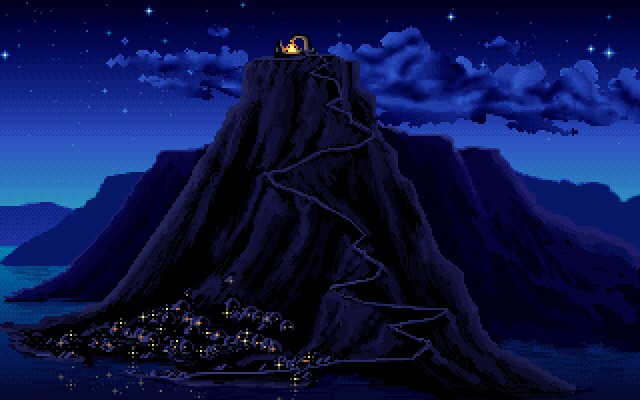
Minecraft evokes much of that sense of magic and wonder for me and I didn't start playing it until my later 30s.
Other key components are:
* A world that is interactive enough to feel like a place where you are and not just imagery that you're skimming over.
* Art that is detailed enough to be evocative but not so detailed that it reaches the uncanny valley of looking real-ish but not actually real.
Minecraft does both in spades.
It felt like you were really in a place, and the lack of HUD directing you to "points of interest" made it that much more exciting and interesting when you discovered something new.
In a word - immersion. The vast majority of RPG games suck at it. In-your-face tutorial pop-ups, GPS quest trackers, complex HUDs, full-screen menus, etc.
For a taste of what properly immersive RPGs are play the Gothic series.
"Other games of this era, and even a lot of modern games, are content to resort to more video-gamey designs that remind you you're playing a video game. Gothic 1 and 2 took the extra steps to ensure that everything was as immersive as they could possibly be." [1]
Videos that give a good overview of the immersive design of the games: [2], [3].
Guide on what exactly to play:
1. Gothic 1
2. Gothic 2 Gold Edition
3. The chronicles of Myrtana Archolos - a fan-made total conversion mod for Gothic 2 that follows in the spirit of the past two games. It's as high in quality as a professional production would be. Seriously. See [4] for a preliminary review.
All are available on Steam.
[1]: https://youtu.be/_V6tdH6YRy8
[2]: https://youtu.be/qvyzjFfxiXo?t=194 (this part refers directly to immersion, for more context you can start from the beginning)
[3]: https://youtu.be/_V6tdH6YRy8?t=597 (whole video is good, but the most relevant parts start here)
[4]: https://www.youtube.com/watch?v=L2F4-2i9gGY
(not associated with the particular youtuber in any way, his content just happens to be good)
--The Phoenix Exultant by John C. Wright
If you approach stuff with positivity, openness and wonder you'll have a blast! This is my current experience with learning Go, having learned Python previously.
I don my explorer's hat and force myself to live into the text, subject or code (Herder's Einfühlung). Personally it makes the journey so much more entertaining than merely as a tools to an end.
It's joyful to obsess over stuff; to try and get better; to try and understand.
There's two things, IMO, that get in the way as an adult:
* The crush of ordinary responsibility can not leave enough time for exploration and wonder.
* Related: We just get used to following a routine and not completely losing ourselves in something new. Maybe we tell ourselves we can't get good at new things anymore like we used to.
Revisiting old stuff, like Monkey Island, is fun; but it's not nearly as intense as something new. I'm looking forward to it and it will be entertaining to share with my family. It's been awhile since I've found this kind of pure fun and intensity in video games, but I'm sure it'll happen again.
EDIT: Oh, and how can I forget the music!

In the modern version the town is no longer twinkling and glittering. It appears smaller due to the large buildings. The strong purple tints (especially on the horizon) gives the scene an uneasy feeling. And the lookout point is no longer forlorn, it appears close to the town due to the way the whole island appears downscaled because of the larger town elements. We have also lost the reflection of the lights in the water, making the island appear to sit on the ground rather than in the waves
I'm still going to play the game and hope to love it. But the art style seems to feature very strong colours and intense gradients. When animated the motion seems too fluid, with characters deforming like in a Flash animation
One underappreciated aspect of low definition graphics is that your mind can interpolate the visuals, and you feel more immersed. (suspension is disbelief has a positive effect here)
When graphics become HD or closer to photorealistic they are starting to trigger an uncanny valley effect.
Yes, what Scott McCloud calls "closure" in Understanding Comics.
That said, my mind also interpolates the newer version of Melee Island, because it's cartoony and "abstract" enough, and so I also like it.
Exactly! I forgot about reading this book, but it was very insightful.
On the other hand, the story, and the subtle humor from 1 and 2 was lacking or different.
MI2 took it a little further with the unresolved tension with LeChuck.
MI3 didn't really have that same sense of tension or urgency because Guybrush is already in a relationship with Elaine and he's just trying to break the curse. MI3 (or CMI) was a great game, but it just didn't leave you wanting more.
Same! First of all I LOVED the “eternal night” in some locations.
It was unexplained and unmentioned (though an easy headcanon might be that everything you do there takes place during a single night) but it has a huge effect on the aesthetic feel of the game world.
The other thing that evoked the sense of adventure was the balance between the Civilized and Unexplored parts of its world, a common theme in pirate settings.
> with part 3 the magic was mostly gone unfortunately.
Curse certainly felt a bit “off” to me (I wasn’t aware that it wasn’t made by the same people but I could feel it) but it still had some charm, except for the abrupt final episode.
Playing it as a tween, it evoked this feeling of one of those rare special nights where I got to stay up way past my bedtime on a warm summer night at an amusement park, fair, circus, camping, etc. (Where the twilight and temperature is perfect after the day's brightness and the heat has broken.)
I genuinely think this game (which I didn't discover until years later following its release) has the impact that it has for me because of the brilliant soundtrack.
I think it was here on HN that I previously read a comment breaking down how the PC speaker could only play one tone at a time, but the team managed to simulate two overlapping melodies
1. To be fair, the speakers were intended for the back shelf of a car. It was cobbled together from castoffs found in the loft...
I looked into responses to the announcement (on YouTube, Reddit, various forums), and didn't find any example of a "fan mob that it's starting the hate." Just about all of the top responses were extremely positive. I only found a small minority of comments saying they don't like the art style, and they're all pretty tame. For example, sorting by controversial on Reddit brings up this:
> I want to be excited but I'm not thrilled about that art and I haven't liked a Monkey Island thing since Curse of Monkey Island.
There can be a tendency to exaggerate any criticism in an effort to dismiss it. Ron is certainly free to make whatever game he likes. But at the same time, people are free to dislike whatever game he makes. It doesn't make them hateful or a mob, simply people with different opinions.
It’s scary tech censorship. I would take the wild go f yourself days of YouTube comments over this v1 matrix toxic positivity world any day.
I didn’t know there was this rage against not being pixel art (but I should have suspected). I am glad it isn’t. I backed and loved Thimbleweed Park (even the ending), but that project was all around nostalgia. The gameplay, the X-Files-y story, it made sense for that game to be pixel art. Now Monkey Island is exactly what Ron said, state of the art. I liked even the 3D one.
I am even more excited for this new one after reading the post.
I mean, for an 2D adventure game, you are basically animating characters. The objective is to create something like an animation movie, in whatever art style you want. It doesn't need to push the tech in the same style that the first games where.
Which is great! I want them to be spending their efforts in the game, artwork, narrative, puzzles, jokes, etc, not on how to create a background that looks OK if you have an EGA screen and a recognisable melody in a PC speaker.
Whether is pixel art or not is irrelevant to me, as long as it's well drawn and animated. I just hope that they end with a fantastic result. I'll sure buy it and play it when it's out.
Certain types of games exist and thrive due to what's technically feasible at the time they're created, just like any other form of art.
An example, Cuphead isn't radically different from something like Metroid in terms of gameplay and yet Cuphead was technically impossible when Metroid was all the rage. Similarly Metroid's asthetic is a product of it's era and wouldn't be received today in the same way.
Games are art, they simultaneously drive the medium while being limited by it.
Usage of real recorded instruments can still be technically challenging today if you want to do what Monkey Island 2 did with its audio via iMuse - synchronization between music and in-game events (easier) and smooth background music transitions between rooms (harder). MI2 Special Edition recorded its soundtrack with real instruments and while it did a pretty good job at it, it still noticeably simplified some transitions the original version had, because they were much easier to achieve back when it was using MIDI.
Although one reason for that (other than the obvious MIDI vs. sampled one) could be that in MI2, a lot of effort went into this music system which ended up working great, but... not many people actually noticed ;)
That is the same blow-back that George Lucas caught when he made the Star Wars prequels. When George Lucas made the original Star Wars he set out to make a state-of-art sci-fi movie, and in fact he pushed the state-of-art ahead by a huge leap in that movie. A decade or two later, with the evolution of cinema effects, the original trilogy stopped being seen as state-of-art, but kept its cultural influence now under a new lens, it started being seen as a type of retro-futurism. So when George Lucas set out to make the prequels, he again intended to make state-of-art sci-fi movies*, as is his right, and as he should, but many of the fans instead wanted the new trilogy to match the retro-futurism feel they now assigned to the original ones, hence the many complaints at the time.
Interestingly enough, later when Disney made the sequels they went the other way completely, and bet heavily on the retro-futurism feel (down even to the story arcs), so they got blow-back from the fans that instead wanted a state-of-art sci-fi.
* If he achieved that state-of-art goal is debatable, my personal opinion he did, but just barely, failing to leap forward like the original did on its time, so they do feel a bit like "generic late 90s/early 00s sci-fi".*
The characters weren't interesting, or even worse, were universally reviled like Jar Jar. The main character (both as a kid and as a teenager) was annoying as hell. The story didn't mesh well with the established Star Wars movies, like that thing with midichlorians that was thankfully played down in subsequent movies. For some reason, Lucas moved The Phantom Menace from "Young Adult" territory (as was the Original Trilogy) to "kid's movie", but halfway and inconsistently, so you get Jar Jar and "yipeee!" but also Trade Federation taxation routes -- what the hell?
To be fair, the visuals were also abused by Lucas. I think there's a legitimate criticism to be made of George Lucas and his "horror of the void": when he didn't have the tech/budget, he had to live with vast empty spaces, and the movies got that "Spaghetti Western" barren look that actually made them better. When CGI became cheaper and easier to use, George Lucas decided to fill every bit of empty screen with some gizmo or cute alien screaming at the screen, and his movies suffered because of this.
Once you see the behind the scenes you start to see this as one of the main reasons it’s so CGI filled.
I’m bummed.
Imagine how fun it would have been watching Ep1 and getting annoyed by Jar Jar once you know he ends up super evil.
It never bothered me that it felt more "modern" than the original trilogy, it bothered me (and plenty of others) that the story wasn't good. For something that was in his head for such a long time, it came out half-baked.
But then they made the serious error of hiring Rian Johnson AND giving him free rein with the direction of the movie.
Rian Johnson already stated himself, he likes making divisive films. He also stated he doens`t like Star Wars...
So he proceeded to ignore the plans that they had, and just do whatever he wanted.
1. He ignored several planned story arcs and just shoved things. 2. He ignored past movies and create a lot of non-sense. 3. He ignored the Extended Universe but in a bad way, Extended Universe books had a look of technical information and whatnot that circulated back into canon, with movies and canon TV series using that information, RJ just ignored that information.
I fully expected Lucasfilm to just give up and not even attempt to make Film 9, that is how bad Film 8 fucked up the plans... But seemly they made an honest attempt to save the franchise in Film 9 by making it fanservice on top of fanservice and hope fans forget all the continuity errors and non-sense the plot became riddled with in Star Wars 8...
Ep 8 had some really interesting character arcs, but also made some basic errors. As a movie, I think that it’s the strongest of the three sequels. Given a lack of plot points to really hang off, Johnson seems to have done something interesting, but left even fewer plot points to hang off than Abrams left him. Let’s be clear: if Lucasfilm had disagreed with his direction, they would have taken him off the project.
Ep 9 was more fan service (who can we throw into this scene?) with an even more inexplicable plot hook (if the Emperor was coming back in any way, there should have been hints of that in Ep 7).
I do not understand the fascination with J J Abrams. He claims to be a fan of various media, but IMO he is the shallowest type of fan out there, appreciating only certain aesthetics without looking any deeper. His Star Trek films are the absolute worst of all the Star Trek films, even worse than Star Trek V: The Final Frontier. Why are they the worst? Because they have become Generic Action Films with a Star Trek veneer. (This is more or less my complaint with Picard.) I dread the idea of seeing J J Abrams touch any more science fiction properties because he just doesn’t get them and turns them into Michael Bay films (but with lens flares instead of explosions).
Amusing juxtaposition in critical reception:
Article about his mystery box thing before Rise: https://www.success.com/jj-abrams-and-the-unopened-mystery-b...
Article about his mystery box thing after Rise: https://screenrant.com/star-wars-rise-skywalker-abrams-myste...
He proved he was great at nailing the aesthetic even if so many other qualities of the franchise like writing and plot take a back seat.
That's basically his Star Wars movies in a nutshell too: he absolutely nails the aesthetic 100% and everything else suffers. I think that's why they feel so much like fan service rather than standalone efforts because of that uncanny valley effect where they feel so much like old Star Wars movies and don't have great ideas but to ape old Star Wars plots, but still aren't "Old Star Wars". A lot of what was new in the films added greatly to the aesthetic of the franchise and pushed that, at least, in new directions.
Honestly, I think "the Emperor has returned somehow" is pure 100% Star Wars aesthetic, too. Weird cloning nonsense: very Star Wars. Evil villains returning at surprise hours after being silently behind the curtain for movies: very Star Wars. Absolutely the writing could have done better of foreshadowing that than by doing it in Fortnite of all places (!), but it's still very Star Wars to just "oh, here's the Emperor now". The new trilogy "rhymes" with the original trilogy: Snoke like Vader is clearly a Lieutenant of someone else (and turning out to be a broken clone of the Emperor, very Star Wars) and then Vader/Snoke are revealed to be less important and we fight the Emperor directly. The only missing is the "I am your father" bit for Snoke, but we all know how corny Rian Johnson thought that was, despite being the exact sort of soap opera (well, pulp serial) plotting that made Star Wars what it was/is.
To my mind, letting Abrams double-down on swerving back to his plot in episode 9 was their biggest management sin when it comes to creating a coherent plot arc. If they'd carried on with what 8 was setting up we'd have had ["nostalgia" => "twist" => "resolution"], and instead we were left with ["nostalgia" => "twist" => "ignore that! more nostalgia"]. The former could have worked out and won over those who disliked the Last Jedi twists, the latter just flopped unsatisfyingly. (A second-movie twist was always in the cards, given general fan sentiment about Empire.)
Disclaimer: I personally liked episode 8 the most of that trilogy, and it's the only one I'd bother to go rewatch. It has the best direction by far, along with the most striking visuals of the lot and most of the quotable lines. That said, I think my take on this holds up regardless of which side of the Last Jedi divide you fall on. :D
And to be fair, I liked Episode 8. Flawed, stupid casino planet bit, the ending was silly. But Star Wars isn't known for its plot and logical consistency anyway; the series is 99% retcons and fan theories. What's important is the atmosphere and the characters, and what the meagre plot means for those characters. And there was actually some genuine effort being made.
Abrams was an Executive Producer on Ep 8 still and was supposedly in the room for all of the plot development. He personally could have avoided most of that swerve had he been paying attention. Admittedly, he thought at the time it was Trevorrow's problem because Disney didn't fire Trevorrow from Ep 9 until the "last minute", but there's a lot of interesting questions left about what Abrams even thought the "resolution" could possibly be even with Trevorrow at the helm. He was still an Executive Producer in a role that should have been preparing for the trilogy as a whole to succeed.
It takes a village to make a movie and all that, and I'm not personally blaming Abrams, though it sounds like it, I think Disney management should have been more involved too. The whole Trevorrow thing reeks of Disney management failure and bad contract planning. (Between that and the shenanigans with Lord/Miller over Solo…)
I think Abrams made the best movie for Ep 9 that he could have given the time, budget, and resources he had to meet a "set in stone" holiday release date. I think he did the best he could with what Johnson left him, and honestly I don't think anyone could have resolved Johnson's plot twists well and still have felt like Star Wars. He had good ideas in absentia, but they weren't "Star Wars".
(Admittedly, I thought Ep 8 was the entire wrong genre for Star Wars: it was a Vietnam War movie in a franchise built around World War 2 metaphors/aesthetics. I also had a big issue with the "Three Billboards problem" of Poe in Ep 8. In my eyes he's unreedemably the villain of the film, and the character is entirely broken beyond repair in Ep 8. But also, admittedly, I haven't liked any of Rian Johnson's films that I've watched [inc. Knives Out; and I especially hated Looper].)
Ah, but Star Wars has always been a Vietnam metaphor filtered through WW2 aesthetics. Specifically, with the Rebels being the Viet Cong -- they're a small group using asymmetric warfare tactics against a vast military machine that's exerting cultural hegemony over even the territory it doesn't control. Lucas has actually been pretty explicit about this being his intention in interviews.
There's still a lot fewer "shades of grey" in "French rebels versus Nazis" than in all the complicated geopolitics of Viet Cong versus US military. Lucas may have used the idea from the Vietnam War, but he didn't just filter it through a WW2 aesthetic, he entirely embedded it in it.
To my mind Star Wars isn't exactly the franchise for "maybe the Empire are the good guys in the story" shades of grey. (Though admittedly I also find it appalling how many people cosplay the Empire and how much merch there is and seeming adulation the Empire gets. Though it is seemingly great for Disney's bottom line if people don't think of the First Order as a Nazi Regime that exploded entire planets worth of people like the text tells us they are.)
The first star wars was glorifying rebellious david against goliath setting and fun adventures. A young nobody becomes a hero for the good side. People identified with luke skywalker.
The later was way more about politics, intrigues and corruption of power. Not a bad story, but much more heavy (and depressing). A young nobody becomes a dark lord. Identifying with a dark lord? A bit harder.
(And the disney movies try to be simple again, but are too shallow for my taste, but are well shot)
I tried watching it with my kids as a marathon of Star Wars for May the Fourth, and they became bored with the trade federation and Senate, and were annoyed by Jar Jar. The pod racing was the saving grace, in their eyes, but even it was only mildly amusing.
I turned it off when they left the room when the pod racing finished.
Putting out a retro version could be seen as a greedy activity that tarnishes the original that could get a different mob after you.
> Monkey Island 1 and 2 weren't pixel art games. They were games using state-of- the-art tech and art.
This is SO true, and as much as I loved those games, as much as I stopped playing modern videogames and as much as I love the style of Thimbleweed Park, going forward for an artist like Ron is what _defines_ an artist. If you like MI1 and Mi2, just play MI1 and MI2 again as I do from time to time. Just like you would watch again a movie from the '70s or listen to the Beatles. But you cannot ask an artist to stay always the same because you loved their first works.