Reminds me of one of my favorite pieces of data.[0] Pew tracks both crime rates and perception of crime rates. There's been an overwhelming declining trend crime (especially violent) in the past 30 years. But if you look at perceptions of crime, people think year over year it is on the rise. There's even a bias that it is on the rise more nationally rather than locally. What I like about this is how it shows the biases that we develop. You're right that _every_ assault makes the news (also there's 350m people in the US, even a 1 in 10k event is likely to occur frequently at the national level). Also, pareto plays a role. Most crime is limited to a few states, and really just a few cities in those states, and even more so specific areas within those cities (pareto is fractal in this way). We humans are typically bad at risk analysis.
I should add to this that I grew up and walked to school in the 90's. So it is safe to say that me walking to school as a kid was statistically substantially more dangerous than it is for kids to walk to school today.
[0] https://www.pewresearch.org/fact-tank/2020/11/20/facts-about...
I was recently chatting with a friend who (like me) grew up in the 90s and they were reminiscing on how great walking to school was because “you could do that back in the day.” They then went on to say that they would NEVER allow that for their children “these days”.
I pulled up the Pew study and it blew their minds. That said the news cycle, perception, parental instinct, etc is too powerful and fear (however irrational) is extremely powerful. After the initial shock they thoughtfully considered it and essentially said “Well, whatever. The kids are still never going to just walk around outside.”
Those kids are never going to be out “in the wild” even though it’s substantially safer today than it was in the 90s when we were doing it.
Unless it’s a clearly serious felony like a murder or burglary, you aren’t really getting any information.
I would say that what people worry about is random freakshow people and the petty crime form other kids or teens. Folks are more aware of the freaks, and the evidence of in front of them that there are consequences for most petty crime.
We walked to school about 12 blocks in those days. It was fine. I live in a small city today; my kid won’t bike to school alone until about 12, mostly due to traffic issues and idiots riding ATVs in the afternoon.
Good news! The numbers reported in my citation are specifically about: Larceny/Theft, Burglary, Aggraveted Assault, Motor Vehicle Theft, Robbery, Rape, and Murder/Non-Negligent Manslaughter. Every single one of these has drastically decreased since the 90's (90's increased in crime since the 80's but current levels are below that).
I don't mean to sound sarcastic, but I can't but help but feel that this could have better been resolved by clicking on the citation I included.
Those are index felonies, and have nothing to do with walking to school. Quality of life crime, non-criminal bad behavior, sidewalks, and traffic hazards all have more impact and aren’t measured in a uniform way.
In fact, I’d argue that there’s an increase in petty street crime as policy has changed and we no longer pursue most minor stuff as it makes stats look better and pts lip service to various social goals.
> Most crime is limited to a few states, and really just a few cities in those states, and even more so specific areas within those cities (pareto is fractal in this way).
What is that based on? Some tangential data leans in the other direction: The most recent FBI/DoJ report (that I'm aware of) said recent increases in gun crime were spread pretty evenly, urban and rural, across the country - though that's just one kind of crime, and only the increases. Another report said crime is worse in 'red states' than 'blue states', and the latter tend to have larger cities (I think). Hardly conclusive data, I know, and I'd love to see some.
Nothing I've stated is really that controversial and is pretty well known by anyone that looks at crime statistics. I think it is also relatively easy for the average person to buy because everyone knows where "the bad part of town" is. Really that's all I've said. That "the bad part of town" exists fractally. There's the "bad states," "bad cities," "bad counties," "bad towns," and "bad parts of towns." I think this all should be rather unsurprising.
To clarify on your FBI/DOJ statement, this doesn't have to be in disagreement with what I said. You can have increases in violent crime over the last year (or even 5) and a dramatic decline in the last 30. The Pew study that I cited does specifically look at violent crime and uses FBI statistics. But let's add more. Here's a DOJ 1993-2011 showing a large decrease in both fatal and non-fatal gun violence[3]. Here's a Reuters article that shows homicides (and the pareto effect I mentioned above) from 1980 to 2019[4]. Notice the trend towards declining (I never said it _strictly_ declined).
[0] https://upload.wikimedia.org/wikipedia/commons/5/51/Violent_...

[1] https://www.washingtonpost.com/graphics/national/crime-rates...
[2] https://www.researchgate.net/figure/Crime-heat-map-and-overv...
[3] https://info.publicintelligence.net/DoJ-GunViolence1993-2011...
[4] https://www.reuters.com/world/us/biden-plans-new-steps-comba...
> Nothing I've stated is really that controversial and is pretty well known by anyone that looks at crime statistics. I think it is also relatively easy for the average person to buy because everyone knows where "the bad part of town" is.
'What everyone knows' is not knowledge; that's why we need data, research, etc (which you have amply provided). Look at what BS people 'know' about all sorts of things. IME the 'bad part of town' is usually not so bad, if at all, and it's often conflated with race.
Sometimes it does. I like not needing a car in SF too, but I do notice my kids being affected negatively after seeing a violent deranged person. I bike the long way to school instead of walking because it was impacting their mood so much. Maybe your kids deal with it better than mine, or maybe you're just not noticing how it's affecting them?
My mother grabbed me in her arms and we just went away quickly. She told me to not look at homeless people for so much time. Of course I was very scared, I don't remember exactly how old I was but I still remember the episode some decades later.
Well, yes, but decent and functional human beings don't react that way to children.
(A teenager or adult is different, but the story above was a kid small enough for their mother to grab them in her arms.)
With an adult present, sure, but holy moly would I not leave my kid alone around drug users offering candy and a chat. Hell, I might be one of those hypothetical CPS callers that everyone is worried about if I saw that taking place!
As someone with kids and living in the Midwest, I just don't even have the words to describe my reaction to this. Wow.
What could possibly be the issue? If anything, it demonstrates Midwestern values pretty well: Freedom, and a moral, not legal, code that people voluntarily follow to prevent kids from being exposed to potentially-harmful things, without any government needed to enforce it!
If anything, it's more considerate than where I live, where people will openly smoke in front of children, which is arguably more harmful, because smoking has second-hand effects, unlike intravenous drug usage.
I'm not sure what you mean: Do you live in a large Midwestern city, like Chicago, and have different experiences? Do you live in a suburban or rural environment and are surprised to hear it?
Personally I spend lots of time in cities and I'm not surprised. If you don't have experience there, realize that the horror stories fit a long-term political campaign to denigrate cities in 'blue states' (note that you don't hear anything about crime in Miami, Houston, etc.), which are a political power base of a one party.
That was a one-time event, on the Muni, with both parents there, and with the giver asking our permission to give our son a sealed lollypop. I don't recommend kids take candy from strangers without parents there, but I do talk to strangers in front of my kids, and encourage them to also.
I don't tell my kids that all strangers are dangerous. First, because it leads to a culture of fear and disrespect. Second, because I obviously don't act as if they are, so it would lead to distrusting my advice.
They have to learn the difference between "stranger who seems reasonable and nonthreatening with whom you can casually chat" and "stranger telling at clouds whom you should avoid". They figure that out pretty young, if you let them.
(Related but not exactly a reply - I think this is a fairly uniquely North American phenomenon, my experience in the UK in the 00's matches these American 70's etc. experiences, and I see no sign that it's changed here. More evidence that it's to do with the way towns are structured I suppose. Or 'towns' - you don't really have them and that's the problem.)
It doesn't take too much searching to find examples of horrible accidents:
https://www.kron4.com/news/bay-area/kids-hit-by-car-while-wa...
But I would make sure my kids know not to just trust the lights.
> It doesn't take too much searching to find examples of horrible accidents:
It doesn't take too much searching to find examples of being hit by lightning or winning the lottery. Anecdotes are meaningless in that context.
I'm not nearly as terrified of strangers or homeless drug users as the legion of SUV drivers scrolling on their cell phones. Distracted drivers are several orders of magnitude more dangerous and several orders of magnitude more common.
[1] from 2016 https://www.ncbi.nlm.nih.gov/pmc/articles/PMC6637963/
Yep, 20% of something that almost never happens. .025% of adolescents die each year, .005% of them due to motor vehicle crashes. Further, the paper suggests most of adolescent vehicle deaths happen as passengers and/or drivers.
(I would be interested in statistics that break out bystander vs occupant and injuries as well if you know of any.)
Finally, I'm not quite sure what your point is with respect to the overall fatality rate of adolescents. It should not be particularly surprising that the vast majority of children survive into adulthood in modern times, but that doesn't mean it's not worth continuing to take precautions against the most common sources of injury and death.
I've been involved in various "free-range kids" groups and kid-friendly maker spaces where children can learn to responsibly use power tools. But I've never met a parent who decided not to bother protecting their kids from the most common sources of injury or death just because childhood deaths "almost never happen". Frankly I'm not sure I'd let someone with such an interpretation of statistics anywhere near either kids or power tools.
By saying "20% of adolescent fatalities are to vehicles" you make it seem like a terrifying threat. It's not. Certainly not worth keeping your child from walking outside.
You're involved in groups that teach kids to use power tools safely. As in you let them use power tools despite there still being a risk after taking such a class. Do the same with regards to vehicles. Teach them how to stay safe as a pedestrian, passenger, and driver.
That said, I still worry more about car traffic and reckless drivers than the homeless. But having aggressive people on drugs yelling at passers by is not an ideal or safe environment for kids to be in. For one thing, it distracts the people in cars. . .
Seattle has seen a large rise in violent crime, and it's hottest around the homeless camps. The fire dept responds to fires in those camps daily.
https://www.macrotrends.net/cities/us/wa/seattle/crime-rate-...
so while its not good, its vastly oess apocalyptic than folks seem to portray.
2008-modernity: https://s.hdnux.com/photos/01/23/72/75/21999466/3/rawImage.j...

Graph that includes pre-2008 levels: https://miro.medium.com/max/700/1*llD-nfzEV_nV-hISBQIRCQ.jpe...
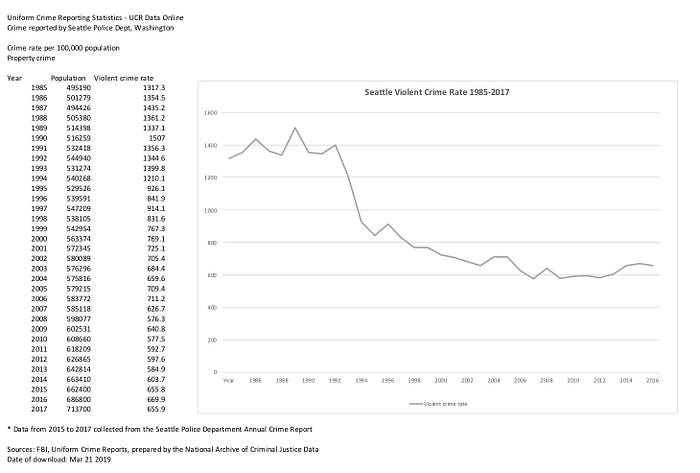
I walked through Cap Hill and DT Seattle to catch a bus at 2am back in 2003. No worries at all.
A lot of crime isn't reported now days, e.g. my mothers truck just got stolen and she is not going to report it because the police are likely not going to even bother talking to her about it. I've had plenty of friends with stolen cars where the police told them "well you should be more careful with your car" and up and leave.
That sort of attitude sure makes the crime stats look good though.
It is a 1992 ford ranger, in theory worth a fair bit in the current used truck market, but insurance will value it at next to nothing, so I presume she'll eat the loss.
The reason is pretty simple. The comprehensive insurance premium adds up to more than the car is worth.
Also, the way insurance works, is your rates go up to reimburse the company for payouts to you. Insurance is only worthwhile for losses you cannot cover yourself.
This is why downtown businesses have largely stopped reporting shoplifting to their insurance companies. It just makes the losses more expensive.
That's why my remark was on violent crime levels.
The chief difference is that the segment of the media dedicated to keeping people fearful, particularly of their neighbors, is enormous now. It was always the case that media liked stories of conflict, but this was moderated by a sense of propriety and responsibility to the community. Now, certain voices have enormous megaphones and no restraints and the paranoia and anger they are actively promoting against their own society has taken root generally.
I know more than a few people in my small town who got arrested for burglaries and robberies. I know a lot of victims too. Rape basically isn't reported because if the neighbor's boy gets in trouble, that'll ruin the relations between half the town. There are the town drunks who got pulled over more times than you can count and eventually killed someone in a car accident.
You're passing by hundreds if not thousands of people in a few hours in a city. A methhead dancing naked on the street corner is going to catch your eye. The thousands of normal people won't.
In a small town, you're not seeing anyone at all some days. Maybe you're just passing by 5 cars. The opportunity to witness anything is lower.
Of course, plenty of small towns are nice and safe. But the ones that have any problems are proportionally going to be way worse, due to lower population.
As an adult I realize why they always wanted me to stay over was he wouldn't lay into them while I was there. He'd just leave and go to brothers house. Or as we found out later, his girlfriends.
Also, there is the Citizen app. I wonder if it's driving perception more than anything else. When I've talked to people in safe cities who nonetheless were ranting to me about crime, I've asked them if they have Citizen, and very many do. Not strong data, but I would love to see some research.
Look up the Fast Company article describing them.
> Suburbs with nice sidewalks and tree lined streets and friendly neighbors who know each other? Safer than rural areas where everyone knows everyone and there’s enough law enforcement to work on a 1:1 basis?
No, no real place can possibly be safer than a fantasy land.
I've been living here for 10 years, and I've seen 2 on-duty police cars so far, one was on the first day of school several years ago, when they stopped every car on the way to school/day-care to make sure seats were safe, and one was due to a traffic accident where an electric scooter had hit a car.
My third grade daughter has been walking/cycling (depending on weather) the 2km trip to school for over a year, with a friend, but no adults. The benefits are considerable, both socially, physically and emotionally. 4km/day on top of normal playtime and sports is a nice exercise boost. Spending time away from adult supervision strengthens friendships and boosts self confidence and mental stamina.
Sometimes I miss the city, but for the freedom of my kids, living where I do is night and day in terms of safety and health compared to where I lived before.
I remember talking to one farmer who said he had a gun because, where he's from, the police are only there to clean up. They can't get to a crime scene in time unless they are lucky to be nearby, and have very few resources for investigations or other operations.
In general, I worry more about crime when I'm in the country, than when I'm in a city.
Are you saying this tongue-in-cheek?
A considerable amount of heroin addicts in the US are also in rural areas.
Drug use is rampant in rural areas, but it doesn't get the press that it does in cities, because it doesn't present the same way. You don't have to walk over junkies in rural areas.
Because from those links it sure doesn't look like rural areas are likely to have more than half the people on meth, or that you've managed to find any actual towns where everybody is on meth.
That was years ago. Seems heroin is more of a problem.
The articles I linked mention ~34% of the testing in a state showing positivity for meth, so I'm not sure why you'd be surprised that entire towns in that state may be addicted.
Here is a hint: it’s cars.
No one cares about averages, and this is not a game of statistics where I'd be interested in playing out the game just because the odds are in my favor.
We don't need to care about the state of "most" strangers when all it takes is one outlier that turns out to be a psychotic.
Sure. But I can't make them social recluses just so they never encounter that high-risk group. That does not mean I need to encourage them seeking out another high-risk group on top of that.
Not wanting your kid to walk alone through Skid Row does not mean you are hiding the issue of homelessness - you can still talk about that at other opportunities.
Here in Canada, it's hard to trust any crime stats because of this:
https://www.cbc.ca/news/canada/more-crimes-going-unreported-...
https://macdonaldlaurier.ca/is-crime-in-canada-really-declin...
Would you walk on Kensington Ave with your children? https://www.youtube.com/watch?v=Bi1Kf-1qd6Y
Speaking as a non-parent, if I had a kid near kensington ave and they walked to school (which they mostly do) I would just tell them to walk down Frankford Ave a few blocks south, which is much less scary. Teaching kids those basic "street smarts" is one of the objectives of having "free range" kids. Although I would also add that living a little ways away from the street infamous for being a drug market is within the means of the majority of the Philadelphians, and the vast majority of the hacker news crowd.
Normal people do not want to put their kids into dangerous situations. And doing so does not make you a good person.
I'll refrain from guessing how enlightened you are.
I think it’s reasonable to question that decision based on what they described happening on that street. Your response acts as if the question is whether it’s fine to take your child with you down that street, but that’s not what is under discussion.
But the thought of letting my kids (5 and 2.5) run errands by themselves (in a city like Berlin with its abundant number of homeless and mentally-ill people everywhere) gave me goosebumps.
"It's only one block away" and "most homeless people are harmless" would never be words of consolation in case of any calamity.
This is extremist thinking and frankly quite useless without considering the actual level of risk involved.
Imagine a game of Russian Roulette with one bullet in a gigantic chamber (N slots) where you get to win a small prize every time the gun doesn't fire. Is there any sense in asking if there is a N large enough to make you consider playing this game consistently for 2-3 years, when the gun is pointed at your kids?
Mind you, I am not defending helicopter parenting and I do believe that we should err on the side of autonomy vs safety. But I can think of other ways to exercise this autonomy (e.g, drop the kid at the door of a local supermarket and say "here is 10€, can you please go get X, Y and Z while I am outside looking for something else?") without worrying about is the worst possible thing that could happen.
Extremist thinking does not improve the likelihood of your children's survival.
> Imagine a game of Russian Roulette with one bullet in a gigantic chamber (N slots) where you get to win a small prize every time the gun doesn't fire. Is there any sense in asking if there is a N large enough to make you consider playing this game consistently for 2-3 years, when the gun is pointed at your kids?
You do this all the time when you take your kids for a drive, on a plane, outside, when you feed them, etc. Hell in your supermarket example, someone inside the store could just kill them there after you dropped them off.
The idea is to avoid things where the upside (even if highly likely) is small but the downside is (even if highly unlikely) catastrophic.
> You do this all the time when you take your kids for a drive, on a plane, outside, when you feed them, etc.
Kids need to go outside, occasionally get on a car or plane and they certainly need to be fed. These are all things were the upside is significant, so of course they need to be done and we do it without wondering about the downsides.
Going on the streets of Berlin by themselves at age 5 is an unnecessary, avoidable risk with very little benefit. It doesn't need to be done, so we don't. It's simple as that.
I think we also need to consider other, less obvious bullets here, namely suicide, or even just a less happy and fulfilling life. Kids have been getting less happy year over year in America and while there are likely many reasons, I strongly believe the inability to be independent is one. I won’t claim to know the best age to let kids wander a city street (and it likely depends on the neighborhood), but when you let them out on their own, you also potentially prevent suicide, something that’s far more likely to kill a kid than a stranger.
https://www.theatlantic.com/newsletters/archive/2022/04/amer...
My point though is that there are ways to develop kids' sense of autonomy without putting them in unnecessary risk, and also that while the benefit of letting them walk by themselves depends on many repetitions of the event (i.e, doing it once a year is not really that helpful), it takes only one single dangerous/malicious person to cause irreversible damage.
And yes, of course this depends on the neighborhood. I wouldn't object the kids roaming around if we lived in a smaller city or a generally nicer area of Berlin, but I could not in good conscience say that any parent should feel totally fine in letting 5 year-olds by themselves in any area full of homeless people and mentally unstable people, and justify it with "most homeless people are just people in terrible situations".
Yes.
We live in San Francisco, and our kids went to a daycare in the Civic Center. We walked [with the kids] by many homeless people every weekday for years. Our interactions with them were almost universally positive; they'd clear the sidewalk to let kids through, try to keep kids from seeing drug use, chat and share candy, etc. On cold days when our kids would refuse to wear shirts [love that young metabolism], homeless folks would yell out, "Put a jacket on that kid!".
Most homeless people are just people in terrible situations, not boogiemen to be afraid of. Sure, some of them are mentally ill--if they weren't when they became homeless, it can make you so--but that doesn't make them dangerous.
Every assault makes the news, but cities are safer than they've ever been, and I'm very glad to be raising my kids in SF. The public transit and density of services will give them much greater autonomy than if we lived somewhere where you need a car to get anywhere.
My older kid's first errand was at age 5.5, to get a loaf of bread IIRC, from a market 1 block away, crossing 1 street. He was stopped by the police. The cop told him to tell his parents that he was too young to be out alone. No CPS, no arrest, fortunately, and he let my kid complete his errand alone, but that's the biggest danger around our neighborhood, not the homeless. We're not in the Civic Center, granted, but we're still in SF proper.