News for hackers. Stuff that matters.
Re:Sumerian dog jokes, or the difficulty of translating dead... by monkeybutton on Monday March 21, 2022 @10:13AM (#30754354)
This is one of the arguments against machine translation: one would first need to construct an AGI capable of observing and understanding the living cultural context that language is being used in. Without that, researchers are endlessly having to update the training corpus for the ML system to learn by example.
Re:Sumerian dog jokes, or the difficulty of translating dead... by mabub24 on Monday March 21, 2022 @10:31AM (#30754548)
"If a lion could speak, we could not understand (verstehen)[0] him."

- Ludwig Wittgenstein, from Philosophical Investigations

[0] Ironically, there is disagreement over the best translation of verstehen. Understand and comprehend have some conceptual overlap, but also some distinctions. The general idea is, though, of understanding in a greater, more all encompassing sense that is only possible when someone/something is no longer alien.

Re:Sumerian dog jokes, or the difficulty of translating dead... by coldtea on Monday March 21, 2022 @11:44AM (#30755369)
"We would [understand the Lion]. We're flexible and can get into different perspectives, and we have been close to animal living ourselves for hundreds of thousands of years, plus we watch nature and learn about how lions live and what they do. The lion would have difficulty understanding us, as our world is a superset of its world" - coldtea
Re:Sumerian dog jokes, or the difficulty of translating dead... by Mawr on Monday March 21, 2022 @12:42PM (#30756274)
Yeah, I think we'd be just fine: https://en.wikipedia.org/wiki/Nim_Chimpsky

> Nim's longest "sentence" was the 16-word-long "Give orange me give eat orange me eat orange give me eat orange give me you."

Re:Sumerian dog jokes, or the difficulty of translating dead... by josefx on Tuesday March 22, 2022 @12:20PM (#30768015)
One could argue that this isn't talking to a well adjusted animal living in its native habitat. It is talking to a long term research subject/victim suffering at the hands of "researchers" while trying to teach it a language that is utterly alien to it. Of course knowing how animals communicate in their natural habitat is not useful if you want to ask them deep questions like "what do you think about global warming" or "do you think god exists", to which they probably wouldn't have an answer anyway.
Re:Sumerian dog jokes, or the difficulty of translating dead... by pavlov on Monday March 21, 2022 @11:35AM (#30755266)
We could just agree that "to forestand" is a new word that means the same as German "verstehen", and maybe eventually it actually would.
Re:Sumerian dog jokes, or the difficulty of translating dead... by Koshkin on Monday March 21, 2022 @05:19PM (#30759831)
I do not believe this would make sense. The German 'ver-' has nothing in common with the English 'fore-'.
Re:Sumerian dog jokes, or the difficulty of translating dead... by mwattsun on Monday March 21, 2022 @10:44AM (#30754701)
How would one even attempt to communicate with an octopus?

Alien intelligence: the extraordinary minds of octopuses and other cephalopods

https://www.theguardian.com/environment/2017/mar/28/alien-in...

Re:Sumerian dog jokes, or the difficulty of translating dead... by runnerup on Monday March 21, 2022 @11:44AM (#30755377)
More seriously, I think humans and other mammals generally can learn to share an “animal” language which uses repetition for bidirectional training (animal to human, human to animal).

Elements used for prediction include: - Predictable timing, both circadian and in relation to circumstantial events - body language - sound patterns - touch patterns - performative actions with environmental objects

It’s not so much a “universal” language, but rather that mammals seem to share some semi-universal ability to train each other in these cues and learn them. They can be used for surprisingly rich inter-species communication and over time both parties move a lot of the inference and signaling to their subconscious, no longer even taking active brain power to decipher intent and meanings.

I’ve also done this when I was working very closely with just myself and one other person and neither of us spoke the others language but we had to get the job done for 8-12 hours every day. We established a system of different grunts and cues that we used first for several weeks. Once that was fluid and we could communicate everything that we needed to, we started replacing/connecting the established grunts with our own language words and that’s how we taught eachother the others’ language. At least for the domain of our work.

I have no idea if any of these would be possible with cephalopods but I feel like if we had children and baby octopuses raised together they may find reasonably robust ways to communicate intent, feelings, and find the ability to create novel games to play with eachother.

Re:Sumerian dog jokes, or the difficulty of translating dead... by wincy on Monday March 21, 2022 @12:57PM (#30756544)
It’s hard to say as the further you get away from a common ancestor the more the behavior of different species diverges (maybe a bit tautological, but still worth pointing out).

I played with my pet rat and we were good friends. We’d play little games and I’d tickle her Rats and humans diverged maybe 80 million years ago. Interestingly, humans and dogs diverged perhaps 100 million years ago, and we know we can communicate with dogs.

However an octopus is ~600 million years away from a mutual common ancestor, which is way back in the Precambrian. It’s an order of magnitude more time.

Re:Sumerian dog jokes, or the difficulty of translating dead... by msla on Monday March 21, 2022 @02:43PM (#30758046)
Humans created dogs out of the wolves best able to communicate with humans.

It's been a consistent artificial selection pressure.

Re:Sumerian dog jokes, or the difficulty of translating dead... by labster on Monday March 21, 2022 @04:35PM (#30759360)
Dogs created civilization out of humans by consistently helping the most cooperative ones. Even today, dog “owners” live longer and attract more mates. It’s consistent selection pressure.
Re:Sumerian dog jokes, or the difficulty of translating dead... by Kye on Monday March 21, 2022 @03:31PM (#30758642)
Dogs even developed facial muscles to communicate with human expressions.
Re:Sumerian dog jokes, or the difficulty of translating dead... by psd1 on Tuesday March 22, 2022 @01:09AM (#30762925)
Shame cephalopods only live a couple of years, while humans typically require 30 years to achieve a basic level of intelligence
Re:Sumerian dog jokes, or the difficulty of translating dead... by dylan604 on Monday March 21, 2022 @06:01PM (#30760291)
>learn to share an “animal” language

Aren't there a few primates that have learned sign language?

Re:Sumerian dog jokes, or the difficulty of translating dead... by jdmichal on Monday March 21, 2022 @10:57AM (#30754852)
It's OK, Contact prepared me for this. We should use math. Have we tried strobing a 2-3-5-7 sequence at one, and see if it gives us 11?

(The above is meant in jest, of course.)

Re:Sumerian dog jokes, or the difficulty of translating dead... by kwhitefoot on Monday March 21, 2022 @11:45AM (#30755389)
> (The above is meant in jest, of course.)

Sounds like a good idea to me. But of course one needs to be open minded, there are other functions that satisfy the same rules. :-)

Re:Sumerian dog jokes, or the difficulty of translating dead... by avisser on Monday March 21, 2022 @12:15PM (#30755834)
> The general idea is, though, of understanding in a greater, more all encompassing sense that is only possible when someone/something is no longer alien.

I would put forward "grok" as a translation. Your use of "no longer alien" evokes that word all the more.

Re:Sumerian dog jokes, or the difficulty of translating dead... by jamiek88 on Monday March 21, 2022 @08:01PM (#30761318)
Funny how a fictional word, ostensibly Martian, can come to have colloquial meaning in English, even to those who haven’t read the book.

Shakespeare and Aesop… and Heinlein.

Re:Sumerian dog jokes, or the difficulty of translating dead... by lifthrasiir on Monday March 21, 2022 @10:43AM (#30754690)
I believe machine translation will coevolve with human languages. The utility of machine translation is clear even when the translation is a bit off, so people will be forced to use machine translation anyway and subsequently tweak their own language to have a better chance for machine translators to pick up its meaning. This is actually also a valid strategy to use MT today.
Re:Sumerian dog jokes, or the difficulty of translating dead... by irrational on Monday March 21, 2022 @10:56AM (#30754838)
I say this both as someone with a degree in linguistics and who has worked as a programmer for decades, there is no way that will happen. People are never going to stop using cultural references, shortened forms, double meanings, puns, abbreviations, slang, etc. just to make machine translation work better.
Re:Sumerian dog jokes, or the difficulty of translating dead... by webmaven on Monday March 21, 2022 @02:06PM (#30757571)
> I say this both as someone with a degree in linguistics and who has worked as a programmer for decades, there is no way that will happen. People are never going to stop using cultural references, shortened forms, double meanings, puns, abbreviations, slang, etc. just to make machine translation work better.

In general you are correct, but there is the special case of a person using machine translation as a tool to try and communicate with someone they don't share a language with.

Of course, the first approximation is the person performing all the stereotypical monolingual behaviors of speaking extra slowly and loudly, using pseudo-simplified language, accompanied with exaggerated hand gestures that don't really help.

BTW, I've seen people struggling with voice assistants in almost exactly the same way (absent the hand gestures).

But the point is that people modify their language to try and compensate for communication barriers all the time, and it is just a skill, whether it is speaking to children, or foreigners, or code switching to speak to someone in a different class or subculture. Machine translation adds a new wrinkle to the mix, but it isn't all that different.

Re:Sumerian dog jokes, or the difficulty of translating dead... by yorwba on Monday March 21, 2022 @11:22AM (#30755110)
Maybe not stop completely, but certainly in some contexts, e.g. when using machine translation to produce text in a language you can passively understand but don't have a large active vocabulary in.

Which I did just yesterday by putting the text I wanted to convey into Google Translate and then tweaking it until the translation looked reasonable. In the end, I still had to postprocess the output a bit, but I ended up with something which I couldn't have written if starting from scratch, which was entirely worth the small pain of using slightly less colorful language.

Re:Sumerian dog jokes, or the difficulty of translating dead... by lifthrasiir on Monday March 21, 2022 @11:18AM (#30755065)
Of course this is all speculative and I never said intricacies of human languages will disappear, but human is extremely adaptive. Historically there already had been cases where different languages are used for different social contexts, so we can imagine a similar dichitomy between an informal language (not very amenable to MT) and a formal language (amenable to MT).
Re:Sumerian dog jokes, or the difficulty of translating dead... by runnerup on Monday March 21, 2022 @11:36AM (#30755277)
I attempt this when communicating with Chinese parts of my business where English may not be spoken at all. I also don’t know any Chinese.

I will generally run my English emails through machine translation back and forth multiple times until I find phrasing and word choices which are “bistable” (I get back the original English). I’ll also usually double check specific critical or unstable words using a variety of translation aids (not machine translation) to ensure any (scope-limited) Chinese I write is actually correct.

We do have one native Chinese on my side of the team, and every time I’ve had her check the Chinese she says it’s correct for our technical domain.

So we really are already at the point where we can communicate across languages with surprisingly low error rates.

Re:Sumerian dog jokes, or the difficulty of translating dead... by tsimionescu on Monday March 21, 2022 @01:01PM (#30756601)
Isn't Chinese actually a best case scenario for machine translation, with huge amounts of text available, and little if any variance (no tenses, no persons, no plural, no declinations)?
Re:Sumerian dog jokes, or the difficulty of translating dead... by lupire on Monday March 21, 2022 @01:18PM (#30756900)
SEO'd websites use "Google English".
Re:Sumerian dog jokes, or the difficulty of translating dead... by JoeDaDude on Monday March 21, 2022 @12:27PM (#30756032)
The (very old) machine translation joke: The computer was asked to translate the phrase: "The spirit is strong but the flesh is weak" into Russian. The output was: "The vodka is great but the meat is rotten".
Re:Sumerian dog jokes, or the difficulty of translating dead... by jdmichal on Monday March 21, 2022 @11:00AM (#30754889)
It's not really a great argument. Languages are always evolving, so there's always a need to update the system by ingesting new inputs. Even natural general intelligences, aka us humans, learn by repeatedly ingesting the new inputs and perhaps supplementary data, like an explanation from a friend or maybe urbandictionary.

EDIT: As an example, how much time is dedicated in schools to explaining turns of phrase and such in Shakespeare. Who at least was writing Modern English. Go back to Chaucer and good luck...

Re:Sumerian dog jokes, or the difficulty of translating dead... by andai on Monday March 21, 2022 @10:45AM (#30754714)
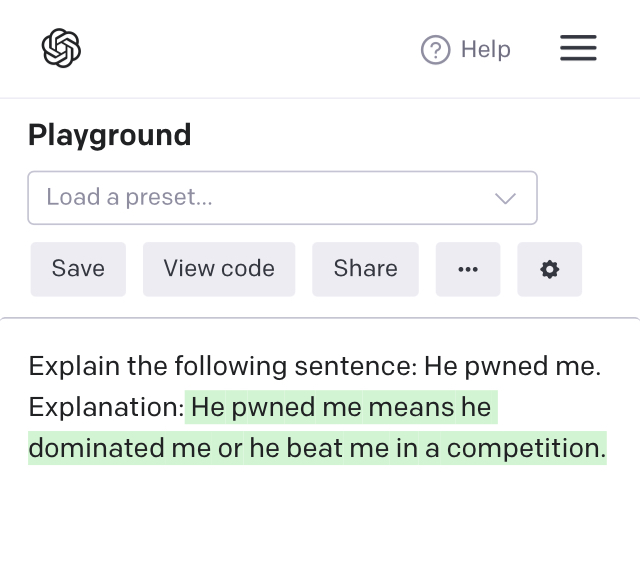
GPT-3 handles idioms just fine. Here I tested it on "I fell for her." https://files.catbox.moe/lp6oyg.jpeg
Re:Sumerian dog jokes, or the difficulty of translating dead... by jchmrt on Monday March 21, 2022 @11:01AM (#30754895)
You're missing the point of the parent comment: GPT-3 can understand this idiom because it was trained on a corpus in which the context for this idiom already existed. If a new idiom would emerge, the system would not necessarily be able to handle it if it can not understand it from the context it was trained on. Therefore, a translating AI needs to be continuously updated.
Re:Sumerian dog jokes, or the difficulty of translating dead... by kbelder on Monday March 21, 2022 @12:03PM (#30755643)
Is that any different than a human? They can be pwnded by new idioms.
Re:Sumerian dog jokes, or the difficulty of translating dead... by ufmace on Monday March 21, 2022 @01:03PM (#30756643)
I think Humans are pretty good at at least recognizing that a particular phrasing doesn't make sense as a literal statement and so must be a reference to something. Often you can get an idea of what it's meant to mean just by context. Sometimes if you see a dozen or so usages, you get the idea of what it means without ever having it explicitly explained.
Re:Sumerian dog jokes, or the difficulty of translating dead... by lupire on Monday March 21, 2022 @01:20PM (#30756940)
One of the main differences between humans and ML is that humans learn in far fewer examples than machines.

"Poverty of the stimulus"

https://en.wikipedia.org/wiki/Poverty_of_the_stimulus

Re:Sumerian dog jokes, or the difficulty of translating dead... by andai on Monday March 21, 2022 @06:40PM (#30760683)
Until the models become more sophisticated than human brains. Then humans will need more examples than a machine would to learn the same thing.
Re:Sumerian dog jokes, or the difficulty of translating dead... by jchmrt on Monday March 21, 2022 @12:20PM (#30755921)
No it isn't of course, but that speaks for the argument that AGI is necessary for human-level translation :)
Re:Sumerian dog jokes, or the difficulty of translating dead... by andai on Monday March 21, 2022 @06:36PM (#30760644)
Or just an up-to-date GPT?
Re:Sumerian dog jokes, or the difficulty of translating dead... by TillE on Monday March 21, 2022 @01:32PM (#30757156)
Good luck accurately machine translating the infinitely growing idiom of jokey Twitter conversation, which most native speakers can pick up pretty quickly.
Re:Sumerian dog jokes, or the difficulty of translating dead... by xyzzyz on Monday March 21, 2022 @12:21PM (#30755943)
Like, for example, “to be pwned”, which I believe is not going to be understood by majority of English speakers.
Re:Sumerian dog jokes, or the difficulty of translating dead... by mcguire on Monday March 21, 2022 @02:26PM (#30757823)
And even fewer ML proggies.
Re:Sumerian dog jokes, or the difficulty of translating dead... by andai on Monday March 21, 2022 @06:38PM (#30760670)
Re:Sumerian dog jokes, or the difficulty of translating dead... by biztos on Monday March 21, 2022 @11:15AM (#30755038)
"The speaker became attracted to the person they are talking about" is definitely not the way I (native US English speaker) would explain falling for someone, and any person or robot using it that way is likely to sow confusion.

How does it do with "I fell for it?"

Re:Sumerian dog jokes, or the difficulty of translating dead... by MauranKilom on Monday March 21, 2022 @02:40PM (#30758011)
"Falling for someone" can mean both "falling in love with someone" and "to be trapped/tricked by someone" according to both my experience and my go-to dictionary [1] [2]. "Falling for something" is clearly in the realm of "being tricked" according to [3] (but that source also puts "falling for somebody" squarely on the "love" side of things [4]).

So I would say that, while you may have never heard it used that way, it certainly has that meaning in practice to many people. Don't judge the robot so harshly.

[1]: https://dict.leo.org/pages/addinfo/addInfo.php?aiid=En842ho0...

[2]: https://dict.leo.org/pages/addinfo/addInfo.php?aiid=EKHR2Car...

[3]: https://dictionary.cambridge.org/dictionary/english/fall-for...

[4]: https://dictionary.cambridge.org/dictionary/english/fall-for...

Re:Sumerian dog jokes, or the difficulty of translating dead... by andai on Monday March 21, 2022 @06:41PM (#30760700)
Re:Sumerian dog jokes, or the difficulty of translating dead... by Victerius on Monday March 21, 2022 @10:26AM (#30754505)
The day a machine can make a meme is the day we reach the singularity.
Re:Sumerian dog jokes, or the difficulty of translating dead... by Ancapistani on Monday March 21, 2022 @11:18AM (#30755067)
Welcome, to the World of Tomorrow!

https://imgflip.com/ai-meme

Re:Sumerian dog jokes, or the difficulty of translating dead... by slowmovintarget on Monday March 21, 2022 @11:24AM (#30755140)
It sort of works... https://imgflip.com/i/69gjkt
Re:Sumerian dog jokes, or the difficulty of translating dead... by heavenlyblue on Monday March 21, 2022 @01:16PM (#30756872)
Machine translation can take the context statistically really well.