This seems like a bit of a silly point, given that the war in Ukraine is, at least so far, nothing compared to the conflicts of the past. Do we wanna rush head first back into something that reliably produced worse conflicts than we see today simply because what we have going now isn't perfect?
>Germany’s dependence on Russian gas is now limiting its ability to respond to a crisis. They’ve handicapped themselves and can no longer promote peace and in fact are funding a war.
A bunch of western companies are pulling out of Russia over this and it looks like the whole thing is going worse for the aggressors here than they expected. I'll take this over Germany and Russia engaging directly in armed conflict.
In many ways, the theory that interconnected trade promotes peace is similar to the neo-liberal economic view that globalization promotes lower prices and thus more efficient economies. Such a view has been shown to be an over-simplification and ignores important side-effects of changing trade balances, such as rising economic inequality and the rise of populism.
The problem with that logic is that it only kinda works for large, powerful, rich countries as they are the only ones with any leverage. This is also highlighted by your own comment when you refer to China, EU, Russia, and we can add US and a few other countries to the mix.
Everyone else is screwed, as shown by the Ukraine invasion, China's constant sea-land grab in the South China Sea, China trying to land grab against India and Bhutan, and so on. So, regardless of how we may want the above to work, the old rules still apply.
In fact I'll say it's made it worse, since now US and China are dependent on each other to not engage in a direct war, but that means China is now free to screw around everyone else without worrying about US interference.
In case of Russia and EU's dependence on its oil, Russia tried to call the bluff and failed, but the EU is still not interfering and Russia oil was sanctioned just recently. So, it turned out bad for Ukraine.
Not Ukraine. If trade interdependence keeps democracies from defending other democracies, but doesn’t deter Russia, then it is counterproductive.
There is probably value in interdependence, but it can’t be blind interdependence - it needs to be conditional and truly multilateral. If EU depends more on Russian fossil fuels than Russia depends on EU imports, it isn’t really interdependence.
>The reason we’re not in a world war right now is
Nukes.
If I recall correctly, the "interconnectedness" of Europe of the Early 1900s was thought to be the reason that a large war was not possible.
Perhaps increased trade will help nations to settle smaller disputes via diplomacy but the outbreak of war seems to be something can defy rational explanation. That is, we can't always expect that the leaders and citizens of aggressor countries are making rational decisions.
Where is Brazil growing that soy? In their vast and ample prairies? (hint: the answer to the second question is 'no')
> So we can't move food where it needs to be, so that should increase reserves being held.
This parallels a problem we have in cluster management - if load increases and you spin up new servers as a response (increasing capacity), then depending on how those servers work they might actually increase load while trying to spool up. You then have to be careful you don't create a feedback loop where spinning up servers triggers spinning up more servers.
If you can't get food into the ports, then stockpiling it means bringing more food in through those same ports. Which makes getting food (and other supplies) slower, which means you increase your stockpiles, which means more shipments having trouble getting into port...
Often the right answer is to raise the low water mark, which means that the status quo is maintained until the next lull, when you hold on to some of your excess capacity instead of letting it go, and to refine your boundary conditions to react a little bit sooner, and/or a little less aggressively (ie, do less but do it sooner).
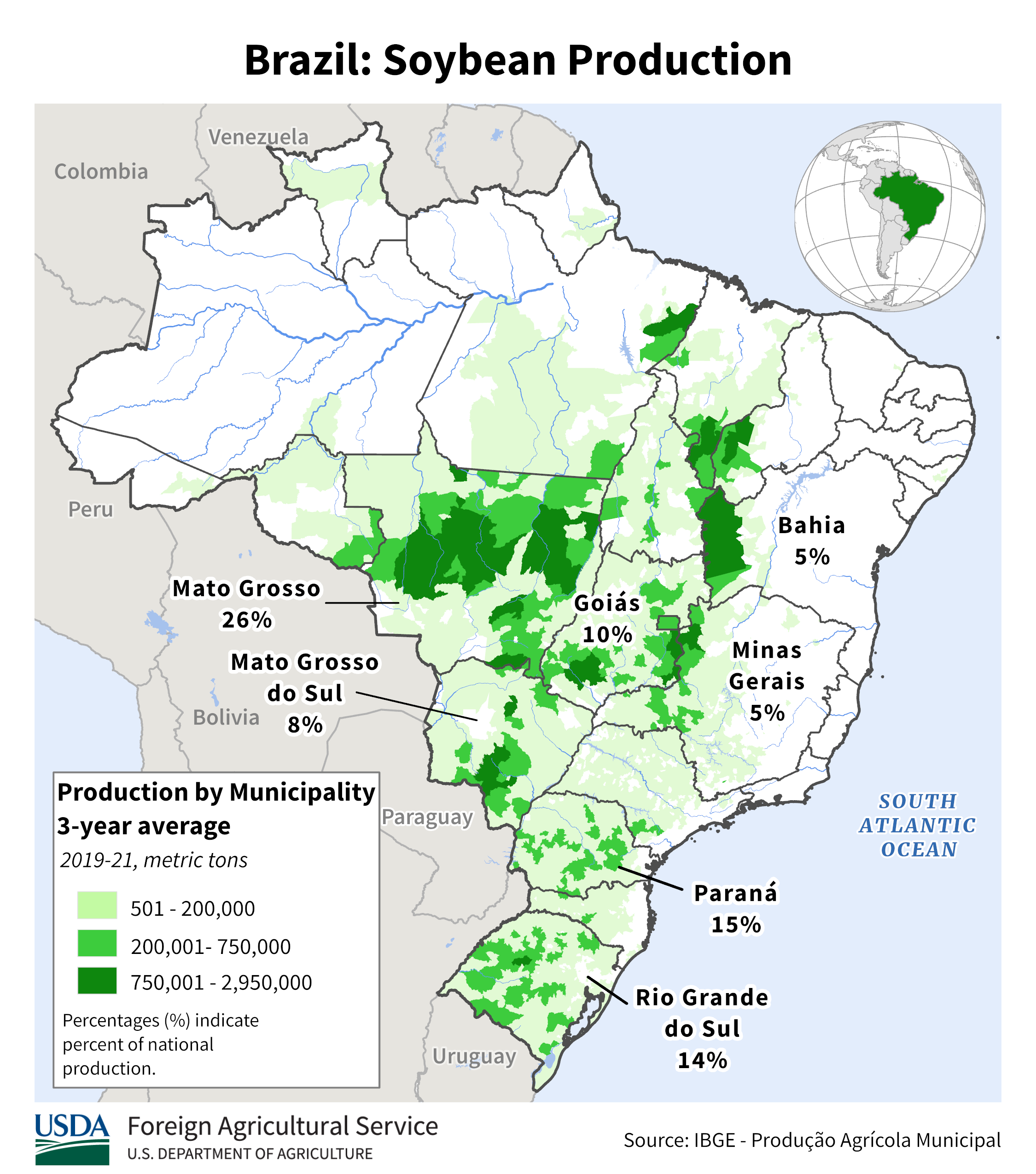
https://pt.wikipedia.org/wiki/Produ%C3%A7%C3%A3o_de_soja_no_...

https://pt.wikipedia.org/wiki/Produ%C3%A7%C3%A3o_de_soja_no_...

Of course it's 'no'. It is mostly produced on the savanna and semi-arid areas.
Where can I find this information?
Japan, Britain, France, Germany, etc. probably either don't have enough consumer manufacturing or natural resources to survive independently.
Except of course, it turns out that wasn’t right. China is raising the stakes and wants a seat in the superpower club, Russia clearly isn’t past WWII style politics. But I guess 4 years ago this wasn’t obvious to the average politician (who tend to be reactive anyway).
Russia is now seeing viable businesses shut down in mass because their owners decide to exit the market. Europe can't sever Russia entirely due to energy dependence. Everyone is wondering what will happen when Russian companies go bankrupt, or the harvests from Ukraine and Russia don't materialize.
Is the real question whether it's safe to have any large economic dependencies on a country that you may have a military conflict with in the future? I'm not sure you can easily segment "core" vs. non-core dependencies except by the fraction of the economy they represent.
So far, it also shows that the theory that a strongly interconnected economy can prevent war is pretty moot. The EU and the US applied just about every economic sanctions (except imports of oil and gas in the case of EU) and Putin won't stop.
I think there was an assumption baked into globalism that heads of state would behave in the best interest of their citizens, but that's only even approximately true when the country is a functioning democracy. In an authoritarian state, what's good for the leader may vary wildly from what's good for the people. One could argue that the entire point of autocratic power is for the leader to be able to do what their people don't want.
And once you have someone with that level of power and no obligations to the masses, there should be no expectation that they will be have rationally or in the economic interests of the entire country. As long as it benefits their perverse psychology or isolated offshore bank accounts, it's on the table.
There can be lots of scenarios where the last 70 years saw lots more war.
(Personally, I think the best way to prevent war is non-corrupt democracies with little autocratic power concentration and a strong fair press. Most people don't want to go to war and kill others, so when you give the entire populace agency over what the military does, you get a lot less irrational wars.)
Hardly a novel error, at least: https://en.m.wikipedia.org/wiki/The_Great_Illusion
it is not a "One Click, Buy now, next day delivery" Amazon Prime type of thing, we have come to expect INSTANT RESULTS, that is just not how Geo Politics works
I also find it amusing when people say Gas price increases are due to Russia... Those are comming for sure, but no there has not been enough time for Russia's action to impact gas prices.. not yet.... But brace for it...
Politicians love to Cease on current events to explain economic results that are actually months or years in the making
The idea that business are adjusting their physical goods sold pricing based on news events is laughable, I know of ZERO businesses that do that.
https://www.macrotrends.net/2501/crude-oil-vs-gasoline-price...
This sounds a little no true scottsman, but I'm not sure Russia was heavily interconnected. What necessary good(s) do they lose out on when/if the world refuses to export to them? They're fairly self-sufficient, as I understand it, which makes sanctions relatively weak.
To some extent, sanctions work more as a threat than a punishment, but threats only work if they are credible. The goal of these sanctions might not be so much to stop Putin (he clearly won't be stopping in the near term, for a number of political, psychological, and sociological reasons) but to a) damage the Russian economy and reduce their capacity to execute this war in the medium term, b) use that example as an object lesson for other countries who are considering expansionism, and c) lend credibility to future threats of sanctions.
Investing in those countries always involved tradeoffs. But the idea any country would help another in a blatantly illegal war of aggression to expand borders - it's so contrary to the U.N. charter and post-WW2 world that it's really quite surprising. China? As a founding member of the U.N. and permanent member of the Security Council helping Russia in any capacity? I am surprised. China may have lost upwards of 15 million in WW2. Have we forgotten everything?
China being against US interest in general makes perfect sense to me, but against the EU it just does not make as much sense.
I'm not sure if EU can be considered as a party able to care about own interest. It's just a group that is more concerned about US than common European interest. If it were an independent factor, we would already have own army and there would be no US occupation^H "support" troops scattered at every strategic point in Europe.
And Europe would have strong rules that would limit the influence of US traditional and social media in Europe, that basically create what Europeans think and want.
So yes, if China wants to be number one, it will focus on harming the current number one, and not his minions, which will sooner or later just change their master when number one changes.
US as Europe's whipping boy knows little bounds. The US has repeatedly asked EU countries to stop funding Putin's war machine and fund their own militaries with something substantial. Most EU countries have continued to poo-poo this, forcing US to spend 4% GDP on defense while Germany has gotten away with 1% while funding Russia's invasion of Ukraine. Trump was threatening to remove majority of military funding to Germany and they were aghast, "how dare the US not spend their $ to protect us." Of course people like you still somehow make US patronage of your defense into an "occupation." We'd be ecstatic if you actually funded your own instead of making us just to keep international order.
If you think USA is doing us a favour, just leave Europe, and Middle East, and Africa, and Asia. Just go back to your continent and let us deal with Putin and other challenges best we can. We don't need neither your "protection" nor your "protection fee".
Maybe without US warmongering, we would not need to be afraid of Russia. German technology and Russian resources is something that USA might be scared to death to end its world domination.
The interested parties in this war are NATO countries and Russia, besides Ukraine, because the war is a consequence of decades of hostilities regarding the re-alignment of the ex-USSR territories East of Poland towards the West and against Russia.
Russia has announced they have the right to expand their borders using aggression. They have committe the supreme international crime, as judged at Nuremberg. If countries aren't subscribing to that world view anymore, then we are lost. We are doomed to have a world war three. The entire fucking point of these institutions is to prevent another one. If nothing else China should be an institutionalist, preserving the international system of laws for its own long term interest.
Maybe it's lost on people, but Poland told NATO in 1993 that if they weren't allowed to join, they were going to build their own nukes. Because they didn't trust Russia. They weren't the only one.
If the U.N. Charter system dissolves, the NPT falls soon after that. And then it's an arms race.
Even before the invasion, the Power of Siberia had been viewed as extremely unprofitable (it seems likely that corruption played a major role in driving up costs), and then there's the further issue that more work is necessary for it to send its total capacity, which is a fraction of what it sends to Europe.
> Yet the project does not appear to be as grand a success as Moscow would have liked it to be. To begin with, the capacity of gas production on the Russian side of the border is open to doubt. The Chayanda gas field in Yakutia region, currently the only source of gas for the pipeline, can produce up to 25 bcm a year.
> To deliver 38 bcm to China, Gazprom has to develop another large field, Kovykta in the Irkutsk region some 800km south of Chayanda, and connect it to the Power of Siberia with another pipeline, which has not been built yet. The completion of the infrastructure needed for pumping the required volume to China is probably going to take more than 10 years, according to Gazprom’s pre-feasibility study of the project.
> ...
> Currently Gazprom sends westwards about 200 bcm annually via a number of pipeline routes. The Power of Siberia project, however, has a limit of 38 bcm and it is unlikely that another major pipeline project would be launched any time soon. Thus, the Russian company would not be able to switch export flows as it pleases.
Is it just China? EU also will continue buying gas, and prices are much higher now than year ago.
the question is if those countries will have strong commitment to invest into significant and non-trivial infrastructure rebuild, or it will be just speeches from politicians.
> Russia takes over all of Ukraine
I don't think this was ever goal of Russia. I think they wanted to occupy some southern and eastern regions, force Ukraine to recognize Russian Crimea and set some puppet government in Kyiv.
I believe Ukraine and Russia will reach some agreement soon, Ukraine will likely lose some territory and political independence, and in 3 years Europeans will mostly forget about this stuff, will be destructed by other issues and continue buying Russian oil and gas.
That's what I meant by taking over all of Ukraine. If Russia sets up a puppet government, then I expect further sanctions. Maybe they won't if a settlement is reached with the current government.
Well, we don't know, and won't for years perhaps, I should've clarified that I'm guessing about what will happen in the long-term, not asserting that Putin will say, "Oh gosh, look at the stock market, I'd better withdraw" in the next few days. But it does seem like the sanctions will have the effect of impoverishing and weakening Russia for decades.
Fertilizer is a good example. Oil for heating homes in winter, or energy generally. Food is an obvious one. I bet there are a lot more.
I don't think complete protectionism is the answer either, but I suspect there is a safer place between the two extremes that many countries will start to move towards.