News for hackers. Stuff that matters.
Re:Why are semi trucks in the US and Europe so different? (2... by tgtweak on Thursday February 03, 2022 @11:41AM (#30194703)
Ford used to make some cab-over semi trucks that were very popular in the US during the 80's and early 90's and resembled very closely the European designs of today.

I think it's pretty obvious and comes down to a few things:

* European trucks typically run shorter hauls, and do not require a bunk in the cab as often as multi-day cross-country runs.

* European Semi's need to accommodate all countries' roads and parking lots. This means the much wider range of nonstandard roads, docks, fueling stations and parking lots extends much farther towards the "small" side. Tight streets and parking lots - making it necessary for the truck to be shorter for tighter turns and parking compatibility.

* It has been proven that a cab-forward design is safer for avoiding accidents directly in front of the vehicles, something that is more focused on in the EU.

* The least obvious but possibly the most relevant reason why it remains: Having and ingraining differing standards makes it harder for a single competitor to play into the both markets. EU is largely locked down by EU manufacturers since any US manufacturers would have to significantly change their design and production to sell there.

The fuel economy point seems to be a distant consideration since the majority of drag economy comes from the trailer and not the tractor.

Re:Why are semi trucks in the US and Europe so different? (2... by froh on Thursday February 03, 2022 @01:01PM (#30196070)
European semis all have a bunk beds, for two. They don't feature a kitchen though, and in the evenings the truckers gather in truck stops which serve humongous servings. These truck stops are all along the freeways all over Europe.

There is a maximum vehicle length though, and a maximum weight, the former ensures vehicle maneuverability, the latter serves road stability, bridge specifications, optimized no-waste parking provisions for pass-through parking spots in said truck stops edit: and ferry capacity. Ireland, Finland are connected by Ferry.

Manufacturing is pretty much internationalized, reusing parts and designs globally. Freightliner and Daimler are one company, for example.

Fuel economy is indeed a point, albeit the combo of trailer and truck define the overall fuel economy. As the trailer usually is equivalent to a standard 40ft container, the ideal truck has a boring standard form, too.

The text is German, the pictures are self explanatory-ish though wrt optimal and sub optimal wind résistance: https://en.vda.de/dam/vda/publications/FAT-SCHRIFTENREIHE%20...

Re:Why are semi trucks in the US and Europe so different? (2... by Aloha on Thursday February 03, 2022 @06:19PM (#30200454)
99.9% of US trucks do not have a kitchen either, unless you count a microwave as a 'kitchen'. Truck drivers also stop at truck stops in the US for food, fuel, a shower, sleep, however many long haul trucks are now team operations - one guy drives and the other one sleeps.

There is something like a 70-90% parts commonality between a sleeper cabover and a conventional tractor, indeed - the only parts that differ are body, frame, and a couple interior pieces - even drivetrains are shared - and commonly shared between europe and NA - though European engines do not have the best reputation among US drivers (neither the Volvo or Mercedes Class 8 engine is well thought of - parts are expensive and take a long time, and sadly they're needed with alarming frequency). Indeed, many interior parts can be shared between a cabover and conventional truck, including the dash, and most of the interior appointments.

Re:Why are semi trucks in the US and Europe so different? (2... by ComputerGuru on Thursday February 03, 2022 @01:29PM (#30196503)
This is completely off topic, but does anyone know of a way to get a top-tier search engine to return the best results across all languages rather than the language matching that of the search query + English, as they are wont to do?
Re:Why are semi trucks in the US and Europe so different? (2... by sdk16420 on Thursday February 03, 2022 @03:17PM (#30198180)
If there is a wikipedia entry on the topic, use the interlanguage links to find the most commonly used words for that term in a foreign language.
Re:Why are semi trucks in the US and Europe so different? (2... by mastazi on Thursday February 03, 2022 @03:38PM (#30198474)
Yes I agree this is what I do all the time and it works in most cases
Re:Why are semi trucks in the US and Europe so different? (2... by fomine3 on Thursday February 03, 2022 @07:31PM (#30201151)
IIRC Google had provided search with translated query. It was useful. Anyone know alternative?
Re:Why are semi trucks in the US and Europe so different? (2... by AaronNewcomer on Thursday February 03, 2022 @04:44PM (#30199374)
I do a lot of research for historical things and often want results from other languages and have found on Google if you search for something and then click the settings icon and then click languages you can choose multiple results for "Currently showing search results in:" which will give you results in the languages you choose.

I typically do this in incognito windows as I do not always want for instance English and Italian results.

Re:Why are semi trucks in the US and Europe so different? (2... by runarberg on Thursday February 03, 2022 @07:54PM (#30201363)
Iceland and the Faroes are also connected via ferry neither are in the EU but I think they also have the cap-over as the more common design. However I don’t know how common it is for semis to board the Norröna as the voyage is 1-2 days.
Re:Why are semi trucks in the US and Europe so different? (2... by algo_trader on Thursday February 03, 2022 @04:49PM (#30199444)
Have u seen any studies on how to add a detachable battery pack to an existing truck configuration?

For example, a 2mx2mx0.5m pack can be slotted between the cabin and trailer.

A 2mx6mx0.25cm can be laid on the roof ?

Etc..

(I have seen demos of an Australian truck where the fossil engine is removed, and the pack is inserted from the front.)

Re:Why are semi trucks in the US and Europe so different? (2... by Aloha on Thursday February 03, 2022 @02:20PM (#30197341)
I suspect all of this is wrong.

The maximum length of an articulated vehicle in Germany (and most of europe) is 16.5m or 54 ft. [1]

The maximum length of a vehicle in California is 65 ft. California is one of the more restrictive states when it comes to vehicle length simply because of the age of the road network.

The longest vehicle you'll see in the states are turnpike doubles, which are around 130 ft long, the longest total permitted vehicle length in Europe is 65 ft.

The US used cabovers before vehicle length rules were liberalized, and thats why we don't anymore, drivers prefer conventional trucks, the ride better, largely handle better, and are safer for the driver.

[1] https://www.itf-oecd.org/sites/default/files/docs/dimensions...

Re:Why are semi trucks in the US and Europe so different? (2... by mcguire on Thursday February 03, 2022 @02:54PM (#30197866)
"The maximum length of a vehicle in California is 65 ft. California is one of the more restrictive states when it comes to vehicle length simply because of the age of the road network."

Sort of.

https://dot.ca.gov/programs/traffic-operations/legal-truck-a...

The STAA (Surface Transportation Assistance Act of 1982) trucks can have unlimited length cabs but are primarily limited to interstates and marked state routes.

Re:Why are semi trucks in the US and Europe so different? (2... by Aloha on Thursday February 03, 2022 @03:15PM (#30198141)
As someone who drove trucks and was licensed in California - California has other rules that limit, including axle to tandem limits, and not allowing triples or turnpike doubles (both of which are allowed elsewhere, but not federally required). The unlimited length of tractor has practical considerations too, there are reasons why 95% of the long haul fleet is conventional condo sleepers (notwithstanding the folks who drive a RV style sleeper, with a little living area in it) - and 95% of the local fleet are conventional day cabs, mostly driver preference.

So while yes, I used California's state limit as an easy from of comparison, because it is one of more restrictive western states - you're correct in that the STAA allows a longer tractor. In the end, the rules are lightly enforced - but the state limits guide the total length of combination. It's why (for example) you almost never see doubles being pulled by anything other than a day cab.

Re:Why are semi trucks in the US and Europe so different? (2... by tgtweak on Thursday February 03, 2022 @04:03PM (#30198799)
Bit of a shitshow of authorities for any given piece of road but generally speaking it's the city streets and town-level jurisdictions that get restrictive moreso than interstates and major highways.

There is also the weight factor - even if you could legally have 90ft trailers and 25ft cabs, it would probably put you over the weight limit for many roadways and negate the savings.

Re:Why are semi trucks in the US and Europe so different? (2... by JudasGoat on Thursday February 03, 2022 @04:22PM (#30199083)
" drivers prefer conventional trucks, the ride better, largely handle better, and are safer for the driver." I drove truck in the 90's and the joke back then was "cabover driver's were the first to arrive at the scene of an accident".
Re:Why are semi trucks in the US and Europe so different? (2... by oblio on Thursday February 03, 2022 @04:55PM (#30199517)
Are they better for pedestrians, cyclists, bikers and other drivers, though? I imagine it's much easier to see things in front of you with the cabover design.

Personally I'd optimize a bit more for everyone else's safety, since you know, there's more of them. Plus a semi is a multi-ton missile going 90kmph.

Re:Why are semi trucks in the US and Europe so different? (2... by AuthorizedCust on Thursday February 03, 2022 @05:39PM (#30200044)
Can you share evidence they aren’t better?

School buses typically have a large nose in front of the driver. Are they unsafe?

Re:Why are semi trucks in the US and Europe so different? (2... by stefan_ on Thursday February 03, 2022 @06:13PM (#30200389)
Those hunking blocks of sheet-metal in the US that you call school buses (alternatively, prisoner transport)? Well, yeah. European buses share much with their truck counterparts, except the massively better visibility all around:

https://www.mercedes-benz-bus.com/content/dam/mbo/markets/co...

Re:Why are semi trucks in the US and Europe so different? (2... by oblio on Thursday February 03, 2022 @06:06PM (#30200334)
I can't really share any studies, but some people seem to have more info: https://news.ycombinator.com/item?id=30195371

Intuitively it would make sense that being able to see in front of you with no obstruction would have an impact on safety. How much, I can't say ¯\_(ツ)_/¯

> School buses typically have a large nose in front of the driver. Are they unsafe?

Guess what, European buses don't have a nose, either :-)))

Re:Why are semi trucks in the US and Europe so different? (2... by zardo on Thursday February 03, 2022 @06:29PM (#30200551)
School busses have a regulatory carve out for pollution controls and seat belts. School busses are most dangerous new built passenger vehicles allowed on the road in the US with more than three wheels.
Re:Why are semi trucks in the US and Europe so different? (2... by Aloha on Thursday February 03, 2022 @06:34PM (#30200603)
Yet fatal accidents involving school buses are vanishingly rare.
Re:Why are semi trucks in the US and Europe so different? (2... by jandrese on Thursday February 03, 2022 @08:07PM (#30201476)
School busses only rarely get on the highway, most collisions happen on low speed secondary roads, which are rarely fatal. Plus the sheer mass of the bus means it doesn't get thrown around as much as a car would in an accident.
Re:Why are semi trucks in the US and Europe so different? (2... by zardo on Thursday February 03, 2022 @06:35PM (#30200620)
They do have higher standards for the drivers
Re:Why are semi trucks in the US and Europe so different? (2... by throwaway0a5e on Thursday February 03, 2022 @06:54PM (#30200786)
The standards are basically the same as for a commercial truck driver. The edge cases of what they're willing to accept are slightly different.
Re:Why are semi trucks in the US and Europe so different? (2... by fomine3 on Thursday February 03, 2022 @07:34PM (#30201170)
How dangerous?
Re:Why are semi trucks in the US and Europe so different? (2... by frosted-flakes on Thursday February 03, 2022 @06:24PM (#30200507)
Some school buses have a large nose, but many school buses are rear-engined and have flat fronts.
Re:Why are semi trucks in the US and Europe so different? (2... by Aloha on Thursday February 03, 2022 @06:33PM (#30200594)
Truck accidents where the truck plows into another vehicle are relatively rare. We know because they're recorded by the DOT, and kept as statistics. You're more likely to take them our with the trailer than driving over the front of them.

I have seen four wheelers do all sorts of stupid shit around trucks, stuff that endangers everyones lives, I want that extra little bit of hood in front of me.

I agree that going to a hybrid model is good, where its a short nose conventional cab, like the Cascadia - rather than a long hood-high hood model.

Re:Why are semi trucks in the US and Europe so different? (2... by freeflight on Thursday February 03, 2022 @09:25PM (#30202053)
> Truck accidents where the truck plows into another vehicle are relatively rare.

Interesting, in Germany there happen 4 truck accidents on highways every day, every third one of those is a truck driving into the end of a traffic jam [0], in total they apparently cause more deaths than speeding [1].

[0] https://www.autofahrerseite.eu/sicherheit/524-lkw-unfall-sta...

[1] https://www.faz.net/aktuell/wirtschaft/lkw-unfaelle-fordern-...

Re:Why are semi trucks in the US and Europe so different? (2... by Aloha on Thursday February 03, 2022 @10:38PM (#30202560)
Driving a cabover would seem to not help in those situations, somewhat obviously.

A cabover has better close up visibility, not distance.

Re:Why are semi trucks in the US and Europe so different? (2... by ngcc_hk on Friday February 04, 2022 @04:53AM (#30204780)
These day even very cheap car (Nissan micra say) has auto brake and track alignment. Not e-car just normal one. If the stat is so bad in German can this help? Seems inexpensive technology now like abs etc.
Re:Why are semi trucks in the US and Europe so different? (2... by d1sxeyes on Friday February 04, 2022 @11:01AM (#30208511)
It's there, but there are issues:

https://trid.trb.org/view/1756275

Re:Why are semi trucks in the US and Europe so different? (2... by autoexec on Thursday February 03, 2022 @05:40PM (#30200066)
< California is one of the more restrictive states when it comes to vehicle length simply because of the age of the road network.

What makes the road network in CA so old compared to eastern states that had roads built so much earlier?

Re:Why are semi trucks in the US and Europe so different? (2... by seanmcdirmid on Thursday February 03, 2022 @05:43PM (#30200099)
California has A LOT of roads given its size, and density is focused in the big cities, so you have a lot of country roads to maintain with limited revenue to maintain them.

A lot of highways in California have warnings like "no services for 100 miles" and you won't encounter a lot of other vehicles (similar to Nevada and Oregon adjacent).

Re:Why are semi trucks in the US and Europe so different? (2... by Aloha on Thursday February 03, 2022 @06:06PM (#30200327)
California started building a state highway network before the east cost did - also it has mountainous roads that have restrictions on overall length, simply because of curve radius.
Re:Why are semi trucks in the US and Europe so different? (2... by lazide on Thursday February 03, 2022 @08:42PM (#30201752)
The first freeway ever was made in California. California is a huge state with widely dispersed population centers (since well before cars), and population growth only really took off around the time of WW2 and the widespread production and adoption of cars and trucks. It’s had a very road and car centric culture since then.
Re:Why are semi trucks in the US and Europe so different? (2... by sk5t on Friday February 04, 2022 @12:51AM (#30203346)
> The first freeway ever was made in California

What road is that? How about the Pennsylvania Turnpike?

Re:Why are semi trucks in the US and Europe so different? (2... by lazide on Friday February 04, 2022 @07:14PM (#30215462)
That is a toll road and highway, not a freeway. Definitely some definition slicing going on - the 110 in SoCal was the first recognized freeway [https://www.motortrend.com/features/1804-americas-first-free...]

Differences are typically that a freeway is designed and constructed to allow maximum speed and no interruptions/stops (hence all the on/off ramps, lack of lights, lack of toll booths), and is available to the general public for use without significant restrictions or costs.

Which make it far easier to use, faster, etc. the interstate highway system was designed largely using the model.

Re:Why are semi trucks in the US and Europe so different? (2... by sk5t on Saturday February 05, 2022 @02:29AM (#30218706)
AFAIK only in California are toll-free, multi-lane highways called "freeways," so there may be no end to the definition-jockeying. If maximum speed is a necessary factor then CA may have no freeways at all remaining.
Re:Why are semi trucks in the US and Europe so different? (2... by lazide on Saturday February 05, 2022 @11:14AM (#30222509)
Haha, yeah the whole ‘high speed’ thing is pretty much only at 2am on a Wednesday in many parts of California now.

One key thing at the time I believe was the grade separation/right of way stuff, which I think had only occurred on toll roads for any distance before.

Previously almost all highways ended up having to stop or intersect with other roads (and hence stop signs, or traffic lights, or whatever). Most highways are still that way, outside of major arterials.

Most major arterial highways are the same as freeways now everywhere of course, but I think that’s more about economic factors. California I think was just the first mover on it (and got exposed to those same economic factors earlier than most).

At the time (and still does, though it gets less press now), California was a huge oil state, and was at the forefront of designing and building refineries too.

Re:Why are semi trucks in the US and Europe so different? (2... by u320 on Thursday February 03, 2022 @02:54PM (#30197855)
Sweden and Finland allows up to 25.5 m.
Re:Why are semi trucks in the US and Europe so different? (2... by ecdouvhr on Friday February 04, 2022 @04:35AM (#30204673)
Incidentally, Finland and Sweden constitute something like 20% of the EU's total area, and both have relatively small urban centres scattered all around the place.

It's pretty natural both have somewhat differing regulations in regards to transportation.

Re:Why are semi trucks in the US and Europe so different? (2... by Aloha on Thursday February 03, 2022 @03:16PM (#30198167)
I did indeed say, most of Europe.
Re:Why are semi trucks in the US and Europe so different? (2... by ska on Thursday February 03, 2022 @12:12PM (#30195205)
The article brings all of this up, as well as the prevalence of "sleeper" cabs in US but not EU. This all seems pretty obviously likely to contribute.

One non obvious thing in article; apparently up until 1986 both US and Europe had a strict limit on length of trailer + truck, which is a clear incentive to shorter cabs (gets you more trailer). In 86 US relaxed this, correlates pretty well with the fall off on cab-over designs.

Re:Why are semi trucks in the US and Europe so different? (2... by runarberg on Thursday February 03, 2022 @08:04PM (#30201455)
In the US I see many dump trucks pulling trailers with a very long extension rod (the thing that connects to the motorized truck; I don’t know the actual name for it). Even on the Puget Sound I see them entering the ferries with a ton of wasted space.

Do you have any idea why dump trucks make them self so much longer without providing any more load capacity?

Edit: Here is an example. You could fit another truck in the space between the truck and the trailer: https://d2uhsaoc6ysewq.cloudfront.net/53248/Dump-Trucks-West...
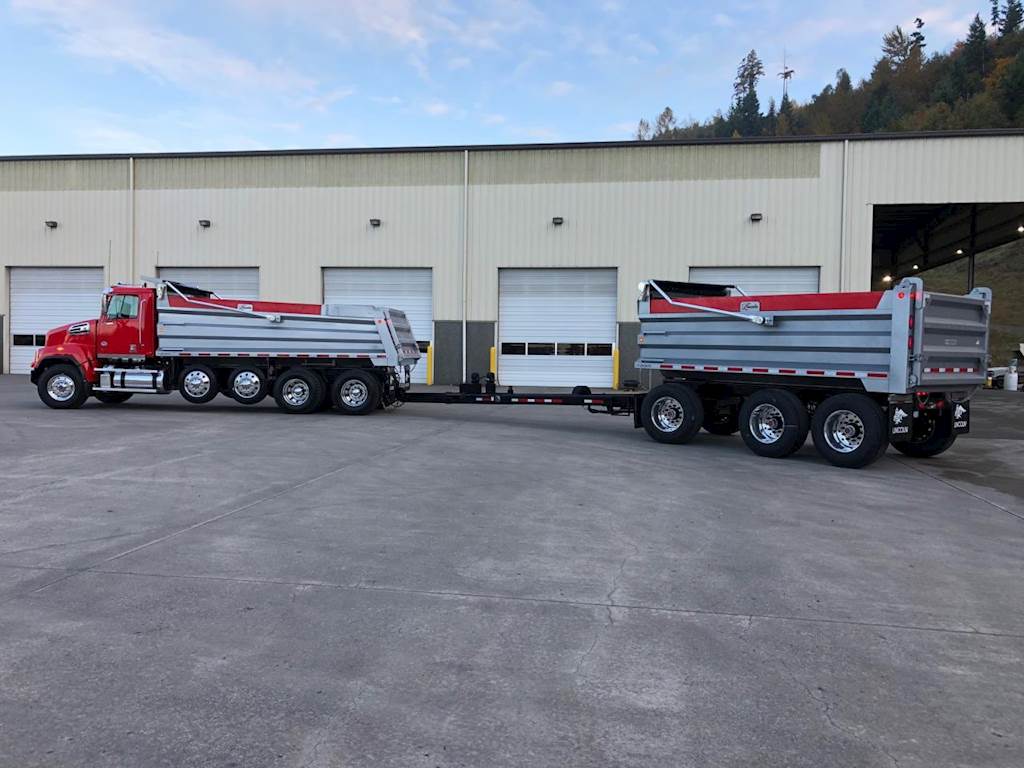
Re:Why are semi trucks in the US and Europe so different? (2... by vallassy on Thursday February 03, 2022 @09:34PM (#30202100)
The bit between the truck and trailer is a drawbar. As mentioned, it is indeed mainly for manoeuvreability. In Australia, that combination is called a 'truck and dog', the dog being the rear trailer. The front axle(s) on the dog are steerable by the drawbar. The upshot of this combination is that you can tip the truck without having to disconnect the trailer, by 'folding' the combination up on itself, turning the whole lot into a U-shape.

As for load, these trucks are completely loaded, there is no waste. This is simply because the things that a tipper transports (bitumen, dirt, grain, gravel etc.) are very dense. Load limits, at least in Australia, are based on the amount of axles under the vehicle, so the only way to increase the load capacity of these trucks is to increase axle count. Example: https://www.aeitransport.com.au/biggest-load-to-be-moved-in-...

The image of the truck and dog you linked seems especially long. This might be a specialised setup for roadworks, where the driver can actually tip the load (in a controlled manner) through the drawbar and drive the dog over the top of it. The longer drawbar would leave room for the tipping body on the truck to raise completely, and also lower the angles experienced by the hitch if the driver offloads too much material between the truck and dog.

Re:Why are semi trucks in the US and Europe so different? (2... by twothamendment on Sunday February 06, 2022 @03:57PM (#30236931)
I'm late to this party, but I didn't see an answer that got to one of the big reasons for the large distance between a truck and trailer. There are laws about weight, specifically measurements called bridge and inner bridge.

My father and grandfather spent a lot of time reading the laws and charts every time they'd build out a new truck or trailer to try and maximize what they could haul. More axels allows for more weight, that seems obvious, but more distance is required between the truck and trailer as well.

It gets to be a really fun problem when one state wants a tongue/drawbar length of 28' and the neighboring state says that is too long and only wants 16'. What to do? Make the length adjustable and switch it over at the state line.

The last and biggest combo they ran was over 100' long, 9 axels, 34 tires and hauled 80,000 pounds. I don't remember the gross weight.

Re:Why are semi trucks in the US and Europe so different? (2... by aklemm on Thursday February 03, 2022 @08:34PM (#30201682)
I would guess this has to do with maneuverability. It's very hard to back up a trailer when the drive vehicle wheelbase is long compared to the trailer. Adding a bunch of tongue length helps a lot.
Re:Why are semi trucks in the US and Europe so different? (2... by mh- on Thursday February 03, 2022 @08:33PM (#30201672)
Maneuverability. There's no articulation point between the cab and the dump. The gap between the dump and trailer allows for very tight turns.
Re:Why are semi trucks in the US and Europe so different? (2... by mantas on Thursday February 03, 2022 @12:36PM (#30195629)
Sleeper cabs are popular in Europe too. But sleeper part is rather tiny. Yet trucker still sleep in them for weeks.
Re:Why are semi trucks in the US and Europe so different? (2... by taneq on Thursday February 03, 2022 @08:21PM (#30201583)
I imagine the truckers in Europe are also smaller than their American counterparts.
Re:Why are semi trucks in the US and Europe so different? (2... by buildsjets on Thursday February 03, 2022 @01:50PM (#30196831)
And that is the difference between a hired employee and an owner-operator.
Re:Why are semi trucks in the US and Europe so different? (2... by VBprogrammer on Thursday February 03, 2022 @03:10PM (#30198065)
I mean, I'm sure European truckers would love a full kitchen, a shower and a double bed if they could get it. But the length limits would still be a problem and it would be hard enough to stay competitive without having to refuse the standard length trailers.
Re:Why are semi trucks in the US and Europe so different? (2... by AshleyGrant on Thursday February 03, 2022 @03:32PM (#30198386)
You're not going to see a full kitchen and shower in a standard sleeper cab. You'll get one or two beds, maybe a dinette, a microwave, and a fridge. To get the kitchen and shower, you're going to have to go custom. Going custom, you're only limited by money, space, and regulations.
Re:Why are semi trucks in the US and Europe so different? (2... by Aloha on Thursday February 03, 2022 @06:21PM (#30200475)
And the 'dinette' is literally a fold down table in front of the bunk.

Cabovers had all of those things too.

Re:Why are semi trucks in the US and Europe so different? (2... by mantas on Thursday February 03, 2022 @01:56PM (#30196919)
I doubt euro trucks had different chassis designs if trucks were owned by truckers.

But trucking in Europe is a mess with massive companies squeezing truckers and importing cheaper workers from wherever to keep salaries low and conditions shitty.

At least one sector where Europe out-big-corps US?

Re:Why are semi trucks in the US and Europe so different? (2... by dghlsakjg on Friday February 04, 2022 @12:58AM (#30203372)
Rest assured: the American trucking industry abuses workers too.
Re:Why are semi trucks in the US and Europe so different? (2... by brnt on Thursday February 03, 2022 @04:31PM (#30199190)
In NL plenty of truckers own their own truck.
Re:Why are semi trucks in the US and Europe so different? (2... by scraptor on Thursday February 03, 2022 @07:42PM (#30201241)
Because US truck drivers are well known for their amazing working conditions and financial independence?
Re:Why are semi trucks in the US and Europe so different? (2... by jandrese on Thursday February 03, 2022 @08:08PM (#30201489)
In the US a lot more truck drivers are owner operators, so yes to the financial independence part.
Re:Why are semi trucks in the US and Europe so different? (2... by closewith on Thursday February 03, 2022 @11:43PM (#30202959)
Is that true? Contractors supplying their own tractors is the norm in Ireland, at least.
Re:Why are semi trucks in the US and Europe so different? (2... by futharkshill on Thursday February 03, 2022 @04:21PM (#30199066)
Most truckers in Denmark own their own trucks?
Re:Why are semi trucks in the US and Europe so different? (2... by ska on Thursday February 03, 2022 @12:39PM (#30195681)
Fair enough, that was sloppy terminology of me!
Re:Why are semi trucks in the US and Europe so different? (2... by mastazi on Thursday February 03, 2022 @03:37PM (#30198460)
European cabovers have beds[1]. Sometimes a double bunk[2]. But they don't have a living area with kitchen etc. like American conventional trucks often do.

> makes it harder for a single competitor to play into the both markets

I don't think this is the case, because many of the top European and American brands are owned by the same conglomerates. For example Paccar owns DAF in Europe and Kenworth and Peterbilt in America.

[1] https://www.youtube.com/watch?v=y3O3ixew1kA

[2] https://www.youtube.com/watch?v=flScrV0pQwU

Re:Why are semi trucks in the US and Europe so different? (2... by jve on Thursday February 03, 2022 @12:40PM (#30195707)
> * European trucks typically run shorter hauls, and do not require a bunk in the cab as often as multi-day cross-country runs.

I find it hard to believe. There are tons of trucks, having multi-day cross-country runs. I know a few truckers, they all have. They sleep in their cabs. Sometimes there are 2 truckers, so they can swap whenever limits reached.

I see trucks from different countries any time I hit the road. If you ride on German autobahn, there is a never-ending stream of trucks from different countries.

Re:Why are semi trucks in the US and Europe so different? (2... by tgtweak on Thursday February 03, 2022 @02:52PM (#30197842)
EU has a LOT more truck volume (both in terms of per capita and percentage of freight shipped by truck). This has some complex and not so obvious implications on how long things get hauled. The smaller trucks also make it more economical to do trips between hubs vs hauling across 3000kms (which is reasonably common in the US). Smaller trailer capacity (due to EU length restrictions) and increased depot/truck distribution means a heavier distribution towards shorter hauling.
Re:Why are semi trucks in the US and Europe so different? (2... by throw0101a on Thursday February 03, 2022 @12:53PM (#30195909)
Also cargo rail is supposedly not a prevalent in the EU as it is in the US. (Vice versa for passenger rail.)
Re:Why are semi trucks in the US and Europe so different? (2... by coredog64 on Thursday February 03, 2022 @09:04PM (#30201918)
Last time I checked, the US was only slightly behind Russia in rail ton-miles.
Re:Why are semi trucks in the US and Europe so different? (2... by sedan_baklazhan on Friday February 04, 2022 @01:14AM (#30203459)
Count it per capita.
Re:Why are semi trucks in the US and Europe so different? (2... by zardo on Thursday February 03, 2022 @02:59PM (#30197919)
Are there any routes in Europe as long as the US coast-to-coast haul?
Re:Why are semi trucks in the US and Europe so different? (2... by teknopaul on Thursday February 03, 2022 @03:32PM (#30198379)
Quick look at a map will tell you yes. Might not be as common, but I am sure fruit gets delivered to Finland from Andalucía by road.
Re:Why are semi trucks in the US and Europe so different? (2... by usr1106 on Friday February 04, 2022 @04:06AM (#30204478)
But Finland has only 5 million inhabitants, so the volume is nearly negligible on European scale. The big population centers are closer to each other and even agricultural hotspots.
Re:Why are semi trucks in the US and Europe so different? (2... by zardo on Thursday February 03, 2022 @03:59PM (#30198752)
I'm sure trailers make the trip. But are they pulled by one tractor the whole way?
Re:Why are semi trucks in the US and Europe so different? (2... by matli on Thursday February 03, 2022 @04:50PM (#30199460)
Yes.
Re:Why are semi trucks in the US and Europe so different? (2... by brainwipe on Thursday February 03, 2022 @12:02PM (#30195030)
Although runs appear shorter in the EU, they're still multi-day. Lisbon to Edinburg is a 2000 mile drive. Most drivers kip in their cabs, not at home.

IMO it's entirely down to the road networks. Driving across the US is like driving across one very broad road network. Driving across Europe is like driving on many fragmented, narrow road networks.

Re:Why are semi trucks in the US and Europe so different? (2... by teknopaul on Thursday February 03, 2022 @03:29PM (#30198341)
[citation needed] Europe has a network of motorways. Last mile is a different story, probably the whole story.
Re:Why are semi trucks in the US and Europe so different? (2... by freeflight on Thursday February 03, 2022 @09:35PM (#30202105)
Europe consists of 44 different countries with sometimes vastly different developed, and funded, infrastructure.

There is a big difference between the motorways in a country like the Netherlands vs those in Moldova [0]

There is often also vastly different regulations in terms of vehicle safety requirements, and many other differences, the combination of which also leads to quite different per capita traffic deaths [1]

[0] https://landgeist.com/2021/09/07/the-best-and-worst-roads-in...

[1] https://www.euronews.com/2018/12/07/which-countries-in-europ...

Re:Why are semi trucks in the US and Europe so different? (2... by marmakoide on Thursday February 03, 2022 @01:32PM (#30196551)
European trucks cross multiple countries during a trip with the same driver. In France, by looking at the vehicle plate, trucks come from Spain, Portugal, Lituania, Poland, Germany, etc Those are 2 to 3 days trips.
Re:Why are semi trucks in the US and Europe so different? (2... by suction on Thursday February 03, 2022 @03:16PM (#30198165)
This. In the EU, trucks drive from Finland to Portugal, same driver. Americans really don't get Europe.
Re:Why are semi trucks in the US and Europe so different? (2... by Aloha on Thursday February 03, 2022 @06:25PM (#30200514)
The opposite is also true. Europeans often do not understand how just how big America is.
Re:Why are semi trucks in the US and Europe so different? (2... by bialpio on Thursday February 03, 2022 @08:54PM (#30201835)
USA's land area is smaller than Europe, but not by much, so I think it's fair to treat it as a non-factor. But the story changes if you also include Mexico and Canada...
Re:Why are semi trucks in the US and Europe so different? (2... by kevin_thibedeau on Thursday February 03, 2022 @07:35PM (#30201185)
And forget that Canadian and Mexican trucks are also transiting the borders.
Re:Why are semi trucks in the US and Europe so different? (2... by suction on Saturday February 12, 2022 @02:35AM (#30310729)
Literally moving goal posts
Re:Why are semi trucks in the US and Europe so different? (2... by CountSessine on Thursday February 03, 2022 @12:15PM (#30195262)
It has been proven that a cab-forward design is safer for avoiding accidents directly in front of the vehicles, something that is more focused on in the EU.

Ironic, because back in the 70's when there were more CoE designs driving around in the US, it was generally known through crash tests that CoE cab trucks were a lot less safe than conventional cab trucks in front-end collisions because of the driver's distance to the collision.

If CoE trucks have gotten safer in front-end collisions, it's because a lot of engineering work has been done to mitigate this old problem.

Re:Why are semi trucks in the US and Europe so different? (2... by yoyohello13 on Thursday February 03, 2022 @12:21PM (#30195371)
OP said cab over engine is safer for avoiding accidents (probably because of increased visibility). Not necessarily safer when an accident occurs.
Re:Why are semi trucks in the US and Europe so different? (2... by tgtweak on Thursday February 03, 2022 @02:01PM (#30197030)
Correct, it has been proven many times that the lack of blindspot directly in front of the vehicle (to the driver) is the main factor. New "stubby" nose school bus designs greatly improved this over existing ones which were closer to a semi. Lately, front cameras and warning systems have made this less of a concern but it still remains the case.
Re:Why are semi trucks in the US and Europe so different? (2... by dwd on Thursday February 03, 2022 @09:23PM (#30202035)
Testing by Volvo determined that in a front-on collision the engine of a conventional cab ended up in the cabin crushing driver. This was the primary reason for CoE adoption in Europe. Similar to cars before safety cells and crumple zones became the norm.

Common perception in America (contrary to actual testing) believed having all that bulk in front made a conventional truck safer.

Re:Why are semi trucks in the US and Europe so different? (2... by animal_spirits on Thursday February 03, 2022 @12:22PM (#30195387)
CoE are better at _preventing_ collisions because of a better field of view, but I'm not sure how good safe they are when there is a collision
Re:Why are semi trucks in the US and Europe so different? (2... by rmason on Thursday February 03, 2022 @02:10PM (#30197182)
Spoke with a trucker about this very issue. He started out driving CoE trucks and said when there's a crash the driver is ejected out through the window. Now this was before the days of airbags but that would be enough to discourage their use. He said it got so drivers refused to work at companies who used them. However it was the desire for increased fuel economy that finally ended their reign.
Re:Why are semi trucks in the US and Europe so different? (2... by VBprogrammer on Thursday February 03, 2022 @03:17PM (#30198181)
I've no doubt that the old CoE trucks from the 60s were death traps. But I'd be interested in seeing what the difference is between a modern European Volvo (one of the few companies who build both types) and a US version. I would be very surprised if the difference wasn't negligible. Putting the engine out front is a brute force way of providing safety which isn't necessary with modern design.
Re:Why are semi trucks in the US and Europe so different? (2... by spollo on Thursday February 03, 2022 @04:16PM (#30198991)
Maybe dumb question- I've never been in a truck. Wouldn't the distance from seat to window be ~pretty much the same whether it's CoE or conventional?

There's a hood in front of you for conventional, and I guess crumple zone deceleration comes in to play there? But as this article mentioned US trucks have a much higher average/top speed so you're probably just as likely to go through the window.

Re:Why are semi trucks in the US and Europe so different? (2... by pmontra on Thursday February 03, 2022 @03:16PM (#30198161)
No safety belts?
Re:Why are semi trucks in the US and Europe so different? (2... by teknopaul on Thursday February 03, 2022 @03:38PM (#30198464)
This. However... Might help if you drive your semi into a brick wall at speed. Just because you are more likely the truck goes through the wall before the cab does. Which happens, someone drove a semi into a data center of ours. Fortunately DR response included this type is disaster.
Re:Why are semi trucks in the US and Europe so different? (2... by ComputerGuru on Thursday February 03, 2022 @01:31PM (#30196525)
There’s safer as in “less likely for the driver of this vehicle to cause a crash” and there is safer as in “in the event of a collision, it is safer for the driver to be in this car than that one.”
Re:Why are semi trucks in the US and Europe so different? (2... by teknopaul on Thursday February 03, 2022 @03:39PM (#30198486)
Neatly distinguishing the EU from the US.
Re:Why are semi trucks in the US and Europe so different? (2... by dragonwriter on Thursday February 03, 2022 @09:28PM (#30202073)
> > It has been proven that a cab-forward design is safer for avoiding accidents directly in front of the vehicles

> Ironic, because back in the 70's when there were more CoE designs driving around in the US, it was generally known through crash tests that CoE cab trucks were a lot less safe than conventional cab trucks in front-end collisions

That's not ironic: safety in collisions from one direction and safety for avoiding collisions from the same direction are very different and often opposed things.

Re:Why are semi trucks in the US and Europe so different? (2... by oblio on Thursday February 03, 2022 @05:04PM (#30199659)
The 70's were 50 years ago.

Back then we barely had seat belts, let alone airbags, adaptive cruise control, automated braking in case of collision, blind spot detectors, etc.

Re:Why are semi trucks in the US and Europe so different? (2... by Aloha on Thursday February 03, 2022 @06:35PM (#30200624)
Most of that tech is not commonly found on a semi-tractor anyhow.
Re:Why are semi trucks in the US and Europe so different? (2... by closewith on Thursday February 03, 2022 @11:51PM (#30203013)
It's all legally required in new tractors in the EU.
Re:Why are semi trucks in the US and Europe so different? (2... by makeitdouble on Friday February 04, 2022 @01:13AM (#30203454)
Other than the collision part addressed by sister comments, the shorter designs also help reduce blind spots. There ‘s a lot more than just the driver’s safety.
Re:Why are semi trucks in the US and Europe so different? (2... by jsdwarf on Thursday February 03, 2022 @04:07PM (#30198861)
Another reason is that longer trucks are harder to overtake on motorways, the longer the truck the higher the risks for accidents. Europe has smaller highways and country roads.

Furthermore truck logistics in the USA is mainly based on FTL (full truck load), which means the truck just drives from A to B. In Europe LTL (less than truck load) is more common, which means pickup and delivery on multiple stops. This requires a better maneuverability, hence shorter trucks.

Re:Why are semi trucks in the US and Europe so different? (2... by tgtweak on Thursday February 03, 2022 @04:29PM (#30199172)
LTL also makes more sense with shorter trailers, since you can unload and reload the trailer quickly without having to play Jenga at the dock. It also encourages depot-to-depot runs vs supplier-to-client, which leads to the average trip length being shorter.

Another factor unmentioned is the amount of independent truckers in the US who own their trucks and who primarily do longhaul sorties spanning a week or more. Can't find any data on this but it is a very commonplace thing in the US for truckers to live in their trucks more than their homes and I'm not sure that is the case in the EU.

Re:Why are semi trucks in the US and Europe so different? (2... by holoduke on Thursday February 03, 2022 @06:31PM (#30200568)
Truckers having their own trucks is history in the EU. Well almost. Nowadays the whole truck busines is in East Europe. with a wide variety of big companies. Mostly if not all international EU transport is driven by trucks from those low wage countries Poland, Bulgaria, Romania. You see them everywhere. From Ireland to Portugal to The Netherlands etc. Most highway parking stops are filled trucks from those countries. They live in their trucks for weeks if not months. It used to be quite dirty environment on those stops. With many eating next to their trucks. It's getting better now.
Re:Why are semi trucks in the US and Europe so different? (2... by croes on Thursday February 03, 2022 @01:20PM (#30196362)
Just because the distances are shorter doesn't mean they drive to the destination and back again.

They could easily have multiple destinations they drive to one after the other, with different cargo each time

Re:Why are semi trucks in the US and Europe so different? (2... by martyvis on Thursday February 03, 2022 @05:38PM (#30200039)
This Tesla was pushed for half a mile seemingly oblivious to the driver of this conventional cab semi.

https://youtu.be/A5GePY23FxI