Ironically, the vast majority of vehicles purchased are SUVs and trucks to the point that Ford will stop selling sedans entirely. At least everyone is prepared for the coming changes?
If we hadn't allowed the automotive industry to essentially dominate american society, we'd have neighborhoods with dirt/gravel roads or narrow paved paths for walking and bicycles, neighborhood parking lots for those who own cars, functioning bus services, lots of passenger rail, etc.
Instead we have a country where we're slaves to cars.
Awhile back I read an observation which really stuck with me questioning how much of the nostalgia many people have for college is due to that being the closest many Americans come to living in a walkable, high-density environment. Most people could do a lot better than 1-2 hours a day in solo car travel soaks up.
I like "walkable, high-density environments" myself, but most people who care about that are highly educated white people and white-adjacent minorities. Which is fine! Urbanism is compelling on its own merits. You don't have to "brown wash" it.
Once that became established, a lot of inefficiency was baked in: single-family rather than shared housing, driving yourself in a car rather than sharing a bus with strangers, not building things like sidewalks or favoring cul de sac designs to discourage non-residents traveling through a neighborhood, etc. You don’t need to know or care about the history half a century ago to think of those as the default when they’re what a lot of us were raised in and saw on TV/movies.
I think you’ve got the causality reversed. Most people, regardless of race, find suburban living more pleasant and more convenient. Urban areas tend to be more “brown” because that’s often where immigrants start out, because “brown” people tend to be younger and lower income, etc. Thus, whites are more able to attain the goal of suburban living. But it’s misleading to make it sound like the suburban preference arises out of white dislike for “brown” people, because the preference seems pretty uniform between races. (If anything, affluent people who prefer urban living are more likely to be white, judging from the demographics of gentrification.)
Urbanists have a good point that the suburban preference might be different if people in the suburbs were forced to bear the externalities of their lifestyle. But that has nothing to do with race.
That some hipsters have found renewed value in density (mainly access to “culture”) is a separate, parallel development.
Right—and OP theorized it was driven by associating “urban” living with “brown people.” My point is that this isn’t the reason, because “brown people” resist dense urban living as well and avoid it when they can afford suburban living.
(Mostly white) hipsters finding renewed value in density is fine. My objection is them working the “brown people” angle to make their cause more politically sympathetic.
Elizabeth Warren’s campaign did this extensively. Her voters on Super Tuesday were almost 80% white, out of an electorate (mostly southern and southwestern) that’s majority minority. But Warren tried to insert a racial angle into every issue.
So I get it now, your angle here is the unfair presumption that POC are politically liberal. Which is fine, but the issue is tangential to the conversation about suburban density and urban renewal.
I don’t think it’s the only factor but I find it very hard to believe that decades of that imagery, often openly embraced by the political candidates those neighborhoods voted for, was coming from nowhere. Absent that, I think there would have been a very different arc for American cities between WWII and the turn of the century.
“White flight” happened, but I think urbanists misunderstand the causality. The 1960s economic and technological revolution allowed people to enjoy comfortable suburban lives. Black people were prevented from doing so by economic circumstances and discrimination. But the impulse to leave to city wasn’t caused by that.
We are seeing that develooment in Stockholm now work is much more organic so and the rays of the star are over burdened by suburb transportation (public true, but mostly private).
This is very easy to disprove: houses and apartments in urban areas cost more than in the suburbs.
Most people are not able to afford a large enough apartment downtown because there is not enough supply, and so they prefer to pay the same for a larger place in the suburbs, but this is not the same as preferring the suburbs.
No. Prices are a function of both supply and demand. Demand for housing in cities is high relative to the supply of housing in cities. That doesn’t mean that the demand for urban housing is more than the demand for suburban housing—because the supply of the latter is vastly larger.
You can create semi private public schools through high property prices and zoning.
You can kick homeless people out.
You can mostly manage a 5-10 person police force
And really you can create zones where people are mostly like you what ever that likeness may be.
Some would say that shouldn’t be allowed but you can see the appeal.
Reurbanization by wealthy whites (and deurbanization by some minority groups) are part and parcel with the earlier trend, and don't entirely subvert it.
https://www.stlouis-mo.gov/government/departments/planning/r...
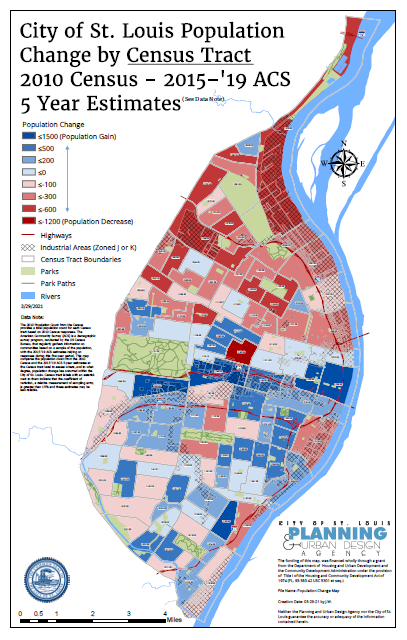
It's been like this for almost two decades now (north is to the right on this map):

I grew up not far from Galesburg, in a town roughly the same size. Many of the rural subdivision roads outside of downtown are paved with chipseal [1] rather than asphalt concrete or portland cement. While chipseal is certainly not as nice as concrete to drive on, it is much cheaper to maintain. I remember the road in front of my house getting re-treated every few years. Meanwhile the paved blvd connecting all these subdivisions hasn't been maintenanced since the 1980s, and is turning to rubble. So I personally think the problem (at least for small-ish midwestern towns) is the bias of state DOTs towards creating new infrastructure (paving new roadways / bridges) over maintaining the infrastructure they've already built (there's no ribbon-cutting ceremony when you're just filling potholes). Of course, this mentality only exacerbates the problem.
[1] https://en.wikipedia.org/wiki/Road_surface#Bituminous_surfac...
Yes, that's why that was the upper range. Note also that I did not restrict it to commuting — designing around car-only transportation means that almost every common activity becomes time spent immobile in a car, and people famously underestimate the amount of time they spend driving, looking for parking, etc. — usually “a 20 minute drive” means “25 minutes if you exceed the speed limit, hit every light, and there's minimal traffic and parking right in front”. If you start measuring that, you realize how much time people spend on things like unnecessary (we have relatives who'll spend an hour going shopping for like half a bag of groceries) or single purpose errands in addition to commuting.
> So I personally think the problem (at least for small-ish midwestern towns) is the bias of state DOTs towards creating new infrastructure (paving new roadways / bridges) over maintaining the infrastructure they've already built
Definitely — and one big factor for this is that single-occupancy vehicles are extremely inefficient so there's always this call to add more lanes or a bypass road to “defeat” traffic, but that reliably encourages more usage so conditions usually only improve for a few months after opening.
I find this very implausible. I grew up in Soviet block and all my friends and relatives grew in very dense small apartments yet all of them who could afford moved to houses as soon as they could.
My point was that when one style of living was picked as the goal and heavily promoted by policy it locked in a lot of negative outcomes like traffic jams and challenging local government finances.
Sure, the numbers say living like a meat popsicle is absolutely more 'cost effective' but that's a hard-pass from me.
You were contrasting a world that had about 150,000,000 people living it with today where we have about 7,800,000,000.
It's nothing to do with "class conflict", and all to do with load bearing. As things stand, we only just have the resources to support a fraction of those at Western living standards, and we damned well can't support the billions who haven't achieved them yet as things stand.
So yes, it's all about practicality.
And you and I are amongst the "patricians" already.
Also, don't pretend you know me at all.
I don't know if you are fooling yourself into thinking you are being rational and caring for environment and practicality but you are not fooling me.
It's ridiculous when there is a wide, flat, straight asphalt road surface with a speed limit of 25mph. Build it out of cobblestones, and 25mph suddenly feels a lot faster!
But how would cyclists fare on cobblestones, especially if you were talking about suburban streets with kids playing, bikes going around, etc?
Really painful and annoying to ride on with a kick scooter though.
I don't know about ease of maintenance and access to utilities, but Romans did not have trucks that destroyed the roads (the ratio of weight of vehicles to the wear on the road is exponential, not linear), but I have no concept of how cobblestone is affected by trucks. Roman roads are also affected by survivorship bias (we see the roads that survived, not 90% of the roads that haven't) and they were not affected as much by freeze/thaw cycles as North American roads are.
My intutition says that they also probably were not generally as wide as North American roads. Drivers here have an expectation of being able to drive at high speeds without worrying about passing on coming traffic - Pictures I've seen of Roman highways were not two wagons wide. Less road width means less maintenance since there's physically less roads.
But for the problems this article discusses for smaller cities where their population has moved to suburbs and exurbs and where the commercial centers have similarly moved out of city core, perhaps the more durable approach to cobbles (or brick) might be an interesting way to address ongoing maintenance challenges. It's mostly a thought exercise, but an interesting one.
Hopefully self-driving cars will get us out of this pit of car-centric infrastructure, but that's a solution that's been a few years out for the past decade.
The biggest problems with car-centric infrastructure are that they require a huge amount of ever-larger roads to funnel people (in cars) often tens of miles to do anything. Even in the rent-a-taxi scenario you would still need these roads, which would probably need more maintenance, not less. And all of that sprawl has knock-on effects as roads create divisions in communities, and low-density housing, enabled by car infrastructure, means you have and know fewer neighbors.
i.e. "I hope you can afford a truck, SUV, or constant repairs to your suspensions/tires"
https://www.theglobeandmail.com/canada/article-mississauga-a...
https://www.google.ca/maps/@43.5675623,-79.740886,916m/data=...
That isn't apartment building density, but that's about as dense as single family homes can get.
Mississauga had to raise property taxes somewhat -- still extremely competitive -- as a revenue source dried up. But those new neighbourhoods all easily pay for themselves in property taxes. Nonetheless, loads of really silly narrative comes out of Toronto writers, still foreboding this dire scenario that they've been pitching for well over a decade. It's a bit farcical at this point.
These traditional north american houses are still not very space efficient at all (large unused garden + lawn + double parking spot + garage).
“Suburban” neighborhoods in Europe easily have double or triple the density of this. I also see zero townhouses or anything with 2+ floors in that area.
I don't know about you, but I actively use and enjoy every one of those things.
Perhaps you enjoy apartment living and consider anything not active indoors a waste.
If so, good for you, I wouldn't want to impose a garden or a parking spot on you. By the same token, calling these out as if they could possibly not be useful, simply because you do not think them useful, is at best, a fallacy.
You can have nice gardens, double parking spots & a garage without the same designed towns and neighborhoods. Most often is done by limiting street parking, narrower streets, and using the rear-entrance drives and lots as done in many cities.
Those designs also enable more pedestrian friendliness vs. the suburban sprawl that is effectively carpeting the U.S. and Canada since the 40's.
>>Most often is done by limiting street parking, narrower streets, and using the rear-entrance drives and lots as done in many cities.
YES, limiting on-street parking is huge.
That's fine, as long as you pay the costs associated with those things. However, in most cities suburbs are revenue negative, and subsidized by the dense downtown areas (that don't have these).
> I wouldn't want to impose a garden or a parking spot on you.
The entire problem is that this is exactly what is done though. Zoning forces a very specific type of housing in most of the city (single family house with large lot size, garage, driveway and backyard), even for those who would be okay with or prefer something else.
Are you conflating city and suburbs here? While this is obviously dependent on each city/town which has their own zoning rules, most of the locales with which I'm familiar have quite the dense-pack throughout the city, and the suburbs are out in separate towns.
>>However, in most cities suburbs are revenue negative. Again, if the suburbs are separate towns, I don't see how this affects the city budget. If the suburbs are within the city and on the same budget, I'd look at the balance of costs and revenue, and if a particular zoning district is substantially more costly, i.e., being subsidized, then it seems a rate adjustment for that zoning type would be in order...
As it is, for where I live, the town is essentially all rural/residential, with 2-acre minimums (some exceptions), 35mi from the major city, and I can say that yes, we REALLY do pay for those associated things - one of the highest tax rates in the state, and increased ~50% since moving in 15 years ago. Yes, we occasionally grumble, but I am much more happy to pay for the zoning rules that maintain an healthy ecosystem where I can see over a dozen types of birds out the window at breakfast and many other healthy populations, than I'd be even slightly interested to see densepack developments reducing my rates (I can find densepack & lower rates elsewhere, and if I wanted it, I'd have gone there)
It’s just not really necessary for every single house to have these amenities. You can have parks, public parking, and a decent sized backyard in a townhouse / attached buildings. The space gained can then be used to sustain actual life in the neighborhood such as stores, restaurants, schools, libraries and small businesses. Once you have this, you don’t need two cars, or to drive everywhere, you don’t need a large private garden to enjoy the outdoors.
Of course I’d love to live in a huge house surrounded by green. But it’s not a sustainable model for urban development.
This is grossly out of touch with how most of these features end up existing. Most of the time, there's a minimum setback for the front yard, minimum parking, etc. specified by local zoning ordinances.
This isn't bottom-up market-driven demand, it's top-down requirements specified by the local government for that area. So they are, in fact, imposed on whoever wants to live there.
Wrong. Of course it is always implemented by a local govt, but it is very much a result of demand.
I very well understand how such regs end up existing, and changing. It is very much related to demand. People are generally against zoning until they realize what it is like to live without zoning, and then it is DEMANDED by the people, and of course implemented by the govt. I've lived in a locale where zoning was first brought in, then developers managed to build a coalition against it and it was abolished, then people realized that that was shi*y, and now it is zoned again.
I've also seen and helped organize opposition to new development that would trash both neighborhoods and wetlands and endangered species habitat - when 100 neighbors come out to oppose the proposed variance, that is not some govt imposing it, it is the residents supporting their own zoning.
It may be different in larger cities with heavier corporate development influence, but I doubt it, since e.g., I'm sure there are plenty of developers who'd love to develop in San Francisco, but all I hear about is NIMBY opposition to changing neighborhood zoning holding it back. Guess what? That's not some top-down govt, it's locals supporting their own zoning.
What is out of touch is your comment inaccurately characterizing it as some faceless govt imposition.
Maybe you meant 2+ units? 'Cause almost all of them have 2+ floors, and many will have livable basements as well.
You can get a little bit denser by going full street grid--Chicago's single family home districts look to mostly be rocking ~6-9k people/km².
I grew up in Chicago on a perfect grid. Now I live on a street that I picked precisely because you only drive down it if you live there. I don't like the sound of cars driving past. That's a personal preference that seems pretty generalized, even among people without kids.
And on a street like that, you don't need speed bumps, because people aren't speeding down the street.
I’m not a libertarian, I think it’s fine for government to tap rich people to provide nice things for everyone, but this particular nice thing (way more roadway than you pay for) has a pretty bad cost:benefit, and its beneficiaries are not exactly the neediest or most deserving of aid.
A positive counter-example would be Houten. Winding street layout that's not good for through traffic, but very nice for walking and especially biking: https://www.google.com/maps/@52.033207,5.1474598,3a,75y,4.09...
We’re talking about pretty different things, though. Suburbs of ultra high-cost-of-living cities have their taxes buoyed up their proximity to the big economic engines, while small towns like Galesburg have to figure out how to be self-sufficient without that constant influx of wealth.
Makes sense for a declining city in far-out rural Illinois.
Some will farm or extract natural resources, but these operations require fewer people than they used to, so fewer towns. Some will be holiday destinations for city-dwellers. But we will probably sustain far fewer of these towns than we have historically.
Software? Sure there are software developers living out in small towns, but obviously not many in this town.
Not too bad in you car but it means that you can't walk or bike anywhere unless they have put in paths between blocks. Means that if a 15-year-old kids wants an ice-cream their parent has to drive them to the corner store.
Now, I think almost everyone would prefer if their one street were not integrated into the grid. That would be the ideal. You live in a grid, but with none of the downsides. But failing that, many people opt to live in denser areas rather than the burbs, even if the cost is that folks sometimes drive down their street who are going someplace else..
Well, you could still get this, more or less, with a grid, like Barcelona's superblocks.
I hate it, because if you miss a turn, you basically have to go another full mile to hit another 'cross street'.
Roughly the equivalent of pointing to IBM as the most high paying and prestigious tech companies can get.
It would be trivial to increase the density there by reducing setback requirements, narrowing the roads, removing minimum parking requirements.
This assumes it’s significantly cheaper to build new roads than to rebuild them which seems false on the surface. It could be that replacing more roads at the same time would drive down costs. If replacing ~600’ of roads is 600$/foot how about replacing 10 miles of roads?
In theory what should happen is the resulting development pays enough taxes to pay for all the infrastructure it depends on to be rebuilt as needed (typically every 15-30 years depending on which kind of infra we're talking about). But in practice the taxes are not actually linked to the cost of infrastructure (they are much too low) and not enough funds are collected to maintain the infra.
This is managed by a shell game where fees from new developments (who just financialized their new infra) are used to pay the maintenance on old projects that are losing money, and where federal subsidies for growth and expansion are contorted to uses like widening a scarcely used road that is falling part (bc. the feds will pay to expand but not to maintain) - which solves the problem for now by making it even worse for the next generation.
Cities also "financialize" the whole thing by selling bonds. The real difference is that when the developers originally build roads at their own expense (recouping it by the sale of the properties they developed), they pay much less than what the city then pays later to repave them. If you frame the question instead "why does the government pay so much more than private companies for the same products and services", it pretty much answers itself.
There are many stories where rebuilding or just renovation of a bridge was vastly more expensive than constructing it 50 or 100 years ago (yes, obviously after adjusting for inflation).
https://www.curt.org/wp-content/uploads/2017/02/Productivity...

Rebuilding projects are contemplated in the shadow of actual returns, which are harder to lie about.
Roads are like startups! We should get VCs in on the action.
I see what you did there...
After the sale, the town only gets tax revenue which is a lot less.
If I had to do this, I’d try to figure out a privacy-preserving way to record Bluetooth IDs since most cars have Bluetooth beacons those now and try to do it regionally so you could address questions of fairness (e.g. I go to 4 places doing errands. How much does each one get assessed?). You’d also need to do this regularly to avoid sampling skew (how much does peak holiday demand at the mall count for?) and that really means you’d need to have a robust privacy policy with teeth.
If they didn’t have to pay for the roads to begin with they have 30 years to set aside money for the replacement. Even minimal interest would drastically reduce their out of pocket costs. Grants turn this into a question of bad fiscal management, which is definitely an issue but says little about how much infrastructure they have.
It’s also not the developers job to consider the long term maintenance and tax implications of these developments. That’s the responsibility of the city itself through plan approval and zoning.
The people running the cities run them into the ground by applying more and more gold plating to the services they provide, making sure to lard the contracts for their friends who keep them elected, and pursuing their luxury beliefs through unworkable policies. Eventually it all collapses and is irretrievable. Then they whine about being underfunded. If only they had more money, they could make their luxury beliefs work.
People move out of cities because they do not feel safe, and the services suck.
It's really the only option they have, since the people running the cities are completely unaccountable.
I live in a large condo building. It has its pros and cons. It's great, in theory--750-1000 people pooling their expertise and funds to tackle infrastructure issues. Great recent example: we fixed a sewer lateral (the pipe that connects to the sewer under the building). Three of them, total cost 200k. Sounds a lot until you realize we spread it across ~350 units (600/unit), which is roughly 1/10th what a typical suburban homeowner would pay for the same thing.
The other side of the coin is that, in larger political structures, governance REALLY matters. You can end up with a relatively well-run condo like mine, or a large, wasteful organization that squanders obscene sums on pet projects and outright corruption.
Many people don't even know this, but SF has been under federal investigation for high-level corruption in the public works department for over a year [1]. The thrust of your comment is correct. Large cities attract large amounts of money, much of which gets wasted, or ends up lining pockets in hard, or even "soft" corruption, with jobs and contracts steered to friends (qualified or not) via patronage networks.
What I think you miss though, is that there's a middle ground. You don't have to be either extreme drive-everywhere suburbia, or a giant mega-city like Beijing or New York. My home town, Homewood, IL, is a nice, walkable city of about 20,000, with a nice downtown, plenty to do, and relatively honest (if not always saintly) government.
The mid-size towns and suburbs can do a lot more to encourage the kind of urbanism the author calls for. Getting explicit about cultivating nice, walkable downtowns is a start. Many, including Homewood, don't, because "development" and "jobs" are seen as unqualified goods, without thinking about the cost side of the equation (roads, plumbing, etc required to service this stuff).
I've written for Strong Towns. What they get most right is that (1) LAND is the scare resource in a town, and (2) cities should explicitly encourage uses that lead to the highest taxable value of that land. Big box retail isn't this. Denser housing and retail districts (I own one of these buildings), is. The numbers on this are simple and don't lie.
[1] https://www.sfchronicle.com/sf/article/Mohammed-Nuru-to-sett...
I once talked to a guy who had been a 3 star general in the army. He was a logistics guy. He had gone to a school in that city that had been prestigious back when he was a kid. He wanted to give back and maybe bring back what had been there, so went through Gate's program, and became the superintendant of schools there. He left after a year. Said it was the hardest job he ever did, and didn't think he made one bit of difference.
He wasn't hopeful that anything would make any difference. Money was not the problem. Per pupil spending was high. Assistance from the state was high. The elites in control of the politics were the problem. Probably too much money was the problem.
If you don't have the ability to make your schools perform basic functions and keep kids safe while they're doing it, then who will live there?
The comment was written with clearly flamebait-level phrasing: "lard", "gold plating", "luxury beliefs", "whine about being underfunded", etc. so it's actually good if it got downvoted.
Additionally, it's flatly wrong about the facts: people have been moving into cities, out of rural areas, for decades now. There's little to recommend in a comment that's grossly incorrect and also written in a way seemingly intended to rile people up.
My argument against the GP comment would be that regional areas would surely have the same problems of maintenance, just without the efficiencies of density. Maintaining longer roads, pipes and cables, still dealing with bridges, etc.
Surely part of the solution is working out what level of 'polish' you want in your area (paved road vs gravel, as one example) and deciding honestly what scale of funding will pay for it now and in the future?
The quality of roads, footpaths and services in my suburb are generally very good. My council rates (AU$2900/yr) scale with the valuation of my property. Concessions for pensioners, but no rate pausing or whatever some parts of the US have.
Separately, we have a fuel excise (40-50c per litre of fuel) which is used to fund federal road projects. Obviously that has a limited shelf life with a shift to EVs and has already been in decline through the fuel efficiency of modern cars.
So the failure state to look for isn't a city going into massive debt as it drastically outspends its revenues year after year, it's a city with infrastructure that's decaying and falling apart because they don't have enough money to take care of it. Then that's the thing that can have ripple effects on the local economy and population.
Small towns are shrinking (and large ones, see Detroit). No surprise here.
It’s a trend that started 20 years ago and seems to be reversing due to housing prices and WFH. Strongtowns is a day late and a dollar short.
Urban planning may be a factor but smart planning could not have overcome the headwinds.
Doesn't this seem like a fatal issue right there? Given that Americans are free to move anywhere in the US, I would expect a general trend towards places that are more comfortable to live. Population growth can cover up a lot emigration, but the era of large families is over. Cities can still draw people with cultural significance, but what is the draw of Galesburg IL? Even for people that like small towns, there are plenty of small towns farther south with better weather.
There are two liberal arts colleges in the Galesburg “metro” area that draw both students and faculty from elsewhere (ps - the big one has a special 5-year 2-campus 2-diploma engineering program gives you a BA from them as well as, for example, a CS degree from UIUC [1]). The student population and their locations support a “downtown” that no city of that size and location would otherwise be able to support and therefore likely draws a lot of the rural population for entertainment.
We pass through there a few times a year on the way to our favorite camping spot. I’d say their biggest problem and much of the cause of the sprawl-style development is that there is a bypass road on the north side of the city built nearly to interstate standards, complete with on-ramps and off-ramps. But it is flagged as both a US highway and a state highway so the chance that Galesburg has any control over it at all is pretty close to 0.
[1] https://www.knox.edu/academics/majors-and-minors/engineering
My reading has usually indicated that if anything the more rural counties get more from the state government than they pay in. It's usually the major metros subsidizing the others.
Then when you look at how the feds treat highway spending, things become even more lopsided in favor of rural counties. There's just an inherent disadvantage against specialization in small metros by virtue of a smaller population, and the way they're laid out in the states makes this difference even larger (young educated professionals don't want to live in a super low density suburban environment that demands they drive everywhere).
> Urban planning may be a factor but smart planning could not have overcome the headwinds.
The German engineering firm that Tesla bought is in a town of just a few thousand (or it was just a few thousand at the time anyway). A cutting edge engineering firm being in such a small town is basically unthinkable to me in the states. Clearly there's some difference, and I do think better urban design plays some part, though yeah it's not the only factor.
Initially it's not so bad, because it takes decades before you need to do replacement-level repairs/maintenance, but eventually it catches up with you. Some cities escape it (at least for a while) by building even more or by simply having a fantastic economy, but the ones that don't...it's not pretty.