I like "walkable, high-density environments" myself, but most people who care about that are highly educated white people and white-adjacent minorities. Which is fine! Urbanism is compelling on its own merits. You don't have to "brown wash" it.
Once that became established, a lot of inefficiency was baked in: single-family rather than shared housing, driving yourself in a car rather than sharing a bus with strangers, not building things like sidewalks or favoring cul de sac designs to discourage non-residents traveling through a neighborhood, etc. You don’t need to know or care about the history half a century ago to think of those as the default when they’re what a lot of us were raised in and saw on TV/movies.
I think you’ve got the causality reversed. Most people, regardless of race, find suburban living more pleasant and more convenient. Urban areas tend to be more “brown” because that’s often where immigrants start out, because “brown” people tend to be younger and lower income, etc. Thus, whites are more able to attain the goal of suburban living. But it’s misleading to make it sound like the suburban preference arises out of white dislike for “brown” people, because the preference seems pretty uniform between races. (If anything, affluent people who prefer urban living are more likely to be white, judging from the demographics of gentrification.)
Urbanists have a good point that the suburban preference might be different if people in the suburbs were forced to bear the externalities of their lifestyle. But that has nothing to do with race.
That some hipsters have found renewed value in density (mainly access to “culture”) is a separate, parallel development.
Right—and OP theorized it was driven by associating “urban” living with “brown people.” My point is that this isn’t the reason, because “brown people” resist dense urban living as well and avoid it when they can afford suburban living.
(Mostly white) hipsters finding renewed value in density is fine. My objection is them working the “brown people” angle to make their cause more politically sympathetic.
Elizabeth Warren’s campaign did this extensively. Her voters on Super Tuesday were almost 80% white, out of an electorate (mostly southern and southwestern) that’s majority minority. But Warren tried to insert a racial angle into every issue.
So I get it now, your angle here is the unfair presumption that POC are politically liberal. Which is fine, but the issue is tangential to the conversation about suburban density and urban renewal.
I don’t think it’s the only factor but I find it very hard to believe that decades of that imagery, often openly embraced by the political candidates those neighborhoods voted for, was coming from nowhere. Absent that, I think there would have been a very different arc for American cities between WWII and the turn of the century.
“White flight” happened, but I think urbanists misunderstand the causality. The 1960s economic and technological revolution allowed people to enjoy comfortable suburban lives. Black people were prevented from doing so by economic circumstances and discrimination. But the impulse to leave to city wasn’t caused by that.
We are seeing that develooment in Stockholm now work is much more organic so and the rays of the star are over burdened by suburb transportation (public true, but mostly private).
This is very easy to disprove: houses and apartments in urban areas cost more than in the suburbs.
Most people are not able to afford a large enough apartment downtown because there is not enough supply, and so they prefer to pay the same for a larger place in the suburbs, but this is not the same as preferring the suburbs.
No. Prices are a function of both supply and demand. Demand for housing in cities is high relative to the supply of housing in cities. That doesn’t mean that the demand for urban housing is more than the demand for suburban housing—because the supply of the latter is vastly larger.
You can create semi private public schools through high property prices and zoning.
You can kick homeless people out.
You can mostly manage a 5-10 person police force
And really you can create zones where people are mostly like you what ever that likeness may be.
Some would say that shouldn’t be allowed but you can see the appeal.
Reurbanization by wealthy whites (and deurbanization by some minority groups) are part and parcel with the earlier trend, and don't entirely subvert it.
https://www.stlouis-mo.gov/government/departments/planning/r...
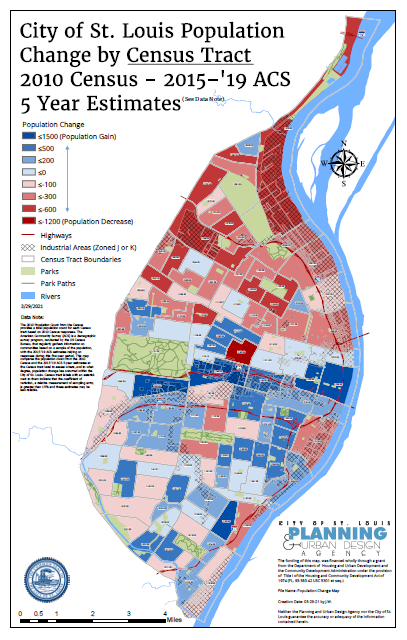
It's been like this for almost two decades now (north is to the right on this map):

I grew up not far from Galesburg, in a town roughly the same size. Many of the rural subdivision roads outside of downtown are paved with chipseal [1] rather than asphalt concrete or portland cement. While chipseal is certainly not as nice as concrete to drive on, it is much cheaper to maintain. I remember the road in front of my house getting re-treated every few years. Meanwhile the paved blvd connecting all these subdivisions hasn't been maintenanced since the 1980s, and is turning to rubble. So I personally think the problem (at least for small-ish midwestern towns) is the bias of state DOTs towards creating new infrastructure (paving new roadways / bridges) over maintaining the infrastructure they've already built (there's no ribbon-cutting ceremony when you're just filling potholes). Of course, this mentality only exacerbates the problem.
[1] https://en.wikipedia.org/wiki/Road_surface#Bituminous_surfac...
Yes, that's why that was the upper range. Note also that I did not restrict it to commuting — designing around car-only transportation means that almost every common activity becomes time spent immobile in a car, and people famously underestimate the amount of time they spend driving, looking for parking, etc. — usually “a 20 minute drive” means “25 minutes if you exceed the speed limit, hit every light, and there's minimal traffic and parking right in front”. If you start measuring that, you realize how much time people spend on things like unnecessary (we have relatives who'll spend an hour going shopping for like half a bag of groceries) or single purpose errands in addition to commuting.
> So I personally think the problem (at least for small-ish midwestern towns) is the bias of state DOTs towards creating new infrastructure (paving new roadways / bridges) over maintaining the infrastructure they've already built
Definitely — and one big factor for this is that single-occupancy vehicles are extremely inefficient so there's always this call to add more lanes or a bypass road to “defeat” traffic, but that reliably encourages more usage so conditions usually only improve for a few months after opening.
I find this very implausible. I grew up in Soviet block and all my friends and relatives grew in very dense small apartments yet all of them who could afford moved to houses as soon as they could.
My point was that when one style of living was picked as the goal and heavily promoted by policy it locked in a lot of negative outcomes like traffic jams and challenging local government finances.
Sure, the numbers say living like a meat popsicle is absolutely more 'cost effective' but that's a hard-pass from me.
You were contrasting a world that had about 150,000,000 people living it with today where we have about 7,800,000,000.
It's nothing to do with "class conflict", and all to do with load bearing. As things stand, we only just have the resources to support a fraction of those at Western living standards, and we damned well can't support the billions who haven't achieved them yet as things stand.
So yes, it's all about practicality.
And you and I are amongst the "patricians" already.
Also, don't pretend you know me at all.
I don't know if you are fooling yourself into thinking you are being rational and caring for environment and practicality but you are not fooling me.
Awhile back I read an observation which really stuck with me questioning how much of the nostalgia many people have for college is due to that being the closest many Americans come to living in a walkable, high-density environment. Most people could do a lot better than 1-2 hours a day in solo car travel soaks up.