Even in the latter case - there is limited benefit from jumping early vs. gliding towards civilization/possible landing sites.
IIRC dealing with engine out/glide contingencies is part of pilot training and licensing in the US
EDIT: the commenters on the FA also point out several distinct troubleshooting steps that are missing from the video including pre-engine failure signs + recovery steps, radioing ATC for guidance, flying above roads to ensure proximity to off field landing sites, and maintaining an updated list of off field landing sites along the route.
At the very least, several flying mistakes were demonstrated.
Recently got my Private Pilot License, emergency descents and planning for emergency landings is definitely part of the check ride.
There are very very very few situations where I'd imagine trusting my parachuting skills over my Cessna gliding skills. That thing is meant to protect you all the way down.
Comments in the article point out several viable landing spots are visible in the video including a (seemingly huge) dry river bed you can see just after the 5 minute mark.
I'm not a pilot (working on it) but my understanding is that most crash landing fatalities occur when the plane clips something like a fence or a power line because they couldn't see it on the approach or they miscalculated the glide angle. This causes the plane to suddenly pitch down and fall like a rock but the stall speed for a 1940s Taylorcraft is around 40 mph so as long as the pilot avoids obstacles, they can touch down and quickly dump enough kinetic energy so that the final impact is more like a slow speed auto collision on a residential street (minus airbags). The plane will be totaled, but the pilot will probably survive.
It's even possible to land up a hill [1] but that area is relatively rocky so I don't know how safe that would be
Edit: Forgot to add, with 40mph stall speed you only really need about a football field worth of space to safely land without totaling the plane, with a decent safety margin to boot.
Flying the aircraft just above stall speed into the side of a barn is far more survivable than entering a stall or spin at 200ft.
Pilots panic and yank back the yoke in denial that they're going down. Or they try to “stretch the glide” in hopes of making it back to an airport. Or if the engine failure is on take-off, they don’t shove the nose down fast enough (you literally have seconds to do so before airspeed gets dangerously low)
Still many reasons to doubt that there even was an engine failure, but that’s a separate question.
I don’t know if all pilots are trained to do this, but my instructor literally turned off the engine multiple times during training and had me land without power. Whoever made this video did it for show; incredibly irresponsible.
> The only reason to jump out of a plane is if you have 0 chance of landing it safely.
I understand that’s the responsible professional attitude. But if it was me in that plane and I saw a 10% risk of serious bodily harm / death in trying to land and a 0.1% risk in jumping, it would be tempting to jump.
As I understand it the landing attempt here would probably be on a dry river bed or a dirt road. That’s not the same thing as turning back to an airfield. There’s serious risk involved.
I would have attempted a controlled crash over gentle mountainous terrain like this. You want to dump the aircraft's kinetic energy rapidly but not suddenly -- gliding into the side of a cliff will kill you, but keeping the airplane pointed forward while shearing off the wheels and crumpling the nose is fine. It looked like there were several areas where this would have been relatively safe to attempt. You don't need a nice flat field for a survivable crash.
After you're on the ground, you also need to be able to survive (possibly for days), and then be visible enough to be found and rescued. Staying with the aircraft is usually considered the safer approach, both for visibility as well as the emergency gear that you're supposed to be carrying in the back.
The only terrain where I'd seriously consider bailing out (assuming I had a parachute) is dense forest with no clearings. Surviving a crash like this is incredibly difficult -- you hit a redwood, shear off your wings, and then plummet 250 ft to your death. It'll be hard to spot the wreckage of a small plane from above. Even with a parachute, there's a serious risk of getting stuck in a tree (or impaled by branches). There are basically no good options here.
In short, mountains aren't so bad. But be super careful flying over forests. If this video was a stunt, there's a reason why he decided to stage it over mountains rather than a forest.
One thing in these comments I haven't seen said: F*K that plane. Off runway landing has significant risk. Parachute is so close to 0.0 risk that you do it just for fun on a day off. I wouldn't do an off runway landing just for fun on my day off.
The thing is staged, no question. The guy knows he messed up and will pay for it. But if I had to decide between my life and protecting a bunch of metal tubes and (fabric | aluminium, not sure), I know what I would do.
The whole thing looks planned, but if I were in the same situation I’d definitely be jumping over trying to crash land a cheap plane in a riverbed or clearing.
This sounds pretty scary though… If you were an experienced skydiver, with your gear on, don’t you think you’d be tempted to jump instead?
Experienced sky divers get to choose their jump points and landing sites. They don’t get thrown out of the plane at an arbitrary time with no preselected landing side.
You would controlled crash the plane because you would know that jumping over mountainous terrain with vegetation is a great way to break a bone which is going to make getting the heck out of there really, really suck.
A plane like pictured is going to stall at like 40mph so that will be your approximate crash speed, which is really damn survivable in an aircraft with a 4pt belt to keep you off the hard bits of the cabin.
Risk of some bruising and maybe a concussion beats risk of broken ankle any day.
It's not so cut and dry as you might think.
> But if it was me in that plane and I saw a 10% risk of serious bodily harm / death in trying to land and a 0.1% risk in jumping, it would be tempting to jump.
I think your intuition is wildly off base w.r.t. the risks of general aviation and sky diving.
If you exclude experimental aircraft like fighter jets and kit builds, general aviation isn't much more dangerous than riding a motorcycle. The leading causes of death are misjudging the weather and miscalculating fuel because most of a pilot's training isn't in how to fly a plane but how to troubleshoot it midair or land safely if that is impossible.
An unplanned skydive in a mountainous area in Southern California during Santa Ana season? Now, that's risky. (Edit) For perspective, Nevada sky diving companies won't even jump over Black rock desert because of the wind and that's a desert so big and flat that it's used for amateur rocketry in the 100k+ feet range.
Sure, but now we’re talking about a situation where your engine has already failed… That’s very different.
What to do on engine failure is one of the first things they teach you after basic flight lessons. After that many instructors will even simulate surprise engine failure by cutting off the engine at random while the student is trying to learn about some other emergency situation. Engine failure is part of the check rides every pilot needs to pass to get a license.
When the engine stops working because it doesn't get enough fuel because there's nothing left in the tanks, the root cause is not putting enough fuel in the tanks, not engine failure.
Here https://news.ycombinator.com/item?id=29731719 it seems like you are essentially saying "engine failure is not too dangerous; one of the leading causes of death is running out of fuel".
I did not say running out of fuel should be formally classified as an engine failure. It was more that I supposed that the effect on the airworthiness of their airplane should be approximately the same whether the engine stops due to failure or running out of fuel. So that makes your comment appear contradictory. Hence my prompting for an explanation, I'm quite willing to believe I misunderstood something of your post or about aviation so I didn't intend for it to sound glib.
I think it's pretty obvious this was staged and he very carefully chose the landing spot.
Of course. Point is, risk does not actually turn that way. Parachuting into rocks is not exactly safe and easy either! Vast majority of pilots are much more trained to safely land than to safely parachute. Movies give us this idea that you pull a cord and land feather like. That is empathically not the case. Especially for an untrained person, parachuting on safe ground will break your limbs virtually guaranteed.
Small airplanes have very low stall speed. If you fly into the wind you can have your land / crash speed very low and very controlled, you are trained to find best possible spot, and are buckled inside metal chassis.
I genuinely believe most licensed pilots would stay inside the damn plane :)
So if the person is an experienced skydiver, doesn't the equation change towards ditching the plane?
Mind you, no one is arguing whether the video is real or not, that's conclusive that it's likely fake. But what if an experience skydiver was actually in this situation?
Its also important to remember that wilderness does not mean people are not there, so if you do something stupid thinking noones around so noone can get hurt, you might still hurt someone.
And just because people aren't directly in the path of a falling plane doesn't mean that the pilot isn't putting people's lives at risk. The recent rains have improved the situation a bit, but a plane crash in the remote mountains of Southern California? That's how you get wildfires.
I think he should still follow the procedure far further than showed in video (where he doesn't follow ANY), and I still feel he should have tried far harder to find a landing spot - cessna 152 has 11 to 1 glide ratio, which means for every foot of altitude you can travel 11 feet of distance. I imagine his airplane has roughly comparable gliding distance so given his original height, he had a LOT of time and options he seemed to have immediately squandered. At best, assuming reality, that feels like a yahoo parachuter rather than methodical pilot, and not advice / approach to follow.
if skydiver has a pilots license he will always prefer to try to land it, unless the wings broke off
While I have never flown a plane nor parachuted, my understanding is that the maneuverability options of both are going to be roughly equivalent, so that either option will have roughly the same ability to choose the site of collision and (for small aircraft) even roughly the same speed at collision. And that makes the choice down to having a layer of metal that can absorb some of the impact for your versus having to be in the exactly correct position to absorb the impact energy best with your body.
Mind you, those planes stall at much higher speeds, and those pilots all wore parachutes and trained on how to bail out if needed. But I wouldn't go so far as to say there's never any reason to jump.
I agree the video looks intentional.
https://texashistory.unt.edu/ark:/67531/metapth873939/m1/76/
"Never attempt a night landing except on a lighted field. So if you are completely lost at night, you have no other choice than to jump. Climb to at least 3000ft (above the terrain), trim your airplane for level flight, cut the switches, and bail out. It may be heartbreaking to crash a fine airplane -- but it beats cashing in your own chips."
"If your fuel supply is running low, if the terrain (mountains, swamps, water, or heavily timbered area) offers no possible landing place, you must bail out."
"If there is no suitable field and the weather is closing in from all sides, climb to 3000ft, trim your airplane, cut the switches, and bail out."
Beyond that, if you're flying an airplane, I think you have some responsibility to not jump out at the first sign of trouble.
I agree, and in the video it looks like he abandons ship very quickly. But there could be a section of video edited out.
EDIT: It doesn’t help his moral case that he’s carrying a selfie stick though, and is filming himself as his plane is potentially landing on someone.
As the saying goes, "The captain goes down with the ship."
There's a great clip of him parallel parking a tail dragger at some fly in on the side of a mountain somewhere in his videos.
> > skydiving rig
> Is this because he is already a skydiver and/or was going paragliding (is this the same rig? Another thing I don't know). Would it make sense that this is just "what he has," as opposed to owning both a bail out and a sky diving kit?
Not really. Those are really different material, with really different design constraints. Skydiving parachutes open slowly so they aren't a good fit for an emergency situation because if you have to leave the plane too low, you're pretty much dead, and as long as your plane is still high in the sky, I guess there's little reason to leave it…
> > long/stable freefall
> What is the norm for this? My thinking was this was to distance himself from the plane, which he later mentioned "came back around him" after he pulled.
AFAIK safety parachute don't open well at high fall speed (unlike skydiving ones) so you want to open it quickly and not enjoy your freefall.
Also, there are other videos of this guy flying without that rig, which doesn't help his case.
It's true that there might be video cuts, but just visually guesstimating, there's very little altitude difference between when the propeller stops and when he jumps.
> Is this because he is already a skydiver and/or was going paragliding (is this the same rig? Another thing I don't know). Would it make sense that this is just "what he has," as opposed to owning both a bail out and a sky diving kit?
Paragliding gear is even more bulkier than a skydiving rig, there's various types depending on the flying you want to do, but here's a typical example: https://qefimagazine.com/wp-content/uploads/sites/303/2018/0...
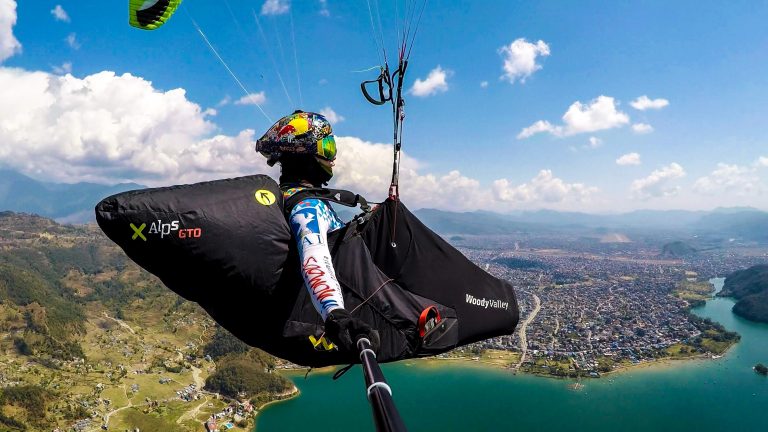
Even if he is a skydiver and pilot, you want to use the right tool for the job
- skydiving rig: larger, main handle is out of sight, has more snag points, built to stop you from terminal velocity (~120mph/200km) so the opening distance is higher
- emergency parachute: small, usually just one handle which you can see and very hard to snag on anything, meant to be opened in under 3s after jumping, definitely not for terminal velocity kind of speeds
> Wasn't it mounted on the plane dash, and he took it with him when he bailed?
I re-watched the video now and you're right, it's a selfie stick in his hand, as he moves the camera from one hand to the other. Another "unlikely things a pilot does in an emergency" from my side then.
> What is the norm for this? My thinking was this was to distance himself from the plane, which he later mentioned "came back around him" after he pulled.
This ties in to the parachute type mostly, for rescue situations with emergency parachutes you want to pull ASAP, as the plane will usually fly away anyway (excepting maybe spins, but then it's pretty hard to exit anyway)
Well, these youtubers are strange people. It doesn’t strike me as that odd he’d consider his fame before his safety.
Are you sure about that? Then you would have to bring some planes to stall speed first in order be able to bail out. Sounds like a huge flaw…
We don't need to know this. We can clearly see ample altitude at the time he abandoned the plane. Although there are reasons to jump at great altitude (severe fire, etc.) none of those reasons are apparent here.
When a competent driver loses engine power while driving they do not immediately stop their vehicle in the middle of the road. They will use the available momentum (pulling to the shoulder or whatever) for the benefit of their own safety and the safety of others, and ground vehicles are deliberately designed to achieve this. The analogy for (conventional, fixed wing) aircraft is altitude; this pilot wasted available altitude for no discernable reason despite the fact that he had a perfectly functional glider.
No competent pilot would do that. So the best case here is an incompetent pilot that shouldn't hold a license. All other possibilities are some form of attention seeking fraud and also reckless endangerment.
It's easy to identify the Y shaped delta of the mountain ridges just 2 clicks north of the Manzana School Camp, with the plane travelling westwards. 34.8081872, -119.9438522.
Given the near service ceiling altitude the dude had plenty of opportunity to double back to eg 34.7683290, -120.1101663 . Not exactly sure how much gliding range it has, but can go to just over 60km/h before stalling, and can't be radically different from a Cessna which will do "1.5 nautical miles per 1,000 feet of altitude above ground level". The landing gear appears made for grass fields.
Of course, one might speculate, given lack of in-plane footage and everything else, he could also not have throttled the airplane and landed it normally instead of pulling this pathetic stunt. Ie it appears reasonable to assume that the entire thing is a complete fabrication.
Who carries a hip altimeter (a few frames of 4:03) and full parachute when flying, as well as covering every angle of the "emergency departure" with GoPros, not a single frame of the "emergency" instruments despite another GoPro in full view, freefalls for ages instead of taking their time to assess etc, then avoids several flat spots including flat riverbeds that were a great alternative to doubling back if completely panicking on basic arithmetics, only to land in dangerous bushes instead "for the views". And then complains of being so so thirsty whilst carrying the whole chute around in his "life and death" situation.
Look at the YouTube history, the guy's pathological prankster.
Lots of camping sites and such in the area, just look at the coords in your favourite map provider. It was reckless beyond belief.
Should I not be wrong with my analysis (having spent a few hours reviewing this), I hope he goes to prison for a very long time.
Reckless self endangerment maybe? But that also doesn't seem to rise to the level of "put you in jail".
If the crash was intentional, then he's certainly liable for violating littering laws by depositing a moderate amount of wreckage in the mountains which he didn't clean up. Again, not worthy of prison time. Probably a hefty fine though.
Last I can think of is if he makes a fraudulent insurance claim; in that case then yeah he might be eligible for jail time, but I don't think we know whether he filed an insurance claim in the first place.
"Reckless endangerment", or whatever it's called when you let a plane crash where it may -- i.e, potentially onto people -- in stead of bringing it to a controlled glider landing? If you let your car coast on in traffic and bailed out at speed, in stead of rolling it to a stop on the hard shoulder, then you'd get caught for dangerous driving, wouldn't you? (Should you not?)
For more perspective, in the mainland US, the furthest you can get from a McDonald’s, let alone a rode, is 107 miles as the crow flies.
A Cessna can glide 9000 feet per 1000 feet altitude loss so at 10k feet that thing can go roughly 17 miles.
A 17 mile radius gives you 900 square miles to find a place to land. Even deep in the Rockies wilderness areas I’m familiar with, there are going to be several forest service roads available and plenty of natural clearings with that kind of range.
I had the exact same thought. If you look at 3m53s in the video, he has both a camera in his hand and the other GoPro remains on the dash.
> Is this because he is already a skydiver and/or was going paragliding (is this the same rig? Another thing I don't know). Would it make sense that this is just "what he has," as opposed to owning both a bail out and a sky diving kit?
Another set of comments discuss that traditionally pilots who might consider using a parachute generally bring a different type of parachute on board, and not one that would be used by normal skydivers: https://news.ycombinator.com/item?id=29730298
Hmm, I see what you're saying - is that a second camera or a mount though?
The most suspect thing is jumping with a selfie stick.
And:
(1) GoPros are a lot cheaper than $500.
(2) GoPros are a lot cheaper than any flyable airplane.
Of course, I wouldn't fly in a plane with a pilot who had and used a selfie stick in flight, so my judgement clearly isn't up to that of YouTube Famous Stars.
(2) He (supposedly) couldn't save the plane, but taking the GoPro takes 5s.
> used a selfie stick in flight
Everyone keeps talking about selfie stick, it was just the normal leg attachment, not a "selfie stick": https://i.imgur.com/hOkcxOa.png

> "great footage of it" isn't a priority at all.
Where is this "Great footage"? He's literally just holding the camera by the leg attachment. Half the falling footage is just his feet or chest, and that's already the heavily trimmed version, which I assume he only kept the better part of the footage.
Again, to me it just seems like he grabbed whatever he could quickly and jumped out, which is a natural instinct.
You can also see much better landing spots when he's hanging in the shoot that he could easily make. So why the hell did he end up in a bush like that?
And why go look for the plane? Like just focus on getting to safety. Nothing in this video makes sense.
You would attempt to go back to civilization ASAP...Unless you'd need to, for example, reenable the magnetos/fuel switch in order to avoid "embarrassing" questions from the authorities.
Radio, food, water, warmer clothes, first aid kit, and weapons are all things that are plausible to have in the plane that would be nice to have when trying to either hike out or get help.
Needing to return to the crash site to destroy the evidence feels like a very forced narrative to me (though I know nothing about flying).
But I agree it's not the strongest argument
Landing in a bush and climbing out from bramble is also more dramatic.
Let's say instead they did pull the chute immediately after bailing and then used the extra altitude to sail back to safety. Would you be more inclined to believe the stunt was real?
> gave up too early
You and a couple other commenters mention this and not trying to land. Do we know how long it was before he gave up? Did he float 15 minutes before bailing after failing to restart, and that's just not included in the video? I understand landing on a small road would be possible in a plane like this, but since he's over mountains (3rd disclaimer, I don't know this area) - is it likely there would be roads available to him?
> skydiving rig
Is this because he is already a skydiver and/or was going paragliding (is this the same rig? Another thing I don't know). Would it make sense that this is just "what he has," as opposed to owning both a bail out and a sky diving kit?
> gopro on wrist
Wasn't it mounted on the plane dash, and he took it with him when he bailed?
> long/stable freefall
What is the norm for this? My thinking was this was to distance himself from the plane, which he later mentioned "came back around him" after he pulled.
I don't have any opinion either way, but I'm curious to know more about why some of these details are "give aways" on it being fake