Goldfish grow to fit their containers. Keep a little 1-inch goldfish in a bowl, it’ll stay that size. Toss it in a koi pond and in no time you’ll have something approaching the size of a housecat.
People are like this. A family might be scratching by on $40k/year. Dad gets some windfall or promotion and is making $60k/year. So did he finish out the year in the same house with $20k in the bank? Of course not, he’s paying for all the clothes and goods that he couldn’t afford before.
Ten years later he’s gotten promoted to making $120k/year. Now is there money in the bank, or are they living in a bigger house and driving a nicer car?
This is what worries me about any climate plan that is only based on clean energy. If driving, for example, gets cleaner, do we use 50% less petroleum, or keep burning the same amount of petroleum on different projects? (And what about all the non-tracked pollution caused by tire wear?)
This problem is even more stark when people talk about atmospheric carbon capture. If we're emitting X tons of carbon per year, and recapture Y tons, will we continue to emit X, or start emitting X + Y?
None of this is reason not to pursue renewables and electrification, but I think it’s inescapable that any "primary solution" has to be a reduction in consumption.
Just like a software team scaling a product is going to discover new scale issues, we discover new externalities on a regular basis.
Hoping that we can discover all externalities ahead of time and price them is an impossible objective.
I think reduction in consumption has to be part of the solution too.
France goal to meet Paris agreement is actually to reduce by ~5% per year ALL energy consumption. -5% is roughly what we had with 3 lockdowns in 2020. So it's basically a COVID added to a COVID each year, for 30 years.
That's no matter what you do in your actual energy deployment and investment.
In much the same way that keeping a puppy in a tiny kennel full of it's own filth will stunt it's growth.
https://www.tfhmagazine.com/articles/freshwater/goldfish-myt...
Germany: 2x the French nuclear capacity in wind and solar + coal and gas (edited): 398gCO₂eq/kWh
France: nuclear + a bit of hydro and renewables: 46gCO₂eq/kWh
* Keep the nuclear plants open until we transition fully to renewables. In the meantime:
* Get LNG from the US or natural gas from the Russians depending on market prices. (Ignore those threats/boycots from the US wrt Nord Stream 2 gas pipeline, show some cojones)
How hard could it be?
They aren't the main cause here. Environmental parties in Europe have historically been built from anti-nuclear groups, and their involvement against commercial nuclear energy is ancient.
If you don't have way to produce in a stable matter, NOW (not in 20 years when we might have the tech to store a crazy amount of electricity across the months) your electricity you have to import it or burn what you have in your country. France choose to import uranium.
Or we go 100% renewable, but we need to start discussing about a society where electricity is not 24/7 available for a major part of the population.
Electricity consumed by source 2020: Nuclear 28% Electricity by combined heat & power production from central heating & industry and other thermal 25% (about 50% split bioenergy vs fossils) Hydro 19% Import 18% Wind 10%
Altogether electricity production is 52% from renewables.
Source: https://www.stat.fi/til/salatuo/2020/salatuo_2020_2021-11-02... And: https://www.motiva.fi/ratkaisut/energiankaytto_suomessa/sahk...
Sure, doesn't solve the night issue. Having energy is something, having a stable production from a very diffuse and non stable one (day/night) is something else.
> Iceland power near 100 percent of its electricity from renewable energy, using their abundant geothermal and hydro supplies. Renewable energy can also dominate electricity needs for more populous countries too.
So geothermal and hydro.
> About 80 percent of Brazil's electricity needs for its 209million people come from renewable sources, biomass and hydro mostly. On average, however, renewables power ~29 percent of electricity around the world. So can renewables reach 100 percent for populous countries?
So biomass and hydro.
> He argues that *there is a heavy reliance on hydro and biomass sources* - while most countries don't have access to these, so would be reliant on sources like solar, wind, and storage. In those circumstances, it's highly unlikely for renewables to power 100 percent of the electricity supply he says.
Well thanks, the article itself is making the point I want to make.
The nuclear part in both countries also face the problem of long term storage that isn't solved by either one of the countries.
More importantly “Capacity” isn’t a useful metric for comparison when nuclear costs are an order of magnitude higher for capacity. Even with a 2x increased capacity factor nuclear is still several times more expensive per kWh. So in terms of actual investment in carbon neutral sources France has spent roughly 4x as much as Germany to get that reduction. It’s an admirable sacrifice by the French people, but the ROI in terms of money spent vs CO2 reduction is quite poor.
They made 6 scenarios, from "100% renewable" (M0) to "50% nuclear-50% renewable in 2060" (N03). And here is there result cost wise: https://www.connaissancedesenergies.org/sites/default/files/...
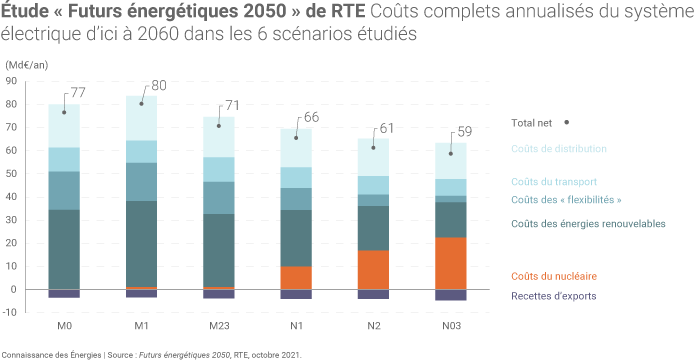
N03 means we actually restart building nuclear plants and maintain the existing ones longer than expected. And yes there is 50% of renewable, because France didn't do anything for 20 years and it's "too late" to replace and extend the existing ones.
There are compelling arguments against nuclear in France (namely the aging of the existing reactors and the industrial inability to ship new reactors because we've lost most of the learning curve after several decades without significant reactor construction) but imaginary subsidies ain't one.
I know Retric won't change their mind, but I hope other readers won't buy their bullshit.
The most obvious French subsidy for nuclear is who pays for possible 500+ billion Euro nuclear accident. The Paris Convention and the Brussels Convention both require insurance for nuclear accidents, but cap liability to operators with the difference being made up by taxpayers.
That’s an easy to verify subsidy, as was the recent bailout for Areva S.A., I could go on but subsidies get convoluted. Pressure from the French government for people to use electric heating, well it’s in support of the nuclear industry but not really a “subsidy” or is it? Let’s say no.
What about low interest government loans? Sure that’s an obvious subsidy.
That's stretching the meaning of the word “subsidy” quite a lot…
> That’s an easy to verify subsidy, as was the recent bailout for Areva S.A.
Oh please tell us more it's gonna be funny because you obviously don't know what you're talking about.
> Pressure from the French government for people to use electric heating, well it’s in support of the nuclear industry but not really a “subsidy” or is it?
Oh you mean the type of heating that's been FORBIDDEN in new building for a decade? Please be serious…
> What about low interest government loans? Sure that’s an obvious subsidy.
Yes, too bad it doesn't exist. (In France, UK has some kind of state-guaranteed loan for Hinkley point, but that's not the right country and not “low interest loan” either).
> obviously don't know what you're talking about.
Please enlighten us: European Union antitrust regulators approved the French government's plan to inject 4.5 billion euros ($4.8 billion) into embattled nuclear group Areva AREVA.PA, saying the rescue would not unduly distort competition. www.reuters.com/article/us-areva-restructuring-eu-idUSKBN14U1L0
PS: Hinkly is somewhat interesting as the French government has a major stake in the UK power plant. Digging into the financing gets rather interesting.
So, by your logic we were building new plants for no apparent reasons in the 80-90s, and to make it useful we decided to force people to use electric heaters to boost consumption. You couldn't imagine that there were no conspiracy to build nuclear plants for the sake of it and the logic actually went the other way around? After the oil shocks the French government decided to become more energetically independent. At this time most of the heating was provided via fuel oil boilers, so it was highly dependent on the international price of oil. So the government decided to encourage people to use electric heaters instead, and then built nuclear plants to provide the needed electricity. (the reader will note that this is a clear example of Brandolini's law, where the amount of effort needed to refute bullshit is significantly higher than to produce it).
> Things have clearly changed over time, but I am unaware of any current regulations banning new homes with electric heating.
So maybe you shouldn't talk about a country you don't know? “Réglementation Thermique 2012” (more commonly called “RT 2012”) is what you're looking for. And it was the biggest and most disruptive construction law ever, and was discussed in depth for years. Anyone with a least a minimal awareness on the French energy issues will inevitably be aware of it.
> Please enlighten us: European Union antitrust regulators approved the French government's plan to inject 4.5 billion euros ($4.8 billion) into embattled nuclear group Areva AREVA.PA, saying the rescue would not unduly distort competition. www.reuters.com/article/us-areva-restructuring-eu-idUSKBN14U1L0
Thanks, this cherry picking from the first Google result you could find illustrate my point about you not knowing the topic. Do you know the difference between a shareholder restructuring an asset and a state bailing out a private company? In the first case, the shareholder is actually rewarded the capital investment through its return on equity. Since Areva's restructuring, the French government has already been paid back through EDF's dividends. (of course these dividends aren't directly the result of the said restructuring, which is still bearing fruits, but simply the result of the recurring revenue that EDF brings to the French government ever year).
[1]: it was not heat pumps (which would be terrible for the job of artificially increasing consumption anyway because of their high yield) but plain convector, which where much affordable.
It’s a little more complicated. RE 2012 arguably does favor gas, but it does not requires it. However RE 2020 as of 2 days from now changes things back to electricity and for homes under construction is what’s actually in effect.
Sorry, if you’re using outdated information but the industry has moved on.
But interestingly enough, two comment above you were “unaware of any current regulations banning new homes with electric heating.”and now you've suddenly become an expert on the topic of French construction law… I like debating with people with opposing views, but discussing with people who are compulsive liars isn't my cup of tea. Good day.
> it doesn't allow electric convectors back in new buildings.
What part do you think bans electric heating? It’s simply not there in RE2012 or RE2020, hell people are actively talking about how RE2020 is switching to electricity from gas in new construction. I can’t prove a negative here, if you think something is banned you’re going to have to show where it’s banned.
The wider context is France is primarily on electric heating be that ultra efficient ground source heat pumps or more traditional regular heat pumps. So yes they changed the regulations recently RE2012 after achieving the desired effect and are now changing them again in RE2020.
PS: This comes back to a winder context the legacy of past subsidies don’t go away. When someone builds a wind farm or nuclear reactor with government backing even just for R&D costs and thus ends up with lower payments those lower payments stick around. Just as someone being given a house avoids mortgage payments for the next 30 years.
Clean up costs in Fukushima will total about $1 trillion.
Probability of a core melt accident in 1 year or reactor operation is apparently 1 in 3704.
Insuring for that much with zero profit margin would be $269 million per year per plant.
That's about 1.5x-2x the cost of operating a nuclear plant.
It's a lot of money to handwave away.
My point was more to show that even you have a huge quantity of renewable, that doesn't means that is the correct path to go CO2 wise. Except if you accept that your society adapt itself to a non planned and highly variable electricity production.
Problem is, that is currently only 1.4GW of capacity. We'll need a whole lot more of it to get fully off gas or nuclear.
In my opinion, existing tech is able to solve the climate crisis. Breakthroughs can make the solution cheaper and sooner.
In my view the main problem is the attitude of doom amongst the general population. If people felt there was a solution, and were excited and energised by the challenge, they'd be more willing to support political changes. I.e. pushing back against entrenched obstructionist industries, pricing externalities, and investing in infrastructure.
[1] https://en.m.wikipedia.org/wiki/Ocean_thermal_energy_convers...
Not until grid-scale energy storage is widely available and affordable.
E.g. hydrogen electrolyseurs + gas plants that can use H2 exist and aren't particularly challenging. The reason you don't see that yet is that we don't have the huge amounts of renewables that would need this infrastructure yet.
An assertion that "renewables and electrification" solves our energy problems is just circular reasoning. It requires a non-existent technology (grid-scale long-term energy storage) and so doesn't fall into the category of "solution" and more into the category of "speculation".
https://www.energystoragejournal.com/southern-california-edi...
Or the 1GW they already have?
BTW I'm baffled to see a website called “energy storage journal” mixing up energy and power like this …
The New Zealand south island electric grid is almost entirely grid-scale energy storage, in the form of hydro. Easy to recharge (pump water uphill, although NZ doesn't need that), easy to tap (open gates).
Whether it can be, or is, or will be deployed is another question.
A lot less storage is needed than most people think. We only need about 3 hours worth of storage. That's a lot, but it's feasible.
This doesn't align with the analysis that I've seen. For example in this post (https://www.manhattancontrarian.com/the-disastrous-economics...) the analysis shows that California would have to spend about $5 trillion on battery storage to have a solar+wind+battery grid.
If the book you reference was accurate we would be seeing headlines about power companies bragging about these new grid arrangements but instead I just see headlines about how India an China are moving ahead with enormous amounts of coal power plants, rapidly increasing energy costs where intermittent power generation is a significant fraction of power capacity (i.e. Germany), and power outages when base load generating capacity isn't sufficient to keep the lights on when the sun sets and the wind dies.
Yeah if their assumptions include a month or more then you can end up with an astronomically big sum. Also you don't need batteries for all your energy storage and they use todays battery prices to come up with that number.
For instance:
> Yet even in systems which meet >90% of demand, hundreds of hours of unmet demand may occur annually.
and
> satisfy countries’ electricity demand in 72–91% of hours (83–94% by adding 12 h of storage).
So not 3 hours and still significant number of days without power.
Capital cost of a simple cycle combustion turbine power plant: $500/kW Capital cost of a nuclear power plant: $10,000/kW
So, one can have this backup sitting there ready to go for just 5% of the cost of an all nuclear grid. You do need the fuel, but if it's only used a few hundred hours per year the fuel cost will be minor.
I believe the appropriate units for consideration would be GWh = gigawatt-hours.
This article, https://www.environmentalleader.com/2021/01/worlds-largest-u..., suggests that the largest battery storage system is 1,200 MWh or 1.2GWh of storage (at a cost of $400 million)
For comparison, all generation capacity in California is 272,576 gigawatt-hours https://www.energy.ca.gov/data-reports/energy-almanac/califo...
One is how many Joules it can deliver in a second (Giga/Mega/Kilo/watts)
One is how many Joules it can delivery completely (Giga/Mega/Kilo/watts) it can deliver
If I'm running my 10kW shower for 5 minutes, I can do that from a battery that only has 1kWh of storage, but I can't run it from a battery that can only deliver 1kW.
This is all high-school level science, and it's an indictment on the lack of diversity in news reporting how badly they get it wrong
Each wind turbine essentially transfers power out of the wind and into our electric grid, right? Is it possible we could build enough turbines for that to be a problem?
The short of it is that since wind exists because of temperature differentials, each wind farm increases them.
>Using wind turbines to meet 10% or more of global energy demand in 2100, could cause surface warming exceeding 1 °C over land installations
This book contains a very practical roadmap on how we can do this quickly, cheaply and practically: https://mitpress.mit.edu/books/electrify
In this thread from yesterday I answer most of the standard objections: https://news.ycombinator.com/item?id=29721417
P.S. The people agreeing with me mostly got upvoted and the people disagreeing mostly got downvoted, so read from the bottom if you want to see answers to objections.