Now, obviously, that's not the case with all education, but my next gripe with it is the seemingly insurmountable debt that said education brings. Literally, all of my friends that have gone to college are no where near paying their debt off and I'm in my late 30s.
Finally, that in of itself, ya know, maybe that's like the licks you gotta take when you're trying to rise up in the world, but the fact that educational debt in America can never be voided through bankruptcy seems like a conscious systemic decision to create debt slaves.
And, while my parents, have been relatively ambivalent about education, almost everyone else in my family has gone out of their way to emphasize the importance of education. I just can't get over the previously mentioned hurdles.
I grew up lower middle class - not poor - took on a healthy amount of debt to get a CS degree from a crappy college in West Virginia.
Most of my classmates are doing quite well, and I'm working at Google - with a fellow classmate, literally in the 1% now (both of us, out of a class of only 8).
I know plenty of rich kids who went to Stanford and studied philosophy or underwater basket weaving, and they're killing it.
But that doesn't mean poor people have no opportunity. Sure, it's not equal. But it's far from hopeless.
I think there's a lot of people who look at the world and see how unfair it is and think: why even try?
The world is not fair, never has been, never will be even close to it. You just have to accept where you started from and try your best. And we can try to push for a fairer world, but don't hold your breath. If anything, inequality is skyrocketing and the world is becoming less fair.
As someone who grew up lower middle class and leapt many, many income deciles, what ideas do you have to decrease income inequality? For example, you say that you are in the top 1% now. Do you favour increasing your own personal tax burden to help offset income equality?
My marginal tax rate is ~48%. I think that's already high enough.
The idea that there is no wealth tax - and that the Fed arguably gives people a negative wealth tax - that seems a little off to me.
The median home owner has about 3:1 leverage on their house - with a home value that's 4x their income. The Fed has been pumping up house prices by a couple percent per year for 13 years.
.02x4x3=.24
The average home owner with a mortgage is getting an ~24% negative income tax. The median tax payer has a ~22% federal tax rate. Effectively, this is a -2% income / wealth tax.
This seems incredibly broken. We've created a society of haves and have nots. People willing to speculate on government handouts on their mortgage are wealthy. People not willing or unable have almost 0 wealth.
I'm in the 1%. Do I deserve to be? I don't know. But by definition, someone does. I make ~4x the median laborer after taxes and transfers. This doesn't seem broken. In my state, I make ~9x minimum wage after taxes and transfers. This also doesn't seem broken. Maybe others think differently?
Before taxes and transfers, the numbers seem much more extreme. That seems irrelevant to me.
The top 1% in wealth have ~100x the wealth of the median person in my state. That seems broken.
My view: If you really believe in reducing income inequality, there is no shortcut. You need to pay. How else can we fix this issue? Beg private corporations to give huge pay rises to medium- and low-skill people? (Don't wait for it!) We need a tax code that forces the 10%/5%/1%/0.1%/0.01%/etc. to pay geometrically increasing effective tax rates. I have never seen an alternative solution that will actually work. Yes, it is painful, but what kind of society and world do we want to create?
Why should it follow that people who break from a culture of poverty should be forced to support those who do not? It smacks of the “black tax” described in the article - a response that undermines the good that could otherwise follow from greater employment and productivity.
What happened to those who didn’t study CS? How are they doing?
We far too frequently look into our bubbles as if they reflected the world around us. They don’t.
The rich kids I knew are all doing way worse than their parents. Not surprising? It's hard and takes a lot of luck to be in the 0.1%.
All of my friends are doing quite well, almost all of them better then their parents.
Is this anecdata helpful? Did I self-select to be friends with successful people? I don't know...
Look, I'm not Joan of Arc - didn't claim to be. There's not a whole lot more else you can do...
~$300k after taxes isn't going to change the world.
Can't you just hack this by going to school for pretty much anything you're interested in and being able to work in an unrelated field?
> my next gripe with it is the seemingly insurmountable debt that said education brings
You've established that education is a good investment. So why not find an affordable college? It's not as important which college you go to or what major you select from your first paragraph. So find a cheap city or state school. Most of the debt comes from people going to private schools. I don't know where you live but NYC for instance is one of the most expensive cities in the world, but they even have a great city university (CUNY) which costs NY State residents around $7k a year, which is definitely reasonable.
My friend often comes to me and says, "Hey, man, how come you don't invest your money in <x>?" Because I'm living in poverty. People who live in poverty don't have money to invest.
> So why not find an affordable college?
So I did a quick calculation. Affordable, meaning junior college and public state college, would come out to roughly $23k for a bachelor. Maybe round it to $30k. When I was paying off my car, which only come out to about a little over $10k. Two years of having to work JUST to pay that off felt really, really uncomfortable. A college infused starting salary would probably only pay about 1 and 1/2 times more than what I was making then and the idea of having to do that for even longer without being able to absolve myself of it through bankruptcy is not something I want to do.
> Can't you just hack this by going to school for pretty much anything you're interested in and being able to work in an unrelated field?
That particular situation doesn't apply to every job. It seems like its mainly tech jobs I see that in and I'm not 100% certain I'd want to work to be forced into a tech job.
So I'm trying to think of the best way to explain this because I feel like I'm going in different directions but it seems like there's two paths:
1) go to college, accrue debt to get a job then work at your job for 5-10 years to pay that debt off
Barring someone making sure I have the proper technical bonafides, I'm philosophically opposed to getting a piece of paper for a job that I could do just as easily without a college education as I could with one. I also feel really uncomfortable with debt in general, especially debt that I cannot choose to have absolved through bankruptcy.
2) live at the lowest possible means necessary and eke out a living as best you can
As it stands now, my current expenses are no more than $500 a month (including rent). My biggest challenge, currently, to maintaining that type of lifestyle is getting remote work that I can do on an ad-hoc basis that will allow me to stay under the income necessary for government subsidies.
You wrote below this line that your current expenses are $500/month. The poverty line is currently $12,880. Even if you are making one half of that (which is hard to believe: $6,440/year works out to $3.10/hour), you would still have $440/year to invest. You wrote elsewhere that you are in your late thirties; $36.67/month invested in the S&P 500 over the last 15 years (which has returned 8.4% over that time) would be worth $13,195.76 today. That is not a lot for folks above the poverty line, but by your own math that works out to over two years' living expenses. Over the course of forty years at the same long-term rate one could expect to have enough saved up for twenty-four years' expenses.
Or you could invest it in something with a greater than 8.4% return … such as a college education.
> I also feel really uncomfortable with debt in general, especially debt that I cannot choose to have absolved through bankruptcy.
Debt can be a problem, but it can also be a solution. Borrowing at X% and investing at Y% is a great idea when Y > X (of course, if Y or X is not constant, then there is a risk that Y < X at some point!). When Y >> X, as in the case of going to college for a marketable degree, it is an easy decision.
Also, people who come to college later in life tend to do better than average, because they want to be there, and have more maturity and discipline to do the work necessary.
I'm not saying college is the right choice for you, you do have important considerations that you're clearly weighing against each other. But, I am saying it may have more in the "pro" column than you credit it for, and there are also some non-loan subsidies that open up for students as well.
But yeah, student loans suck. A lot. For sure!
You have your time and energy to invest, and you can get an educational loan.
" then work at your job for 5-10 years to pay that debt off"
I don't think all of your money goes into paying off the debt during that time.
"I'm philosophically opposed to getting a piece of paper for a job that I could do just as easily without a college education as I could with one"
Well if you don't need it and don't want it, obviously don't get that degree.
" I also feel really uncomfortable with debt in general, especially debt that I cannot choose to have absolved through bankruptcy."
Since you have established you can earn as much without a degree, and it takes 5 years to pay off the costs, you could also work for 5 years and save money for the degree.
"Well if you don't need it and don't want it, obviously don't get that degree."
The concern is that, according to parent, and I believe parent, is that the system requires a useless piece of paper. The degree is more an economic hurdle than a proof of capacity. That merit is a social construct.
Apart from that, while the usefulness of some degrees can be questioned, there is a general concept called "signalling" which has actual value. That is you demonstrate certain qualities in a way that are difficult to fake (usually by doing something costly, like getting a degree, or carrying around a huge tail if you are a parrot).
This probably wasn't the situation prior to the USA population tripling over the last 70-80 years while tech/automation has acted as a limiting force to job growth. It's easy to say the cost of college has skyrocketed because of cheap non-discharable debt but it's pusdo-requirement has also caused demand to skyrocket too.
The two options here are that either all the businesses using college degrees as a signal are wrong and they could be saving a lot of money by hiring non college educated applicants for slightly less pay and building them up.
OR college education is a useful signal and so businesses are willing to pay a higher price for it.
If the prior were true, then I would assume a business would have developed already to take advantage of the arbitrage opportunity. It is not a novel or less known idea.
It would be better if we found ways to let young people get into white collar and middle class professions without spending $100K and four years of their lives. This used to be possible. I'm quite sure it could be done again, but collectively we're not going to go there. Yet, anyway.
Sure, but it answers the question of why a degree is “needed”, and that is given the supply and demand curves for labor, the suppliers of labor need it to compete with each other.
> It would be better if we found ways to let young people get into white collar and middle class professions without spending $100K and four years of their lives.
Really simple, remove all taxpayer funded (including guaranteed) education loans, and any special bankruptcy protection they might have.
And by all means, keep complaining and if you have some power, use it to fix the system. But don't incentive people to act in self-defeating ways.
There are certainly a lot of useless majors. But that doesn't imply all of them are useless.
"the fact that educational debt in America can never be voided through bankruptcy seems like a conscious systemic decision to create debt slaves."
I'm not in the US, but isn't the rationale for that construct to make people more credit worthy? Ultimately you have to convince somebody to give a random person a lot of money on the odd chance that they'll finish their education and earn the money back. I suppose if you don't like "educational debt", you could also try to convince somebody to give you another type of loan.
It's not so much a critique of the majors but rather the professional requirements of the job listing. For jobs that don't have an innate technical (technical in the loosest sense of the term) requirement, they only want a certain class of person working there and college degrees are just how they do that.
> I'm not in the US, but isn't the rationale for that construct to make people more credit worthy? Ultimately you have to convince somebody to give a random person a lot of money on the odd chance that they'll finish their education and earn the money back. I suppose if you don't like "educational debt", you could also try to convince somebody to give you another type of loan.
One rationale that I heard that seems reasonable at face value is since you can't give back your education, that's the justification for not being able to declare bankruptcy.
I mean, I could put it on credit cards or take a personal loan, but that just increases the financial burden (via the interest rate), and if I'm not going to do that for the explicit purpose of purposely declaring bankruptcy, it seems unnecessary.
It goes a little further than that. It doesn't really matter that you can't give back the education. It's that the loan is entirely unsecured - there's no collateral, but also the people who get student loans typically don't have any assets. So it would cost nothing to take out student loans, study, and then declare bankruptcy.
> why wouldn't that apply to credit card debt?
So I'll just leave an answer here. Credit cards, when they are issued to college-aged kids with little to no income or assets, are typically issued with very small credit lines (i.e. we're talking much smaller amounts than students loans) and/or require a co-signer, like a parent with an established credit history.
At face value, yes, but in the real world if you're not earning enough after 10 years to pay it down, it was a bad investment. Allowing bankruptcy after the passing of a few year's time is a way of notifying lenders, who should be the more sophisticated party to the transaction, that if the career investment fails to pan out, they take a loss.
That would work, except that politics become involved, so it doesn't.
You also need a method is deemed legally acceptable. Throwing out all the resumes of women, for example, could land you in some legal hot water. Degrees are one of the few filters that is deemed legally acceptable. It's there to keep the lawyers happy and little else.
I'd go further and suggest that many of these jobs only really exist to save face for the underperforming children of the upper-middle classes.
In the U.S., this is due to the fact that employers practically may not use proficiency exams; since they are prevented from testing for actual proficiency, they must use a proxy, and a college degree is a decent proxy for 'reasonably educated enough, exposed to enough general knowledge, knows how to function in a group.'
I don't think that class really enters into it.
> the fact that educational debt in America can never be voided through bankruptcy seems like a conscious systemic decision to create debt slaves.
More that without the inability to discharge it in bankruptcy interest rates for student loans would need to be sky-high: the smart move for anyone graduating at 22 would be to immediately declare bankruptcy when all he would have is debt and no assets.
What do you mean here?
I'm a life-long US resident and I've never heard such a thing. I've also taken exams when applying to jobs. There is also the civil service exam which is a prerequisite for many government jobs. Jobs like the police and military have exams, both written and physical. I can't square my experience and your statement.
More likely, employers do not want to pay for additional exams as part of the hiring process and use college-degrees as a proxy. But there's nothing preventing them from using exams if they wanted.
Griggs v. Duke Power held that if a test has a disparate impact on ethnic minorities, then the burden of proof is on employers to demonstrate that the test is reasonably related to the job. The practical effect is that private employers are highly unlikely to use these tests, since doing so opens themselves up to liability, particularly since due to socioeconomic factors any fair test will have a disparate impact. For example, the tests in the particular case were a general IQ test and a mechanical aptitude test.
> I can't square my experience and your statement.
Every particular instance you gave was of a public employer, but I was careful to note that employers practically may not use proficiency exams. It's not directly illegal, and some employers might use them because either they do not realise how much liability they are exposed to, or because they have been very careful to justify them.
It actually held that for any employer-imposed hiring requirement (not merely a test), and later cases have made it clear that applies pretty much to any element of the hiring, advancement, retention, or disciplinary process.
> The practical effect is that private employers are highly unlikely to use these tests
No, its not. The practical effect is that employers doing cargo cult HR (which is quite common) are highly unlikely to use the specific tests that have been at issue in superficially well-known cases like Griggs (e.g., specifically due to Griggs, IQ tests) even when they could easily meet the test laid out Griggs but simultaneously using many employer-imposed job requirements for which they could not meet the test.
OTOH, employers that have decent legal advice regularly use tests of even the specific types that have been problematic in other cases, but make sure that there is a job rationale supported by evidence for both tests and other requirements in case they are challenged, because that’s the thing that actually matters.
Proficiency exams are exceedingly common (heck, when I did clerical temporary work for a while, it was pretty much the entirety of the hiring and placement process.)
Tell us you grew up in an middle-upper class environment without telling us you grew up middle-upper class.
A solid 31% of college graduates have no loans, and current graduates with loans average something like $30k in debt. With this in mind, it's perhaps worth pausing to consider why the sample that is your social circle suffers from decades of crushing debt. Perhaps your sample is not representative?
Or, more insidiously, perhaps debt levels tend to reflect class and class aspirations? Someone who attends a community college likely has little to no debts. Someone attending a local tier two or three public university probably has some modest debt, often below their yearly income after graduation. Someone who goes through a private post-grad program likely has six figures worth.
> Finally, that in of itself, ya know, maybe that's like the licks you gotta take when you're trying to rise up in the world, but the fact that educational debt in America can never be voided through bankruptcy seems like a conscious systemic decision to create debt slaves.
What do you imagine the outcome might be if student loans were voidable through bankruptcy? How do you think fresh graduates with loans and no assets would handle things?
The inability to be voided through bankruptcy, as I understand it, was setup so that educational loans would not wind up with insane interest rates. Given that they are unsecured (there's nothing for the lender to repossess if the borrower fails to pay), there is much greater risk to the lender. Being unable to discharge the load in bankruptcy is one way to mitigate this. Raising interest rates on everyone taking such loans (so the people that do pay subsidize the people that don't) is another. Presumably, it was decided that the former was a better option than the later.
Most loans issued before 2010 are guaranteed by the US government. So while they are technically unsecured, the government will cover the lender if the borrower doesn't pay.
Since 2010, student loans are actually owned by the government, that is, students are borrowing money directly from the US federal government.
So, in most cases, if a student loan were discharged in bankruptcy, it would be the federal government that would eat the cost of the loan.
Federal student loans are owned by the government. Private student loans, of which there are many and more every day, are owned by private (generally for-profit) companies. They're also not covered by the student loan relief efforts of recent times (CARES), if I understand correctly.
While there is no doubt an entertainment benefit to be gained, that is not likely the best choice for someone without the means to take on nearly a million dollars of opportunity cost.
I went to college mostly as a means to get some distance from my horrible family, and I advise anyone coming from a rough family to go to college just so you don't need to do with your family as much. You don't need to go to a good one, even with a GED. You can always go down to community college a few cities over.
That can more than be enough.
>Now, obviously, that's not the case with all education, but my next gripe with it is the seemingly insurmountable debt that said education brings. Literally, all of my friends that have gone to college are no where near paying their debt off and I'm in my late 30s.
I will say this generation is all about complaining and less about hard work. It's about going on Twitter to complain about how hard it is to find a job, instead of going on LinkedIn to actually find one.
I can make a single phone call and pay off all my student loan debt today, I just feel no need to since some politician is going to eventually forgive it some of it.
I also use having a degree as a filter for who I associate with. In my current city, except for a single person I've never gone out with anyone not either pursuing, or currently holding at least a four year degree.
If you tell me your 24 or something and you've never gone to college and you've never worked, I know you can bring harm to me. I'm from a very bad background full of these freaks who don't want to do anything except cause chaos.
Hold high standards for both yourself, and anyone else you surround yourself with. For example, on the Tinder TOS thread, I saw a minor debate over if it's okay to exclude people who don't have jobs from your dating pool.
I wasn't going to argue with anyone directly, but if you tell me your unemployed and you're still spending all day on match or Tinder, I don't want to be around you. Where I'm from, if someone doesn't have a job particularly they aren't even trying to find one, bad things tend to happen.
What major did you choose?
How did you manage to find an apartment and the means to pay for independently one at 18?
Add in loans and it wasn't really hard. This is why I'm actually a defender of student loans, used correctly their the best thing ever.
At 18 you can do dozens of life destroying stupid things. You can have a kid you can't afford, drive drunk , etc. Taking out a loan for school isn't going to hurt even if it doesn't work out
Let's not forget that government-backed loans will require information regarding parental income and assets unless you file as "Independent", a status with its own restrictions on well may apply.
I was also working full time too, a good chunk of the time anyway, so that helped. You could seriously figure it out 10 years ago
That's because (starting in high school) teachers are "assigned" a subject. If they change subjects, they essentially have to restart their career, there is a great personal cost (mostly going back to part-time teaching) for doing that. Plus for a whole bunch of things, from sick days to yard supervision there's a "pecking order". Changing subjects means you go to the back of the pecking order.
So if a biology teacher gets hired to emergency fill a math teacher's position, if they're smart they will never give up that math position.
For me, the things that broke me out of my family's cycle of poverty were a public library, a love of reading, and a determination to learn a valuable skill that people would be willing to pay me for.
I read everything from medical journals to books on auto mechanics to baking. I was willing to do anything to make more than the $5.85 an hour I was, at the time, raising my family on. Eventually, I picked up a copy of "Sam's Teach Yourself C Programming," which was weird, since I didn't know what C was and didn't own a computer. But, for some reason, the book clicked. I kept reading and studying programming books from the library and eventually got my first programming job with Intel. In my case, the public library was the key to breaking the poverty cycle, not just for me, but for my children as well.
I eventually got a college degree in my early 40s and graduated with a 4.0 GPA. I don't think I could have done that in my 20s though, due to the way I was raised. I had to get there via another route; the public library.
Because of the benefit they've been to my life, I love public libraries and recommend them to anybody wanting to improve their current situation. I'm sure there are other resources available too. That's just the one that worked for me.
Ah, wait! I see your point!
To be clear, there was nothing inherently superior or inferior about any of these kids. All the populations had outliers in both directions. That's also not to say the academically maladapted nature of some cultures are exclusively or even primarily the fault of those cultures. I do, however, believe the continued determination to not address these disadvantages represents a failure on the part of educators just as surely as a refusal to address visually-impaired students would be a failure.
One trait I often observed is risk-taking. The ones that broke free from their upbringing always seemed to have high tolerance for risks. So maybe it's simply statistics -- if you have a group of people taking a lot of risks, some of them are bound to end up doing well (with a comparable subset end up doing worse).
I don’t know how to check the robustness of these figures, sounds a bit headliny, maybe sounds approximately sensible at first glance.
Probably something in it.
The last one may be selection bias, but I'm not so sure. I remember listening to an interview with Grant Petty (Co-Founder/CEO of Blackmagic Design, grew up in public housing in Shepparton, would be worth $100m+ overnight if they IPO'd) saying that he was basically too Autistic to pick up on social cues from others informing him that he was white trash and had no future.
No pain, no gain, but don't do things that may kill you, maim you or land you in prison for several years or make you homeless.
I am a moderate risk taker as well, but I had my share of failures and my instinct would never allow me to gamble everything at once. I always try to have some reserve/slack just in case.
First time I went financially to 0 at the time first salary came, not a nice feeling. I don't have anybody rich in family, rather poor university educated parents (the beauty of communism and some time afterwards - when you are highly skilled engineer, hardworking and manage 200+ people you may get half the salary of some common agriculture worker or trench digger; or when being head of economic departments of 3 high schools combined you deserve even less). I had to adapt 'fuck it' mentality to make this step, otherwise the risks were too high. With kids for example this wouldn't be possible, parents generally move to very risk-averse mindset.
Second move didn't ruin me completely since I've saved up a little, but I had running mortgage which was eating my savings constantly. Plus I've moved to Switzerland and started looking for work - even when living on tuna cans and pasta in flatshare my expenses skyrocketed. Going through this for 2.5 months with very real option of failing and coming back and trying to not lose the mortgage takes some nerves. Again, 'fuck it' mentality helped, this time hardened with 6 months of backpacking in India and Nepal.
In both cases, I've had plenty of folks who were dissuading me from the moves (its hard to find job, more competition, foreign country and language etc. - all true at that time). None I know made similar move to mine. Many of those were talking about it, trying to find some super convenient way through it, asking me after move if I can find some work for them. When I explained to them its not an easy feat and they probably have to move beforehand they ignored the advice. Needless to say all remained where they live.
When comparing my first 100% software dev salary ever and the first after second move, my net income jumped 20x. I was extremely lucky when picking up my university studies to go for software development - it was not popular, we were unattractive geeks to girls, the salaries at least at home sucked and not too much work.
What I want to say with all this - its possible to move out of poverty, but one needs luck (at least with timing of actions), some tungsten balls help, and the less responsibility one has the easier the choices and hardships are. Generally its worth taking risks, but one has to know when to push hard and when rather accept losses and retreat.
This is a pretty standard solution by people working from abstractions that aren't checked against the realities of people.
It’s also a stunningly bad idea that tends not to survive past very initial steps toward implementation (on a general societal level; it has often been implemented in a more limited way targeted at disfavored minorities where it is a component of genocide by destroying the people as a people) in real societies, even when there is a powerful governing group devoted religiously to an ideology which embraces it.
It is a common meme in some circles that sending (problematic) kids to boarding or military school will "set them straight". To me, it's basically just hope that a bit more violence will work.
Also, after 6 years spent in an environment where you are told what to do every minutes, where rules are clear and mostly non-negotiable, bed and meal times always the same... what happens when you are put back in the regular world ? I exaggerate things to make a point, it's not black and white but still.
https://en.wikipedia.org/wiki/Stolen_Generations
https://en.wikipedia.org/wiki/Canadian_Indian_residential_sc...
https://www.bbc.com/news/world-europe-55238090
https://en.wikipedia.org/wiki/Kidnapping_of_children_by_Nazi...
Extensive supervision and scrutiny? I mean, are we not doing some of this with public schools now? And if not, why not?
And seriously, we (in the US) allow lots of options for troubled kids without supervision ("work the bad out of you), we've allowed conversion therapy for LGBT+ children, have little oversight on for-profit schools and we allow folks to force their religion on their children, even if the 16- or 17-year-old doesn't believe.
I highly doubt there would be oversight.
I'd also like to point out that the Canadian schools were really, really recent, and I don't think much has changed since.
They thought that the parents were (for whatever reason) incapable of raising their children appropriately and that the best way to properly raise the children was away from their homes, their cultures and their problems. They may even have thought their goals were noble and justified - as most folks tend to.
I cannot see a meaningful difference between taking kids away from their parents for racial reasons, for class reasons or really any other reason.
The issue isn't necessarily why they saw them as inferior, it's that they saw them as inferior.
> For example, teenagers routinely join the army, and spend time learning and training at what is essentially a boarding school.
This choice is made by the family and the individual. This is not the same thing. A meaningful harm vector is the removal of autonomy.
The people sending the Indians away to religious schools in the 1910s said the same damn thing about prior attempts to do the same damn thing.
I could always tell in college, which people had not lived on their own before. They were a mess.
That school in my country has not been trivial to get accepted. He aimed for good grades at high school and participated in sports teams.
https://news.softpedia.com/news/Microsoft-039-School-of-the-...
I’m surprised it didn’t catch on more. Maybe others on here were involved and can shed some light on why this initiative stalled?
Your article cites no actual results.
In reality, the problems it seems to have had is that the basic idea just doesn't work: the first years were plain rocky. [0] When it dealt with some of the early problems, it got good results, to the extent it did (and certainly some measures were quite good), largely by costing more, even though the fundamental concept was to prove a scalable, efficient model by requiring no additional funding (so it had to try to close the gap by aggressive outside fundraising to meet the additional costs.) [1] When the baseline funding for public schools dropped, the extra cost of SoF’s original model became even less sustainable. [2]
The school still exists, but I can't find anything after 2014 even treating it as a particularly interesting thing.
[0] https://www.eschoolnews.com/2009/06/01/school-of-the-future-...
[1] https://technical.ly/philly/2012/11/12/high-school-of-the-fu...
[2] https://www.phillytrib.com/news/past-problems-saddle-school-...
Of course, this could be construed as "discrimination" against the better off, since they have to go through what seems like a tough time "just because of the poor people".
I really recommend watching the film "The Killing Fields", in order to see this in action.
Both the USSR and China ended up abandoning these efforts and now acknowledge them as terrible failures. The Khmer Rouge had to be forced out via military invasion.
Always the justification is the fact that smarter parents tend to have smarter kids, patient parents tend to have patient kids, etc. E.g. most things in life are at least half heritable, and so you will see both competency and dysfunction cluster in families. This offended the levelers greatly and so they decided that families need to be broken up and the kids randomized in order to achieve a Great Leveling.
The result has always been catastrophic, not to mention a gross human rights violation.
[1] https://www.theguardian.com/world/ng-interactive/2021/sep/06...
If anything the mentality has more similarities to race relations today - “the White Man’s burden” of helping these cultures “bring themselves up”. Back then they took kids from parents and gave them a European education, and told them their current culture should be forgotten.
Today we just get rid of failing grades, calculus in high school, and standardized testing and implement racial quotas. In the end it’s the same - assuming we know best for other groups even if in the end it harms them.
In my country the middle class guards their children from the deplorables. Education is no longer equal for all.
Poor people are taught to distrust everything and everyone, and to think strictly short-term because nothing you can't hold in your hands here and now can be trusted to be real, this prevents them from moving to the middle class.
Middle class people are taught to get a most expensive degree (sinking them forever in debt) and get a stable job with benefits, and buy a house, which all prevents them from making good money by getting an inexpensive degree in area they like, and/or contracting and making top $, and investing into the stock market.
Upper class people are taught to be gentlemen and do the respectable things expected from one: follow their parents' role in the company, or do civil or military service, or do other bullshit, which prevents them from becoming the like of Elon Musk and moving even further up.
Poor are not alone: beliefs and cultural norms of all classes alike are built to prevent people from succeeding just because doing otherwise would result in too much of a dog-eat-dog society. Trick is to learn to ignore norms of your class and follow your own way.
Put aside those exceptionally smart or dumb ones, most people are more to less with the same capabilities and the class they were born to almost define who they will become. The reason is simple: upper class have maybe 10 times the resource a middle class have and in turn a middle class may have 10 times the resource a poor people have. So the upper class can easily have enough resource to develop themselves, and provision for the risks and still have lots to invest. For middle class, they have enough to develop themselves, a little bit surplus to insure themselves and/or to invest. For the poor people, what they have is barely enough to make ends meet, little or none for personal development or invest.
So if everything goes well, the upper classes can get decent investment returns even if they do nothing actively. For the middle classes, it's not too bad, they can still get a piece of the cake, though not much. For poor people, they might be able to save a couple of bucks but nothing much.
If things go side ways, the cut of the cake for the upper class at worst is slightly smaller as they are impacted but as there are already provisions for that so they don't really lose much. Sometimes their portfolios actually grows a lot because central banks print lots of money and the inflation skyrockets. For the middle class it really depends on how lucky they are. Lucky ones' asset grows, average ones are not impacted or lose little bit. If they made wrong decisions, they might become poor people. For the poor people, the best case would be their savings eaten by inflations. If other bad things happen, they might become homeless.
Just take a look at statistics around the world, almost exactly the same story.
https://www.kansascity.com/news/special-reports/article23820...
You're assuming blanket good intentions on part of institutions and schools. Does it really need to be said this is exceptional, rather than the norm? Here is a study that quantitatively compares really bad home situations to many forms of institutional care.
https://www.aeaweb.org/articles?id=10.1257/aer.97.5.1583
Here is a study that correlates the "help" given by institutions like schools with betterment or worsening of symptoms. And again, we see: beyond giving information to children ALL institutional help is worse than no help at all. So I wonder how you justify these good intentions? More institutional involvement makes lives of children worse, not better. (And yes, I get it, some problems evolve in dramatic fashion, and tend to worsen, such as anorexia. However, again, no institutional help has better outcomes. It's just no help results in a slowly worsening situation, institutional help results in a fast, dramatic worsening of the situation).
Therefore, I question why you criticize children and parents for refusing help. For the large majority of help provided this is the best choice for the child. Do people overreact? Yes, absolutely. Especially CPS is famous for "one wrong move, one second of trusting the wrong social worker, locked up for years" situations. It's almost funny, but these institutions are a recurring theme IN HORROR MOVIES.
I realize it's only one aspect of the problem you're identifying, but institutions, especially schools, really aren't good for children. Otherwise we'd see a lot of effort preventing this situation (and therefore a lot of tolerance for suboptimal home situations). Yet we see the reverse: defunding institutional care, defunding actual help, taking away information (talking with any social worker as a child can result in getting locked up for up to 27 years in New York, yes, really), fund 1000 new efforts for getting more kids into institutional care, because the kids never want to, not even when they are deep in abusive situations, and force everyone and everything to "report" kids for institutional care. I recently found an article that hairdressers are to watch for signs of child abuse.
Obviously that article never once mentioned just how bad the institutional alternative to "child abuse" situations is.
The arguments are that it's about "justice" (the many suggestions for punishing families, by "helping" the children (because criminal law makes touching the parents very hard) for example, for not vaccinating. Or for "disturbances". Or ...). Systematically we see the effects of this: youth crime is dropping like a stone. Crimes against children are dropping like a stone. And ever more kids are forced into institutional care.
Schools are a big part of that.
> As an adult I watch my local schools reach out to provide services, help of all kinds and struggle to find more than a handful of takers or folks who want to try…
As illustrated above, most social help programs at school are meant to trap kids and force them into institutional care. And if 1 school program has this intention, nobody will trust other efforts.
Besides, I don't get this attitude. In low primary school, perhaps this is true. But starting at something like 2nd-3rd grade the teachers, in my experience, are not sufficiently competent to effectively help children learn. And there's too many kids in a class to do it even if you do have the odd teacher that really does make a difference.
At home, kids can be taught by parents, and by a great many people on the internet. Pedagogical studies have always shown that parental teaching produces far better results (to the tune that some studies claim 1h of teaching by parents is roughly equivalent to ~14h of school, or 1h daily work by a parent makes kids advance far faster than in school). And, essentially all parents aren't incompetent and really care about their children.
And yes, there are bad and abusive parents. You know what is MUCH more common? Bad and abusive teachers (look up how many gym teachers are convicted for sexual assault yearly ...). Bad and abusive classmates is more common still (one UN study claimed 70% of kids have been victims of violence from classmates, done under teacher supervision. And whilst I'm not claiming teachers often cause or supervise violence, they are still failing to care for these children). And yet ... never is anything done about those teachers or schools.
Many policy maker are born well off, so it's hard to relate. When the social workers are driving in BMW's and talking to you like you're retarded...
It's ongoing. I have done a bit of outreach work in the past and it's totally wacky on so many levels.
If we're in the reality of accepting that culture, patterns of behavior, and what thoughts are inculcated in people actually impact the outcomes they'll net in life, then I hope we can start legitimately talking about the harm that comes from attitudes like the one you've laid out. The idea that, say, a black person need not even try, because they'll just be attempting in vain in what is ultimately a white man's world...it's horseshit, and it does far more harm than good.
The reality is that almost every elite institution is geared for precisely the opposite of what you're describing. For better or for worse, being a black person applying to college or a job at Google will actually be advantaged on the basis of their race. And if we acknowledge that the first step towards seeing a black person in poverty becoming a black software engineer is knowing that this is even an option for them, and that they have more than a realistic chance of achieving that goal, then maybe we'd be more cautious with the sort of oppression rhetoric we deploy.
In China where I emigrated, white people arent poorer than their yellow counterparts in average because immigration is done differently (no slavery, no low income, leave if you cant make it etc).
The problem is more complex than color, it's just the immigration origin of the population that drive the current state. A better sentence maybe would be "to be a descendant of slaves in a world of descendants of masters", and even then would probably be unfair to people who actually wanted to end slavery and are now guilty of succeeding.
Not saying you're wrong about white people, but I've heard some very different stories about Filipino/Indonesian maids in HK, as well as Black and Domestic Migrant labourers holding a rural hukou on the Mainland.
Casual racism against Asians is pretty strong, not just in the US, in Europe, too. (My own country has a significant Vietnamese community and casual racism against them was absolutely shocking in the 1990s. It has since become less pronounced, but is still there.)
And yet they thrive in your so-called "white mans world" and within two generations, sometimes only one generation, after arriving from formerly colonized and impoverished countries, they become MPs, ministers, professors and investors.
That is just a small part of the entire picture. Plenty of Asians arrived as low wage manual workers or refugees (boat people) from then-strongly underdeveloped countries. Sometimes as orphans or incomplete families with all male relatives killed.
Or you can look at Jewish people, terrorized, oppressed and killed by their neighbours for centuries. Expressions like "pogrom" and "ghetto" come from a long, bloody history of violent antisemitism.
Nigerian Americans have the highest # of PhDs per 1000 people. Albanian Americans (white) are among the poorest Americans, while Russians are among the richest ones.
As usual, there is a lot more diversity within the big racially defined groups than among them.
And I would not discount the "nail salon" achievements at all. In my experience, it is the parents who build up these small shops, but their kids set their sights much higher than just inheriting those.
You’re the one who wanted to focus on Asians:
> > As usual in the American racial discourse, this argument entirely ignores the huge gaping hole in its side that is the Asian community.
But now that you aren’t managing to prove your point you (perhaps) want to broaden the topic again. Or?
> Nigerian Americans have the highest # of PhDs per 1000 people. Albanian Americans (white) are among the poorest Americans, while Russians are among the richest ones.
Ok? Racism is huge topic and can manifest itself in a lot of different ways. One type of racism would be to be mean to an African-looking person, and ~~an African~~ a Nigerian could be confused with an African-American. But that’s not really the kind of racism that is relevant here.
Again, not sure what point you’re trying to make with this specific paragraph.
> As usual, there is a lot more diversity within the big racially defined groups than among them.
What people like you (or people who make the same points as you do) fail to realize is that disparity of outcomes among non-whites does not disprove racism, or prove that group X just need to study/work harder.
One could theorize that the descendants of chattel slavery will have (for example) less family wealth than whites who are descendants of property owners and indentured servants. For example. And that’s a result of racist policies like slavery and lack of equal legal rights (of course blacks have less wealth to this day since blacks gaining equal legal rights did not even the playing field with regards to wealth…).
Take your point about Nigerians for example. An African-American descendant of slaves and a Nigerian expat PhD-holder who works and lives in America will have about zero common background. Zero! The common experience they will have while living in America is to be treated like blacks. But their family background and upbringing will be as different as that of another Nigerian and a white American. So does that mean that racism isn’t really a thing? Not really. The African-American will still have been held back by racism.
People have even less family wealth in less stable places, plagued by war, genocide, forced expropriation, violent regime changes, state bankruptcies etc. For example, both Germany and Poland were big heaps of rubble in 1945. Nothing to inherit there but destroyed, burnt-out cities.
The 20th century in general was pretty awful outside North America. If bad history was such a universal determinant of future failure or success, the world would be one giant hopeless poverty-stricken hellhole.
But we’re comparing whites and blacks in America, so the old “but people are starving in Africa” doesn’t apply here.
So why is there a disparity of family wealth between whites and blacks in America? Any alternative theories? Because “but the bombing of Dresden…!!!” does not explain it.
As for your question, I do not have any theory. A viable theory would have to explain the variation of the black-white gap across the US.
Looking for data, I found a graph mapping the differences of average black and white income (not wealth) across U.S. states:
https://www.stlouisfed.org/-/media/project/frbstl/stlouisfed...
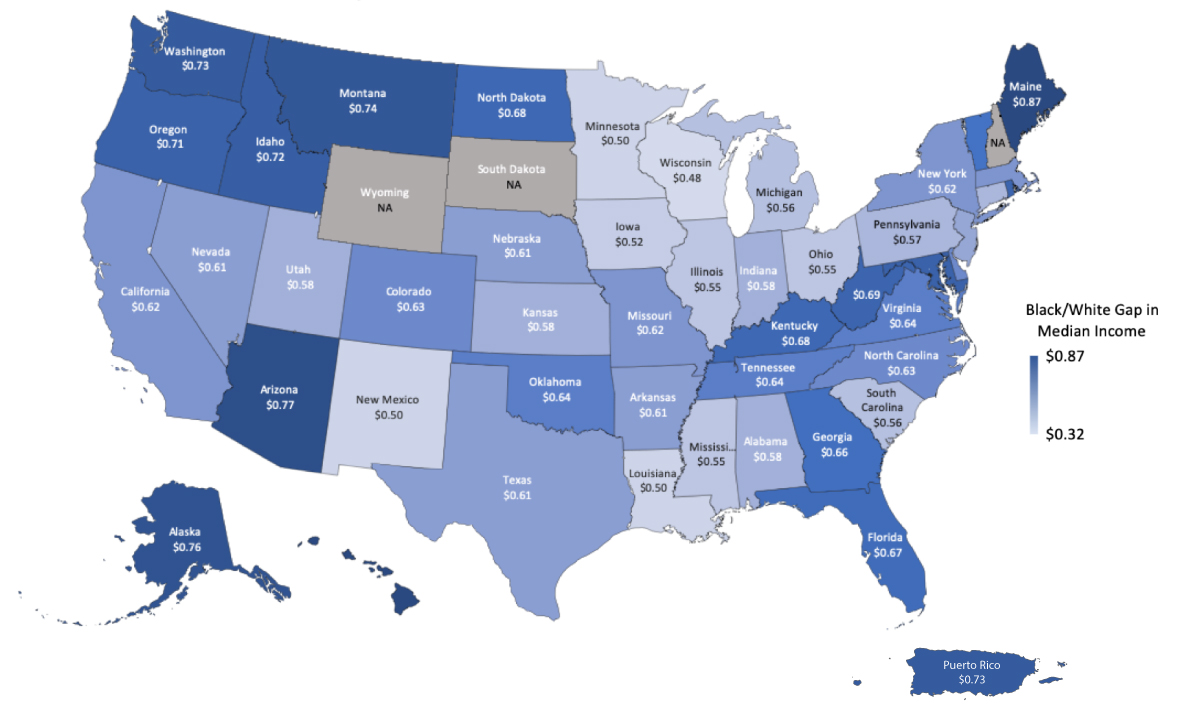
If racism was the only root explanation, Pennsylvania would be more racist than Georgia and Wisconsin more racist than South Carolina. That does not seem plausible to me.
Clearly poverty and even oppression doesn’t explain a groups eventual standing.
Man what social workers get BMWs?
A lot of people regardless of status will still try to have pride. I used to help homeless people and they would often have a lot of trust issues and often prefer to be homeless rather than help.
While a social worker may dress up and drive a nice car because they have money, the poor people they are helping don't have trust in them for many reasons. One is that they have nothing, and then they see someone that wants to help and that person is getting richer while they are getting poorer.
Same reason people get miffed at donating to the United way only to find out the CEO was making something like 750k a year and asking me to donate 10% of my pay automatically deducted to them. Lol
For context my mums 2 bed house in Coventry was not much more than that, and she's still paying off that mortgage.
well, BMWs tend to last a while and very old ones are often affordable but reasonably functional used cars, so probably quite a few.
If you mean new BMWs, then ones that are wealthy from some other source and doing social work for self-fulfillment.
I often wonder about these.
Growing up I watched friends whose families had what you might describe as a cultural distrust of institutions, including schools, or even anyone who seemed to “think they’re better than us” (translation anyone who did well in school or a career).
They constantly made self defeating choices and seemed destined to have the same problems/ poverty as their parents.
Their distrust of institutions like schools could maybe be justified… but they were capable people who made choices that reduced their opportunities.
As an adult I watch my local schools reach out to provide services, help of all kinds and struggle to find more than a handful of takers or folks who want to try…
By no means does that mean there are no other barriers, but even trying to address those barriers/ help, you can encounter some surprising resistance/ challenges.