It’s everyone else who suffers the most. Usually they have no choice but to move somewhere else or stay at home with parents, so you can’t get an accurate picture by looking at aggregate household statistics. Unless you’re deliberately trying to ignore everyone excluded by these policies.
Rent control is one of those policies that sounds great as long as you ignore second-order effects and pretend the population and economy never change. In practice it just creates a different system of haves and have-nots while removing any chance for the market to compensate.
A lot like London without rent control then, but if rent control were implemented it would be the primary culprit for what's happening anyway?
Color me skeptical.
Seems to me it's the landlords that really "suffer". E.g. the SF landlords that paid a tenant hundreds of thousands to get them out ( https://apnews.com/article/lifestyle-business-san-francisco-... ). Rent control just decides whether the "spoils" of restricted supply go to landlords with the most capital or the renters who lived in the city the longest.
Hacker news cries bitterly about nimbyism (especially in SF) that restricts development to keep up property values and rents. Whom do they think is most incentivized to do that? Redirect those spoils to leveraged landlords and find out.
I’m not sure what you’re trying to suggest about hypothetical rent control in London, but it should be clear that London was geographically exhausted long ago and they’ve been debating architectural preservation and building height control ever since.
You can’t simply buy a property in London, knock it down, and build a 50-story skyscraper. Using it for your case study on rent control doesn’t make any sense.
> Seems to me it's the landlords that really "suffer".
This is the fantasy: Stick it to those evil developers and landlords, amirite?
The fallacy is assuming that you get the exact same apartment under rent control, but cheaper. You don’t.
The truth is that being a rent-controlled landlord is easy mode. You have very little competition, by law, and the waiting list to get into your apartment can be years or decades long. As a result, you don’t have to compete on anything. Who’s going to turn your apartment down when it’s their only shot at housing and no one’s building new construction to compete at artificially depressed prices?
Now you don’t have to worry about installing good appliances or even nice carpet. The air condition doesn’t work well? Too bad, as long as it meets regulations (if any) then that’s good enough. Why would you if your tenants aren’t choosing based on competition? The tenants suffer, too.
And you’re still ignoring all of the people locked out of the system by the ensuing decade-long wait lines, as is the case in this article.
I'm stating that the extreme lack of supply ascribed to rent control also exists in similar cities without rent control.
So maybe rent control's effect on supply is vastly overblown as you can see by looking at the large amount of house-building in NYC before 1974 in the graph above, which is when rent control laws started getting really watered down.
>It should be clear that London was geographically exhausted long ago
Thats kind of absurd. It only recently caught up to prewar population levels. Property prices skyrocketed way before that.
>The truth is that being a rent-controlled landlord is easy mode.
If they like it so much why do they try to trick/bully tenants into leaving or offer large sums of money to tenants to leave if that fails?
>And you’re still ignoring all of the people locked out of the system by the ensuing decade-long wait
Give leveraged landlords market rent in restricted supply environments like SF and the FIRST thing they will try to do is to inhibit further development with NIMBYism that might bring down their rents and damage their investment.
Detractors of rent control tend to feign support for new residents but theyre perfectly happy for them to be priced out alongside the long term residents of the city.
More social housing fixes the underlying supply issue. Higher property taxes fixes the underlying supply issue. Wanting to kill rent control before or instead of fixing these things means being concerned with profit, not people.
Rent control is a band aid while that happens to keep long term (especially elderly/vulnerable) renters housed.
And landlords loathe it.
Just because rent control negatively affects supply doesn't mean bad supply is only caused by rent control.
I live in London too and I'm baffled by the lack of tall buildings in pretty central parts of the city. The real solution is more supply.
> Rent control is a band aid while that happens to keep long term (especially elderly/vulnerable) renters housed.
At the expense of people who don't currently live in London but could, such as immigrants or people from poorer parts of the country finding a good paying job here.
Kicking grandma out of her rented apartment and on to the street isn't going to suddenly mean that Romanian cleaners won't be living 7 to a house in zone 5.
This housing crisis was deliberately engineered in London as a result of the 1980s war between Thatcher and local government. Council housing was privatized as a result (& some of those gains were capitalized by existing residents through right-to-buy).
Councils were starved of tax funding through the UK's comically low council tax rates. This meant that not only was owning property a much better deal but also that councils lacked the funds to increase the supply of housing. Hence prices taking off like a rocket.
There's your supply issue. Rent control would be a drop in the bucket compared to that.
Well, in cambridge, i got kicked out of 2 flats in6 years because they wanted to raise rents, each time, i had to move further out, get a smaller place and still had to pay more money each time, i wasn’t getting pay rise in line with this and i think that’s still the reality across much of the uk, house prices and rents are rising higher than wages.
I also noted across this time that younger people apparently like staying in more and the selfish gits are spending less money on other things and somehow that’s their failing.
I didn’t have my rent raised in ten years here, in fact, as interest rates went down, i would have been well within my rights to demand a decrease. Also, bars, restaurant and clubs seem much more vibrant here than when i was in the uk, as if younger people had a bit more disposable income that flows in the local economy
It would create problems for poor companies that will have to make room for more effective entrepreneurs. At the same time it would create new opportunities in areas normally not considered.
If she's retired, she can move somewhere cheaper so someone who actually needs to live there for their job can move in.
The rest of what you've written is completely unsubstantiated.
A landlord is to housing what a scalper is to tickets (or for the nerds, graphics cards). Only one of them leaves you fucking homeless.
OTOH that is extremely cruel. Older people, assuming they have lived there most of their life, are the hardest hit by having to change. All their lifelong friends are near, their trusted doctors are nearby, it's all they know.
I just spent 5 days in London and was shocked at how many tall buildings there were that weren't there 20 years ago, and indeed how many are being constructed - not just in the centre and docklands, but in battersea and vauxhall too
How could social housing fix the issue? The underlying issue is too many obstructions to building new houses, which restrict supply. If commercially motivated developers cannot build enough houses due to bureaucracy and obstructions by NIMBY groups, then municipality would likely fail too.
I imagine the collective mind could greatly benefit if everyone had to spend a few (education focused) months in construction (and/or say farming etc) Its not boring if its just a short period. In construction you can learn the basics of a discipline (and make yourself useful) in just a few days.
But I agree it is the obstruction that prevents cheap housing. Its probably intentional (to some extend) simply to drive up prices.
I'm totally against rent control, but London's rogue landlords and its very low quality housing are world famous and people coming from all over the world spend the first 6 month adapting to crazy stuff like carpet, old carpet, 10 year old carpet, fucking carpet, windowless toilets, wooden walls, decaying electrical systems, holes in the walls, carpet (I can't get my head around the idea of having carpet in a flat), etc... and carpet (unless they are in the top 5% of the income distribution and can afford to pay 2-3K£ per month in rent). Air conditioning and half-decent insulation are for the top 1%.
Said that, I don't think London's problem is lack of rent control, but rather it is lack of development of the rest of the country and the government artificially inflating the housing market.
It's clear that there are over 30,000 empty homes in London, while most flats built are way out of the range of ordinary families.
Many people are locked out of the system now, we have "affordable housing" that you need to earning about £80k to buy, the current system is utterly failing.
So? According to wikipedia london has anywhere between 10.0 million and 14.3 million people (depending on whether you're counting "urban" or "metro"). 30,000 empty homes translates to 80k people[1]. As egregious as that might sound, is a drop in the bucket relative to the overall population. The 30k number also fails to differentiate between long term emptiness (eg. billionaires hoarding houses) and short term emptiness (eg. units undergoing renovation, units looking for a new tenant). The latter is necessary for a functioning rental market, otherwise it's impossible for people to move into/around the city because all the housing units are locked up.
[1] https://www.statista.com/statistics/295548/average-household...
Who can afford to keep homes empty at such great expense, and for what purpose?
Sounds like a step is missing...
Seattle so far has not imposed rent control, but they've done everything else they can to create benefits for renters at the expense of landlords.
And so the smaller landlords exit the business, and the larger ones raise rent to cover these new "free" goodies.
One of the freebies is the city will provide a free lawyer to any tenant with a dispute with the landlord, but the landlord gets to pay for his own lawyer.
With a firehose of money sloshing around, of course rents are going to rise. You can be damn sure that I'm going to outbid any of the locals for my apartment. Rent is barely a blip on my budget.
The housing inventory doesn't change, regardless of whether landlords are 'exiting'. Like any conscious class, they are just complaining because they, like the rest of us, want more money.
Which, in terms of the rental market, is the exact same thing as that person long-term renting the unit.
> Underperforming buildings also get razed by developers.
... And in this town, when that happens, they get replaced by buildings containing more units. You may have seen a few cranes here and there on the city skyline.
Rent control discourages building more units. The more you can make from rental, the more companies will invest in new construction projects.
Rent control can decrease efficiency of living situations. You can imagine an old woman living alone in a 3 bedroom unit with rent control because it would be more expensive for her to move to a smaller unit. Or someone who gets a new job far from their current rent-controlled apartment but won't move out because the rent is so much cheaper.
Yet the strictest rent controls went hand in hand with the fastest homebuilding spree in 1950s NYC.
It clearly didnt discourage that much. Maybe it didnt discourage it at all?
Or maybe it does a bit but is eclipsed by the effect of, say, NIMBY landlords inhibiting development, hellbent on staying above water on their eyewatering SF mortgage.
>Rent control can decrease efficiency of living situations. You can imagine an old woman living alone in a 3 bedroom unit with rent control because it would be more expensive for her to move to a smaller unit.
I can imagine. She could get priced out of the city entirely I suppose.
It seems to me that if the market rate is intent on 10x'ing her rent maybe it's the market that should be forced to adjust first, not her.
More home building. Higher property taxes. Rent control while the effects kick in.
Weakening them in 1974 if anything seemed to restrict supply.
SF has comically low density housing that is driven by homeowners lobbying to restrict development.
The difference between SF and Seattle is probably property taxes (higher in Seattle). It discourages land from being hoarded and used unproductively.
Then when rent controlled unit can be redeveloped, there's a desire to allocate various percentages to different income levels. This means that some units have less income for the same cost so it's hard to balance meaning fewer projects get off the ground.
Now there's even further issues about development as a right vs requiring a use permit...
So, there's a lot of contributors, but the political impact of the politics of rent control is significant.
[0] https://www.berkeleyside.org/2021/07/28/uc-berkeley-settleme...
and yet to keep up with demand we would've needed to more than 3x what we did, though from what I understand, the infrastructure to build more high density housing even faster just doesn't exist. Seattle was literally building housing as fast as it is possible for a US city to build housing.
If true that, in my opinion, points to a more significant problem in America.
Assuming a family of 4 would live there instead, she's effectively removing 3 people from the city. That can force other old women to move out of nearby homes that aren't rent controlled (since prices become higher than they'd be if more people could fit in existing housing), or it could prevent people from moving in. But either way, less people can live there. The policy isn't without harm.
> I can imagine. She could get priced out of the city entirely I suppose.
kind of an unlikely worst case. There's a gradient of prices as you move further from the city center, and this particular hypothetical woman is moving to a much smaller unit. I haven't heard of a city where the average market price unit was 10x the rent controlled price. It's probably 2x-3x at worst for an equivalent unit.
I think is overrated concern in general. Most popular cities aren't underdeveloped. Rather the problem is concentration of resource. Having less optimized areas are actually a good things as that means more areas are equivalent. Which is really what supply is in housing markets. It's when every one too young, old or poor have to move you get problems because now all the attractive things are in the same area. Which means the demand will be very high.
Also this is happening in the housing market in general but apparently it isn't a problem when it's wealthy people retiring in their forties because of the housing market itself.
> There's a gradient of prices as you move further from the city center, and this particular hypothetical woman is moving to a much smaller unit.
That is mostly true if you are moving voluntarily. Because if you couldn't find something beneficial you wouldn't move in the first place. It isn't as true when you are being forced to move. Often it isn't even about what you are moving to but what you are moving from. Once you can't live close to your family, acquaintances or familiar establishment it doesn't matter as much.
It's sort of curious how so many seem to agree that we are "losing our values" in society (or whatever) but then base everything on assets. If we want people to be able to live close to their grandchildren, know their friends from growing up, involve themselves in organization or otherwise make social connections it isn't going to be free.
> More bread baking. Higher bread taxes. Limit bread prices while the effects of all these magical new baking companies flocking to lower prices and higher taxes kick in.
Also, some will get cheap subsidised bread allotments, others won't get anything. And if you get an allotment of bread to feed 3 people but it's only you, there's no mechanism that redistributes the excess to those who need it most, despite massive scarcity.
And if you get a certain type of bread you like at a certain age, but your preferences change and it becomes bland, there's no mechanism for others who love your type of bread, to be incentivised to exchange your types.
e.g. my dad, who is in a rent-controlled apartment with 3 bedrooms in the capital city and has no mechanism or incentive to move out, despite not using the space, not wanting the space, and not wanting to live in such an in-demand area necessarily. Oh wait, I meant bread.
Rent control has 2nd order effects that can do a lot of harm. If rent-control was mixed with market based incentives and a limited time to the right to an apartment, it wouldn't be as bad. I'm not against rent-control per se, but as with all things, it must be balanced. Just adding more of it isn't a solution. And balancing existing rent-control rules with reasonable additional (market) incentives, would help.
For example, if cities allow an individual to live in a rent-controlled unit for 8 years, after which they must leave, that's better. The unit can then go to someone else, also rent-controlled. Instead, some people get a lifetime right, and others a lifetime waiting list. That's a fundamentally unfair use of public funds. It's not perfect (leaving a home has a chance of making it harder to stay connected to a local labour/social circle), but two people having each 8 years is clearly preferable to one having 16 and the other nothing.
Another example is if (such as in Germany I believe, if anyone can link an English source that'd be great) you have a system where your rent is controlled based on usage. e.g. suppose market rent is 1500 for a 3 bedroom, rent controlled it's 750 for a family of 3. The moment you live there alone it's no longer 750, but instead say 1000. That creates natural incentives to only renting a place that is necessary to fit your lifestyle. My dad for example would exchange his place with someone who lives with a family of 3 in a 1 or 2 bedroom home, because of this.
https://www.guernicamag.com/the-rise-and-fall-of-public-hous...
Edit: I guess you mean taxes on land, not the houses. But even then, would this not encourage to build high-yield luxury condos instead of high-density cheap space?
Actually, I would think the opposite. If capital-laden landlords aren't getting increased returns from their existing holdings, they would be incentivized to create more supply by funding new developments.
I think your logic is flawed here.
1. There's no reason why making landlords earn less money would make them want to invest in real estate more. If you have $1 million to invest, you'll try to choose the best investment available to you. It doesn't make a difference if your current property is doing well or badly.
2. If landlords make less money, they should have less capital.
3. Even assuming your premise was correct and landlords who make more money from their property want to invest in new properties less, it wouldn't matter. As long as building new units is a good investment, someone else would do it.
Though Berlin is going through interesting times with rent control at the moment.
Interesting times. It'll be fascinating to see this play out. Like a social experiment on rent control.
https://web.stanford.edu/~diamondr/DMQ.pdf
In terms of London, there is also the problem of building restrictions. I don't think we're going to see tall residential towers popping up in say, Mayfair, anytime soon. I understand that this kind of change would completely transform the character of London. But the price of not wanting change is sky high rents.
Turnover in SF is actually quite robust. The vast majority of tenants don't stay in the same apartment for decades. This is especially true during boom periods. IOW, ebbs & flows in turnover actually tend to benefit landlords. But a small number do. The average turnover rate is ~20%, which means the average occupancy is ~5 years. For large buildings what matters is the average. The fewer the number of units (either in a building, or in your portfolio), the riskier things become.
The riskiest of all is a single-family home, whether you rent out an in-law or the whole house. In the face of rent control you're not only risking being stuck with the same person indefinitely, paying an increasingly below market rent, but you're locking up for an indefinite period what is probably your largest and most important asset. It's a potential financial nightmare, and one with realistic odds (e.g. maybe 1 in 10 instead 1 in 10000) of befalling you.
As the building grows larger, the more the risk is spread and you can rely on the average occupancy term. Moreover, the larger the building, the less likely one would want to tear it down to build something larger. IOW, the larger the building, the more closely your expected future investment returns approach non-rent control levels.
Rent control policies should be accompanied by policies that promote densification. All forms of rent control will tend to reduce supply to some extent (at least, that should be the a priori expectation), but rent control also provides important social benefits. IMO, those lines cross, but I would never expect the benefits to be greater than the costs in the context of single-family homes.
The 1994 law encompassed multi-unit buildings of 4 or less, which were previously excluded from rent control. An elderly neighbor of mine owns a classic 1960s-era 3-story, 2-unit apartment building. He lives in one unit and keeps the other vacant so that his children won't have any trouble refurbishing or selling the asset when he dies. This is a nearly identical scenario to someone living in a single-family home with an ADU. There are several such homes on my block, though I don't know the owners so don't know how many are kept unnecessarily vacant.
If you want a £500,000 studio flat 30 minutes away from central london by tube there is a massive amount of supply. If however, you can afford said property, you probably dont want to jam your wife and 2 kids into it.
London permitting just will not allow builders to construct enough housing.
Perhaps for worthy reasons, or perhaps not, but regardless there's no question as to the source of London's housing shortage.
With rent control, basically those who were there first get the housing, those who come later are out of luck.
Without rent control, those who are more wealthy can afford the housing, those who are poorer are out of luck.
If that was the only oversimplified way to see the effects of rent control, I'm sincerely not sure of what would sound better (or less worse) to me. I like when a city keeps its soul and doesn't slowly become a theme park for rich people (which is what I see in mine over the decades).
And then they vote against any new construction "to keep the neighborhood's character intact" (remember in the 50's when certain groups of undesirables were excluded from certain neighborhoods?)
> Without rent control, those who are more wealthy can afford the housing, those who are poorer are out of luck.
That creates an incentive to build more.
I prefer that. It's not just about wealth, but also about how much you want to live there. I know people who earn about as much as me and spend > 30% of their net income on rent because they want to live in a trendy area. I don't need to live there, so I was able to choose differently and pay ~12% of my net income.
Also: with wealth, there's at least some correlation with merit. With a lottery, there's none.
Secondly, why is the merit of high income more valuable than waiting in the line for longest time? None of them is a lottery in my opinion.
People invest internationally. This gives a strong bias for money to chase large metropolis because of agglomeration effects. So now "everyone" has to move to the city to work for the investor money. There are people who just want to get their fair share of the money. If you let someone live there that can't find a job that gets him investor money then he basically displaced a productive worker bee and made the entire economy worse off. Social mobility takes a massive hit as a result.
That worker bee could have earned enough to live in a newly constructed apartment. If he actually managed to get a rent controlled apartment then congratulation, you just subsidized one of the richer individuals.
Think about it this way, you want vulnerable people to afford their apartments. Why are you subsidizing every single apartment instead of subsidizing people in need? In fact, the subsidy is greater the more expensive the apartment is. You're subsidizing the rich.
> Secondly, why is the merit of high income more valuable than waiting in the line for longest time?
Because it correlates with useful stuff being done for society. Not perfectly, of course, but somewhat. Waiting doesn't at all. And it's usually not about "waiting", it's often about being part of some group, having the luck of the draw, knowing someone in the office that assigns priorities, or "inheriting" the right to live in some (publicly owned) flat from your parents.
What happens then? Person A lives in a very desirable place, person B does not, and person B has to subsidize A's flat.
There's an obvious solution here, it's just not one most people living in these areas wants to hear.
All these ill people have doctors around them, which also can clearly be linked. That in itself doesn't seem to be an argument.
(Note I'm not taking positions here, I don't know enough about the topic)
Taxing improvements to land makes it less likely that people will build or renovate, so all such taxes should be removed. Taxing land, however, disincentivizes landlords from holding land idle.
Regulations are also important.
If there is a mandatory minimum amount of parking that must be provided, then it becomes that much harder to build more units, even if you are near transit and most of your tenants don't need cars.
If there are height restrictions, restrictions on mixed-use development, restrictions on the number of units allowed, and so on then these will likewise cap the amount of supply.
The reason people support things like rent control is "I've lived here my whole life but I can't afford rent anymore because it keeps going up."
It's not perfect because it is basically a subsidy to owner occupants so it won't help suburbs become denser. However, it disconnects the impact of taxation on home owners and commercial developers/investors which means home owners will be more willing to tax developers. The one benefit is that large scale development will naturally consider denser housing because they want to optimize their tax burden.
However, with respect to affordability, a key complaint across the board, LVT does indeed help by reducing the amount of speculative holding and removing tax penalties for improvements. Under LVT residents will be able to afford better accommodations for less money. Particularly if other onerous policies are removed such as rent control, building restrictions, parking mandates, taxes on demolition, and the like.
A media that is very "concerned" with housing shortages where rent control is concerned suddenly loses its concern and gets overly concerned with crime, delinquency, public debt, etc. when a solution that brings down property values is mooted.
Raising property taxes will also help as it will act as a disincentive to use land unproductively or as a store of value.
A more feasible option is to let private developers (who collectively have access to trillions in capital) to finance housing creation for rich/middle class people, and rely on government subsidies for low-income housing.
Obviously the solution is that you should've built two luxury towers. However, people watching the situation sometimes get the counterfactual wrong and conclude that if the luxury tower hadn't been built, none of the rich people would have moved to the area. They then conclude the best idea would be to build no new housing at all and do everything they can to make sure that is the case
https://www.bankofengland.co.uk/working-paper/2019/uk-house-...
When people talk about how raising interest rates lowers the cost of housing what they really mean is that interest rates lower the value of income streams derived from monopolies and land is the biggest monopoly of them all. Monopolies basically can do perfect price discrimination, the more money you have, the more the monopolist can charge. Thus the obvious solution of giving people more money doesn't seem to work.
Raising interest rates is basically the opposite. What if we take everyone's money away? If people have less money the monopolists will charge lower prices. This didn't really solve the monopoly problem. After all, the monopoly allows perfect price discrimination. If the monopoly power is strong enough to get 30% of your salary it will always get 30% of your salary no matter how high it is. What really happened is that you now have less money to buy non monopoly goods.
Here are the practical implications: You can spend $1000 per month on your mortgage at 5% interest or -5% interest. The -5% interest house is significantly more expensive but the monthly payment is still the same. You still lose $1000 no matter what you do.
The places where this is not true are all places that have seen significant population growth and have not permitted sufficient new construction. For example, in Jacksonville, FL, the median home costs $250k, which would leave a payment of ~29% of the median household income in Jacksonville using a 5% down payment. Similar math works in other cities where builders have been allowed to keep pace with population growth.
Portland does still have high rents, so it’s hard to point to this as a “success”, but I think it’s a good template for how you can encourage affordable units without putting the whole city under tight rent control.
I’d be delighted to be proven wrong, but it seems unlikely.
For example, not everyone can afford San Francisco, but there is a lot of buildable land besides SF in California (the Central Valley, for instance). Everyone should be housed, but it’s likely it might not be their first choice.
All cities need janitors, teachers, baristas, grocery clerks, garbage collectors, etc. in order to function, and those people have to live somewhere at least within a reasonable commuting distance to the city. You can't have all the garbage collectors move out to Bakersfield and have San Francisco _just_ be a citadel of software engineers, unless the software engineers haul their own garbage, or the garbage collectors in SF also get paid $100k+ per year.
The teachers, janitors, baristas, etc will move to the location that gives them a better quality of life. If they decide that's not San Francisco, they can move to a better city. If SF wants them back, SF can sweeten the deal for them.
I guess it's kinda sad that not everyone who wants to live in SF gets to, but I'm not sure how "closing the door" is any more fair.
Which (as I understand it) is kind of the topic of this whole sub-discussion: it is not easy to find a solution which will sweeten the deal for them (aka: make it economically feasible and attractive for low/middle income people to live and work in a city with a housing shortage and high housing costs). Rent control is one such proposed solution. It has its benefits and drawbacks, of course, as evidenced by all the debate about it here.
Then you either pay very high rates for basic labor or you push the government to build cheaper housing. It all fixes it self.
Rent control would be one such measure. Other examples are loans with better-than-market terms for certain privileged buyers, publicly-built houses sold at lower than market rates and so on. The market reaching equilibrium for everyone and the local government saying "sorry, but screw you" to buyers is at least honest, if a little heartless from the voters who live there.
I suppose it's fair enough as long as other markets with decent job options are available elsewhere. If not, I would classify it as a failure of democracy if a significant portion of society has no better option than to pay most of their productive output towards rent. This probably varies a lot by location; San Francisco wouldn't be the first example I'd use. Maybe Oslo.
People per square mile: San Francisco: 17,246.4 Brooklyn: 35,369.1 Manhattan: 69,467.5
If demand ever reaches that high then the market will move to a new equilibrium.
Speaking of Manhattan:
https://www.nytimes.com/2021/07/01/nyregion/manhattan-vacant... (Office Vacancies Soar in New York, a Dire Sign for the City’s Recovery; Nearly 19 percent of all office space in Manhattan has no tenants — the highest on record — as companies shed leases and embrace remote work.)
https://www.bloomberg.com/news/articles/2020-12-05/even-befo... (Even Before Covid 2,600 People a Week Were Leaving New York City)
It makes no sense to reserve city space for single level buildings.
For employment, for instance, much more useful analysis comes out of lifetime income analysis. We really ought not care how many people earn minimum wage... we ought to really care how their wage changes over time. Not even suggesting that there isn't merit to a minimum wage, but just that our discourse of it almost always omits the point you bring up about "everyone else who suffers." That's important to talk about.
Minimum wages reduce some of the exploitation that low quality employers will always engage in. If you travel to a state that has the lowest minimum wage for waitresses, you won’t find more waitstaff, lower prices or better quality. Just more misery. Any further erosion of worker rights in this gilded age is gross and unacceptable.
Get yourself a breakfast omelette plate in San Francisco and the same order in Jackson, MS. I can pretty much guarantee that the plate in Jackson will be less, possibly 50% less.
* I don’t claim it’s caused by the minimum wage difference, but it seems pretty strongly correlated.
For instance, I searched "Brunch" in Google Maps for Jackson and omelette plates are $10-16 at Google's top result[1].
Labor costs certainly impact prices, but restaurant pricing isn't totally formulaic outside of maybe "market price" fish dishes. Kenji Lopez Alt has written about this[2]:
  Here's where one of the first intricacies in menu pricing arises: Menu prices have to make sense to the customer. Placing a $15 carrot entree and a $20 chicken dish next to a $40 mushroom dish and a $45 steak doesn't compute; the range is simply too big. Either the latter two dishes are far too expensive, or the first two are far too cheap. Which sceniaro seems true largely depends on the atmosphere of the restaurant and pricing at similar restaurants, but both cases can be disconcerting.

  Because of this, most successful restaurant owners fudge the numbers a bit. "You're willing to lose money on some things because they're important to keep on the menu," says Maws.
Some of that may be on you, choosing to eat the expensive food.
My experience in Shanghai was that I could eat basically the same things I'd eat in America, and it would cost basically the same amount of money. Or I could eat local food for 5-10 times less than that.
But you know, if I go to 老外街 ("foreigner street") in Shanghai to eat at the Mexican restaurant there, it's not exactly a secret that I may be willing to pay more for food than a normal Chinese person. And they price accordingly.
Rents are probably considerably higher in NYC too, especially restricting to Manhattan.
In addition she is even more likely to make use of state services like food stamps and medicaid which in effect you and I help pay for even if we don't even live in that state let alone eat at that diner.
I don't think its cheaper its just subsidized by everyone.
(In practice, those places still have minimum wages - it's just that they're negotiated between employers and unions, and can vary across different industries and geographically where that makes sense.)
The real problem with min wage is that it's effectively a regressive tax, because it raises the cost of the cheapest produced goods/services - which, of course, tend to be disproportionally used by those who simply can't afford anything else. So you're taxing the poor to help the very poor! It is better compared to a free-for-all jungle, but it's much worse than e.g. UBI (funded by actual progressive taxes, on income, or better yet, on capital gains) without min wage.
You now have a segment of the population with enough work and another with too little. Those with work are scared of losing the job. Those without are desperately trying to compete in the labor market to get a new job.
As people in general are becoming poorer, we’re shifting towards either more rentals or less safe/sound construction practices. Tenants need rights beyond market forces to avoid a revolving door of 1 year leases, etc. Stability in communities is important for both families and the community at large.
That said, the unchecked development model where construction of actual homes is impossible, or where exclusionary construction is allowed (entire buildings of studio apartments, no family apartments, etc), you are correct, rent control just benefits incumbents.
So let’s agree to avoid the buzzword.
What’s a more accurate - yet succinct - phrase to describe housing market controls that protect the least fortunate of us from being priced out of their homes and communities without disrupting the significant market forces which should - ideally - be promoting new housing construction?
(Also, ban unsustainable zoning regs, enact an unimproved land value tax, and only allow greenbelts in areas with full mixed-use developments without building height restrictions)
Meh, rent control has almost no effect on a market where there is enough housing. Ownership of housing has the exact same consequences as rent control, and is even more likely to have crazy NIMBYs preventing anyone from building new housing (looking at you the bay area).
The situations where rent control don't apply still suck. More rent control would cover those, no?
Not sure what you think that has to do with rent control?
> Not sure what you think that has to do with rent control?
With rent control, the owner may not be able to afford to do any maintenance (let alone improvements) if the tenant has been there long enough that the landlord is losing money every month. But also, the tenant knows they have a deal they can't replicate anywhere else so they have an incentive to never move out, even if the place falls in disrepair.
Without rent control, the tenant is free to move out if conditions are not acceptable and the landlord can afford to maintain the place.
But, not every rent control city is the same of course, details matter. In some cities maintenance or improvements are allowed to reflect in rent, in some places they don't. So it depends.
With rent control, that threat will not be taken seriously.
They started to remove rent control in the early 50s due to a housing shortage. So by your argument removing rent control helps increase supply.
The main issue is that the government doesn't build enough. There are just nowhere near enough first-hand contracts, like not even the same order of magnitude.
They've effectively abolished the system by just never building any, much like council housing in the UK.
Your article says that it shifted from federal to state control in the 1950s, not that it was removed.
Realistically they werent properly weakened until the 1970s.
I mean, OP literally did that, erroneously implying that rent control increases supply by using a historically incorrect example from 50s NYC.
This is why people get so annoyed with many proponents of rent control, they don't stop mid way as you do but keep going and implying it solves all housing problems.
False. OP (me) was implying that it didnt meaningfully restrict supply.
I suspect a longitudnal study would find the two variables to be tenuously related at best.
>This is why people get so annoyed with many proponents of rent control
Because they make wrong inferences?
The OP said "fastest period of homebuilding" with fastest being in italics. I don't see how that can be read as anything except saying rent control increases supply.
One could make the argument that it helped increase supply but that wasnt my intention.
Providing housing security to existing residents through rent stabilization is a moral imperative. Homeowners such as myself have access to it through mortgages. Renters should have the same.
Beyond that, of course we need to build a ton of new housing. That can either be done by the state directly, or by loosening zoning regulations, or by some other means.
To build a ton of new housing, you need investors willing to do so. If you have a million dollars, would you invest to build in a rent control city, or in a city where you can raise the rent as you wish? Most people would choose option 2, thus creating shortages in rent control cities, which in turn make the housing more expensive than it would be if the rents would be free-market.
There are things in life we treat as core moral values even if they cause issues with incentives. For example, people should not go to prison for not paying their debts, even though it runs against incentives. Rent stabilization should be one of them as well. The rest of society should adjust.
Try to not pay your taxes and you end up in prison in all the countries I know about.
Anyway, I feel like your argument works against you, actually. I think a core moral value is to allow anyone to move into the city if they wish so. With rent control, you limit the privilege to live in a city mostly to those born there. This is worse than the unfair advantage you have when raised in a wealthy family. At least anyone can study and make a good life later on, but rent control doesn't allow for much movement altogether. If you're born outside the city - bad luck.
The same rent control alternative applies too. You can move to the outskirts of the city that are less desirable locations.
In fact, they did build housing. Luxury housing that doesn’t solve the problem at all. Student apartments that are so expensive to live in, you have to work a job while studying.
A lot of things happened in the 1950s. How am I supposed to untangle cause and effect? I'd more likely credit the return of American troops from the war, the baby boom, home loans as part of the GI Bill, and the economic power of a country still ramped up for wartime industrial output, but existing in a world in which every other industrial power had been reduced to rubble.
They seem to be building as much housing in London as it's possible to do so - new blocks of flat flying up all the time.
However what's needed is sometimes entirely disconnected from the past trend. Ask a lot of people in San Francisco, and they will say that there's been a huge amount of building of new apartments, even though they are nowhere close to matching the 2% growth rate of US population, much less the much higher growth rate that a thriving urban area needs to match the trend of people moving from rural areas to urban areas, or to match an increased preference for urban life over suburban life.
You can't really look at country-wide population though. The population of e.g. Germany is pretty stable, but within Germany there's a lot of movement with people moving to the large cities. Rent is rising in those cities, while it's getting lower and lower the further you move from those cities.
What you suggest would in fact probably lead to MORE segregation and MORE of the same issues.
Wages don’t magically rise because you abolish rent control, either. You would simply price out the less wealthy to live… in the shitty suburbs.
All these crime-ridden suburbs are within 20-30ish minutes easy public transport to the city center.
Basically think these sorts of buildings: https://upload.wikimedia.org/wikipedia/commons/0/01/Hammarku...
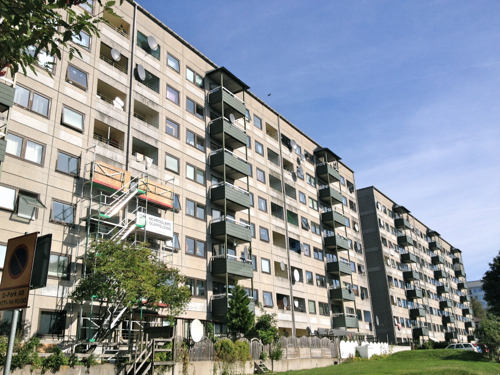
rather than these sorts of buildings: https://upload.wikimedia.org/wikipedia/commons/thumb/3/37/Su...

https://www.nytimes.com/2018/03/03/world/europe/sweden-crime...
Obviously you also have also suburbs with villas where richer people live and little crime. Sweden at this point is a highly segregated society.
From a western European perspective, tax fraud is rampant in Greece. e.g. In Athens, around 400 swimming pools were reported for tax purposes. But satellite analysis shows almost 17,000 houses have swimming pools: https://boingboing.net/2010/05/04/satellite-photos-cat.html
> The median burden of rent payments for tenant households is highest in Finland, the Netherlands and Sweden (30%), Norway (29%), and Denmark and the United Kingdom (28%)
That said, it's not very different from its peers, so I doubt rent control is having a huge effect.
The BBC have gone full union and need to knock any Scottish Government proposal.
That is the only reason this article is published. Don't read too much into it.
https://www.renthop.com/studies/nyc/building-age-and-rents-i...
1. It is universal
2. Rates are collectively negotiated between landlords and tenants
This is more like a renters union that there is a 9 year waitlist to join than typical rent control.
The impression I get is that Sweden has fewer people sharing flats and more affordable flat rents (adjusted for income) than most places in western Europe.
Both could be politically minded, or something else
Actually, a market-allocated one is always a political allocation since it's got the idea that rich people deserve better housing than poor people asked into the market.
I wonder what metric they use for "not working".
It's not like a lack of rent control is creating vast new supplies of housing here in London and as far as Im aware the fastest period of homebuilding in NYC was in the 50-60s when rent control was at its strictest (https://cbcny.org/sites/default/files/media/image-caption/Ho... ).