For example, I'd say the basic subway system between Seoul and Tokyo are pretty similar but you also have the advantage of a vastly superior rail network that serves Greater Tokyo and the rest of Japan. KTX and SRT in Korea are improving every year but don't really compare yet. Additionally, the new subway stations in Seoul are quite nice (Line #9) but you also have really old lines (Line #1) where many of the stations are so badly maintained they feel inferior to their counterparts in Tokyo (Ginza, Hibiya).
I can't really speak to the english speaking issues in South Korea, but in Tokyo I never really had any issues even though I don't speak Japanese. Most places in Tokyo will have english menus because it's a tourist centric city. Neighborhood family owned dives probably don't speak english very well but they wouldn't in Seoul either.
The thing that makes Seoul fall short for me is the standard of building maintenance. Although things are changing, it was generally the case that for several generations of building maintenance they just expected to tear them down and rebuild. Tokyo has a similar problem, necessitated by constant building damage and updated building codes from earthquakes, but the biggest difference is that a lot of these buildings in Seoul are 10+ stories tall. Most of Tokyo's building stock is <10 stories. It's become cost prohibitive in Seoul to actually tear these buildings down and rebuild them.
One of the worst things for me is how car centric Seoul is. It's rare in Tokyo to have 3+ lane roads that aren't toll road/expressways. They're all over Seoul and the side roads are packed full of "valet" parking for restaurants that don't actually have parking lots. The entire car culture feels way more chaotic there than Tokyo. In Tokyo, you can't buy a car unless you prove you have a registered parking spot. In Seoul, you just double park your neighbor and put your phone number in case you need to move your car.
Lastly the air quality in Seoul is way worse than Tokyo. Feels like you constantly have to stay indoors for weeks during the bad "yellow dust" season.
I have taken KTX but I have not taken (non-subway) rail in Japan. The KTX train I took was similar in quality to German inter-city rail or American regional rail lines. That is to say, it wasn't that special.
The air quality issues are a huge pain for sure.
Japan's car-ownership experience is rather hostile. Expensive tolls, Shaken inspection, and higher price tags than SK. In a way, this benefits tourists because streets are cleaner, cars are newer, and people tend to drive less.
In Korea, it's flipped. It's great place for car ownership. But from tourists POV, it's chaos.
As much as I love Japan, I'd prefer to live in Korea while visit Japan as tourist. Seoul isn't so bad once you go outside from central Seoul to new cities. Everything is more spread out, cleaner, and very modern.
I've been to tons of tourist spots and onsens in Miyagi by train/shuttle bus with no issue.
In Korea, because of the high car penetration rate for young people and new families, many attractions are inaccessible without a car.
You're just a tourist so you may can't see everything, but didn't you saw many small/family cars run on Miyagi at trip? Sendai city in Miyagi, maybe ranked TOP 10 city for great public transport in Japan, 75% of family still buy at least a one car. Rest of the place is far worse than Miyagi for transport. Of course they buy cars becaues it makes sense.
https://www.statista.com/statistics/1027885/japan-share-car-...
There are cars in Japan, of course. Families own one because it's convenient, of course. Also there are more cars in Japan than Korea, mostly because more people can afford it. But I'm quite sure that, at comparable income levels, Koreans own more cars per capita.
Korea has a very car-centric infrastructure, and people own massive cars, and drive recklessly, because the roads allow you to and people are used to it. Children are taught to never cross the road if they see a car, no matter if they have the right to cross or not.
I'm not saying Japan is a car-free country, of course. But car culture and car safety is a lot more reasonable.
Fast forward 50 years (once the demographic collapse has fully hit Asia and Europe), and we'll see if their infrastructure continues to be so modern.
But Tokyo infrastructure felt basically as old as NYC infrastructure to me (a totally qualitative impression).
That said, Tokyo is massively cleaner and nicer than NYC even if some of the infrastructure seems old. There is no question it is nicer than NYC.
NYC's trains are constantly late, always go out of service, are deafeningly loud, incredibly slow, filthy, don't have great coverage outside of the Manhattan core and generally unreliable. Tokyo's are always on time, very clean, pretty silent, have incredible coverage of the entire metro area especially in combination with the bus networks (which also are efficient, clean, and don't hold lower-class stigma), and are super fast.
The lines that aren't underground in NYC tend to be depressing under the tracks and pretty unlivable around them, leading to tons of urban blight; the over-ground lines in Tokyo, thanks to their thoughtful design and reasonable noise level, are often full of shops, restaurants, bars, and walking paths that people actually use, positively contributing to their neighborhoods.
The main thing that feels "old" about Tokyo's trains is just that they look like they were decorated a long time ago or are kinda plain; but from a functional perspective they outclass practically any system on the planet, especially when taking into account the integration into the broader Shinkansen network. They have the best safety record of any rail system anywhere and are economically sustaining. The only major complaint I have is that it's relatively expensive fare-wise, especially considering transfers between different rail companies' lines/buses.
Also, it's worth checking out the pre-Olympics revamp of some lines - for instance Ginza Line (Shibuya station especially) and Odakyu Line (Setagaya Daita-Shimokitazawa in particular) got a lot of station and neighborhood renovations that give them that sparkly new shine.
Aside, I've also lived in Shanghai before - the rail network in China is something to watch, their high speed rail stations and urban networks are very nice as of late, although they need more express lines within city limits (Shanghai/Beijing are enormous so crossing the city by rail takes a long time).
One thing they all pointed out is that Japan is full of what by our standards would be considered semi-antique technology like trolleys from the 1950s and computers and fax machines from the 1990s, that are all still being used, and maintained in really good condition.
Living in Tokyo, do you notice this as well? I assume this sort of commitment to maintenance / "orderliness" must be cultural?
What do the really bad parts of Tokyo look like?
Ikebukuro is the nearest place to where I live that has a reputation for being “dangerous”, with a homeless population and a large yakuza-dominated nightlife district, but by that I mean there’s like 20 harmless old drunk men around in the plaza sitting around, and a high concentration of sex shops - not dangerous at all though by foreign standards (small women can still feel safe walking around at 3am if they felt like it).
In part because it is, most of Tokyo's major subway lines were built in the 1960s to 1970s. Ginza line was built before WW1 and was the first subway in Asia.
The highways were all built soon after the war too.
Thus part of the issue is age. Japan stabilized much sooner than Korea and built up faster.
A bigger component though is Japan's preference to build new then let sit. Maintenance for visual reasons is rare. Thus combined with the high humidity stuff rusts and molds. You can see rust on iron beams waiting at the JR platform in Shibuya! Literal rust on one of the most high traffic stations in the world with gleaming skyscrappers as your backdrop.
In part Japan feels like a retired country. All the heavy lifting has been done. The mortgage paid. I joke with friends we are young people in an old country. Everything around us is going into the night, and we are just now waking up.
I like it, but I can see why others would prefer a newer country.
The Seoul subway [1] opened its first line in the mid-1970s (8km of line 1). Most of their subway growth opened in 1995 and later, a huge amount post-2000.
The first Tokyo subway line [2][3] opened in 1927, with only 3 new lines since the late 1970s (and barely even any line extensions in the 2000s)
It feels newer in SK because it is.
[1] https://en.wikipedia.org/wiki/Seoul_Metropolitan_Subway
One of the key problems is that Japan has a huge domestic market and does not 'need' English to survive. Korea, on the other hand, is a lot more dependent on its external connections and a push for better English proficiency makes a lot of sense.
Parts of Amsterdam have that sort of feel, but it’s definitely more mixed. Not crumbling, but old and making do since it’s fine.
Economically, Japan has been in stagnation since the late 80s.
That's a nice way to put it, it's been actually decreasing clearly over time since 1989, with ups and downs on the way: https://mebfaber.com/wp-content/uploads/2009/12/japan.jpg
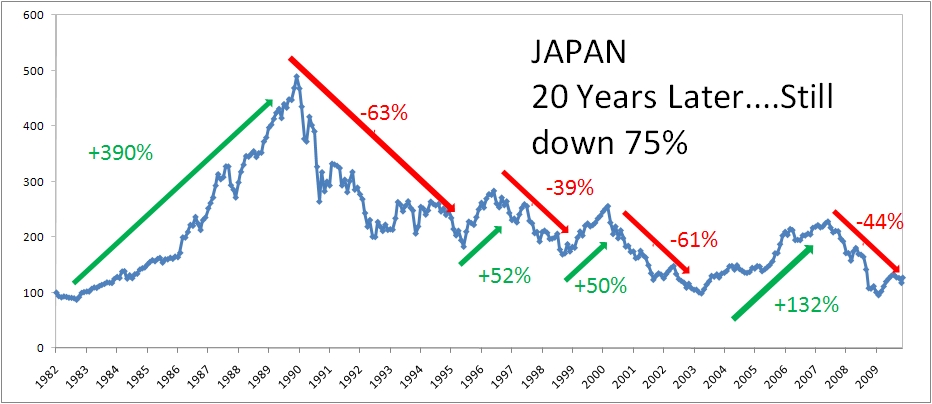
Chart source: https://mebfaber.com/2009/12/20/japan-the-us-and-the-lost-de...
Amsterdam is basically a super old village built in a swamp that it interesting for its history, architecture, culture, and so on. Or for the red light district and weed shops, if you prefer that. It's not a display of infrastructure.
The Netherlands has some of the best developed infrastructure nation-wide: roads, railways, and most famously its massive water management systems, as half the country is below sea level.
It is also very well developed economically (punching far above its tiny weight), technically, and socially (hybrid welfare system).
By comparison, many parts of the US feel like a 3rd world country.
I am being a nitpicker here, but I think there is no correlation between country size and level of economic development. Many of the richest polities in the world are quite small. Places like Singapore & HK come to mind.
I think bigger countries, even if they are "1st world," can sometimes look rather rough, because there is a lot of variation between different regions / municipalities / neighborhoods. It can be surreal sometimes, but it is what it is.
For example, would you expect the Netherlands, smaller than a typical US state, to be the world's #2 food exporter? From a tiny country that is also extremely densely populated?
To produce a number of mega corporations like Unilever, Shell (partly dutch), Philips, Heineken, the like...and this doesn't even begin to describe lesser known companies in extremely heavy transport, water management, mega scale infrastructure.
Combined with the extremely favorable location of being a distribution hub (Rotterdam), indeed similar to Singapore.
So I basically agree, it doesn't require a large country to produce a lot of economic output. Yet I'd still say the food export fact is a crazy one, as you would expect that to very much be surface-related.
I would expect food production to be area-related. Rotterdam is Europe's busiest seaport, and one of the busiest seaports in the world, so I'm not the least bit surprised that the Netherlands is one of the world's top food exporters.
https://www.nationalgeographic.com/magazine/article/holland-...
Which of course is surface-related, so the remarkable/surprising fact is the intensity of it, and the stunning yields.
"Feeding the world" from a very small surface and with very little human labor is quite a marvel. I think any farmer, from any other country in the world, will have their minds blown when they see it with their own eyes.
That's because you're comparing small nations to a nation that is better compared to the EU in size and diversity. The EU has dozens of third-world ghetto zones and the bottom 10% of the EU is exceptionally poor by first world standards.
The poorest areas of France also look like and function like the third-world, the quasi ghettos on the outskirts of eg Paris. It's more rare for large nations to not suffer from such poverty problems, and few accomplish that (Germany and Japan get close).
The largest population nations: Russia, Brazil, Indonesia, China, India, US, Pakistan, Nigeria, Bangladesh, Mexico
Do I need to point out the condition of the bottom 1/3 or 1/2 in most of those nations?
Ever read up on how the bottom quarter in Russia - Europe's largest nation by population - are faring the past decade (it's beyond dire, to put it politely)?
It's a small miracle the US isn't far worse off than it is.
In Seoul yes, but not necessarily other places, in my experience. I had really confusing experience trying to sleep over in a spa in Busan. The only English phrase we got out of them was "Robot steal your phone". Admittedly this is not a place tourists would generally go though. We got recommended doing it by Korean friends and our hostel host in Seoul helped us find the place.
In Japan I experienced a few times that a Japanese person that could speak english would come over to help me if I was staring at something (map, ATM machine) in confusion for a while. Didn't experience that in South Korea even though I stayed there longer.
I agree that South Korea feels extremely modern.. but not much less than Japan. I wonder if it has something to do with how recently the infrastructure was built. Maybe South Korea is just at that perfect stage now where nothing is too old, and yet they've managed to improve/refurbish almost everything. I've noticed Taiwan is a mixed bag. Some places feels insanely modern, while there's still big areas with a lot of old construction. But then those areas tends to be the ones with the most charm and the best night markets.
If your "modern country" means "modern buildings", then I can agree. But if you're saying people, culture, art, technology of South Korea is more "modern" than other countries, I would disagree.
Have you been to Singapore?
Singapore has less than 1% of South Korea's land mass, which is 25% of Japan.
It's not a fair comparison on the scale of the infrastructure.
Also, in my experience, Koreans speak even less English than the Japanese do. Seoul is still OK, maybe Busan, but out in the sticks there's zero signage and very few speakers.
One more massive advantage Korean has over Japanese is that Korean has a fairly simple alphabet so you can read and pronounce words after only a little practice.
In contrast, it takes quite a while to be able to read Japanese with their three writing systems and Kanji in particular.
On the other hand, if you can read Chinese.. then reading signage in Japan is like having half Chinese half weird squiggly stuff but the Chinese half would still mostly make out most of the sense.
I guess you've never been to China?
Is everything just recently built or actually designed with modern principles in mind that will still feel relevant a decade down the road?
I’m no researcher of any thing but the casual impression I’ve gotten from reading here and there over the years is that South Korea has plenty of problems, social and otherwise, and some of them pretty archaic and morbid (like idols collapsing on stage but nobody helping them)
They also continually build out entirely new rapid lines like the Bundang express line which takes you from a suburb of Seoul to the center of Gangnam (a major district) in 15 minutes.
Their buildings are also mostly new. It seems like every decade or two Koreans demolish older buildings and replace them with new ones. Whereas the US and Japan seem more often to keep old buildings around for much longer (and don't clean them).
The cars on the street in Seoul were also newer than the ones I saw in Japan (although similar in age to NYC). For example the taxis in Japan look like 80s BMWs. They look very cool for that reason but also seem pretty old.
Finally in Japan there's a lot still done by cash and weird single-purpose ticket machines. It would be a hardware hackers dream because of the variety and number of ticketing machines everywhere.
But in contrast Korea has gone almost totally cashless everywhere or so it seems. You just "tap" with your phone. The US is getting there, and maybe Japan is now too since it's been a few years since I was last there.
I wrote a bit more about this a while ago (and included pics) here: https://notes.eatonphil.com/on-nyc-tokyo-and-seoul.html.
This may change like next year but Japan has had a 5 year head start. https://www.imore.com/apple-pay-coming-korea-part-k-new-deal...
Japan has updated their taxis since 2017 - roll out has been slow but I've rode in them multiple times as a tourist since then. https://global.toyota/en/jpntaxi/
I love Seoul for it's nightlife/cheaper restaurants, but I can't help but notice that it once tried to be an urban sprawling American city. It's just not as pedestrian friendly as Japanese cities, and I find myself taking more cabs than I would in Tokyo despite the Seoul metro being world class.
The cheonggyecheong stream used to be a disgusting urban highway and I'm sure there are plenty more. https://www.landscapeperformance.org/case-study-briefs/cheon...
The only annoying thing so far is that my US based Visa card just can't be processed in some places even if Visa is advertised. When I called Chase to see if it was a security thing, they said they didn't even see the charge attempted, and said there are 2 different kinds of credit processing in Europe? I haven't done any research into that yet, though. Overall, I just bring my phone and pay for everything with my iPhone.
If your card is a debit card, you might have to talk to the cashier about specifically setting the reader for a credit card transaction. Debit cards do run through a separate process, and your US card would fail. But keep in mind that the same thing happens with Norwegian cards in the US - debit cards need to be run as credit otherwise they'll fail.
EDIT: To be more clear, this is coming from the US.
One of the complaints I had from my SK friend is that other subway platforms don't have safety walls
> Finally in Japan there's a lot still done by cash and weird single-purpose ticket machines. It would be a hardware hackers dream because of the variety and number of ticketing machines everywhere.
Are they connected to the internet?
For NYC I've read that it's complicated: https://nypost.com/2021/02/10/mta-says-subway-shove-preventi....
Yes, but it's not common. I live here. Maybe in certain wards that have more international residents, such as Minato.
Sorry I didn't mean that in the sense of "cracking" but just that people who are into hardware would find it awesome that there's so much use of electronic hardware in Japan.
Seoul the city and metro area are both more populous than NYC. And yet you see them rapidly pivoting to fast new lines like this Bundang line. You see them demolishing old buildings and building new ones. You see them switching their entire payment system to digital-first.
On reflection I think this is mostly enabled because 50M is still a small-ish population and the country is fairly culturally homogenous. Combine that with a desire to compete with their bigger neighbors (Japan, China, the US, etc.).
I think Korea (like smaller countries in Europe) has a pretty unique ability to pivot existing society into new technology.
So does the US, and Japan, and ... basically every country. Each country is going to have pros and cons. Talking with my Korean friends, their perspective is that the US also has plenty of problems, social and otherwise. Are they wrong? And we've had discussions around e.g. why US cops are going around killing US citizens, etc.
The pros for Korea for me include hospitable people, great food, universal healthcare, and fantastic public transportation (you can get around basically the entire country via bus/metro/trains with a unified T-Money card). I also felt a sense of unity that I don't often feel in the US.
Some cons would include a work culture around working insane hours and compulsory drinking. Those are changing with the current generation though. Schooling is extremely competitive since everyone is trying to get into a handful of colleges in order to have career prospects with the large conglomerations. And having to worry about the air quality index is annoying from my US perspective.
Social problems to what cultural viewpoint?
In contrast, the US and Japan seem to be somewhat falling apart with a peak in infrastructure and buildings a few decades ago. It's not that bad of course but relative to countries like South Korea and the Netherlands I think you'll agree.
Also, in my experience Korea was way more ready to handle English speakers than Japan was. I was surprised how I felt so lost in Japan not being able to read or speak Japanese. (Of course I don't expect to go to another country and be catered to. It's just that I was spoiled by Korea. And I wanted to address any reasonable concern that Japan might be friendlier for tourists than Korea.) In contrast in Korea there was a lot already in English and all the service workers I met spoke English well.