Often, but that’s not what is happening here. Here you have real world cooks and the collective experience of them telling recipe writers that you can’t caramelise onions in 5-10 minutes.
In your own video examples, the onions aren’t caramelised, they aren’t even cooked. You can tell because you can still see the green/white colour of the onions.
This is what they should look like: http://rachel-cuisine.fr/wp-content/uploads/2013/09/ob_598de...
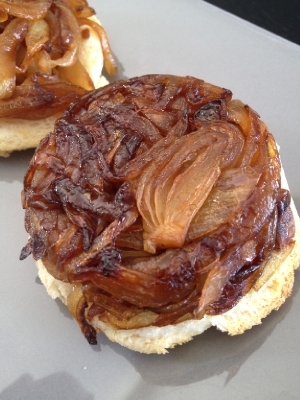
What you’ve made is halfcooked onions that have been fried in butter and sugar. Which may taste perfectly fine, but also nothing like the real thing.
I suspect that the reason most cooks lie is that they're not the ones doing it. To them, cooked onions are an ingredient that a spouse or assistant put in a bowl for them while they were still deciding which homey anecdote to fill out their "recipe" with. Peeling, chopping, and basic preparation are for the little people.
This. There's plenty of people backing this up.
This is backwards. It's really the other way around here.
What you have is real-world cooks and chefs, with all their collective experience, giving recipes correctly, but using the word "caramelized," and a bunch of people telling them that that isn't technically what "caramelized" means.
The vast majority of recipes involve cooking onions for 10-20 minutes, not caramelizing them for 45.
The "mistake" in all these thousands of recipes is simply the word, not that none of these people know how to cook, or are deliberately lying to you about how to caramelize am onion.
This guy is frying onions, might as well prepare a bowl of Froot Loops and you’ll be just as close to caramelized onions.
Caramelization products aren't sweet, they're primarily bitter. Sweetness in caramel products comes from residual sugar that hasn't been caramelized.
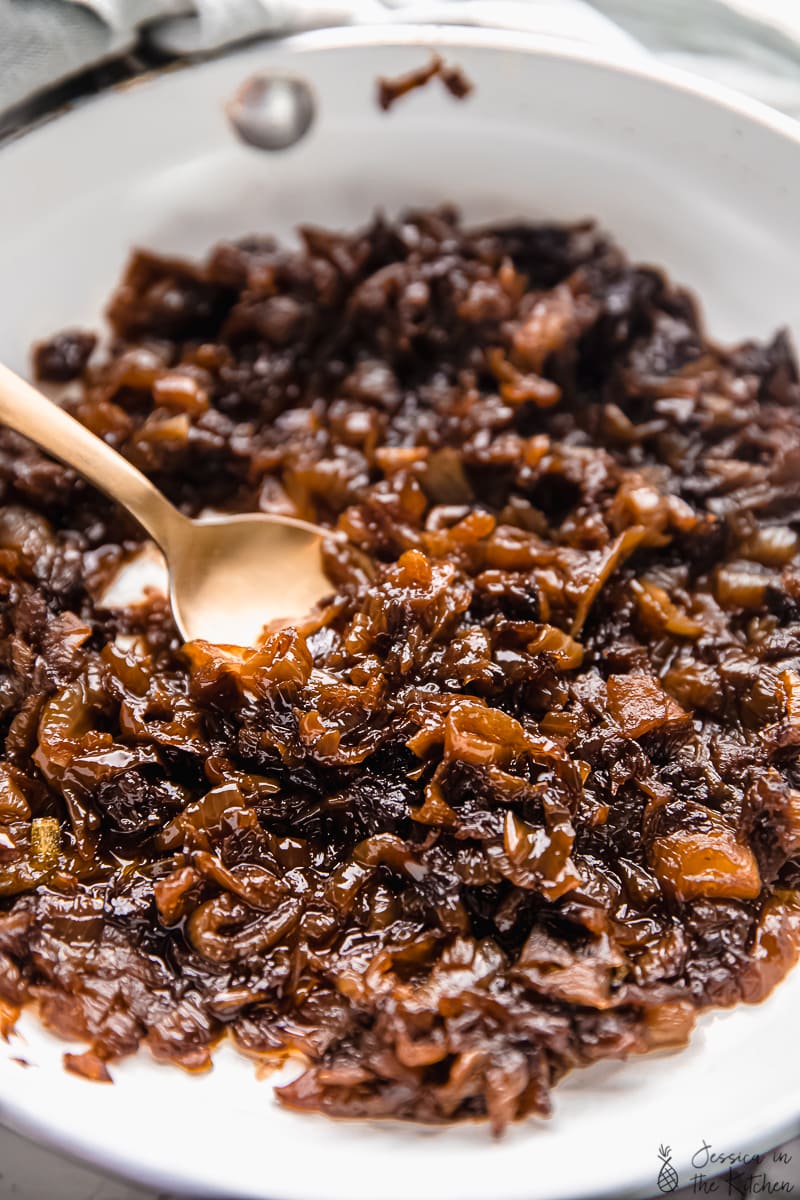
OP's video looks like fried onions with slightly burned sides.
Just like you can't bake a cake at 1000 degrees for 5 min instead of 200 degrees for 25 minutes, you can't caramelize onions in 5 or 10 minutes no matter the heat
As other replies hints at, "caramelize" is not a judgement call or varying definition; it's specific thing, a particular chemical reaction on sugar. if it hasn't happened then the onions are not "caramelised" and they actually are wrong.
It doesn't make the incorrect usage correct, but it does mean correct interpretation of _intent_ requires acknowledging incorrect _vocabulary_.
In chemistry, validity is not so subjective. it seeks to describe reality by measuring presence of clearly definable chemicals. The question of "what percentage of the sugar in this food item has been converted via caramelisation (or the Maillard reaction)" is not something that we can choose different but equally correct measurements of.
if you're referring to the "long debate" here on HN, then no, it doesn't mean very much about the facts of the matter.
original article doesn't debate the definition of caramelize, rather is about how it can be achieved.
Some things such as "pleasant music" or "good food" do not have crisp definitions. However, chemical reactions are far more clear-cut. They can be described and measured accurately, and debate settled. It doesn't matter how "long" the debate is, there are correct answers.
The only debate that IMHO I can see is "what percentage of the sugar has to be caramelized before it counts as a caramelized onion" ? Are there terms for partly and totally caramelized onions?
And yes this means if half say C and half say Not-C they both are 99% wrong. :)
No, ‘caramelized onions’ is a standard term. The issue is not one of confusion.
Yes, there is a technical definition of "caramelized." No, not every recipe writer uses this definition.
Look, when a recipe says "caramelize the onions for ten minutes" then there is something wrong, right? It's either the time or the word. Why does everyone learn the "true" definition of "caramelize" and then start assuming that the author must have used the right word and the wrong time, and that what they actually want you to do is sit there tending to onions for 45 minutes?
The VAST majority of recipes, particularly Italian or French, neither require nor want caramelized onions. Unless it's a recipe like French Onion Soup, the vast majority of such recipes want softened or browned onions. Take this from someone who has cooked in Italy and France for nearly 35 years.
If I'm a chef, and I have two line cooks, each with an onion, and I tell them that their onions will need to be prepared for French onion soup, and I order them to caramelize their onion, and one comes back in 10 minutes and the other comes back in 45 minutes, I am going to have a long conversation with them about how words having meanings.
This isn't a random context, this is the context where the term "caramelize" is technical jargon.
(Imprecise language bugs the hell out me as well, but it seems like it’s easier for me to bend than to attempt to fix all the humans.)
I can be mowing my lawn when it's 110F outside and say, "Gosh, I'm boiling." But if a recipe tells me to "boil" something, and it means anything other than put it in 212F water with heat applied in such a way that the water is bubbling, then the recipe is a shitty recipe, and I will diagnose the author with a confusion of the mind. The fact that the term now encompasses a much broader range of meaning in other contexts is completely irrelevant: I am not in those other contexts, in this context, it is a word with a very specific meaning.
You have a point here, there is a "context collapse" happening, when this definition is necessarily precise for professional chefs, and less so for "people who cook to eat".
However such recipe books typically claim to bring some of the professional techniques and results to the home cook, and as such are sowing confusion if they encourage "semantic drift"
https://interparestrust.org/terminology/term/context%20colla...
You will end up with barely a teaspoon of completely broken down onion matter that looks like apple butter or quince paste.
Your onions look delicious, but they are a different outcome to what the article describes.
I got a buddy who's from Texas, and he makes a mean brisket. He spends like 6 hours on it. I'm from California, and I make a pretty awesome tri-tip. I spend like 1 hour on it. They're both beef. They're both delicious. They look the same if you squint at it right. But they taste absolutely nothing like each other. And that's fine, as long as I don't call my tri-tip brisket and he doesn't call his brisket tri-tip. Cuz they ain't the same thing.
You've just discarded like half of Spanish cuisine... For instance the first thing you do in a paella involves frying (well, sautéing really) meat, vegetables and then very precisely paprika with olive oil. It's widely used to fry everything here, including potato omelettes and fish.
Of course it's good for frying things, there are cheaper and easier oils to cook with if you like them, but they make lousy substitutes for the dishes traditionally fried with olive oil.
This isn't what the author thinks. He thinks recipe writers are lying, not wrong. If you learned face-to-face, they would teach you the proper way... 40m. When they cook the dish themselves, they do 40m onions. When they write the recipe, they say 5-10m.
Your onions are great topping onions. Lovely on a burger, spuds, yum. Onion soup needs softer onions.
Leaving aside French Onion soup and looking your other example of rogan josh, here are some deep links to videos mentioning "~10 minutes":
- "7 to 10 minutes" : https://www.youtube.com/watch?v=B2GKfjaZQZE&t=2m15s
- "caramelizing quicker [...] 5 to 7 minutes" : https://www.youtube.com/watch?v=ICT_oOoMf4w&t=2m40s
- "caramelize into light brown color [...] 10 to 15 minutes" : https://www.youtube.com/watch?v=Ri3rSU1MkJY&t=0m57s
So either 2 possibilities:
- the different cooks actually cook the onions for 40+ minutes but hide the extra 30 minutes from the viewer and prefer to lie on camera and say "~10 minutes"
... or ...
- those cooks are actually just browning the onions for ~10 minutes and calling _that_ quick process "caramelization"
Doesn't Occam's Razor point more to the 2nd scenario?
I don't think deducing from pure logic in a court of first principles (I am being dramatic, obviously) is the way to go here. These are some pretty established recipe families and good cooks tend to cook them the slow cooked onion way.
I suppose one can always argue that art is in the eye of the beholder, that French Onion Soup, Bunny Chow or Rogan Josh are whatever we decide they are, plurality, etc. but... well... these recipes are half onion. They're not quick fried onion recipes. The onions are soft and mix gently with the gelatinous liquid parts. There's no lost in translation here. They're saying and showing pictures that imply slow cooked onions. In their restaurants (and homes), they are certainly not serving soup that's a stock with crunchy onion rings floating around! They're making french onion soup that's french onion soup. They're using slow cooked onions and lying about it! Godammit HN! Sometimes things just are as sneaky as they seem. I've had it with these onion fibbin fraudsters. They've been lying to us this whole time!
I agree that the author is not dissecting semantics and that omission is my point. It's the flaw with his essay. I'm saying the best way to explain the widespread "lie" (across books, Youtube videos, etc) is via differing language usage.
And look closely again (freeze the frame) at that deep link of the onions in the Vivek Singh of Cinnamon Club video... those are not deep dark brown onions (scientific chemistry of caramelization) -- and yet he calls that 5-7 minute heating of onions ... "caramelization".
>There's no lost in translation here.
Those videos and this entire HN thread full of contradictory comments about "caramelization" and various posters trying to correct each other ... seems like evidence that there's plenty lost in translation. :-)
The author quotes Madhur Jaffrey's cookbook for rogan josh and the Youtube video shows Madhur Jaffrey re-iterating that it's 7-10 minutes to brown the onions.
It is similarly difficult to "prove" the antipattern in a web app's data consent model to a neutral observer. But, if you live in a world of Web Apps & TCS, then it's quite intuitive. Users can tick here, click there... consent. If someone has never used a computer before, it'll sound reasonable.
There is more context to these "misunderstandings" than language usage. The author's point is as true if you just used the term "onions," without a descriptor.
You can point to end cases... special onion cultivars, special cooking methods (the author tries one), a twist on the mainstream recipe... Any of these could "explain" the observations, if you're looking at it this way. There's no smoking gun without an author admitting that they fibbed about onion times...
>>Those videos and this entire HN thread full of contradictory comments about "caramelization"
Of course it they are! Semantics are Nerdbait Pro. That's why these states persist.
The semantics are cover. This is a conspiracy, of sorts. ... No cooking class will teach you the 5 minute onion version of french onion soup or Rogan Josh. Only written recipes trying to look quick and easy. This is not a coincidence. I'm not claiming there is enough evidence on the table to convict anyone specific. Each one could just be wrong, or eccentric. I am saying that as someone who cooks and eats these dishes....On average, these are blatant lies!
Despite the fact that people use terms like "caramelized" in multiple ways, we can usually know a lot of meaning from context. The more context we know (eg, knowing how these dishes are ordinarily made), the better we are able to distinguish meaning... and also antipatterns like habitual fibbing in a certain context.
We're more likely to notice the photo effects, if we know that we're looking at a thumbnail.
[disclaimer] Being melodramatic for fun. Obviously not this cranky about onion recipes.
My guess is the wrongness is either a lack of fat or overcrowding, or both. Fat (butter, margarine, oil, whatever, I prefer butter) acts as a flux to spread the heat. Use enough, plus use proper tools.
"Butter seemed a little risky at that temperature, so I went with olive oil, in a cheap, lightweight nonstick skillet. In five minutes, a few flecks of brown had appeared". Olive oil is good for many things, but not for frying things. The "few flecks of brown" sounds like there's not enough of it either, so the heat oil gets applied where the onions touch the skillet directly. Add more flux until the flux generators cannae take it any more, Cap'n!
Just to prove my point, here's a timelapse of half an onion done in butter, the way I usually do it. Quality skillet, induction stove set to my favorite level, 7 of 9. 5 minutes and they're good: https://photos.app.goo.gl/tpfAy5uqc6NRRFsB8
If you want to be more careful, you can lower the heat - here's me cooking the other half onion at 2.5 out of 9, which is really very low (though done on a warm skillet, so it's a bit warmer): https://photos.app.goo.gl/QLaW7YkqijxF7K95A