mb is short for millibit, the abbreviation for megabyte is MB (or MiB if you mean 2^20 bytes). I know it's a minor thing, but "m" and "M" does not mean the same thing, neither does "b" and "B", and they're mixed up too often.
Sorry for the off topic.
No, they're not. Sure, in more familiar scenarios where you're measuring the size of some amount of data it's an integer, but there's nothing mathematically wrong with having a not-integer number of bits.
See: https://en.wikipedia.org/wiki/Shannon_(unit)
If you do any sort of calculations with information theory you're quite likely to end up with a non-integer number of bits, and there's nothing wrong with that.
Just because physical hardware is more or less restricted to integer bit quantities doesn't mean fractional bits aren't a useful concept.
He was going crazy over a file being shown as 600Mb on Windows and 629Mb on mac. When he compared the bytes values, they were the same (around 629,145,600 bytes) and that settled it.
My MacBook Pro's internal "1 TB" disk is actually 1,000,240,963,584 bytes -- neither 1 TB nor 1 TiB.
To be fair: It make sense to measure RAM in MiB, because it is addressed by binary address lines so you always end up with a power of two.
Files are, however, as big as somebody decided to write into them (modulo some rounding to the next sector, depending on file system implementation details). It does not make much sense to measure them in MiB. Quite often it just more confusing to calculate file sizes in MiB instead of MB. I dont even know why Microsoft stated that MiB business.
Similar with hard disks by the way. They contain as many sectors as the manufacturer was able to put on them. There is no power of two involved.
I believe the reason is that all storage devices are marketed in decimal sizes anyway.
Darker single color gradients exhibit very strongly noticeable color stairs. Tried to generate one for a background, locked horrible. It only looked good once I randomized the gradients a bit, i.e., even with 8 bit colors, you might need dithering.
Similar effects can be noticed in relatively dark photos of scenes with gradients, e.g., a sky.
Of course my experience is only 1 test point...
Yes, if you actually compare a 10-bit and an 8-bit panel next to another, it's immediately obvious.
Here's a photo of a 6-bit, 10-bit and 8-bit gradient on a native 10-bit panel without any dithering (Dell UP2718Q): https://i.k8r.eu/VolYbQ.png
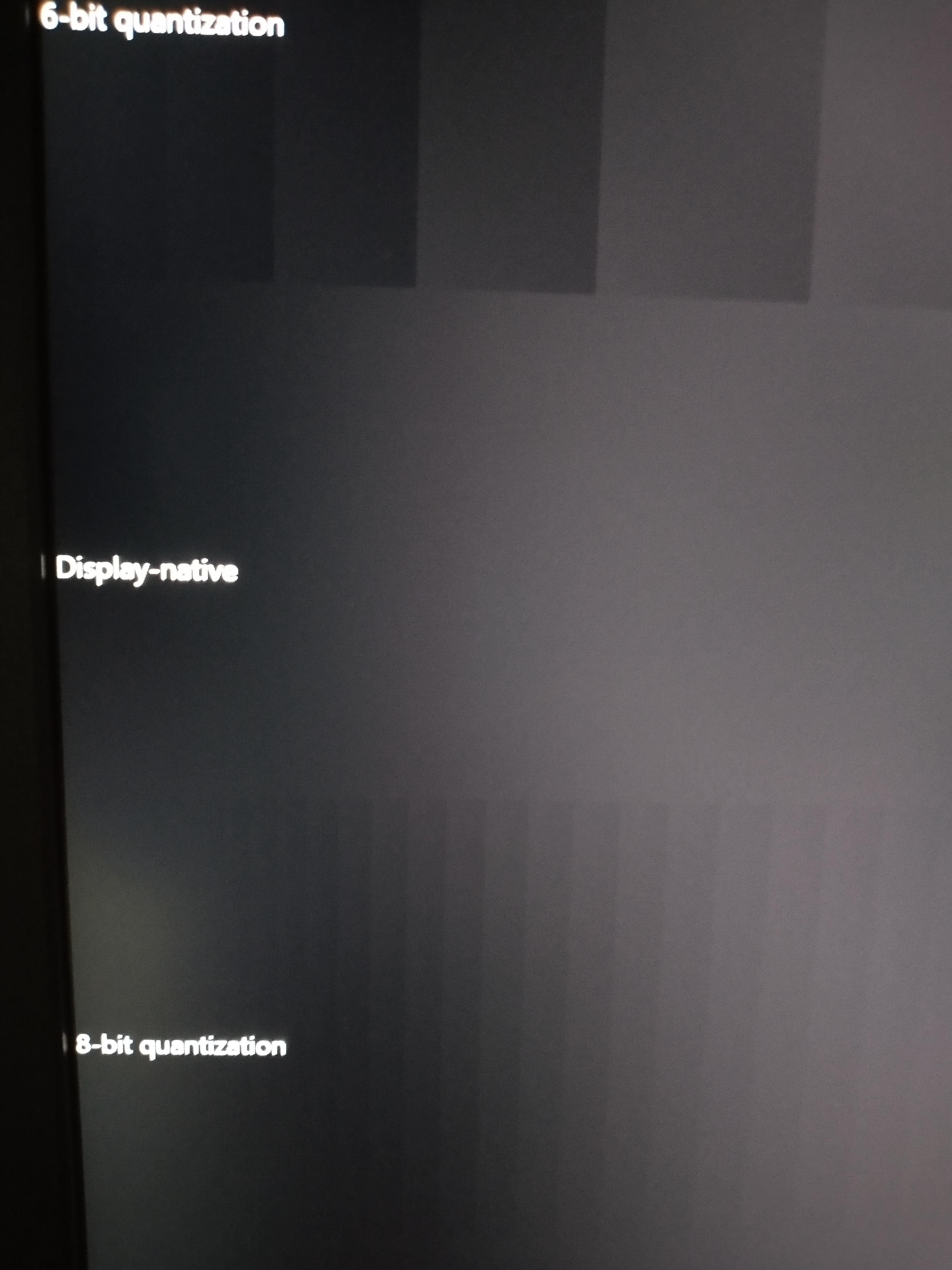
Running on a Dell UP2718Q, in HDR10 mode.
That said, in person can be – depending on environmental lighting conditions – much more subtle. The test here was done with blinds closed in a mostly dark room.
In bright environments 8-bit is enough, and 6-bit with dithering can be close, but in dark environments (such as when watching a movie or gaming) you'll even notice banding in 10-bit content.
Additionally wider color gamuts also mean that each quantization step would cover a larger absolute difference if we kept things at 8bpc.
Wikipedia agrees with that (https://en.wikipedia.org/wiki/Video_Graphics_Array), but adds “The 640×480 16-color and 320×200 256-color modes had fully redefinable palettes, with each entry selected from an 18-bit (262,144-color) gamut.”. That, I don’t remember knowing, even reading that.
So, a quarter of a million, but only 256 at a time. I think the Macintosh II, doing 256 colors out of 16.7 million, looked better, especially with a Trinitron display (https://everymac.com/monitors/apple/classic_monitors/specs/a...).
that's neat that someone else does that.
i'm like that with the voodoo2, for some unknown reason.
don't get me wrong, the voodoo2 was great, but i'm not sure why it stuck in my head for that long.
My first thought was "yeah, that makes sense" but my second was "what could it possibly mean when we talk about a 68000 being 'fast' in 2021?!"
It really made me think about how an attribute like "fastness" can get endowed and then still stick 40 years later, almost as though it were describing some spiritual attribute that transcends the fact that a modern $0.25 microcontroller is many times more performant.
Same goes for some symbols like 386 dx2. Our young brain were imprinted hard.
Now cards have more RAM than I had disk.
Now CPUs have more L2/L3 cache than I had disk!
It's called seizure test, aka intermittent photic stimulation ;) https://en.wikipedia.org/wiki/Intermittent_photic_stimulatio...
7 bit color would also count as "millions of colors", but I don't remember any GPU ever offering it as a display mode.
Edit: link https://www.tomshardware.com/uk/reviews/graphics-beginners,1...
I used to work as a hardware technician in a local computer shop as a summer / weekend job back then. I installed dozens of 4mb Cirrus Logic PCI graphics cards when building PCs.
The motherboard multiple ISA and 1 PCI slot if I recall right. In fact I was testing VGA and also sound cards on the ISA slot. So checking sound and playing some mpeg video file.
I can maybe write up a short post about this if anyone would be interested more.
At home, away from work, I owned a mac which was running the power pc processor. And that was also 25 mhz. What I remember was how everything seemed integrated (e.g. not upgradable. Young me could not understand why there was no graphics card. I could only upgrade here the hard drive, or simm memory)
Is this one of them?
Dark scenes on a OLED might look better since your eyes can adjust to low light.
640px x 480x x 3 bytes per channel = ~1MB. So yeah, 4-8MB is about right for a VGA card.
VGA came with 256 kB RAM onboard. Then, in the early 90's, SVGA came with 512 kB and 1 MB onboard, and it could do 800x600, 1024x768 and 1280x1024. The main RAM would be around 4 MB for the midrange computer. It took until mid-90, that you could get 4 or 8 MB SVGA, that could also do hicolor and truecolor.
I would basically run a macro which cycle through the resolutions from b/w, 4 colors, 16, 256, ... and up to a million or so. I think there is a name for this, but basically watching a prism of rainbow colors. At a million+ the color tones are very smooth and you don't see an outline.
I could not imagine I would be able to differentiate a billion colors from its previous factor. At that point, I would stamp it and it goes off to shipping for packaging, and to the customers.