Re:Apple Silicon M1 supports “billion of colors” a.k.a. HDR ...
by kuschku on Saturday January 30, 2021 @07:27AM
(#25968518)
> Are you sure the panel you are viewing on is in fact also 8bits/color
Yes, if you actually compare a 10-bit and an 8-bit panel next to another, it's immediately obvious.
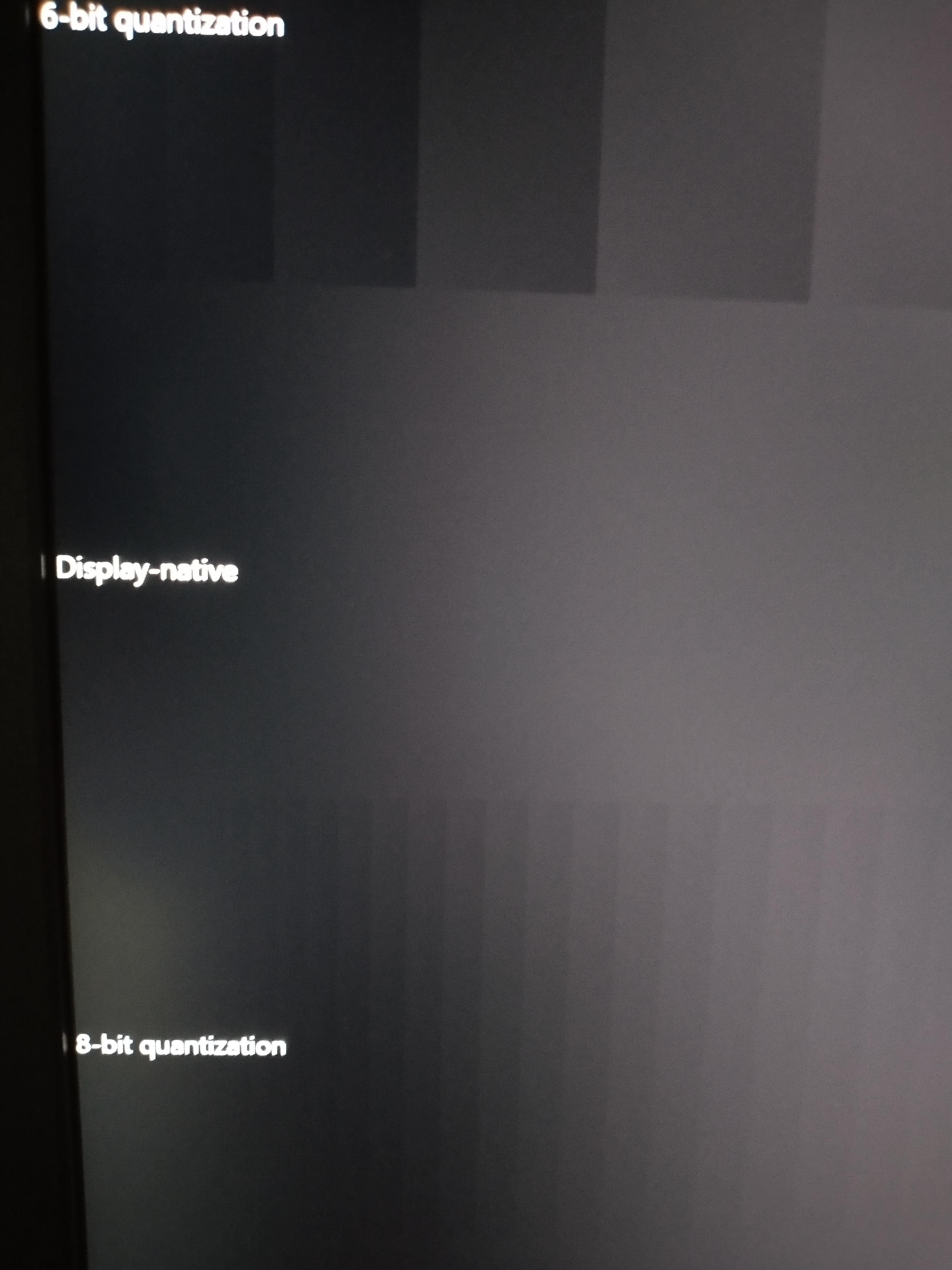
Here's a photo of a 6-bit, 10-bit and 8-bit gradient on a native 10-bit panel without any dithering (Dell UP2718Q): https://i.k8r.eu/VolYbQ.png
Re:Apple Silicon M1 supports “billion of colors” a.k.a. HDR ...
by Ballas on Sunday January 31, 2021 @06:23AM
(#25977997)
Thanks, that is very informative. Could you give a link to the source, or even the grey level range used here? I am trying to reproduce the results, but I an not having any luck unless I change my brightness/contrast to unacceptable levels.
Re:Apple Silicon M1 supports “billion of colors” a.k.a. HDR ...
by kuschku on Sunday January 31, 2021 @06:42AM
(#25978103)
That’s the grey level test of the official VESA DisplayHDR Test application: https://www.microsoft.com/en-us/p/displayhdr-test/9nn1gpn70n...
Running on a Dell UP2718Q, in HDR10 mode.
That said, in person can be – depending on environmental lighting conditions – much more subtle. The test here was done with blinds closed in a mostly dark room.
In bright environments 8-bit is enough, and 6-bit with dithering can be close, but in dark environments (such as when watching a movie or gaming) you'll even notice banding in 10-bit content.
Of course my experience is only 1 test point...