News for hackers. Stuff that matters.
Re:Law Enforcement Is Accessing Locked Devices by wing-_-nuts on Wednesday December 09, 2020 @09:17AM (#25358673)
So, are we to gather that encryption on most android / iphones can now be easily broken? I seriously doubt this capability is just confined to law enforcement. How do we protect ourselves? I've started running full disk encryption on my laptop, but if I'm completely honest the data on my phone is just as valuable if not more. Any solutions to this?
Re:Law Enforcement Is Accessing Locked Devices by kop316 on Wednesday December 09, 2020 @09:41AM (#25358907)
My understanding of it comes down to this:

Most people do not use secure passphrase to lock their phones, but use a PIN. Even an 8 digit PIN is only 10^8 guesses, which any modern desktop can crack. To solve this, Android/iOS make an extremely long salt, so that + your PIN is your passphrase. In addition, there is logic to deter brute force attacks (e.g. after 10 guesses wipe my device)

The attacks have to overcome both of those, but if they do, cracking the original secret (your PIN) is easy.

The other method is attacking a "live" phone/laptop, as it has the unprotected key, and one just needs to exfiltrate it.

If you are truly concerned, DO NOT USE a trivial crackable PIN! Use a long password that is hard to crack by itself. Additionally, turn off your device if you think you are in a position where you have to surrender your electronics! That way the unprotected key is gone.

(As a side rant, I wish Android and iOS would allow you to have a "start up" password and a screen unlock password. You used to be able to do that on Android, but it was through root and not officially supported. But it would be nice because then you could have an easy to unlock screen password and a really difficult encryption password).

Re:Law Enforcement Is Accessing Locked Devices by caconym_ on Wednesday December 09, 2020 @11:27AM (#25360327)
My understanding is that the master encryption key does not exist on the device in non-volatile storage, but rather is computed by combining a secret key (I guess you could call this a “salt”) stored in the secure enclave with the user’s passphrase. When you start the device and authenticate, this derivation happens, and then the derived key is kept in memory and it’s only software keeping an attacker out.

If the locked state without a derived key loaded is as secure as it theoretically should be, doesn’t that mean recovering data off the device without uncapping (or similar) requires correctly guessing the passcode in however many master key derivation attempts the secure enclave is configured to allow before it wipes the secret key and renders the stored data useless?

This seems really secure on average, even with a weak PIN. I’m trying to decode Cellebrite’s claims about access to “locked” phones and I’m assuming they mean locked with key loaded, though I guess I can imagine some vulnerability that sidesteps the maximum attempts logic in the secure enclave.

Re:Law Enforcement Is Accessing Locked Devices by kop316 on Wednesday December 09, 2020 @12:26PM (#25361069)
> My understanding is that the master encryption key does not exist on the device in non-volatile storage, but rather is computed by combining a secret key (I guess you could call this a “salt”) stored in the secure enclave with the user’s passphrase. When you start the device and authenticate, this derivation happens, and then the derived key is kept in memory and it’s only software keeping an attacker out.

Sorry yes I sort of glossed over this part and some other parts in my explanation.

> If the locked state without a derived key loaded is as secure as it theoretically should be, doesn’t that mean recovering data off the device without uncapping (or similar) requires correctly guessing the passcode in however many master key derivation attempts the secure enclave is configured to allow before it wipes the secret key and renders the stored data useless?

You are correct. As pointed out below, this also assumes there is no vulnerability in the enclave. Having a secure passphrase with a secure key derivation function provides a more secure foundation however, because even having unlimited guesses means you are still down to the original brute force.

Re:Law Enforcement Is Accessing Locked Devices by gruez on Wednesday December 09, 2020 @10:12AM (#25359269)
>To solve this, Android/iOS make an extremely long salt, so that + your PIN is your passphrase. In addition, there is logic to deter brute force attacks (e.g. after 10 guesses wipe my device)

nitpick: it's not just a "long salt", the "salt" is burned into the phone's security processor (trustzone or secure enclave) and can't be extracted so any attempts must be made using the exact phone. Using a gpu cracking cluster wouldn't help, for instance. AFAIK the anti-guessing logic is also implemented like this, otherwise you can just extract the salt and make unlimited attempts since the phone can't keep track of how many attempts you made.

Re:Law Enforcement Is Accessing Locked Devices by SEJeff on Wednesday December 09, 2020 @10:50AM (#25359807)
Trustzones or secure enclaves can be "broken" via uncapping. They are designed to be resistant to that, not unbreakable. Uncapping is not new and has been around for a long time, it just takes a lot of expensive hardware and expertise. Ultimately, the keys are bits on silicon, and with some acid, a scanning tunneling electron microscope, and a lot of time, the keys can be pulled off.

There are even articles from 2016 on how this is possible: https://arstechnica.com/information-technology/2016/02/how-t...

It is very unlikely this sort of technique would be used against anyone but the most extreme threat actors (potential terrorists, etc). But with physical access, all bets are off. It isn't a matter of if they can decrypt, but how long it will take them given the resources available.

Re:Law Enforcement Is Accessing Locked Devices by bigiain on Wednesday December 09, 2020 @06:44PM (#25367212)
> Trustzones or secure enclaves can be "broken" via uncapping.

That's true, but it's a big step up from the “push a button, data appears,” described in them article.

If you become "a person of interest" to MOSSAD, good luck. You'll be needing those magical amulets and the submarine to hide in - and YOU'RE STILL GONNA BE MOSSAD'ED UPON!

https://www.usenix.org/system/files/1401_08-12_mickens.pdf

Re:Law Enforcement Is Accessing Locked Devices by Throwaway1771 on Wednesday December 09, 2020 @10:57AM (#25359941)
Are you referring to chips like the Titan M in this as well?
Re:Law Enforcement Is Accessing Locked Devices by arilotter on Wednesday December 09, 2020 @11:03AM (#25360024)
Does the Titan M not store data in some physical medium? As far as I know, there isn't any way to prevent a truly dedicated and resourceful attacker from reading data that exists physically. The only constraints are money and time. A chip that e.g. self-destructed on detecting signs of tamper would be harder to break, but if the data exists physically, it must be recoverable in some way, no?
Re:Law Enforcement Is Accessing Locked Devices by SEJeff on Wednesday December 09, 2020 @11:15AM (#25360175)
Bingo! Money and time. When you're going against an adversary with massive amounts of both, all bets are off. Physical access means eventual compromise.
Re:Law Enforcement Is Accessing Locked Devices by glator on Wednesday December 09, 2020 @12:10PM (#25360862)
Shouldn't a strong symmetric encryption with a long key prove to be safe enough as to not be crackable in a reasonable amount of time (~10 years), even if the hardware is directly accessible ?
Re:Law Enforcement Is Accessing Locked Devices by mrandish on Wednesday December 09, 2020 @05:26PM (#25366160)
Probably, at least in practice if no critical components in the chain fail due to bugs/exploits and are as secure as intended (excluding the metaphorical "hammer VS fingers" attack).

I think the difference here between you and the poster you replied to is that you're probably correct given certain assumptions but the earlier post also remains correct in a conceptual or theoretical sense, like pure information/security theory

Re:Law Enforcement Is Accessing Locked Devices by gruez on Wednesday December 09, 2020 @02:21PM (#25363151)
Yes, but long keys are unwieldy. There's a comment I made in this thread[1] that calculates how long of a password you need for 128 bits of entropy.

[1] https://news.ycombinator.com/item?id=25358206

Re:Law Enforcement Is Accessing Locked Devices by Forbo on Wednesday December 09, 2020 @12:59PM (#25361460)
I don't know why you were voted dead for asking a question. I vouched for your comment.
Re:Law Enforcement Is Accessing Locked Devices by PhantomGremlin on Thursday December 10, 2020 @03:00AM (#25371061)
I don't know why you were voted dead for asking a question.

That's a new account (name in green). I think they start out dead. I think one or more comments need to be voted up and then the account becomes not dead (alive?).

Re:Law Enforcement Is Accessing Locked Devices by GoblinSlayer on Wednesday December 09, 2020 @02:18PM (#25363084)
The trick for this case is a very long key, 1mb of more, try to recover all of them, you can lose about 60 bits, but not much more. What is the speed of extraction? You only need to delay it for a couple of decades.
Re:Law Enforcement Is Accessing Locked Devices by andromeduck on Thursday December 10, 2020 @01:38AM (#25370547)
Yeah some higher end security chips have passive mechanisms that make the microstructures more delicate and harder to reach and therefore harder to physically read. This is on top of active mechanisms that try constrain operation to well defined range of temperatures, voltage and power conditions to prevent brown out and booby traps that trigger effacement.

You have to disclose a lot of info during the cert process though so I don't think this is too much of a hurdle for big players like the NSA.

Re:Law Enforcement Is Accessing Locked Devices by mtgx on Wednesday December 09, 2020 @01:46PM (#25362395)
Newer devices (only Pixel 3 and newer, and Galaxy Note 20 and newer) also come with hardware security modules called Strongboxes (like Apple's Security Enclave).

https://www.android-device-security.org/client/datatable?sor...

Re:Law Enforcement Is Accessing Locked Devices by dpifke on Wednesday December 09, 2020 @04:42PM (#25365594)
The big issue with the unlock password being used for FDE is that the average user unlocks their phone many times/day, often in view of cameras.

If I worked for a LEO and was asked to "crack" a locked phone, I would start by looking at surveillance footage from anywhere the suspect might have pulled their phone out of their pocket.

Re:Law Enforcement Is Accessing Locked Devices by k1t on Wednesday December 09, 2020 @10:28AM (#25359489)
Although not exactly startup vs unlock passwords, you get similar functionality with fingerprints.

99% of unlocks can be done by touching a finger. The standard unlock code is only required after a restart or every 3-4 days.

Re:Law Enforcement Is Accessing Locked Devices by kop316 on Wednesday December 09, 2020 @10:37AM (#25359613)
That's my set-up with Android now. However, on a Pixel3a, I feel like I have to do a manual input several times a day, usually if I wash my hands, use lotion, things like that. It also doesnt work well if I am outside in the cold and need gloves.
Re:Law Enforcement Is Accessing Locked Devices by taxidump on Wednesday December 09, 2020 @11:24AM (#25360285)
This is exactly why I learned in the tip of my nose. Try it.
Re:Law Enforcement Is Accessing Locked Devices by zaroth on Wednesday December 09, 2020 @11:46AM (#25360573)
Kinda gross though, and definitely not sanitary!
Re:Law Enforcement Is Accessing Locked Devices by neolog on Wednesday December 09, 2020 @01:07PM (#25361554)
Can someone else's nose unlock your phone?
Re:Law Enforcement Is Accessing Locked Devices by 542354234235 on Wednesday December 09, 2020 @02:05PM (#25362847)
Only if they have his nose.
Re:Law Enforcement Is Accessing Locked Devices by beezle on Wednesday December 09, 2020 @11:50PM (#25369867)
Also, it is probably possible to narrow down pin codes by looking at the surface of the phone for finger prints/screen damage. At least on Android, the unlock will appear in the same location every time and unless your pin uses every digit, there will be heavier use in some areas. It is unfortunate that stock android does not rotate the input keypad, I believe some ROMS (AICP?) would do this and thus eliminate this attack surface.
Re:Law Enforcement Is Accessing Locked Devices by jmt_ on Wednesday December 09, 2020 @10:50AM (#25359812)
Computationally I understand that cracking PINs is trivial for modern computers. But does anyone know by what means these mobile forensics tools are able to brute force? I thought iPhone's will lock you out for a certain amount of time after a certain amount of failed attempts. Depending on the device/OS, are there ways to extract some sort of hashed password then crack on desktop like usual? Is a vulnerability of some sort always required to extract phone hashes?
Re:Law Enforcement Is Accessing Locked Devices by Scoundreller on Wednesday December 09, 2020 @10:56AM (#25359917)
Could be the latter.

But Every process can be prone to glitching. Just mess with the “how many password failures have occurred? If >10 start erasing” process and there’s no such thing as too much failure anymore.

iPhones used to increment (or save the increment) after the password entry failure, so bypassing used to be as simple as quickly disconnecting power before your failure got recorded.

It’s also possible they can make copies of enough data and have a “slave” iPhone embedded in the device to continue cracking offline, just in case only the guts of an iPhone can do the decoding.

Re:Law Enforcement Is Accessing Locked Devices by mcphage on Wednesday December 09, 2020 @11:16AM (#25360185)
> I thought iPhone's will lock you out for a certain amount of time after a certain amount of failed attempts.

One of the techniques used is, copying the memory from your phone onto another phone, and then testing passwords on that. When it locks up, wipe it and recopy. I don't know if that is still used, however.

Re:Law Enforcement Is Accessing Locked Devices by Shivetya on Wednesday December 09, 2020 @12:37PM (#25361208)
(out of my league here)

why not copy memory to another device and run a crack against a segment of the memory known to hold specific values until you match? I am not sure if they can block taking encrypted data off a device.

So my question is, case intrusion. Can this be detected in various forms in order to render the contents of the device useless? The safety factor to the owner is that they would have backed up the device to a trusted source before they voluntarily submitted a phone to being physically opened. you would need to not only check for separation but drilling through either side.

Re:Law Enforcement Is Accessing Locked Devices by jmt_ on Wednesday December 09, 2020 @11:40AM (#25360499)
Conceptually that makes sense to me but if you're already locked out of the phone how would you access the memory in the first place?
Re:Law Enforcement Is Accessing Locked Devices by WJW on Wednesday December 09, 2020 @12:06PM (#25360812)
Open up the phone, solder leads to the memory bus?

EDIT: If you can access the real time clock chip and set the clock to a point in the future where the lockout has elapsed, that might work as well.

Re:Law Enforcement Is Accessing Locked Devices by dboreham on Wednesday December 09, 2020 @10:12PM (#25369187)
No. The memory in question is inside a special chip designed explicitly for the purpose of not allowing easy access.
Re:Law Enforcement Is Accessing Locked Devices by WJW on Thursday December 10, 2020 @04:37PM (#25379068)
Not allowing "easy" access is not the same as "no" access though. I could easily imagine a radar/MRI imaging system generating instructions for a cnc drilling rig that would make micrometer accurate holes through the chip packaging, then inserting extremely precise probes directly into the wires inside the package.

I could also imagine a team of 5-10 engineers making such a system in a year (total costs <10 million), with 20-50 million in off-the-shelf hardware costs as a pessimistic estimate. As a company, you then "only" have to amortize this cost over 20 countries each wishing to crack the phones of 5 phones of high-profile criminals and/or dissidents each to get to an average cost of 600k per phone. It would easily be worth that much to the US to crack the phone of a high profile drug lord.

Long story short, private companies (even with as much resources as Apple) either need watertight mathematical proofs of security or accept that they stand no chance at all against nation state adversaries.

Re:Law Enforcement Is Accessing Locked Devices by dylan604 on Wednesday December 09, 2020 @09:54AM (#25359057)
Unless your Apple product has a T2 chip. If it does, there's not protecting it other than don't let it physically fall into someone else's hands. The T2 debacle is probably the single greatest let down for me in Apple products. There have been plenty of things I bitch and moan about, but nothing has been as compromising as the T2 failure.
Re:Law Enforcement Is Accessing Locked Devices by mariodiana on Wednesday December 09, 2020 @09:55AM (#25359072)
What's the details with the problem with the T2 chip? Do you have a link? Thanks!
Re:Law Enforcement Is Accessing Locked Devices by snazz on Wednesday December 09, 2020 @10:07AM (#25359202)
Re:Law Enforcement Is Accessing Locked Devices by firloop on Wednesday December 09, 2020 @10:06AM (#25359197)
Ars Technica writeup about the vulnerability: https://arstechnica.com/information-technology/2020/10/apple...
Re:Law Enforcement Is Accessing Locked Devices by mistersquid on Wednesday December 09, 2020 @10:50AM (#25359810)
Thanks for the link, whose article is understandable by non-security technology types like myself.

Here are some limitations to the T2 vulnerability which give those of us with T2-equipped devices less to fret about:

> There are a few important limitations of the jailbreak, though, that keep this from being a full-blown security crisis. The first is that an attacker would need physical access to target devices in order to exploit them. The tool can only run off of another device over USB. This means hackers can't remotely mass-infect every Mac that has a T2 chip. An attacker could jailbreak a target device and then disappear, but the compromise isn't "persistent"; it ends when the T2 chip is rebooted. The Checkra1n researchers do caution, though, that the T2 chip itself doesn't reboot every time the device does. To be certain that a Mac hasn't been compromised by the jailbreak, the T2 chip must be fully restored to Apple's defaults. Finally, the jailbreak doesn't give an attacker instant access to a target's encrypted data. It could allow hackers to install keyloggers or other malware that could later grab the decryption keys, or it could make it easier to brute-force them, but Checkra1n isn't a silver bullet.

Re:Law Enforcement Is Accessing Locked Devices by dylan604 on Wednesday December 09, 2020 @01:20PM (#25361788)
If law enforcement has your device via warrant or confiscation at a border, then this vulnerability is very much in play.
Re:Law Enforcement Is Accessing Locked Devices by ArchOversight on Wednesday December 09, 2020 @01:40PM (#25362260)
If the device is left unattended at a border crossing and it is taken away to a back room, you should just assume its been hacked or modified and shouldn't trust it again.
Re:Law Enforcement Is Accessing Locked Devices by dylan604 on Wednesday December 09, 2020 @02:12PM (#25362978)
I wasn't referring to someone leaving/forgetting/losing a device. I'm talking about carry your devices through border inspection, and having those agents confiscate your devices.
Re:Law Enforcement Is Accessing Locked Devices by ArchOversight on Wednesday December 09, 2020 @06:30PM (#25367024)
Yes, "left unattended"/"taken" are the same thing here.
Re:Law Enforcement Is Accessing Locked Devices by czbond on Wednesday December 09, 2020 @10:31AM (#25359522)
I purchased the 16" solely for the T2 chip. Then vuln'ed - curses!
Re:Law Enforcement Is Accessing Locked Devices by bigiain on Wednesday December 09, 2020 @06:40PM (#25367158)
> In addition, there is logic to deter brute force attacks (e.g. after 10 guesses wipe my device)

The brute force protection has historically not been flawless. Rumour says the Greykey used to brute force the pin/passphrase by glitching the power every few attempts which reset the counter.

Re:Law Enforcement Is Accessing Locked Devices by ashleyn on Wednesday December 09, 2020 @09:56AM (#25359085)
What length PIN would you recommend in light of what commercially-available equipment is capable of cracking? Is an actual, honest-to-god password supported on latest Android?
Re:Law Enforcement Is Accessing Locked Devices by gruez on Wednesday December 09, 2020 @10:22AM (#25359400)
It really depends on how your password is selected. "aaaaaaaaaaaaaaaaaaaaaaaaaaaaaaaaaaaaaa" is a long password but won't protect you. You really want to optimize for ease of entry and memory, rather than using the largest character set or having the longest password. For a point of reference, these three choices have (roughly) equivalent security (128 bits of entropy):

1. 27 characters - all lowercase, randomly selected

2. 20 characters - upper/lower case + 15 special characters found on the first page of the iOS keyboard, randomly selected

3. 45 characters - 10 words from eff's short diceware wordlist, randomly selected

the first option would be the easiest to enter, despite being 7 characters longer than the second one, because you don't have to constantly switch between the various character types (since you're using a touch keyboard). The third one is 66% longer than the first one, but probably is easier to remember.

As for how many bits of entropy to use, AFAIK a preimage attack against md5 (128 bits) hasn't been pulled off yet, so it's probably safe for for the foreseeable future. You can probably go lower than that and still be safe, considering that a md5 preimage attack is significantly easier than cracking a phone pin (eg. no memory/cpu hard KDF, no trustzone/secure enclave).

Re:Law Enforcement Is Accessing Locked Devices by Forbo on Wednesday December 09, 2020 @05:49PM (#25366435)
Last I checked, Android had a 16 character limit on password. Pretty frustrating when I went to set my phone up.
Re:Law Enforcement Is Accessing Locked Devices by kop316 on Wednesday December 09, 2020 @10:09AM (#25359224)
> honest-to-god password supported on latest Android?

Yep, I have one. I haven't kept up with the latest, but the "standard" good password should be good (i.e. above 12 characters, letteers, numbers, etc.)?

Re:Law Enforcement Is Accessing Locked Devices by randmeerkat on Wednesday December 09, 2020 @11:27AM (#25360324)
Obligatory xkcd: https://xkcd.com/538/
Re:Law Enforcement Is Accessing Locked Devices by PeterisP on Wednesday December 09, 2020 @09:49AM (#25358999)
They aren't easily broken - they can be broken by tools which would stop working if the underlying vulnerabilities would get detected and fixed, so the availability (and thus usage) of these tools is quite restricted.

E.g. many of law enforcement agencies can break encryption on modern phones by shipping the phone to someone like Cellebrite and paying a hefty fee per device, but they can't do it themselves, and often can't buy the capability to do it themselves (they don't get trusted not to leak the tools somehow and kill the goose that lays the golden eggs so to say) and thus can't do it on a large scale.

There almost certainly are some intelligence or LE agencies in the world that have such a capability in-house, but it's a quite high bar, and I believe that most countries and most agencies in a decentralized policing environment like USA don't have such tools available to themselves - they could have the connections to get it done for some specific devices by one of the very few actors who can do it, but that's not what "easily broken" would mean.

Re:Law Enforcement Is Accessing Locked Devices by gowld on Wednesday December 09, 2020 @10:26AM (#25359449)
To be clear, LE won't get Cellebrite's tools because they don't trust themselves to use the tools properly, but LE demands key into all companies' systems and claims they can be trusted to use those kes properly?
Re:Law Enforcement Is Accessing Locked Devices by closeparen on Wednesday December 09, 2020 @11:56AM (#25360701)
Law enforcement is not a monolithic entity. Your municipal police department or county sheriff’s office can barely check its email, let alone backdoor a tech company. However it might be able to get technical assistance from the FBI or a private digital forensics consultancy on an important case.
Re:Law Enforcement Is Accessing Locked Devices by detaro on Wednesday December 09, 2020 @10:30AM (#25359515)
No, because Cellebrite doesn't trust law enforcement to do so.
Re:Law Enforcement Is Accessing Locked Devices by wmf on Wednesday December 09, 2020 @02:20PM (#25363127)
Clearly the "solution" is for backdoors to be administered by a centralized, "trusted", private, for-profit monopoly! I'm sure VeriSign would be happy to bid on it.
Re:Law Enforcement Is Accessing Locked Devices by sandworm101 on Wednesday December 09, 2020 @09:48AM (#25358978)
Use your phone as a thin client. For instance, dont install email software but instead use a webmail interface via a secure browser. That way when they unlock the phone they dont get your email. The airport cop might see a bookmark to an email service but will still have to ask you for login details, giving you control over which account they see.
Re:Law Enforcement Is Accessing Locked Devices by alextheparrot on Wednesday December 09, 2020 @10:43AM (#25359705)
This is a hard balance, though. Using unique, randomly generated passwords for the 30 or so sites I routinely use is safer against breaches, but starts to almost require a password manager, which presumably can be broken if someone is already exfiltrating secrets from your phone.

In my opinion, the only route to actually make this work and still be good against breaches is to memorize a function that generates a unique password given the website name. If you type it enough you’ll eventually memorize it, otherwise you can just use that function to figure it out more slowly.

Not to mention that if you have access to my texts a lot of sites will just let you reset my password.

Re:Law Enforcement Is Accessing Locked Devices by searchableguy on Wednesday December 09, 2020 @02:56PM (#25363756)
> In my opinion, the only route to actually make this work and still be good against breaches is to memorize a function that generates a unique password given the website name

That's a bad idea. If one guesses your function, all your passwords are gone and it's not very hard.

Re:Law Enforcement Is Accessing Locked Devices by knodi123 on Wednesday December 09, 2020 @03:15PM (#25364108)
> That's a bad idea

That's a compromise. The best idea is to memorize a totally unique machine-generated password for each separate site and service. But there can't be more than a handful of people in the world with the skill and drive to do that correctly. There needs to be some degree of tradeoff with accessibility, or you're just designing security for spherical cows in a vacuum.

I think a security savvy person using the function approach correctly is in much better shape than most people, and indeed most security professionals.

Re:Law Enforcement Is Accessing Locked Devices by sandworm101 on Wednesday December 09, 2020 @05:31PM (#25366222)
But is this about website account breeches or the FBI unlocking phones? There is no omni-answer to privacy. My recomendation was only to address the threat of law enforcement unlocking devices, not securing one's accounts on dozens of random websites.
Re:Law Enforcement Is Accessing Locked Devices by alextheparrot on Friday December 11, 2020 @11:04AM (#25387238)
There’s a key word that, I think, further validates what you said above and that I missed considering in my post. “Random” assumes one has equal security for everything, when there are things like email or cloud storage in general that should be protected above and beyond.
Re:Law Enforcement Is Accessing Locked Devices by RapidFire on Wednesday December 09, 2020 @03:35PM (#25364449)
So you would memorize a master password and then hash it + the websites name?

Just sounds like a normal password with the same amount of steps.

Re:Law Enforcement Is Accessing Locked Devices by LocalPCGuy on Wednesday December 09, 2020 @05:54PM (#25366480)
If the password is ever exposed via a breach, generally smart people can pick up on that pattern and then all of your passwords are cracked.

There are ways you could alter the pattern, maybe a separate short salt for each site in addition to the domain, so all you need to remember is the salt, like "dog" for pets dot com, that could make it a bit more secure. Or vary how you combine the master PW and the domain (i.e. count the number of letters in the domain and insert the domain starting with that number, or each letter of the domain that many characters appart embedded into the master PW.)

Or...just use random passwords, a password manager, and make sure you both trust the provider of the password manager (or use one you control) and use a super high security password as your master password in addition to other forms of authentication. And never let it allow you to stay logged in to your password manager.

Re:Law Enforcement Is Accessing Locked Devices by alextheparrot on Friday December 11, 2020 @11:15AM (#25387372)
I personally use a password manager except in a few physical cases where I use the function approach or have just directly memorized the PIN (iPhone, YubiKey pre-fingerprint).

The function approach is a normal password, just that it scales O(1) with your memory for O(N) passwords. The expectation is that if you have a complex enough function it will be non-trivial to back-fit it, this doesn’t necessarily hold for any arbitrary function, of course.

Re:Law Enforcement Is Accessing Locked Devices by jmnicolas on Wednesday December 09, 2020 @02:16PM (#25363047)
Memory is trainable, 30 passwords is nothing. Before mobile phones, most people probably knew by heart about 30 phone numbers.

But I'll admit it's not practical.

You could also just remember one password and have an online password manager (I don't know if it exists though).

Re:Law Enforcement Is Accessing Locked Devices by gst on Wednesday December 09, 2020 @10:36AM (#25359597)
There's a lot of public documentation available that describes how those systems work. Even on Cellebrite's own website: For example on https://www.cellebrite.com/en/blog/android-acquisition-simpl... and https://www.cellebrite.com/en/blog/iphone-extractions-5-ques....

There are definitely some workarounds for encryption available. For example, it appears that even for some newer phones Cellebrite supports an approach of brute-forcing the PIN without locking the phone due to too many retries. But those workarounds don't seem to be the primary benefit / use-case of Cellebrite: It seems that in lots of cases people surrender their passwords when asked and the main benefit of Cellebrite is in extracting and presenting information from a phone once it's unlocked.

Once unlocked data from iPhones is relatively easy to extract with a local backup. Android is much more limited in terms of which data is available as backup and the common approach appears to be to use ADB for extraction. Either by downgrading an application or by automated screen-scraping of the data (or by using exploits on outdated Android versions). For WhatsApp it appears that the "downgrade" approach might be used, which downgrades to an earlier version that makes extraction easier. That's the same approach that's also used by consumer backup tools such as Wondershare Dr.Fone.

Regarding the more complicated approach to extract data from Android: Starting with Android 11 and API level 30 Android is starting to ignore the allowBackup manifest attribute, thereby allowing to locally extract data from applications via ADB even if the applications don't allow that (source: https://www.xda-developers.com/android-11-force-app-local-ba...). While definitely a benefit for users, I wonder if another motivation for that change was to simplify data extraction for law enforcement.

Re:Law Enforcement Is Accessing Locked Devices by synkarius on Wednesday December 09, 2020 @09:31AM (#25358822)
If you are in an environment in which someone else can physically access your device (like an airport), don't bring it with you. For example, when traveling abroad, use a cheap alternate cell phone.
Re:Law Enforcement Is Accessing Locked Devices by kspacewalk2 on Wednesday December 09, 2020 @09:39AM (#25358893)
That sounds like a good idea in theory, but how does it work in practice? Asking as someone who's never tried it.

For example, most of what I do on my phone is saved to the cloud. That's why I can mostly migrate from one device to another without actually directly copying anything over. Contacts, photos (if you pay for e.g. Google One), user contents of virtually all apps, etc. Last time I did it, I actually moved over the call log, SMS history and maybe that's it? Can't remember.

So what benefit is there to using an alternate phone if you sign in to the same accounts? And if you don't sign in to the same accounts, then your alternate phone is more than just for travel. You're using it (or accounts associated with it) to plan your travel, for example. You've now got to have two parallel 'digital identities' continuously in use, which gets complicated fast.

My strategy for dealing with this is not to worry about it, but to only travel to countries where I don't have to worry about it. I'm not a journalist, a politician or an activist, so the list is quite large. The countries where I could get in trouble, I won't travel to anyway (because I don't want to be arrested for being a member of a cultural organization they deem 'extremist').

Re:Law Enforcement Is Accessing Locked Devices by afiori on Wednesday December 09, 2020 @09:48AM (#25358983)
It might be a huge drop in usability but a solution might be only logging into services via browser and never logging in via apps or system accounts (not even logging in with your brower sync feature).

This way once you have purged your browsing history/cookies your device doesn't have access to your accounts (even if likely it will still remember quite a few personal informations).

Re:Law Enforcement Is Accessing Locked Devices by xoa on Wednesday December 09, 2020 @10:10AM (#25359247)
>So what benefit is there to using an alternate phone if you sign in to the same accounts?

It depends on whether you need all the "same accounts" when you travel, and what specifically your threat profile for "travel" is specifically in time and geography. I suspect in many cases, the threats vary tremendously, with the most sophisticated dragnet ones existing primarily at specific times/places like airports or borders. In fact those usually explicitly have unique legal regimes associated with them, all nation-states have strong interest in their ability to filter what enters/leaves. But once someone is past that, they often have protections that are much stronger both as a legal matter and a purely practical one that it's still hard/impossible for authorities to apply the same kind of tools and scrutiny they do at chokepoints. The threat for most would shift to common criminal activity which is different to defend against.

So in my case, for the specific act of traveling the only accounts I really need are ones that frankly have zero particularly privacy vs government actors. I'll have my accounts for the specific modes of travel (airline, taxi/car rental, maybe train) all of which are covering data that is shared as a matter of course (air travel is massively regulated and involves a lot of security concerns, I'm going through government control points and checks for international travel regardless). I'll probably have some stuff that falls under the category of "financial", ie., a couple of credit cards, but the financial industry is also heavily regulated. A dedicated travel email for a few hours is easy. I might load up a few ebooks to read, but there's plenty of completely innocuous stuff I'm interested there. I can read plenty on the web without being logged in. And that's about it, and even that is "luxurious", it's still perfectly possible to travel for a few hours with no digital devices on at all.

So the most risky parts become easier to get through with "nothing to hide", and then you can pull up a secure channel back to your own systems (or cloud you trust more) on arrival from memory. From there you can restore what is needed for local use, or run purely online. In some cases one could even do an offline "ship themselves an encrypted drive" separately. No need for anything in parallel. This also has the advantage of simply less worry about having a device lost/stolen/confiscated, reducing such an event to purely a matter of money which can be insured against.

Obviously the logic has to change if someone, specifically, is a Person Of Interest to a state-actor. But generalized dragnets and just bad luck (some border guard thinks a random person is "acting suspiciously") are a bigger chance of hassle for most people and being able to react with that to reduce stress, time and cost for low effort is useful to at least consider.

Granted it could be even easier on handhelds (for regular systems there are a lot of powerful tools one can use or whip up themselves already), and I'd love to see Apple and Google explore the concept of profiles that can automatically switch what apps & data are fully encrypted/on-device or not depending on user defined criteria.

Re:Law Enforcement Is Accessing Locked Devices by at-fates-hands on Wednesday December 09, 2020 @02:30PM (#25363288)
>> If you are in an environment in which someone else can physically access your device (like an airport), don't bring it with you.

Agreed.

After going to a few infosec conferences and getting flagged on way home, I started doing this now whenever I travel, no exceptions. Full disclosure: I'm a web developer. I have little if any connections to known hackers or highly public Blue Team members; so I'm still not sure why I got flagged, detained and all my electronic devices (smartphone, laptops, storage devices) seized and searched.

I now use an old windows Lumia 950. No fingerprint sensor, fake email accounts set up for the outlook app and I use a vpn with the mobile IE version on the phone to access web mail accounts. Still get texts ok, but if I need to save something, I just log into my email, copy/paste then delete the texts before I get to the airport.

If I'm stopped now, I can be totally compliant and still have somewhat peace of mind they won't have anything worthwhile.

Since Windows has long since killed off its smartphones, they are easy to get a hold of on ebay and elsewhere. The other nice thing is I'm not sure Microsoft is even tracking users data on these phones anymore so you might have a nice advantage that way too.

Not 100% the best solution, but better than most.

Re:Law Enforcement Is Accessing Locked Devices by SoSoRoCoCo on Wednesday December 09, 2020 @08:49PM (#25368542)
The encryption is not broken. The protocol is broken. Modern ciphersuites (AES128+SHA256+ECC) are bulletproof. The problem is the protocols for storing keys, which is every single attack.
Re:Law Enforcement Is Accessing Locked Devices by andromeduck on Thursday December 10, 2020 @01:41AM (#25370570)
Modern ciphersuites are mathematically bulletproof but rife with implementation hazards like side channel leakage.
Re:Law Enforcement Is Accessing Locked Devices by jbob2000 on Wednesday December 09, 2020 @09:23AM (#25358735)
If someone wants you gone and has the power to make you gone, whatever encryption you have is irrelevant. Just do enough to protect yourself from automated or low skill attacks.

I’m kind of curious though... what are you storing that would draw the attention of a nation state with the power to do this? Whatever you’re storing is not worth the anxiety of storing it.

Re:Law Enforcement Is Accessing Locked Devices by leetrout on Wednesday December 09, 2020 @09:43AM (#25358930)
I know you didn’t say this explicitly - but in the interest of privacy I don’t want anyone looking at anything I own without permission. It’s as simple of that. We’ve gotten so far away from basic rights to privacy with digital devices it’s sad.

I read a great analogy - everyone knows what happens in a bathroom but you still shut the door (and usually lock it) because you want some privacy not because you have something to hide.

Re:Law Enforcement Is Accessing Locked Devices by jbob2000 on Wednesday December 09, 2020 @10:11AM (#25359257)
Correct, but nobody builds bank vault doors for their bathroom. That’s my point here. This article is about how law enforcement can break down bank vault doors and everyone here is like “this makes my bathroom door irrelevant”.

Your bathroom door was already irrelevant, you just never found that out because nobody is busting down bathroom doors.

Re:Law Enforcement Is Accessing Locked Devices by angelbar on Wednesday December 09, 2020 @10:02AM (#25359161)
This...
Re:Law Enforcement Is Accessing Locked Devices by pdimitar on Wednesday December 09, 2020 @09:39AM (#25358894)
None of us here has anything actually illegal to hide IMO.

Political climate and affiliations change however. What was quite fine and protected by freedom of speech today can be declared illegal by an oppressive government tomorrow. In a situation like this you definitely don't want to have your personal data gathered as easily.

Re:Law Enforcement Is Accessing Locked Devices by throwaway0a5e on Wednesday December 09, 2020 @10:09AM (#25359234)
>What was quite fine and protected by freedom of speech today can be declared illegal by an oppressive government tomorrow.

"declared career-ruining by Twitter" is just as likely IMO.

Whether you're the subject of a public or private witch hunt doesn't really matter if the end result is the same.

Re:Law Enforcement Is Accessing Locked Devices by a1369209993 on Wednesday December 09, 2020 @04:02PM (#25364929)
To be fair, random assholes on Twitter are much less likely to have nation-state-level resources with which to investigate you, so the threat model is a bit different for one type of witch hunt versus the other.
Re:Law Enforcement Is Accessing Locked Devices by pdimitar on Wednesday December 09, 2020 @10:13AM (#25359283)
Yep, sadly you are right and that has been happening quite a bit as well.
Re:Law Enforcement Is Accessing Locked Devices by SkyBelow on Wednesday December 09, 2020 @12:10PM (#25360854)
>None of us here has anything actually illegal to hide IMO.

If they can break your encryption, they can add the illegal stuff that was clearly yours to begin with. Works great as a character assassination. And of course any questions about such incidents would be dismissed as conspiracy theories.

As for how society would react to such a setup? I think the guy involved in 3d printing guns gives a close enough example.

Re:Law Enforcement Is Accessing Locked Devices by jbob2000 on Wednesday December 09, 2020 @09:44AM (#25358936)
But that’s my point. If the circumstances change such that the people in power want you dead, they don’t need your hard drives. They’ll just kill you.
Re:Law Enforcement Is Accessing Locked Devices by jtbayly on Wednesday December 09, 2020 @09:49AM (#25358992)
Only if they already know they want you dead. The whole point of this discussion is protecting your data from them so they don’t know that.
Re:Law Enforcement Is Accessing Locked Devices by pdonis on Wednesday December 09, 2020 @10:48AM (#25359770)
This has little, if anything, to do with protecting the data on your phone. You would have to never post any information anywhere on the Internet.
Re:Law Enforcement Is Accessing Locked Devices by jtbayly on Wednesday December 09, 2020 @11:53AM (#25360662)
"Private" communication exists using the Internet. Sometimes your device is in custody because you are in custody for suspicions they already have. In which case, good luck. Other times your device is in custody just because you happen to be crossing a border, for example. In that case, having the device be actually locked might prevent you from being turned away at the border or even ending up in custody yourself.
Re:Law Enforcement Is Accessing Locked Devices by pdonis on Wednesday December 09, 2020 @03:55PM (#25364778)
> "Private" communication exists using the Internet.

Sure, but virtually nobody depends on it to protect the sort of data that you are worried about if you're worried about an oppressive regime deciding to persecute you for what you say. For example, if you're afraid something you post on HN might cause an oppressive regime to come after you, securing your phone, or for that matter your laptop or desktop, isn't going to help you at all. Same goes for pretty much any place people say things on the Internet. Unless you never say anything except in a private, locked chat room secured by unbreakable encryption, and never send any email to anyone without using PGP and without being certain that they are also taking the same precautions you are, anything you say on the Internet is out there for the finding if anyone gets interested enough in you to look.

Re:Law Enforcement Is Accessing Locked Devices by jtbayly on Wednesday December 09, 2020 @06:50PM (#25367280)
Signal is incredibly easy to use and many people use it. It’s easy to limit sensitive things to a medium like that. It’s also easy to create profiles that are some degree of “anonymous” that you can use for semi-sensitive data.

You don’t have to resort to never using the Internet as you imply. The vast majority of things people do online are perfectly safe for you to do, even if you are a potential target of a government.

Re:Law Enforcement Is Accessing Locked Devices by pdonis on Wednesday December 09, 2020 @07:28PM (#25367735)
> Signal is incredibly easy to use and many people use it.

For particular kinds of communication, yes.

> It’s easy to limit sensitive things to a medium like that.

It's possible, I suppose, but I would not say it's easy. People want to do many, many different things online. Signal only facilitates a tiny fraction of them. Most people won't be willing to limit their activities online so drastically.

> The vast majority of things people do online are perfectly safe for you to do, even if you are a potential target of a government.

Either you have a particularly limited set of online activities you engage in, or you are drastically underestimating the lengths to which governments will go if they become sufficiently oppressive.

Re:Law Enforcement Is Accessing Locked Devices by pdimitar on Wednesday December 09, 2020 @09:57AM (#25359091)
Fair enough, but that's not my point. My point was more about persecution, not outright killings. That's an extreme that many governments won't reach for, even in the third world.
Re:Law Enforcement Is Accessing Locked Devices by germinalphrase on Wednesday December 09, 2020 @09:26AM (#25358761)
Depending on who you are or where you live, the data might simply be your existence in that place, political affiliations, sexual preference, etc.
Re:Law Enforcement Is Accessing Locked Devices by jbob2000 on Wednesday December 09, 2020 @09:46AM (#25358956)
Anne Frank had to hide in an attic to get away from those in power who wanted her dead.

Wondering how encryption helps when the gestapo simply goes door to door?

Re:Law Enforcement Is Accessing Locked Devices by tremon on Wednesday December 09, 2020 @11:13AM (#25360149)
It forces the gestapo to go door to door (i.e., expend human resources). Many jews disappeared from western countries simply because the nazis used the civil records first -- it detailed what everyone's religion was where they lived. Who needs to go door-to-door when you can use centralized records to pinpoint exactly where you need to be?
Re:Law Enforcement Is Accessing Locked Devices by Throwaway1771 on Wednesday December 09, 2020 @11:05AM (#25360045)
Hide the messages telling your neighbor they're on the way/the ones you received saying the same so you could get yourself in order as needed.
Re:Law Enforcement Is Accessing Locked Devices by mcphage on Wednesday December 09, 2020 @11:25AM (#25360299)
> what are you storing that would draw the attention of a nation state with the power to do this?

The costs they're discussion (several hundred dollars to a million dollars) aren't only the province of nation states; plenty of larger criminal organizations can afford that. And the price of software & hardware generally goes down over time.
Re:Law Enforcement Is Accessing Locked Devices by alistairSH on Wednesday December 09, 2020 @10:15AM (#25359298)
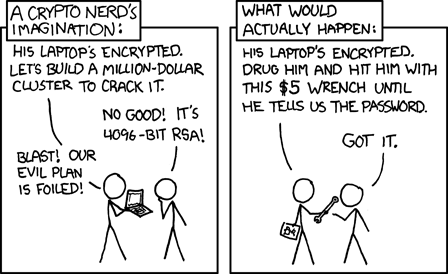
There's always an XKCD... https://imgs.xkcd.com/comics/security.png

I don't think a nation-state is looking for my info and even if they are, there's nothing I can realistically do to stop them. Thee NSA (or whoever) simply has more resources than me.

So, my primary concern is protecting from ID theft and nosey police officers/TSA agents. A long passcode is mostly sufficient. Lock the device before interacting with said LEO and hope they don't decide they need the $5 wrench.