In fact, practically the only facilities being built for the last decade have been wind and solar and in massive quantities. If you look in the generation queues of the various RTO/ISOs (organizations that manage which units run and at what level for large parts of the grid) the only thing expected to be built is even more wind and solar along with storage. Multiple GW of wind capacity is being added each year, so it isn't slowing.
Why is this happening? It's complicated, but it's basically economics at this point.
What problems do we face? Well, sometimes wind and solar aren't available. You can solve this in three ways. The first is to have thermal generation respond when the wind/solar dips. This can be tricky as thermal generators (outside of natural gas) weren't designed to move that fast. They were designed to run near max for most of their life. Natural gas peakers are more effective here. Another option is storage, which can hold you over until you get more wind/solar again. However, we would need a massive amount of storage built for this to be effective. A third option would be to increase demand response at the industrial and customer level. Meaning, power isn't generally expected to be 100% available in that scenario. If there isn't enough generation capacity, those that aren't willing to pay the high prices are shut off (or something along those lines). That is generally how supply/demand is supposed to work anyway, but practically speaking, the demand doesn't participate today. In actuality, I expect a combination of all of that to become common place and it is what the Federal Energy Regulatory Commission has been pushing for.
You can model this as (cost per kWh of cheapest alternative) / (cost of rentable per kWh) = marginal oversupply you want. So, if hypothetically Solar was 2c/kWh and peaking natural gas was 6c/kWh then you would want to add more solar until 3kWh of new Solar only offset 1kWh of natural gas with the other 2kWh being wasted.
Which does not mean 2/3 of total solar energy would be wasted. Further, storage and energy markets also complicate things. However, it does illustrate why you want an over supply of the cheapest option even if not all of it gets used.
Though when selecting individual locations for wind, different locations favor different time of the day. And of course solar output varies significantly east/west and based on local weather conditions. That all gets modeled ahead of time and in practice get reflected in market rates.
Even then, I do really expect a category of "peak demanders" to appear soon (storage is one kind, but there are other things one can do with intermittent almost free electricity). That will help increasing the spare capacity.
I suspect an outgrowth of oversupply is storage will ramp up based on consistent access to very cheap rates. It makes a huge difference if you’re paying 0.4c/kWh or 4c/kWh to charge, especially when storage is significantly less than 100% efficient.
That said, consistent very low prices will likely result in someone using most of that power for something even if the power plant operators aren’t making money during that period.
I don’t think any of these solutions are viable to prove we can be reliant on renewables, and this one especially would not resonate with a populace.
Just at a consumer level, think of everything you use power for on a daily basis. It’s a cornerstone of modern life, and you can’t expect society to backtrack.
Before I left the UK, the flat I lived in had two electricity rates, with the night rate being significantly cheaper then the day rate [0]. This meant the water heater and the (electric) storage heaters [1] were powered at night, when schools and offices used no power.
[0] I’m not certain, but I think it was: https://en.m.wikipedia.org/wiki/Economy_7
Also, storage heaters are a real pain to deal with. They're inefficient and not very controllable in terms of the amount of heat they produce.
Not so; when the problem is bad weather rather than the diurnal cycle, even weather forecasting gives more forewarning than emergency stop buttons in power stations, and (given the geographical distribution) the change itself is smoother. On the scale of a continental grid, do you even need to care about anything besides diurnal storage/demand-shifting (as preferred) and seasonal issues?
The result for individuals: many people just subscribe to a flat rate from the electricity companies to avoid the uncertainty and pay the same predictable price each month (but of course, this predictable price comes at a significant markup with respect to the "free market" price). The rest of us go with the fluctuating price but just don't bother, because we are not going to spend substantial amount of time every day looking at how the prices evolve to decide when we turn stuff on or off. So we just read the bill every two months, not even making an effort to understand it, grumble a bit and go on with our lives. I suppose there may be some people who actually try to optimize, but I don't know any - from what I know, people short on income tend to go with the flat rate because they can't afford the uncertainty.
I don't know how it works in industrial applications. I do know that some industries (e.g. steel) complain about the fluctuating prices because they operate 24/7, and basically they reaction is that if the government doesn't subsidize their electricity bill, they'll just close and go to some other country. So my guess is it's not really working either.
You say that like it's true, and it's not. Anyway, the climate doesn't care. Human emissions will reach equilibrium with what's compatible with life on Earth, one way or the other. Figuring this out is preferable to massive loss of life and degraded standards of living for the survivors.
I find it particularly telling you exclude nuclear as a baseload and specify it has to be fossil fuel baseload.
I'm not.
>which have already demonstrated their viability in southern Australia.
They didn't. They replaced natural gas in one specific use-case, namely to provide grid stability. Those batteries (no batteries) are capable of bridging renewable variability.
When the wind is blowing. If the wind isn't blowing, you're not getting any power and you're going to have to fire up those coal/natural gas plants.
>when their new synchronous capacitor projects are completed they won't need stand by gas power plants.
How much power can these 'synchronous capacitors' store, and for how long? Can they even store enough to power a small city (~250k) for more than few mins? Let me spoil something for you, there is no battery technology that can scale to run a modern economy and hard industry. Not now, and not upcoming. If you have favorable geography, you may be able to do pumped storage, but that's about the best you can do.
Keep in mind that EVEN if you miraculously had something to store grid-scale power over a long-term, you need to greatly overprovision renewables because those 'batteries' need to be charged (with lots of energy loss) during peaks enough to bridge daily, seasonal and inter-year variability. And of course, land-use requirements for renewables is MASSIVE (from mining to deployment to decommissioning) - so renewables are very heavy on the environment. They aren't going to work.
There's a reason why no developed region relies on renewables without either fossil fuel backup (or if geography allows, geothermal or hydro). There's a reason why Germany is spending billions to build pipelines to ship natural gas from Russia for decades to come. What do they know about renewables, that you don't?
The problem is, that change didn't effect anyone negatively, and thanks to cheaper gas imports it was essentially free.
Now that we are off coal, future cuts are going to be a lot harder.
Fossil fuel to .. fossil fuel. Sigh.
https://www.volker-quaschning.de/datserv/CO2-spez/CO2-spez_e...
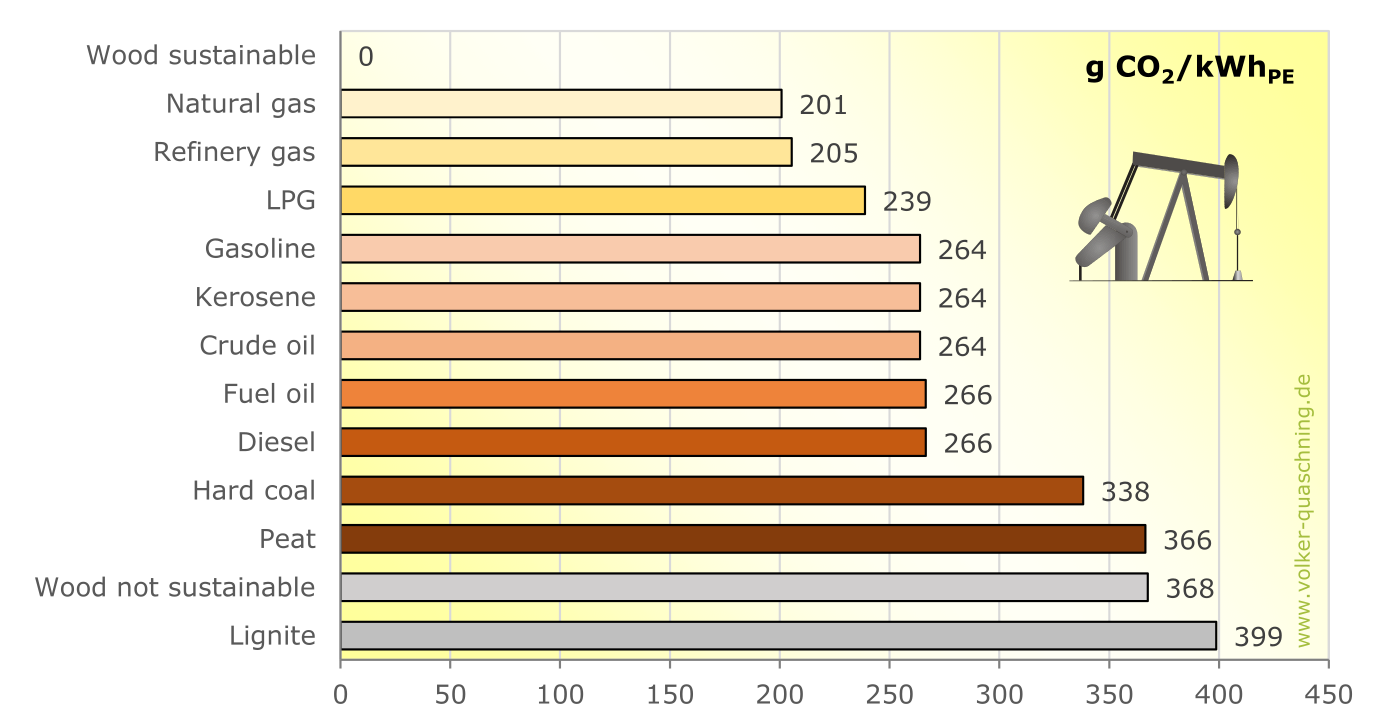
Unfortunately there are methane leaks in the systems, and it is quite possible that when accounting for the methane releases, natural gas has equally bad climate effect (emissions of CO2 and CH4 combined) as coal.
--
[0] - https://en.wikipedia.org/wiki/Atmospheric_methane#cite_ref-C...
[1] - https://en.wikipedia.org/wiki/Atmospheric_methane#Atmospheri...
I think fixing leaks is an easier task than reducing the coal CO2 footprint. We'll have to figure this out somehow anyways, because a lot of methane will be going into the atmosphere from thawing permafrost, both on land and in the seas.
In practice, doing either of those will spike the price of the energy, and the only reason to use them over renewables is their being cheap, so it won't happen.
Sure ... and how do we do that? Nuclear is dead in the developed world (very few new nuclear projects and lots of existing plants being decomissioned)... so what's left? What do we replace natural gas with?
But the gas infrastructure synergizes extremely well with a shift to a hydrogen based energy economy, as is not just the goal in Germany, but pretty much an EU wide ambition [0].
It has nothing to do with the German nuclear phase-out that started in the early 2000s, just like European reliance on Russian resources it not anything new, nor is it bound to change, it's the consequence of geographical proximity and thus realpolitik.
Particularly considering the alternatives: LNG shipped from the US to Europe in tankers is an net-energy negative. It would be a pointless and expensive exercise of creating even more pollution all for the sake of satisfying US foreign policy ambitions to antagonize Russia and keep it as separated from the EU as possible.
[0] https://www.euractiv.com/section/energy/news/dutch-pin-hopes...
Look at the numbers: https://www.cleanenergywire.org/factsheets/germanys-energy-c...
Yeah, there is a slight increase in natural gas over the years (with large fluctuations), while coal is in slight decline. By far the largest share of the nuclear phaseout has been replacing it with renewables.
One can discuss the pros and cons of german energy politics (of which there are both plenty), but that should start by knowing the facts.
[1] https://i.imgur.com/KgcCyWu.png

[2] https://energy-charts.info/charts/energy/chart.htm?l=en&c=DE...
This is completely fallacious. There will always be outliers but the overwhelming majority of power needs, both residential and commercial, can be addressed with renewable energy and battery solutions.
> not to mention that because renewables are a diffuse energy source, they require HUGE land areas which makes no different for CO2 emissions, but makes a huge difference for environmental collapse.
Can you cite anything backing that up? Hydro electric does dramatically impact the environment but other renewable sources have no such impact. Wind is negligible despite the fanatic ravings of one fat orange lunatic who doesn't like it's aesthetics. Solar is easily deployed on rooftops and along transit corridors which has zero impact. You don't have to consolidate all the renewable energy sources in one location.
I have a solar array that covers less than half my roof, produces 1.5x my energy needs annually, it stores reserves in a battery, and back-feeds excess into the grid. The cost to operate the array is less than the cost of grid power, and my excess production results in a payout from the power company.
The excess production from residential and commercial arrays can be captured and distributed to outliers who are unable to directly leverage renewable energy and completely offset the need for polluting energy sources.
How about, at the very least it is symbolic of the fact that the US will fully take part in one of the most important global programmes there is. That it will set targets and be transparent, reporting on its efforts to reach those targets. It will share know-how and expertise with countries that are trying to solve a problem that is an existential threat to civilisation.
And if, as you suggest, the US is actually beating the progress it needs to make to keep global temperature rise to within 1.5C, then that's great - it can get the global plaudits it deserves, with no further action needed.
The graph in [2] is subtitled:
Since 2000, rising CO 2 emissions in China and the rest of world have eclipsed the output of the United States and Europe
The graph in [1] is subtitled:
Per person, the United States generates carbon dioxide at a far faster rate than other primary regions.
Of course a country of 1 billion people, like India or China, is going to produce more emissiosn than a country of 330 million, in total, even if each of the smaller country's citizens produces about twice as many as the citizens of every other country in the world.
If we are serious about tackling climate change then we need to decarbonize these other sectors by moving them off of fossil fuels and onto clean electricity. We are going to need to generate a lot more energy, not less.
Because reducing energy use reduces quality of life at constant dollar income (at least medium term), and reduces economic growth (energy's an input in all economic activities), with all the social negative consequences that produces. It's a third rail, politically. No one's going to get elected by saying "your children have to live worse than you".
The Western world is already (slowly, over decades) reducing this (look at per capita energy use dropping nicely since the 90s), and there's significant pushback even at this rate (gillets jaunes, cost of living protests). All future energy use growth is elsewhere (Africa, China, India) with no plans to stop and if the Western world tries to impose their views on them, it'll look a lot like neocolonialism for environmental reasons.
Cars are more fuel efficient than ever. I own an SUV and average 30.1 MPG. Imagine that in 2000. Light bulbs are overwhelmingly LED these days. New homes are much more insulating than ever. Smart homes are less wasteful.
Smarthome might theoretically work, but as of right now most people are just throwing even more IT and IoT devices, constantly drawing power, into their homes. As these come from a myriad of different vendors, there is no unified platform to utilize and manage all that for electricity efficiency, it's just going on, drawing additional power.
But is it obvious? Let's say that fusion becomes commercially viable and vast amounts of emission-free energy become available cheaply. Would reducing the usage of it still matter? I would say the driving factor is the side-effects of energy production by current methods, not the energy itself.
I think this is because energy consumption is directly related to our ability to manufacture things, and the ability to manufacture things is directly connected to both wealth and military power.
(I’m half-remembering someone else’s explanation, so I assume this is an oversimplification).
And that's ignoring the reality that if you make something 10x efficient, it tends to become used more - sometimes much more, cancelling the gains. Our economy is self-regulating; altering one factor only makes all others readjust to compensate. Permanent change will require more complex approach.
Energy efficiency is definitely a very important part of dealing with climate change, but it isn't a silver bullet.
We need to get off this exponential! Any modification of Capitalism is painted as an attack on basic human freedoms so that the rich can go down with the ship, rather than pass it on for the rest of humanity and the world.
How do we change what we optimize for? Because it currently isn't working.
> 10x efficient, it tends to become used more
It doesn't require coordinated action to move away from coal and gas at that point.
Solar is great for marginal additional output, but to make it useful as a primary energy source it requires massive investments in storage technology. Solar doesn’t work at night or on cloudy days, so you still need other power sources. At least as long as storage solutions are rare.
But that's not the case. America is reducing its emissions greatly by shifting from coal to natural gas (which mirrors what Germany is doing, for example). Coal is ostensibly dead in US. If you look at the charts from Wikipedia [1][2], you'll see the US has cut emissions at about the same rate (or faster) than Europe. That trend will continue. So what will Paris actually do in practical terms?
The problem is that after transitioning away from coal, there isn't a clear answer about the next step. Renewables are not a panacea and may never be able to power a modern economy as they will probably always require fossil fuel baseload ... not to mention that because renewables are a diffuse energy source, they require HUGE land areas which makes no different for CO2 emissions, but makes a huge difference for environmental collapse.
[1] https://en.wikipedia.org/wiki/Greenhouse_gas_emissions_by_th...
[2] https://en.wikipedia.org/wiki/Greenhouse_gas_emissions_by_th...