Also (emphasis mine),
> Democrats will restore the Federal Communications Commission's (FCC) clear authority to take strong enforcement action against broadband providers who violate net neutrality principles through blocking, throttling, paid prioritization, or other measures that create artificial scarcity and raise consumer prices for this vital service.
Regardless of anyone's feelings broadband is not categorized as a utility. You may want it classified as such. Then ask yourself which party is likely to move in that direction.
https://www.demconvention.com/wp-content/uploads/2020/08/202...
It's only "cost-prohibitive for a competitor to enter a region" because of build-out requirements which are broadly supported by Democrats. I used to live in Baltimore, where Verizon wanted to come in and compete with Comcast. The city refused to let Verizon come in and compete. Then they put out an RFP that basically sought bids for ISPs to come in and provide universal service for free. Nobody took Baltimore up on the offer.
Step 1: create conditions that prevent capitalism from solving a problem. Step 2: declare that capitalism has failed and call for government solutions.
Step 1: Create conditions that prevent the government from solving a problem. Step 2: Declare that the public sector has failed and call for privatization.
Businesses in a free market aren't writing laws and regulations that can put people in jail. With government's great power should come an acknowledgement that it must solve the problems it claims it can, in the way it claims it can, or back the hell off.
This is particularly the case when our electoral choices at many a level boil down to binary options that may not project well for individuals with values/views that are largely orthogonal to the options practically available. For example if I were pro ABCDEFG, and one candidate is Anti ABC, and the other anti EFG; Which one should I choose when taken together the value of one set over the other is subjective and not even ordinal?
One mustn't forget that the power to do great good is inherently also the power to do great harm intentionally or not.
I've seen exactly this scenario play out in Santa Cruz. Comcast had a virtual monopoly. Even as recently as about 5 years ago one of the best internet packages was up to 20mbps (4mbps in reality) for $40/month.
The city announced a partnership with Cruzio for municipal broadband and virtually overnight Comcast started offering 200mbps for $50/month. Today you can get around 400mbps for $55/month.
We should do the exact same thing with healthcare (public option).
Step 1: kneecap a social progrm Step 2: argue that because the social program isn't working, it should be canceled outright.
What major social program has seen funding cut since the 1970s? The percentage of the economy that goes to means-tested welfare has almost doubled from 1970 to today: https://www.heritage.org/sites/default/files/inline-images/B.... The only blip was right after the 2008 recession, but spending has mostly recovered since that time.
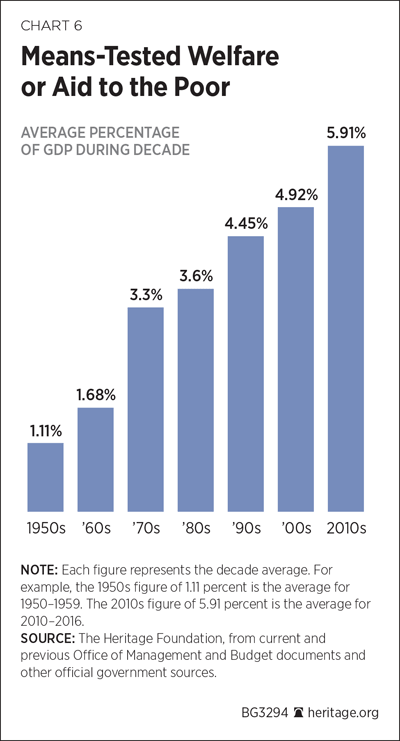
Now, I support welfare spending. (I'd like it better if we focused more on cash transfers to the poor, though.) But the notion that any major social program has ever been "kneecapped" is a myth.
The 2018 omnibus budget contained a variety of funding cuts for social programs. A good example of a dramatic reduction is the 21st CCLC (a funding stream for afterschool programs) being eliminated entirely, to the tune of $1.2 billion USD[2]. That was part of a larger >10% cut to education programs as a whole, which I would consider significant.
[1]: https://www.nytimes.com/2019/08/19/health/planned-parenthood...
[2]: https://www2.ed.gov/about/overview/budget/budget18/budget-fa...
But overall, education spending consistently goes up over time: https://www2.ed.gov/about/overview/fed/10facts/index.html#ch...
> On a per-pupil basis and adjusted for inflation, public school funding increased: 24 percent from 1991-92 through 2001-02 (the last year for which such data are available); 19 percent from 1996-97 through 2001-02; and 10 percent from 1998-99 through 2001-02.
A concrete example: the current DOEd has increased funding of both charter and private schools. We can go back and forth on whether elements of that constitute social programs, but I think the point about it not being tied to the larger funding trend stands.
Similar stories about in other areas. In Europe it is common for private companies to operate transit systems. (Stockholm’s subway is operated by the same company that operates Hong Kong’s.) In the US, nearly every large transit system is operated by government workers on the government payroll.
Goverment funding has been chopped for state schools, housing projects, the list goes on. The right kills social programs on a practically daily basis. Not to mention shifting the tax burden away from the upper class and towards the middle class. If your taxes have been going up over the last 30 years, it's because you aren't upper class.
And yeah, social spending has increased ever since we shipped all the jobs to China. Democrats rationalized it by promising to use the new revenue on social programs; Republicans put a stop to that straight away. The American middle class got double-teamed. Privatize the gains, socialize the losses!
I'm not a hard-right libertarian--I think healthcare probably has some examples of market failures and maybe we need something like universal catastrophic insurance. But yeah, some of these problems, like housing costs, really are self-inflicted.
I think the other approach is to shift blame or sweep under the rug problems with services that are entirely publicly run. If you have a problem with the schools or police in your blue city/state, 90% of your energy should be directed to your own state and local officials! (Instead of railing against Jeff Bezos or Donald Trump.)
The Bay Area has a number of little-known unincorporated enclaves that are often located within incorporated cities. Places like Devonshire (San Carlos), Emerald Hills (Redwood City), the unincorporated strip of San Carlos Ave (San Jose), Ladera or Los Trancos Woods (Portola Valley), Castro Valley and San Lorenzo (Hayward/Oakland). I've noticed that in today's hot market, houses in those areas consistently go for anything for $0-150K under asking, while houses in the nearby cities go for $150-500K over asking. A typical swing in purchase price for equivalent homes in nearly equivalent locations is about $300K (on prices of about $1.8-2.2M).
The usual real-estate confounders don't apply here because the geographic locations are so similar. The fire danger is roughly equivalent (but high): places like Devonshire and Emerald Hills are inside of 280, and right next door to equally flammable but more expensive houses in Belmont, San Carlos, and Redwood City. Commute times are basically identical, if anything a little shorter. There's less regulation for building, but not much more additional supply of land since these are constrained enclaves.
It seems like buyers are willing to pay a premium specifically to get city services and city regulation. Instead of the free market being impeded, this is the free market speaking: buyers are paying a premium to live in areas where there are more services and more regulation.
I can think of another difference: loads of people want to live where they do, pushing up prices, while few people want to live where you do, keeping prices reasonable.
Since the cities are generally under solid Democratic control (there's not a single Republican in elective office in Seattle, for example), there's something else going on.
I'm not confident that municipal broadband will ever really take off in the US but I think local loop unbundling might have a chance since I'm sure companies are more than happy to unload all the expensive construction work to the local gov't.
Company X: "We'd like to meet with you to discuss how we can service your community better than municipal broadband. Our representative is going to be in Hawaii for the next 3 weeks and we'd be more than willing to fly you and your family out to meet with him. Of course it's inconvenient for you to travel so we'd provide for hotel and airfare."
Actually, It's all about the lobbyists and industry groups, often with model legislation from ALEC[0][1][2] that have blocked municipal broadband in 22 states[3] (down from 25 a few years ago):
"Over the past year, several promising developments have been made on the municipal broadband front.
Two states were successful in repealing their municipal broadband bans, bringing our tally down to 22 states from 25 states identified in our 2019 report. Those law changes are significant, and may portend similar measures being considered across states in the coming years.
This report is the latest in our annual series looking into the state of municipal broadband in America, and provides a state-by-state breakdown of the various roadblocks and restrictions used to prevent their establishment. This year, we’ve also compared access to low-price broadband in states that have no municipal restrictions versus those that do, and we’ve found that the former have lower internet prices on average.
State legislatures around the country considered a wave of broadband-focused bills in 2019. That signals not only the importance of addressing broadband access gaps for state lawmakers, but also a growing acknowledgment among state and local governments that they have a larger role to play in ensuring all residents have access to the high-speed internet."
>I'm not confident that municipal broadband will ever really take off in the US but I think local loop unbundling might have a chance since I'm sure companies are more than happy to unload all the expensive construction work to the local gov't.
I'd tend to agree, as long as state and local government officials continue to be bought (and critically, stay bought) by industry groups.
That's not to say that municipal broadband is the solution for every county/city/town. Rather, it's a solution that, under the right circumstances, can improve the livability, access to commercial opportunities, higher-paid residents and a raft of other positive outcomes.
These are local and state issues that aren't well suited to regulation/lawmaking from the Federal government, and should be addressed in that fashion. A good place to start would be to reverse the anti-competitive laws in place in 22 states that limit the ability of local governments to implement municipal broadband.
I'd say that if the big ISP's don't want it, it's probably a good thing to do.
[0] https://www.sourcewatch.org/index.php/ALEC_Communications_an...
[1] https://www.govtech.com/network/Lawmakers-Mount-Federal-Effo...
[2] https://arstechnica.com/tech-policy/2015/04/anti-municipal-b...
[3] https://broadbandnow.com/report/municipal-broadband-roadbloc...
Would it not be possible to make it illegal to provide internet access and to own the infrastructure at the same time?
Where I'm from, there are two national phone networks, owned by the two biggest phone plan providers. They also rent out their network infrastructure to smaller companies, which effectively means they control the price of phone plans. As a result, phone plans are comparatively very expensive where I'm from. It seems like separating the infrastructure from the phone plan providing would make the market more competitive, leading to lower prices.
Municipal broadband is the only way you’ll get competition? A “public option” seems to invite the very opposite of competition. Less regulation is how you increase competition — by allowing more new entrants into a market, you necessarily increase competition.
Municipalities should own the wire, not the service flowing through the wire. Making capital expenditures less expensive would encourage more service providers.
How would another option decrease competition? In what world does that make sense? This isn't without precedent. In markets where there are municipal broadband or increased competition in general, companies like AT&T immediately up their speeds, cut their prices, cut their contract lengths, etc.
This seems antithetical to their newfound views on how corporations like Twitter should be able to block political news on their platforms. I don't see how it's dramatically different for Twitter (or Facebook or Google) deciding to block the New York Post than it is for Comcast to do so.
It's not obvious to me right now which is the party for a free and open internet.
If Comcast decides to block the New York Post, you can't see it at all until you change your Internet provider. That may involve breaking a contract, and will certainly cost you time and money. And that's if you have a choice at all - large swathes of the country have only one ISP. Many apartment buildings only have hookups for one provider.
If TwitFaceGoog don't show NYP links you're free to type in their domain name in your web browser and go to the site directly.
Suggesting there's no difference between the two is dishonest.
If you use a Comcast email address -- is it ok for them to scan emails you send to your friends, and quietly delete them if they contain links to newspapers they don't approve of?
This would be illegal under net neutrality, and is identical to what Twitter and Facebook are doing regularly.
They're probably already doing this, at the very least to scan for viruses and filter scammy emails.
> quietly delete them if they contain links...they don't approve of?
That's what a spam filter does.
> This would be illegal under net neutrality
a) ISPs aren't subject to net neutrality. They were, but now they aren't. Guess who voted to make it that way?
b) It would be a dick move and would cost the ISP a lot of business. Email is 1:1 and you (presumably) consented to receive email from your friends. But it isn't illegal afaik. Can you cite the relevant law you think makes this action illegal?
> is identical to what Twitter and Facebook are doing regularly.
Maybe, maybe not. It's not illegal. Considering that an ISP operates at the network layer and social networks operate at the application layer, such comparisons are meaningless. ISPs perform plenty of network-layer moderation that you never see and might never find out about.
I’d like to hear why you think it is terrible when Comcast bans a website but fine when Google/Facebook/Twitter do it. Both groups have monopolistic power. And, if anything, the ISPs are much less powerful and less important than the big tech companies. If anything they should be held to a higher standard.
Nah.
> I’d like to hear why you think it is terrible when Comcast bans a website but fine when Google/Facebook/Twitter do it.
In many areas of the country, there is only one ISP available. In my area, there's two, but one only offers very slow DSL; there is a de facto monopoly on meaningful internet service.
This is not the case for social media.
> Both groups have monopolistic power.
That you had to say "Google/Facebook/Twitter" and not just one of them clearly indicates that they do not.
Hey, it’s their platform... don’t like it, go somewhere else.
And every American has a choice in cellphone service providers - so they can block journalist they don’t favor too. What could possibly go wrong?
Not really, no.
https://www.eff.org/deeplinks/2018/12/new-fcc-data-indicates...
> The major takeaway of this report, which provides policymakers in D.C. and the states a wide-ranging view of available data to see trends in the Internet, is that competition for broadband only looks good at slow speeds while a vast majority of Americans (EFF estimates at least 68 million) are facing monopoly or no access to high-speed broadband.
> Instead, in a handful of markets we have reviewed, we find that the average price consumers pay ranges from 200% to 400% above competitive rates and that cable prices are established surgical precision in order to extract monopoly rents. For example, I myself would have to pay $159.95 for a gigabit service whereas my coworkers would pay $40 for a superior product.
My goodness you folks will bend over backwards to defend the world's largest corporations censoring journalists. It shows just how illiberal the Democratic Party has become. It's very lonely right now for those of us that believe in freedom of speech as an ideal worth standing up for.
That's not actually what the highlighted quotes say.
https://arstechnica.com/information-technology/2017/06/50-mi...
Title: "50 million US homes have only one 25Mbps Internet provider or none at all"
Article:
> The household analysis found a slightly better, but still troubling, situation, with nearly half of the 118 million US households lacking any wired Internet choice at the FCC's broadband standard of 25Mbps.
What actually bothers me the most is the rules that (in most places) prohibit cities and towns from offering new municipal broadband service as a competitive offering. This used to be more common in smaller towns that had not been able to get good commercial service, and it adds valuable options and competition, but my understanding is that it's extremely hard for cities who don't already have municipal broadband to start offering it now.
These are private companies. But since they're considered natural monopolies, they are more highly regulated than a typical company.
0 - Yes, I know, it wasn't perfect or even "great" most of the time but that was largely because the incumbent carriers dragging their feet on doing literally anything and the FCC not enforcing the competition rules. And when, largely out of spite, the copper-based incumbents simply didn't do anything to upgrade their networks while the not-at-all-regulated cable companies blew past them in speed and reliability, people switched in droves which gave the incumbent phone companies even more reason to throw up their hands and say "not worth it."
When telephones were first installed, competing telephone companies stringing wires sprang up everywhere. Regulation put a stop to that.
But ISPs are not, generally speaking, a monopoly. There's usually at least two wired options and they compete with cellular and satellite options. Profit margins generally reflect this. The large ISPs are around the average for the S&P 500.
Per https://www.fcc.gov/internet-access-services-reports approximately only about 25% of census blocks have two or more providers for wired internet. Often within a census block most households will only have one option.
https://arstechnica.com/information-technology/2017/06/50-mi...
For my home, 2.5mi from the Capital Building in Washington State, I'm offered four wired broadband providers: 1. Comcast, "advertised 100mbps to 1gbps" (true enough, although you can only get 150mbps, so I'm not sure if that's bracketing) 2. CenturyLink, "25-50mbps" (CenturyLink's own website says "Our systems indicate that our High Speed Internet is not currently available at your service address." I tried several other streets in the area that indicated that none of them had availability either.) 3. Platinum Equity LLC, "10-25mbps" (err, Platinum Equity is an investment firm - oh, one of their portfolio offers "T1 and Bonded T1" lines to businesses and after further investigation would offer me 192K SDSL as a residential offering) 4. Integra Telecom Holdings, "3-6mbps" (a Vancouver telco that does business fiber). So there's one - Olympia, WA.
Everyone else has a subpar coaxial connection from Comcast/Cox/Spectrum.
The issue is that fiber internet itself is a much better product than non fiber internet. And tell the people who have kids and are also working from home that they can't stream video because an HD video stream is 3Mbps+ and 4 people in a house streaming at the same time at high quality is basically impossible.
Some people also have security cameras streaming upload too. The applications for increased bandwidth are numerous. Remote doctor visits can use high quality video, you can stream things from your home NAS, backups are quicker.
(side rant: in the following ten years, the tech giants sweeped in, competed, provided a better service, with better cross-platform support, for zero dollar immediate cost to the end customer -- gained a massive following (think whatsapp), and are now vilified for their "monopoly" and the "harm" it has caused.)
My read of this situation is:
- Real monopolies (esp Telco) have entrenched lobbying bases
- Tech has done a poor job at lobbying, possibly due to idealism that logic wins even though thats now how things work in the US
- Tech has disrupted so much that they now have multiple industries as enemies
- Tech is concentrated enough geographically that there is some jealousy against this sector "over there" raking in too much money, even if they have provided an amazing service
Net neutrality was a good example of this - still good despite not being the most important issue du jour. Received attention because it's coincidentally in the interests of Google et al.
Why voters don't know/care is another issue, but it might have something to do with the fact that the news media has also been bought.
Take Ron Wyden (D-OR) for example. He’s been talking about the problems of “Big Tech,”[a] the NSA, etc. for years, but no one outside tech or his state have even heard of him.
[a]: Those aren’t “scare quotes.” They’re because there isn’t really a good word for it. FAANG seems too restrictive compared to how many companies are actually part of the problem.
I'd guess because the media is controlled by some of the same people who want us to remain unaware. They block information from reaching the media, and flood media with sensationalist stories to prevent attention from settling on issues that matter.
https://hn.algolia.com/?dateRange=all&page=0&prefix=false&qu...
Even stipulating that your comment had some kind of probative value, the cost to the community of people routinely pulling this shit far outstrips that value; accusations of bad-faith commenting are one of the most corrosive forces on message boards. Demanding users not make those accusations is one of the things HN gets uniquely right.
https://www.natoa.org/events/BrokenPromisesGarcia.pdf
BTW the logic in your link doesn't make sense. The $200 billion number is "based on taking what ISP profits would have been had they been regulated as a utility", yes, but the only reason we didn't regulate them as a utility is they promised us the fiber networks!
The government deregulated prices in 1996 for the same reason we deregulated airline fares, truck tariffs, etc. The government wanted to get out of the business of price control. And it didn't just happen in the U.S., it happened all over the world.
Fiber was presented as a benefit that would result from increased capital investment following deregulation. And that happened to an extent--wireline capital expenditure almost doubled from 1996-2001. But after 2000, capital started moving to the fast-growing industry of cellular wireless, where the returns were better. So yeah, we didn't get as much investment in fiber as we expected. But we got huge investments in cellular. That's how free markets work--the government can't predict or direct where capital goes.
The 1996 telecom deregulation wasn't a bargain, where ISPs were allowed to raise prices in exchange for a "promise" to build fiber. It was a deregulation of the industry. It's fair to complain that maybe the benefits of deregulation were oversold. (I can also claim that projections about premiums reductions under Obamacare have been oversold!) I think the 1996 deregulation should have been paired with a preemption of state-and-local broadband construction regulation. (American municipalities regulate in a way that makes it expensive to build infrastructure, whether you're talking about broadband or subway tunnels.) In particular, the nearly universal requirement to agree to service an entire city in exchange for permission to service any part of a city vastly limits the competition that could have been enabled by deregulation.
Its fair to have a debate about the ultimate outcomes of the 1996 deregulation. But its deceitful to act like it was a planned government fiber-construction project where ISPs just "pocketed the money" and didn't build the infrastructure.
"I've been tracking the telco deployments of fiber optics since 1991 when they were announced as something called the Information Superhighway. The plan was to have America be the first fiber optic country -- and each phone company went to their state commissions and legislatures and got tax breaks and rate increases to fund these 'utility' network upgrades that were supposed to replace the existing copper wires with fiber optics -- starting in 1992. And it was all a con. As a former senior telecom analyst (and the telcos my clients) i realized that they had submitted fraudulent cost models, and fabricated the deployment plans. The first book, 1998, laid out some of the history "The Unauthorized Bio" with foreword by Dr. Bob Metcalfe (co-inventor of Ethernet networking). I then released "$200 Billion Broadband Scandal" in 2005, which gave the details as by then more than 1/2 of America should have been completed -- but wasn't. And the mergers to make the companies larger were also supposed to bring broadband-- but didn't. I updated the book in 2015 "The Book of Broken Promises $400 Billion broadband Scandal and Free the Net", but realized that there were other scams along side this -- like manipulating the accounting."
Moreover, the books and research not only use the expertise of our gang (or which some of us have been working together for a few decades) but, we quote primary research, such as annual reports, state and federal filings by AT&T et al, etc, much of which are hidden in plain sight, such as the Verizon NY 2019 Annual Report, which is the financial report of the primary telecommunications state-based public utility-- and ironically most reading this don't even know that there are still state public utilities left. http://irregulators.org/wp-content/uploads/2020/06/Verizonny...
The $200 billion broadband scandal was published in 2005 and that was based on examining the state-based commitments for fiber upgrades and the changes in state laws that gave the companies billions per state to do the upgraded-- i.e., rate increases and tax breaks.
The most recent work uncovered that the accounting has been manipulated in the utilities and caused the networks to appear unprofitable --- and we're preparing to take legal actions in multiple states-- it's about $20 billion annually in the US. https://bit.ly/3mQUWgf
As a former senior telecom analyst to the telcos 1982-1994--we knew were the skeletons were buried...so, we didn't just 'wing it', and the books detail our claims. So while others may follow in our footsteps... we've been at this for decades with actual documentation to substantiate our work. to see the latest, I post at medium.
My point on this thread is simply to remind people that we already knew going into the discussion that you believe there was a $200 billion broadband scandal. Since the point of the thread itself is to debate whether that's true, simply restating your premise doesn't move the discussion forward.
What would be neat is if you could click through Rayiner's thread, read it, and then rebut that.
(Here's the link: https://news.ycombinator.com/item?id=7709556)
let's start with this-- The reference to ISPs. In the 1990's, the largest group of Internet service providers was not the incumbent phone companies, but entrepreneurs-- by 2001 there were 9335 independent ISPs and they handled the majority of the traffic-- it was only after 2004-2005, when the FCC killed the right of competitors to use the copper wires for line sharing did this definition change-- and what is now AT&T (then SBC) stole the business from the ISP.
Second, I never said anything about ISPs -- as, well, I was a research analyst for the competitors-- the ISP associations, like the Texas ISP association, TISPA, or CISPA, or the Competitor associations like ALTS or Comptel. And we filed to protect the ISPs from the harms caused by those who controlled the wires. We filed at the FCC, we were working with Congressmen Nadler to create the "Broadband Bill of Rights" and created a small ISP summit with the Small Business Administration -- Read our impact study.
https://newnetworks.com/smallbusinessimpactstudy.html
Let me address this quote--its hard to know where to start. In 1991, when the info highway was proposed by the Clinton-Gore ticket, the telephone companies were still state utilities, controlled by holding companies. They were regulated, and the profits were regulated. They received alternative regulations in almost every state from 1992-1995. -- i.e., PA, CA, IA, OH, NY, NJ, KY, TN-- all had primary state-based public utilities and all had state laws changed.
And the investments were supposed to replace the existing copper wire with fiber. And laws were changed to pay for these fiber build outs. And phone rates went up, and profits went up, but virtually nothing was built; and there were others besides us tracking the amount of money collected for these utility networks. They were NOT free market companies but utilities, like water, gas, electric or roads---
So, Pacific bell (CA) claimed it would spend $16 billion and have 5.5 million households done by 2000 All of Verizon NJ. 100% was to be done by 2010-- with fiber capable of 45 mbps in both directions, starting in 1996, All of CT was to be done by SNET, and spend 4.4 billion -- completed by 2007.
And cable? Wireless? They were and separate subsidiaries and it is illegal to subsidize these other lines of business out of the state utility budgets--it is known as 'cross-subsidies'.
Since I was actually a consultant to the companies when all of this was going down... I had a front row seat.
Think of this as a highway plan-- you pay a contractor to build a highway and they charge the state billions, which in turn turns into additional taxes... here, the local rates and other charges were applied to customer bills as prices should have went down when there were staff cuts.
Where did the money go? As documented, they lost over $16 billion as a group overseas, and they wanted to go into the long distance market-- which was separate, but was very profitable
So, according to this, the companies were ISPS and not utilities, wrong. They were allowed to cross-subsidize all lines of business-- wrong, and there were no commitments to build out the fiber as part of these utilities-- wrong.
And might as well finish this:
1) That the internet and mobile booms are unrelated to deregulation and should not be factored into the analysis. Of course, that's ludicrous.
2) providers of the infrastructure underlying those boom industries to depreciate infrastructure and invest in new infrastructure faster than before?
The book is about the wired infrastructure of the state utilities -- a fact that the commentor appears to not understand, and the 'deregulation' that was granted was based on the utilities who control the wired infrastucture to not lie to the public and not charge them for other lines of business that are supposed to be paid for by INVESTORS, not the utility customers.
Ironically, most of the wireless networks were subsidized, which shouldn't have occurred because, well, starting in 2010, the telcos started to divert the funding to wireless -- not legal in most states, to fund wireless, instead of upgrading the cities and rural areas. -- See, utilities are based on serving the territory they cover... So, Verizon and AT&T took billions and moved them to these other lines of business but then left the copper to deteriorate and not upgraded to fiber..
And that is 'ludicrous that the critic doesn't understand telecommunications laws, or even examined the details of the financials for the state utilities -- or the consequences that occurred.
The internet occurred because we, and others, spent years get the Telecom Act passed so that the small ISPs could do what they did.
2) That 1970's-style rate-regulation doesn't have an adverse impact on capital investment.
More crap. the investment under this "1970's" regulation, not referred to as "Title II", and the manipulation of the accounting was used to allow the companies' other lines of business to cross-subsidize and not build out the states with fiber and not even maintain the networks, especially in rural areas.
We wrote an entire report on the current Verizon NY 2019 Annual Report financials and cross-subsidies
http://irregulators.org/wp-content/uploads/2020/08/REPORTVer...
I'll be glad to answer questions-- but it's not 200 billion... counting the cross-subsidies we uncovered over the last decade, it's over 1.1 trillion; The overcharging from changes in state laws which were based on commitmenets not met since 1993 is eclipsed by the massive cross-subsidy scheme underway playing out, today in the state utilities -- and yes, PA, CO, CA, NY, MA, all have primary state public utilities... like AT&T California or Verizon MA
First: I ran tech operations (as employee #2) at what became Chicago's most popular independent ISP, in the mid-to-late 1990s, and had a similar "front row seat" to that sector. And I'll say right now that the claim that "deregulation killed the independent ISP" does not at all ring true. Economies of scale is part of it, but so was consolidated billing, coax Internet, "triple play" packages, and wireless. Also, the market just consolidated; even among the indie ISPs, by the end of the 90s, everyone was doing roll-ups.
Further, while I loved my time in independent ISPs, I'm confident that as a consumer, I'm far better served by AT&T than I was by any independent ISP I've used. My service is faster, more reliable, less expensive, and simpler than it was in the '90s in Chicago and San Francisco, or the early 2000s in Ann Arbor. Honestly: even Comcast did a better job than most of the indie ISPs I used.
Second, while the additional detail you've provided here is interesting, you really haven't engaged Rayiner's central argument, which is that however many billions of dollars you're saying telcos were "given" to build fiber, you're just counting dollars in their prices that you think are unreasonable. Which is not what people people on HN typically mean when they cite this "200 billion dollar scandal".
We were the survey firm and did the analysis for multiple ISP associations, and we worked with the indie ISPs and CLECs, as well as with Small Business Administration's Office of Adovcacy. In the 1990's, at least, there was no triple play. the cable companies had not offered voice, or even broadband with any seriousness. AT&T was an indie and started bundling local and long distance, and wireless wasn't even on the radar as a broadband service.
And we filed complaints with the FCC, AG and state commissions because about 40% of the orders placed by an independent didn't go through -- harming the ISP but also pissing off their customers https://newnetworks.com/baadslscrewisp.htm
And in 2001, we wrote an impact study, quoted by SBA about the lack of FCC enforcement, and the fact that the wired companies were stealing the ISP customers, that the orders weren't going through, that it took weeks to get orders, that there was preferential (illegal) treatment of the companies' own ISP,
https://newnetworks.com/smallbusinessimpactstudy.html
(these links still work....) And how bad was it for those seeking justice from the regulators? Dave Robertson, the head of the Texas ISP Association, recounted his recent meeting with Chairman Powell and senior staffers at the FCC Enforcement Bureau.
"The meeting was Tuesday May 8th. In a nutshell, all the "bad acts" submitted to them to date have resulted in exactly "ZERO" dollars in fines, and little delay in their 271 approvals for the Bells to jump into the long distance market. We asked for something blatant as handwriting on a wall as to the future of the complaint process as we are approaching it. We got it. WE SHOULD EXPECT NOTHING FROM THE INFORMAL COMPLAINT PROCESS. We should expect nothing from any complaints we have submitted to date.
"A couple of weeks ago we met with a senior person in the ENFORCEMENT BUREAU. After a one-hour meeting and receiving some heartfelt empathy for the plight of ISPs and the consumers who are being victimized by the illegal, anti-competitive behavior, I suggested that our best move might be to just jump out a window. He suggested we might want to consider throwing a chair out of the window first, so we wouldn't get cut on the glass as we jumped."
So, yeah, wireless and the triple play? -- had the networks been open, would the independent ISPs used the networks to offer these other services? AT&T and MCI at the time were large enough, as was AOL and other ISPs like Earthlink could have, probably would have.
I agree there was consolidation -- but, when the FCC got rid of line sharing and refused to address the litany of charges against the telcos who controlled the wires, -- but worse, the companies lied about deployments and took the money --didn't upgrade their networks to fiber as paid for by local phone customers --- we were put on a path where those who control the wires killed off most of the competition.
>Second, while the additional detail you've provided here is interesting, you really haven't engaged Rayiner's >central argument, which is that however many billions of dollars you're saying telcos were "given" to build >fiber, you're just counting dollars in their prices that you think are unreasonable. Which is not what people >people on HN typically mean when they cite this "200 billion dollar scandal".
Arrgh. While we did track price increases, which shouldn’t have happened as they were based on supposedly using the extra cash to upgrade their aging copper infrastructure --- we didn’t use price increases for our overall calculations
We examined multiple states' plans as well as the data that the FCC collected, as well as other groups that since stopped including NARUC, BEllCORE, and state and federal filings by the companies.
but-- I'll play... The incumbent utilities are regulated, because they control critical infrastructure, get use of the rights of way, and had requirements to deploy fiber--based on their own filings and commitments made.
READ THESE: we quoted other analysts Here’s testimony by ETI about Verizon PA fiber plans and monies collected – (ironically funded by AT&T against Verizon,-- before the networks were closed and AT&T and MCI were put up for sale and AT&T was taken over by SBC http://www.teletruth.org/docs/LLS%20PA%20Senate%20Testimony%... This is a scathing review of the first 5 years of the Verizon NJ ( Bell Atlantic – 1997) by the New Jersey consumer advocate. https://web.archive.org/web/20160429003841/http://www.rpa.st...
It’s clear no one has read the original source materials – We covered a) depreciation, b) return on equity, c) dividends paid d) extraneus deductions charged to the state, e) growth in lines, minutes, revenues, expenses, corporate operations expenses, marketing, employees, etc –
So, as a group the telcos took $25 billion in tax deductions when they claimed that they were replacing the copper… didn’t do it. The state freed their profits so nationwide it went from 12-14% Return on Equity to 29% on average—but they were still monopolies and no direct wireline or wireless competition. And again, this was supposed to be used for fiber. The overcharging, then was comparing the commitments against the excess billions the companies-state utilities- got from the changes in state laws was supposed to be used for construction, not buying companies overseas.
And when $200 billion was written, no telco had done the work but all got billions. FiOS and U-Verse were announced in 2004 specifically to close the networks—claiming it was harming investments – when, we, the people, were the investors, which the FCC, etc never recognized.
It simply doesn't reach a high enough priority for people to really push for reform, but it is high enough priority to broadband companies that they fight tooth and nail.
Only so many issues can be discussed at once in the commons and politicians are mostly going to react to those.
So BLM, Facebook, Twitter, the Election, Trump etc. are sucking up all the air and that's that.
There are other ugly factors: CNN is owned by AT&T. So do you think CNN is going to help 'fan the flames' of the movement? I don't think so.
'Anti Trust' is also a complicated word, almost a little to complicated for MSM cable news. It's possible for watchers to understand 'Privacy and Facebook' but it's a struggle to get the plebes to try to think about such an abstraction as 'anti trust'.
Those entities spend a fortune lobbying both sides of congress.
Without some popular focus and the press latching onto it like they did BLM, it's going to be hard to get some kind of movement going there.
Even politicians that 'care' about the issue are going to want to 'pick their battles' and it might not be a while before someone starts knocking on that door.
Here Biden clearly seems to be for net neutrality while Trump is, obviously, against it. So it's not as if this issue is not visible to both candidates. It's just never spoken about in terms of "monopoly" because there's no clear way to eliminate natural monopoly without a ton of regulation (e.g. sharing the last mile) or outright public takeover of the last mile infrastructure.
Net Neutrality assumes the monopoly will stay, that no alternatives are available, and that top-down control is the best bet.
If you focus on the monopoly instead, different ISPs could offer different advantages based on the consumer's requirements: gaming, video consumption, media upload, basic light browsing - you could tailor engineering costs to meet the needs of consumers, instead of one-size-fits-all baggage.
Also, most of the difference in these services lies in the backbone, but that's not where most of the cost lies. The main cost is digging the last mile. Generally, having multiple ISPs put cables to your porch will n-fold their cost. Who's gonna pay for that in the end? You, the customer. It's best to have one ISP lay fiber cabling to your home and then have them rent it out to others, on terms set up by regulators in advance. Maybe that last mile ISP could even be publicly owned.
Letting anyone tear up the street to run their own wires whenever they want isn't feasible. From a competitor perspective,that's super expensive and a massive capital investment, so any preexisting competitor with a large enough warchest could just lower their competing prices to drive the new competitor out of business. But from a municipal or society perspective, cable right of ways/culverts are already a constrained resource, and installation disrupts traffic and residents. So basically that last mile infrastructure is a great example of a natural monopoly.
If it wasn't such a natural monopoly, a market could be a great solution for increasing ISP quality, but since it is a natural monopoly, market based solutions fall flat due to lack of competition.
This is where the socialism bit comes in. If america were less anti-socialist, it would treat the last mile of wires like it treats public roads. It doesn't solve the natural monopoly issue, but it does solve the issue that ISP users have no means by which to get the ISP to improve service. Unlike, a private ISP whose only constituents are the shareholders, a governments constituents are the people being governed, so if they want a better ISP, they can vote for improving it through bonds or taxes or however they want to finance it. But that's socialist and america hates socialism, so instead state governments pass anti-municipal-ISP laws and/or municipal governments grant multi-decade-exclusive service contracts in exchange for the ISP deigning to maintain the infrastructure or promising to marginally improve it (but of course at a rate that never threatens their quarterly numbers).
A new set of PG&E leadership settled in -- bean counters and control-focused policy. The old engineers, for good reason, considered their "job well done" and went to play golf or whatever. The new management hid money, played hardball with sub-sub-contractors, and told old people on pensions to pay up, as business people tend to do..
source: attorney from the time of the Enron price crisis in California
There isn't much of a difference on the service side either; the trucks which come around here are all third party fulfillment firms regardless of who your ISP is (and they have super-bland, forgettable names like "Dependable HomeTech")
It's extra sad because it didn't have to be this way for internet, but the US chose to privatise public internet infra back under clinton and then double and tripled down under bush. Meanwhile, it still maintains at least 1 set of infra for itself (I don't know if siprnet and jwics use separate cables).
In Canada, that body is the CRTC. I think they largely do a good job, though some of it ends up in the courts, and TekSavvy happily engages customers by bumping monthly rates up or down in response to the rule changes, and encouraging us to write our elected representatives if we like or dislike it. Examples:
https://www.teksavvy.com/in-the-news/2019-press-releases/tek...
https://www.teksavvy.com/in-the-news/2020-press-releases/tek...
Concentrated benefits, disparate costs. Paying $20/month too much for internet is a pain in the ass, but it's a pretty minor issue for most people compared to (say) healthcare.
At least today we have hundreds of small ISP companies, and at least a few big ones.
Every time I move I consider who my ISP will be.
Firstly, most municipal broadband networks, either built or proposed, absolutely do not include ISP services.
Rather, they provide last-mile/Fiber-to-the-premises infrastructure that comes back to an interconnection point where multiple ISPs can provide Internet access services to customers.
This actually increases competition, because ISPs don't need to pull cable to every single customer in order to provide service. They just need the appropriate back-haul capacity to service those customers who sign on with them.
This allows for more competition on price, features and customer service, not a "single government ISP."
Just because the same problem has happened in other places doesn't mean it isn't a problem.
Which is half the basic US DSL price
The cynic in me says that it's because it helps neither win against the other.
Mainly because ISPs are not engaging in viewpoint discrimination. They don’t care what political viewpoint you have, as long as you pay them money, they will let you post it on the internet. In addition, most people have become used to the prices and expending a bunch of political energy to save $30/month isn’t worth it to a lot of people.
Now the feeling of being censored, on the other hand, generates a visceral reaction, and people can be convinced to expend a lot of political capital for that.
It seems like such a cut-and-dried political issue: they're utilities and they overcharge you whether you're a Republican or Democrat. And taking action doesn't require new antitrust concepts, because it's just your garden-variety utility. It's the same established principles as electric or natural gas.
Yet bizarrely this doesn't show up as an issue on Republican or Democrat platforms. Going after Google and Amazon and Facebook's free products is the sexy new issue, but the fact that we're all overpaying hundreds of dollars a year for broadband is just massively ignored.
And I'm not talking about politicians being bought. It baffles me why voters aren't writing letters to their city councils, their mayors, their state reps, their governors. If voters actually care, politicians do respond.
It would seriously be so easy to change if the voting population actually did care about it. But, inexplicably, we just pay the fees and deal with the crappy customer service and complain, but it never seems to occur to anybody to actually organize local political action against it.
It's utterly baffling.