It's only "cost-prohibitive for a competitor to enter a region" because of build-out requirements which are broadly supported by Democrats. I used to live in Baltimore, where Verizon wanted to come in and compete with Comcast. The city refused to let Verizon come in and compete. Then they put out an RFP that basically sought bids for ISPs to come in and provide universal service for free. Nobody took Baltimore up on the offer.
Step 1: create conditions that prevent capitalism from solving a problem. Step 2: declare that capitalism has failed and call for government solutions.
Step 1: Create conditions that prevent the government from solving a problem. Step 2: Declare that the public sector has failed and call for privatization.
Businesses in a free market aren't writing laws and regulations that can put people in jail. With government's great power should come an acknowledgement that it must solve the problems it claims it can, in the way it claims it can, or back the hell off.
This is particularly the case when our electoral choices at many a level boil down to binary options that may not project well for individuals with values/views that are largely orthogonal to the options practically available. For example if I were pro ABCDEFG, and one candidate is Anti ABC, and the other anti EFG; Which one should I choose when taken together the value of one set over the other is subjective and not even ordinal?
One mustn't forget that the power to do great good is inherently also the power to do great harm intentionally or not.
I've seen exactly this scenario play out in Santa Cruz. Comcast had a virtual monopoly. Even as recently as about 5 years ago one of the best internet packages was up to 20mbps (4mbps in reality) for $40/month.
The city announced a partnership with Cruzio for municipal broadband and virtually overnight Comcast started offering 200mbps for $50/month. Today you can get around 400mbps for $55/month.
We should do the exact same thing with healthcare (public option).
Step 1: kneecap a social progrm Step 2: argue that because the social program isn't working, it should be canceled outright.
What major social program has seen funding cut since the 1970s? The percentage of the economy that goes to means-tested welfare has almost doubled from 1970 to today: https://www.heritage.org/sites/default/files/inline-images/B.... The only blip was right after the 2008 recession, but spending has mostly recovered since that time.
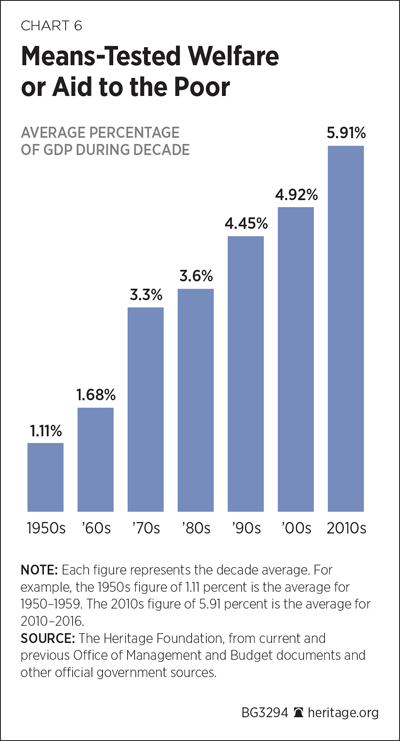
Now, I support welfare spending. (I'd like it better if we focused more on cash transfers to the poor, though.) But the notion that any major social program has ever been "kneecapped" is a myth.
The 2018 omnibus budget contained a variety of funding cuts for social programs. A good example of a dramatic reduction is the 21st CCLC (a funding stream for afterschool programs) being eliminated entirely, to the tune of $1.2 billion USD[2]. That was part of a larger >10% cut to education programs as a whole, which I would consider significant.
[1]: https://www.nytimes.com/2019/08/19/health/planned-parenthood...
[2]: https://www2.ed.gov/about/overview/budget/budget18/budget-fa...
But overall, education spending consistently goes up over time: https://www2.ed.gov/about/overview/fed/10facts/index.html#ch...
> On a per-pupil basis and adjusted for inflation, public school funding increased: 24 percent from 1991-92 through 2001-02 (the last year for which such data are available); 19 percent from 1996-97 through 2001-02; and 10 percent from 1998-99 through 2001-02.
A concrete example: the current DOEd has increased funding of both charter and private schools. We can go back and forth on whether elements of that constitute social programs, but I think the point about it not being tied to the larger funding trend stands.
Similar stories about in other areas. In Europe it is common for private companies to operate transit systems. (Stockholm’s subway is operated by the same company that operates Hong Kong’s.) In the US, nearly every large transit system is operated by government workers on the government payroll.
Goverment funding has been chopped for state schools, housing projects, the list goes on. The right kills social programs on a practically daily basis. Not to mention shifting the tax burden away from the upper class and towards the middle class. If your taxes have been going up over the last 30 years, it's because you aren't upper class.
And yeah, social spending has increased ever since we shipped all the jobs to China. Democrats rationalized it by promising to use the new revenue on social programs; Republicans put a stop to that straight away. The American middle class got double-teamed. Privatize the gains, socialize the losses!
I'm not a hard-right libertarian--I think healthcare probably has some examples of market failures and maybe we need something like universal catastrophic insurance. But yeah, some of these problems, like housing costs, really are self-inflicted.
I think the other approach is to shift blame or sweep under the rug problems with services that are entirely publicly run. If you have a problem with the schools or police in your blue city/state, 90% of your energy should be directed to your own state and local officials! (Instead of railing against Jeff Bezos or Donald Trump.)
The Bay Area has a number of little-known unincorporated enclaves that are often located within incorporated cities. Places like Devonshire (San Carlos), Emerald Hills (Redwood City), the unincorporated strip of San Carlos Ave (San Jose), Ladera or Los Trancos Woods (Portola Valley), Castro Valley and San Lorenzo (Hayward/Oakland). I've noticed that in today's hot market, houses in those areas consistently go for anything for $0-150K under asking, while houses in the nearby cities go for $150-500K over asking. A typical swing in purchase price for equivalent homes in nearly equivalent locations is about $300K (on prices of about $1.8-2.2M).
The usual real-estate confounders don't apply here because the geographic locations are so similar. The fire danger is roughly equivalent (but high): places like Devonshire and Emerald Hills are inside of 280, and right next door to equally flammable but more expensive houses in Belmont, San Carlos, and Redwood City. Commute times are basically identical, if anything a little shorter. There's less regulation for building, but not much more additional supply of land since these are constrained enclaves.
It seems like buyers are willing to pay a premium specifically to get city services and city regulation. Instead of the free market being impeded, this is the free market speaking: buyers are paying a premium to live in areas where there are more services and more regulation.
I can think of another difference: loads of people want to live where they do, pushing up prices, while few people want to live where you do, keeping prices reasonable.
Since the cities are generally under solid Democratic control (there's not a single Republican in elective office in Seattle, for example), there's something else going on.
I'm not confident that municipal broadband will ever really take off in the US but I think local loop unbundling might have a chance since I'm sure companies are more than happy to unload all the expensive construction work to the local gov't.
Company X: "We'd like to meet with you to discuss how we can service your community better than municipal broadband. Our representative is going to be in Hawaii for the next 3 weeks and we'd be more than willing to fly you and your family out to meet with him. Of course it's inconvenient for you to travel so we'd provide for hotel and airfare."
Actually, It's all about the lobbyists and industry groups, often with model legislation from ALEC[0][1][2] that have blocked municipal broadband in 22 states[3] (down from 25 a few years ago):
"Over the past year, several promising developments have been made on the municipal broadband front.
Two states were successful in repealing their municipal broadband bans, bringing our tally down to 22 states from 25 states identified in our 2019 report. Those law changes are significant, and may portend similar measures being considered across states in the coming years.
This report is the latest in our annual series looking into the state of municipal broadband in America, and provides a state-by-state breakdown of the various roadblocks and restrictions used to prevent their establishment. This year, we’ve also compared access to low-price broadband in states that have no municipal restrictions versus those that do, and we’ve found that the former have lower internet prices on average.
State legislatures around the country considered a wave of broadband-focused bills in 2019. That signals not only the importance of addressing broadband access gaps for state lawmakers, but also a growing acknowledgment among state and local governments that they have a larger role to play in ensuring all residents have access to the high-speed internet."
>I'm not confident that municipal broadband will ever really take off in the US but I think local loop unbundling might have a chance since I'm sure companies are more than happy to unload all the expensive construction work to the local gov't.
I'd tend to agree, as long as state and local government officials continue to be bought (and critically, stay bought) by industry groups.
That's not to say that municipal broadband is the solution for every county/city/town. Rather, it's a solution that, under the right circumstances, can improve the livability, access to commercial opportunities, higher-paid residents and a raft of other positive outcomes.
These are local and state issues that aren't well suited to regulation/lawmaking from the Federal government, and should be addressed in that fashion. A good place to start would be to reverse the anti-competitive laws in place in 22 states that limit the ability of local governments to implement municipal broadband.
I'd say that if the big ISP's don't want it, it's probably a good thing to do.
[0] https://www.sourcewatch.org/index.php/ALEC_Communications_an...
[1] https://www.govtech.com/network/Lawmakers-Mount-Federal-Effo...
[2] https://arstechnica.com/tech-policy/2015/04/anti-municipal-b...
[3] https://broadbandnow.com/report/municipal-broadband-roadbloc...
Would it not be possible to make it illegal to provide internet access and to own the infrastructure at the same time?
Where I'm from, there are two national phone networks, owned by the two biggest phone plan providers. They also rent out their network infrastructure to smaller companies, which effectively means they control the price of phone plans. As a result, phone plans are comparatively very expensive where I'm from. It seems like separating the infrastructure from the phone plan providing would make the market more competitive, leading to lower prices.
Municipal broadband is the only way you’ll get competition? A “public option” seems to invite the very opposite of competition. Less regulation is how you increase competition — by allowing more new entrants into a market, you necessarily increase competition.
Municipalities should own the wire, not the service flowing through the wire. Making capital expenditures less expensive would encourage more service providers.
How would another option decrease competition? In what world does that make sense? This isn't without precedent. In markets where there are municipal broadband or increased competition in general, companies like AT&T immediately up their speeds, cut their prices, cut their contract lengths, etc.
This seems antithetical to their newfound views on how corporations like Twitter should be able to block political news on their platforms. I don't see how it's dramatically different for Twitter (or Facebook or Google) deciding to block the New York Post than it is for Comcast to do so.
It's not obvious to me right now which is the party for a free and open internet.
If Comcast decides to block the New York Post, you can't see it at all until you change your Internet provider. That may involve breaking a contract, and will certainly cost you time and money. And that's if you have a choice at all - large swathes of the country have only one ISP. Many apartment buildings only have hookups for one provider.
If TwitFaceGoog don't show NYP links you're free to type in their domain name in your web browser and go to the site directly.
Suggesting there's no difference between the two is dishonest.
If you use a Comcast email address -- is it ok for them to scan emails you send to your friends, and quietly delete them if they contain links to newspapers they don't approve of?
This would be illegal under net neutrality, and is identical to what Twitter and Facebook are doing regularly.
They're probably already doing this, at the very least to scan for viruses and filter scammy emails.
> quietly delete them if they contain links...they don't approve of?
That's what a spam filter does.
> This would be illegal under net neutrality
a) ISPs aren't subject to net neutrality. They were, but now they aren't. Guess who voted to make it that way?
b) It would be a dick move and would cost the ISP a lot of business. Email is 1:1 and you (presumably) consented to receive email from your friends. But it isn't illegal afaik. Can you cite the relevant law you think makes this action illegal?
> is identical to what Twitter and Facebook are doing regularly.
Maybe, maybe not. It's not illegal. Considering that an ISP operates at the network layer and social networks operate at the application layer, such comparisons are meaningless. ISPs perform plenty of network-layer moderation that you never see and might never find out about.
I’d like to hear why you think it is terrible when Comcast bans a website but fine when Google/Facebook/Twitter do it. Both groups have monopolistic power. And, if anything, the ISPs are much less powerful and less important than the big tech companies. If anything they should be held to a higher standard.
Nah.
> I’d like to hear why you think it is terrible when Comcast bans a website but fine when Google/Facebook/Twitter do it.
In many areas of the country, there is only one ISP available. In my area, there's two, but one only offers very slow DSL; there is a de facto monopoly on meaningful internet service.
This is not the case for social media.
> Both groups have monopolistic power.
That you had to say "Google/Facebook/Twitter" and not just one of them clearly indicates that they do not.
Hey, it’s their platform... don’t like it, go somewhere else.
And every American has a choice in cellphone service providers - so they can block journalist they don’t favor too. What could possibly go wrong?
Not really, no.
https://www.eff.org/deeplinks/2018/12/new-fcc-data-indicates...
> The major takeaway of this report, which provides policymakers in D.C. and the states a wide-ranging view of available data to see trends in the Internet, is that competition for broadband only looks good at slow speeds while a vast majority of Americans (EFF estimates at least 68 million) are facing monopoly or no access to high-speed broadband.
> Instead, in a handful of markets we have reviewed, we find that the average price consumers pay ranges from 200% to 400% above competitive rates and that cable prices are established surgical precision in order to extract monopoly rents. For example, I myself would have to pay $159.95 for a gigabit service whereas my coworkers would pay $40 for a superior product.
My goodness you folks will bend over backwards to defend the world's largest corporations censoring journalists. It shows just how illiberal the Democratic Party has become. It's very lonely right now for those of us that believe in freedom of speech as an ideal worth standing up for.
That's not actually what the highlighted quotes say.
https://arstechnica.com/information-technology/2017/06/50-mi...
Title: "50 million US homes have only one 25Mbps Internet provider or none at all"
Article:
> The household analysis found a slightly better, but still troubling, situation, with nearly half of the 118 million US households lacking any wired Internet choice at the FCC's broadband standard of 25Mbps.
Also (emphasis mine),
> Democrats will restore the Federal Communications Commission's (FCC) clear authority to take strong enforcement action against broadband providers who violate net neutrality principles through blocking, throttling, paid prioritization, or other measures that create artificial scarcity and raise consumer prices for this vital service.
Regardless of anyone's feelings broadband is not categorized as a utility. You may want it classified as such. Then ask yourself which party is likely to move in that direction.
https://www.demconvention.com/wp-content/uploads/2020/08/202...