For example, I'm not so sure that giving folks a small welfare check and putting them in highly subsidized public housing projects is the best solution. I'm sure it does reduce poverty and homelessness with some, but does it also increase unemployment and alcoholism? I don't claim to know the answer, but it's worth exploring. Perhaps a UBI is the answer? Just giving away condoms seems less effective than also creating educational programs. There are plenty of alcoholics with interesting things to do, maybe there is more than just lack of resources at play?
Bromides: a trite and unoriginal idea or remark, typically intended to soothe or placate. "feel-good bromides create the illusion of problem solving"
I'd like to see more experiments, trials and studies but ultimately they'll all fall flat because they're not the real deal (still useful, just not 100% accurate). The 'Universal' part is what makes it so interesting to me and also happens to be impossible to test without actually implementing it at a massive scale. Any data gathered from not-truly-universal sources will always be fundamentally flawed from the perspective of what the impacts actually would be in the real economy.
There are lots of open questions around UBI but IMO that just means it needs further debate and discourse.
The best solution to what problem, exactly? All of them?
> I'm sure it does reduce poverty and homelessness with some, but does it also increase unemployment and alcoholism?
It feels like you're shifting the goalposts here. Are you trying to find some kind of silver bullet where one "solution" solves all of these problems at the same time? Each of those "bromides" offers actual good solutions to each of those individual problems.
Notable also is that the OP did not call it "welfare" checks or "highly subsidized public" housing. Those extra qualifiers make it quite clear what your agenda/already made opinion is, even when you're attempting to hide it in conciliatory/placating language.
The stated problems of poverty and homelessness (and perhaps secondary and tertiary problems).
> Each of those "bromides" offers actual good solutions to each of those individual problems.
I don't think they do, because they are poorly defined. How much money must be given to reduce poverty? A small welfare check? $1,000 per month in UBI? A $6,000/month stipend from your parents? How much poverty is reduced and how?
> Notable also is that the OP did not call it "welfare" checks or "highly subsidized public" housing.
That is exactly why I chose those terms, because OP didn't other than using "money" and "housing". They needed to be more precise, in my opinion so I used an established vehicle for giving money and housing as an example. I actually don't have specific policy in mind here, I just feel being too vague about these things doesn't actually help and tends to confuse things.
Housing First model
Rat Park addiction
Iceland teen drinking
Colorado abortion rate
Careful. The US ranks pretty poorly compared to most European countries.
My personal experience makes me doubt this is the case. To give an example, my grandpa was an alcoholic and had a family of 7 and was the lead accountant at a major pharma company. Did he lack things to do?
I think the main cause of drug use is availability of drugs. That's one reason why doctors tend to be addicts more than the general population. My anecdotal experience is that the people that used drugs were not people that lacked "interesting and useful things to do", they were rich (and accomplished) kids with money to blow and drugs were always just a phone call away.
I'm not against people living motivated and interesting lives, but I just think you are vastly oversimplifying a major public health problem.
Maybe your grandpa was depressed and was self medicating? One anecdote doesn't really prove that full blown many year research studies are wrong.
You can reduce homelessness by making more housing available for purchase.
You can reduce abortions by educating people about sex life.
You can reduce health care expenses by teaching people to live a healthier life.
Except the last two, you're just treating the symptoms and not addressing the actual problems. There are legitimate problems with giving things away for free. A few would realize the full value but for the majority would still remain in the same situation they were before.
Obviously, if they wants that, it's not involuntary.
You strawmanned a figure out of thin air.
And you didn't ask if they likes their taxes going to existing corporate subsidies, or F35s, or Presidential golf vacations. All of those could be traded as well.
... until you run out.
If society took the money they put towards policing, treatment, etc., and prevented that problem in the first place by just giving cash handouts, could it save both money and suffering?
I don't know the answer, but I'm pretty sure just reflexively looking at top-line costs isn't the way to improve society.
For example, if you register heroin addicts and supply them with clean heroin on a regular basis, you destroy the market for heroin.
If you legalize and regulate cocaine like tobacco, you can destroy billions of dollars worth of criminal activity.
One of the strongest arguments for heavy foreign aid and development in my opinion is the squandered human potential. The man or woman who could be the next Einstein may well be tending a cassava field right now. That's our loss as well as theirs.
Was there an assertion that there isn't a return on investment? Asserting that the inevitable outcome of rampant income redistribution is systemic collapse is compatible with "investment in personnel has returns"
Forcing the most productive workers to subsidize the consumption of unprofitable workers always leads to failure. "How am I to eat when I only grow 10kg of wheat a year but need to eat 11kg? We should use the state's violence to take 1kg from the farmer who grows 20kg and eats 12kg, Now I can grow 13kg of wheat for every 12kg I eat! A net gain in production!"
It's a misallocation of capital, simultaneously (the apparent) investing in the more profitable producer would have been better and (the non apparent) that deluding the worker into believing farming 13kg of wheat for every 12kg increases the price of the input goods and input labor for other industries.
Marxist Communism's argument is essentially: "While capitalism's losses are privatized, the fact that the profits are also privatized causes everyone to suffer. Instead of allow bricolage economics, the state's central planners will be to sole source of investment and sole consumer. Profits will be nationalized but losses will also be nationalized."
Having that state be the sole investor in an economic -- a monopoly on entrepreneurship -- dooms it to failure. It does not mean "investments [even centrally planned ones] don't returns"
Probably not. Einstein was not a solitary genius. He lived in a culture and society that placed high value on learning and especially math.
He was also in communication with some very gifted people such as Emmy Noether who actually discovered the mathematical foundation for much of his work.
Srinivasan Ramanujan on the other hand is a much better example of finding someone who had super human abilities in an unexpected place.
Thus the aid, to attempt to create that society.
Hm, maybe we should chill on these COVID bailouts then
Take a look at Norway's finances from that date until today.[1]
Norway decided that the profits from natural resources belonged to every citizen of Norway, not just the companies that landed the leases. The profits were invested in infrastructure, including education, and conservatively invested in external markets as a hedge to internal economic crises. The results speak for themselves.[2]
America has more natural resources, more workers, more opportunities to make sensible economic decisions that provide for the well being of everyone. Instead we have an oligarchy that write laws to benefit themselves. The claims that it won't work here because market socialism "doesn't work", or because America is "too different" are pure bullshit.
[1] https://www.macrotrends.net/countries/NOR/norway/gdp-per-cap...
Surely you're being sarcastic? There's this minor issue of inflation which results in constantly paying more $ for the same goods.
Of course, the US can only play this game so long before we devalue our currency enough that it's worth it for the world to switch to another currency. And when that happens, the USD will no longer be a good store of value, which means all those dollars will come flooding back. And we'll experience decades of inflation in a very short period of time, with disastrous consequences.
1: http://www.shadowstats.com/alternate_data/inflation-charts
Inflation's been normal? Maybe we don't share the same reality. Let's continue with the USA, which previous commenters have be referencing.
The median price of a US home has gone up 45% [1] since 2008 when The Fed started "printing money hand over fist". Did the quality of all homes suddenly go up by 45% in lockstep? I would doubt that. It could be that all people started to be more productive simultaneously, and despite an aversion to paying a premium on housing, the price increase is merely a symptom of a supply-restricted market -- and yet Median incomes (household, individual) only increased (26%[2],28%[3]).
The US is experiencing at least 13% and practically 45% asset-price inflation over the period you referenced. I would hardly say that's "normal". It's the sign of a dying currency -- one that cannot maintain its long term purchasing power. [4]
>Classical economics no longer correctly models reality.
Economics is not physics -- it's an intangible process of action, human action. One cannot make an economic model of the utility I get from the sloth of laying in a field on a warm day, even if it means I'll be less robust against a winter storm. "Ce qu'on voit et ce qu'on ne voit pas" and TNSTAAFL still hold despite what the central planners decree.
[1] https://dqydj.com/historical-home-prices/ [2] https://dqydj.com/household-income-by-year/ [3] https://dqydj.com/individual-income-by-year/
[4] Living in a home is a consumptive act: Using land, material, past labor for one's enjoyment. It is not "investing". One may try to reduce the costs of that consumption by buying the house etc.
Actually, inflation has been very low.
> The median price of a US home has gone up 45%
The median sale price of existing homes has gone up 45%. Without knowing the profile of homes sold, it's hard to say what it means. It could just be that turnover has accelerated at the higher end of the market, or slowed at the lower end, or both (which would be consistent with basically everything I've seen about the real estate market since 2008, both in terms of direct reports and indirect influences—better lending terms but stricter qualifications to get a loan at all, for instance.)
> The US is experiencing at least 13% and practically 45% asset-price inflation over the period you referenced.
Asset-price inflation isn’t what the unqualified term inflation refers to, and aside for the fact that money supply can drive both, is otherwise driven by different forces to general inflation (both in terms of distributional and behavioral drivers.)
> I would hardly say that's "normal".
Why not? Certainly the home price measure you've chosen went up a lot less in the 12 years from the trough in 2008 that you measured from than it did in the 12 years leading up to the peak just before the downturn. Even ignoring the question of whether it's a relevant measure, by what standard is it unusually high?
In short, your analysis is grade school level.
Correct me if I'm wrong, but I didn't analyze anything. My goal was to assert: Inflation is present in the US economy, Home prices as an example; and to provide some relative bounds on what that rate might be.
>I wonder if tax policy has anything to do with this
What's you thesis of the tax policy changes that occurred in the past 12 years that caused asset-price inflation?
>way wealthy people can shelter money in a residence
How are "wealthy people" "sheltering money" in the bottom 50% of all home prices -- those homes who prices would need to change to change the median price?
>lack of savings interest is a big driver
The opportunity of high, investment returns doesn't reduce the prices of the goods we need to buy to exist.
If I was to actually provide some analysis for the price increases, I'd posit: Downward, interest-rate manipulation by central banks has caused systemic-wide credit expansion. The new money that results from this policy affects economic of all goods but most severely inelastic goods -- such as houses and in markets that receive artificial economic intervention from central planners (in the US, the housing market is a prime example).
This is a perfect storm for pushing up costs and denying lower income Americans the ability to pay rent and buy homes.
citations: https://blogs.cornell.edu/cradle/2019/02/11/what-the-federal...
https://www.forbes.com/sites/advisor/2020/07/28/fed-policy-h...
Providing the homeless with housing reduces social service and ER costs [1]. Paying for IUDs and other forms of long term birth control reduces unwanted pregnancies [2]. These are just two examples, but the thesis is sound: spend now, get ahead of the curve, and have less spend need in the future. Instead of technical debt, this is policy debt, which leads to actual debt.
[1] https://www.npr.org/2015/12/10/459100751/utah-reduced-chroni...
[2] https://powertodecide.org/what-we-do/information/national-st...
We've been pumping new money into financial channels. A UBI would pump it into real channels.
That said, this article is about a municipal program. Cities don't print money. They transfer it from some groups to others.
Spain is experimenting with something not quite UBI [4] (but close enough for this comment I will refer to it as such), and their inflation rate is currently negative [5]. Something to follow.
EDIT: jcranmer said it better in a sibling comment ("To me, it seems a case of economists clinging to models that predict the opposite of reality, and it contributes to my general impression that economists prefer mathematical models even if their correlation to reality is poor.") [6].
[1] https://www.visualcapitalist.com/chart-the-downward-spiral-i...
[2] https://www.visualcapitalist.com/wp-content/uploads/2020/03/...
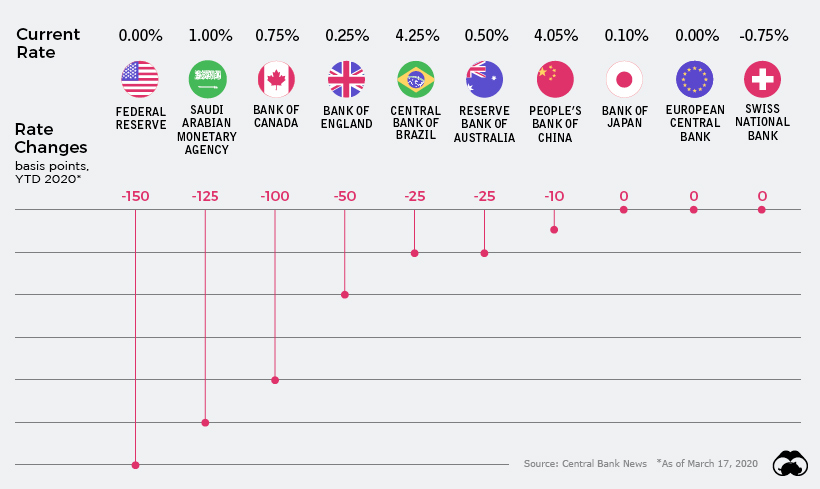
[3] https://voxeu.org/article/great-disinflation-emerging-and-de...
[4] https://www.nature.com/articles/d41586-020-01993-3
Since QE operations were not designed to produce inflation (and were arguably designed specifically to not produce consumer price inflation), this isn't exactly surprising. They did, however, affect prices of the assets the government bought up as predicted.
Suffice to say, there's a massive difference between monetary expansions in a time of deep recession - economic policy orthodoxy since Keynes - and the assumption that inflation isn't a thing in developed countries.
It's much the same as a startup can pay for stuff by emitting more equity: pay for the right stuff and the value of the company might actually rise and there are many examples of valuations leaping afterwards, but you can't just assume these examples and the infinite divisibility of the cap table means no startup needs to worry about dilution or impact on future valuations.
> Spain is experimenting with something not quite UBI [4] (but close enough for this comment I will refer to it as such), and their inflation rate is currently negative [5]. Something to follow.
Spain reforming its benefits system to create a new payout to 5% off its population to be funded by debt and taxes isn't remotely similar to Spain reforming its benefits system to pay its entire population newly printed money, so the fact the former has little immediately evident inflationary impact in the middle of Covid tells us very little about the latter.
I'm reminded of the Phillips curve which relates inflation and unemployment. If you graph these data points for the 1950s and the 1960s, you do get a great correlation. But extend the graph to the 1970s and the 1980s and the data instead looks a lot more like a random scatterplot. Yet the concept is important enough to be covered in Economics 101 textbooks. To me, it seems a case of economists clinging to models that predict the opposite of reality, and it contributes to my general impression that economists prefer mathematical models even if their correlation to reality is poor.
As for interpreting trends unwisely, isn't that what you're doing by noting a lack of inflation and arguing therefore that fundamentals don't matter. Common sense says if you give out more cash, people can bid up prices higher. There are undoubtedly variables not accounted for in all economic models. As the statisticians say, "all models are wrong". But those unknown variables can turn on you too. Every bubble consists of people ignoring fundamentals because they don't fit the recent curve, then getting burned when it crashes.
WRT providing homeless with housing and birth control specifically, I think a very strong argument can be made that a government agency is not the best provider of that service. Why wait for a slow, inefficient bureaucracy to waste a bunch of the money and time on admin costs? Every athlete and actress telling us from their multi-million-dollar homes we need to help the homeless could pool their excess money in a non-profit trust and just do it. They would help way more people with way less effort. People unable to do so need not be coerced through the tax system into participating in a less efficient program.
The point of MMT is not that it's impossible to cause inflation, but that printing money and investing it in the national interest doesn't, for the same reason that issuing shares doesn't reduce a company's stock price if those shares are being issued in exchange for a capital investment. We shouldn't print money to fund consumption, but we should be happy to print money to pay for infrastructure, healthcare, research - anything that's ultimately going to return more money to the economy than it costs.
> WRT providing homeless with housing and birth control specifically, I think a very strong argument can be made that a government agency is not the best provider of that service. Why wait for a slow, inefficient bureaucracy to waste a bunch of the money and time on admin costs?
Why do you believe that a government is more likely to be a slow inefficient bureaucracy than a private NGO or whatever it is that you're suggesting?
> People unable to do so need not be coerced through the tax system into participating in a less efficient program.
No-one with that kind of money is "unable" to pay their fair share of taxes. They choose not to.
It's the same as everyone paying their share of a dinner. If one person skipped out, everyone else could probably cover their meal without really noticing. But everyone would object to doing that, because no-one wants to feel like a sucker.
> Why do you believe that a government is more likely to be a slow inefficient bureaucracy than a private NGO or whatever it is that you're suggesting? Because I've worked with government organizations. A large chunk of the employees lack motivation for what they are doing. Arcane employment rules mean you can't fire people who are dead weight, or pay the well-performing people based on merit. NGOs and private sector have other motivations that usually (not always) makes for more efficiency. One has only to go to their local DMV to see this. And of course, it's a spectrum. Most reasonable people see merits in some government programs, and some private. Where to draw those lines vary.
>It's the same as everyone paying their share of a dinner.
I think a better analogy is a group where half want to go to a really expensive lavish restaurant (UBI+Universal Healthcare+Free Housing), and the other half want to go to a local pub (safety nets, small government, private charity). They could fight over which place to go, or, just each go to their own place. No need for the expensive dinners to insist the pub-goers go with them, or for the pub-goers to begrudge the restaurant-goers their meal. The "unable" I referred to were poor-to-middle class. I'm saying a middle class person saving for her retirement and kids' education, need not be coerced by millionaire class actors and athletes into paying for UBI or other programs she doesn't think are wise investments. If the Screen Actors Guild members think UBI is so great, their first step could be to set up one with their own funds.
The benefits apply at country scale. So it's more like someone saying "well, I'll respect our voting and go to the fancy restaurant if that's what the rest of you want, but I'm only going to pay what a pub meal would have cost because I'd rather go to the pub" - i.e. a major dick move.
All of this stuff sounds great from an academic perspective, but life is not simple. There are people who given a couple of thousand dollars a month, will throw a bag of potato chips and beef jerky at their kids and buy some booze and a Mustang on a 7 year, 18% APR payment plan.
You cannot make an alcoholic stop drinking. They need to make that decisions.
You cannot give people money and assume they will get out of poverty.
Money is a tool to solve problems, but it doesn't solve them, many people in poverty who end up on the dole need social and other supports.
You can reduce homelessness by giving people housing.
You can reduce abortions by giving people IUDs and contraception.
You can reduce health care expenses by giving people health care.
You can reduce alcoholism and drug use by giving people interesting and useful things to do.
You can reduce unemployment by giving people meaningful work to do.