News for hackers. Stuff that matters.
Re:Cities Experiment with Remedy for Poverty: Cash, No Strin... by toomuchtodo on Tuesday September 29, 2020 @10:12AM (#24628027)
A central bank with the authority over a reserve currency never runs out. We (the US Fed, specifically) incinerated $3 trillion in USD value in response to COVID. We've borrowed and continue to service trillions in debt for useless decades+ wars. We can afford it (because it's cheaper to pay for these things upfront, before they're more expensive down the road), and those who say we can't use that as an excuse to avoid the uncomfortable conversation about why they don't want to pay for it.

Providing the homeless with housing reduces social service and ER costs [1]. Paying for IUDs and other forms of long term birth control reduces unwanted pregnancies [2]. These are just two examples, but the thesis is sound: spend now, get ahead of the curve, and have less spend need in the future. Instead of technical debt, this is policy debt, which leads to actual debt.

[1] https://www.npr.org/2015/12/10/459100751/utah-reduced-chroni...

[2] https://powertodecide.org/what-we-do/information/national-st...

Re:Cities Experiment with Remedy for Poverty: Cash, No Strin... by RHSeeger on Tuesday September 29, 2020 @10:15AM (#24628075)
Assuming you just print unlimited amounts of money because it convenient, how do you deal with the inflation that comes with that?
Re:Cities Experiment with Remedy for Poverty: Cash, No Strin... by jcranmer on Tuesday September 29, 2020 @10:17AM (#24628095)
At some point, the inflation does become a problem. But notice how it hasn't yet? Take a look at Japan, which has printed an awful lot of money and yet inflation is still hard to come by.
Re:Cities Experiment with Remedy for Poverty: Cash, No Strin... by JumpCrisscross on Tuesday September 29, 2020 @10:21AM (#24628148)
> notice how it hasn't yet?

We've been pumping new money into financial channels. A UBI would pump it into real channels.

That said, this article is about a municipal program. Cities don't print money. They transfer it from some groups to others.

Re:Cities Experiment with Remedy for Poverty: Cash, No Strin... by RHSeeger on Tuesday September 29, 2020 @10:42AM (#24628398)
The comment I was responding to was about the central bank.
Re:Cities Experiment with Remedy for Poverty: Cash, No Strin... by toomuchtodo on Tuesday September 29, 2020 @10:47AM (#24628461)
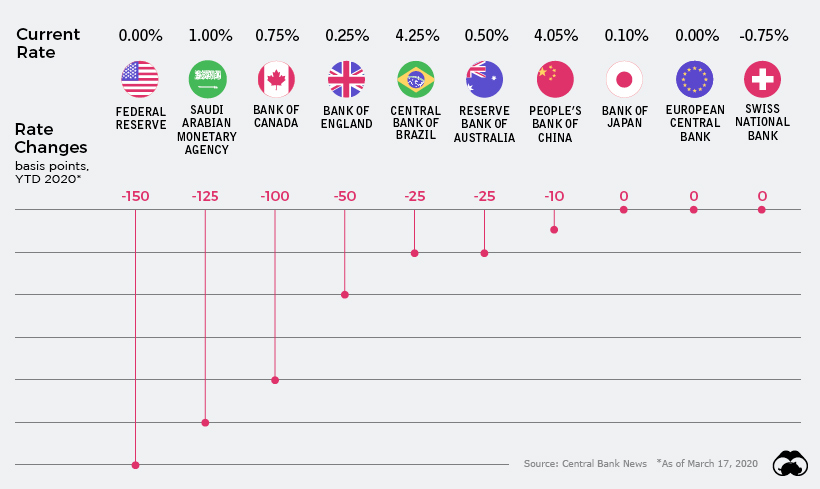
I don't see the need to plan for inflation until a future point arrives that demonstrates there might be inflation. Looking at evidence from developed countries and their central banks, they are unable to generate an appreciable amount of inflation from monetary policy (significant quantitive easing operations). Maybe generous fiscal policy causes it (UBI, "helicopter money", and the like), it just seems a bit disingenuous to argue what we'll do about a hurdle that seems unlikely to present itself (many developed country central banks are near zero, at zero [ZIPR], or below zero interest rates [NIRP] [1] [2] and you're still not generating inflation [3] so ¯\_(ツ)_/¯).

Spain is experimenting with something not quite UBI [4] (but close enough for this comment I will refer to it as such), and their inflation rate is currently negative [5]. Something to follow.

EDIT: jcranmer said it better in a sibling comment ("To me, it seems a case of economists clinging to models that predict the opposite of reality, and it contributes to my general impression that economists prefer mathematical models even if their correlation to reality is poor.") [6].

[1] https://www.visualcapitalist.com/chart-the-downward-spiral-i...

[2] https://www.visualcapitalist.com/wp-content/uploads/2020/03/...
[3] https://voxeu.org/article/great-disinflation-emerging-and-de...

[4] https://www.nature.com/articles/d41586-020-01993-3

[5] https://tradingeconomics.com/spain/inflation-cpi

[6] https://news.ycombinator.com/item?id=24629128

Re:Cities Experiment with Remedy for Poverty: Cash, No Strin... by notahacker on Tuesday September 29, 2020 @12:52PM (#24630125)
> Looking at evidence from developed countries and their central banks, they are unable to generate an appreciable amount of inflation from monetary policy (significant quantitive easing operations)

Since QE operations were not designed to produce inflation (and were arguably designed specifically to not produce consumer price inflation), this isn't exactly surprising. They did, however, affect prices of the assets the government bought up as predicted.

Suffice to say, there's a massive difference between monetary expansions in a time of deep recession - economic policy orthodoxy since Keynes - and the assumption that inflation isn't a thing in developed countries.

It's much the same as a startup can pay for stuff by emitting more equity: pay for the right stuff and the value of the company might actually rise and there are many examples of valuations leaping afterwards, but you can't just assume these examples and the infinite divisibility of the cap table means no startup needs to worry about dilution or impact on future valuations.

> Spain is experimenting with something not quite UBI [4] (but close enough for this comment I will refer to it as such), and their inflation rate is currently negative [5]. Something to follow.

Spain reforming its benefits system to create a new payout to 5% off its population to be funded by debt and taxes isn't remotely similar to Spain reforming its benefits system to pay its entire population newly printed money, so the fact the former has little immediately evident inflationary impact in the middle of Covid tells us very little about the latter.

Re:Cities Experiment with Remedy for Poverty: Cash, No Strin... by RHSeeger on Tuesday September 29, 2020 @11:04AM (#24628680)
Given the nearly unlimited number of places one can find explanations of why printing more money causes inflation, I think it's reasonable to assume that, at worst, it _can_ do so. As such, throwing caution to the wind and just printing as much money as you need because "it wasn't a problem in <that country>" seems risky.
Re:Cities Experiment with Remedy for Poverty: Cash, No Strin... by jcranmer on Tuesday September 29, 2020 @11:38AM (#24629128)
When you have a model that says something should happen under certain conditions, and every practical instantiation of those conditions have failed to cause the predicted effects, perhaps your model is wrong.

I'm reminded of the Phillips curve which relates inflation and unemployment. If you graph these data points for the 1950s and the 1960s, you do get a great correlation. But extend the graph to the 1970s and the 1980s and the data instead looks a lot more like a random scatterplot. Yet the concept is important enough to be covered in Economics 101 textbooks. To me, it seems a case of economists clinging to models that predict the opposite of reality, and it contributes to my general impression that economists prefer mathematical models even if their correlation to reality is poor.

Re:Cities Experiment with Remedy for Poverty: Cash, No Strin... by unishark on Tuesday September 29, 2020 @01:14PM (#24630377)
What in tiny experiments like the article's? Inflation and even hyperinflation have occurred many times in many places in the last century. In Venezuela the inflation rate is something like 2000 percent. It's not just theory. Even the US had double digit inflation when I was in school. We were taught things about the time value of money (using numbers like 8 percent interest rates) that seem nuts now.

As for interpreting trends unwisely, isn't that what you're doing by noting a lack of inflation and arguing therefore that fundamentals don't matter. Common sense says if you give out more cash, people can bid up prices higher. There are undoubtedly variables not accounted for in all economic models. As the statisticians say, "all models are wrong". But those unknown variables can turn on you too. Every bubble consists of people ignoring fundamentals because they don't fit the recent curve, then getting burned when it crashes.

Re:Cities Experiment with Remedy for Poverty: Cash, No Strin... by bdamm on Tuesday September 29, 2020 @12:17PM (#24629679)
Or, the model is right, but the system is being gamed in a way that isn't clear to us in the public. Then when we find out what the game is it'll be too late.
Re:Cities Experiment with Remedy for Poverty: Cash, No Strin... by tptacek on Tuesday September 29, 2020 @12:40PM (#24629982)
Aren't you worried that there's really no model that you can't support with that logic, no matter how dumb it might be?
Re:Cities Experiment with Remedy for Poverty: Cash, No Strin... by lmm on Tuesday September 29, 2020 @10:26PM (#24635152)
You have to actually examine the specifics of the issue and see whether the measures actually reflect the reality. But in this specific case there's a pretty strong case that what's broken down is not the relationship between how many people are able to find work and the rate of inflation, but the relationship between how many people are able to find work and the "unemployment rate".
Re:Cities Experiment with Remedy for Poverty: Cash, No Strin... by bdamm on Tuesday September 29, 2020 @03:31PM (#24631928)
Yes. It comes with the territory of realizing that there are actors gaming the biggest systems around, and part of the game is building support for those gaming the system, without knowing which segments of our society are participating.
Re:Cities Experiment with Remedy for Poverty: Cash, No Strin... by notahacker on Tuesday September 29, 2020 @12:56PM (#24630171)
I'm more worried about the implicit economics textbooks cover how an old model was falsified in the 1970s, therefore we should assume every other economic model is also false argument he was responding to...
Re:Cities Experiment with Remedy for Poverty: Cash, No Strin... by nitrogen on Tuesday September 29, 2020 @01:32PM (#24630623)
Have the metrics used by models changed? E.g. can you hypothetically define away inflation by excluding property prices from the basket?
Re:Cities Experiment with Remedy for Poverty: Cash, No Strin... by freedomben on Tuesday September 29, 2020 @10:21AM (#24628141)
FYI to people trying to follow, this is MMT, Modern Monetary Theory: https://en.wikipedia.org/wiki/Modern_Monetary_Theory
Re:Cities Experiment with Remedy for Poverty: Cash, No Strin... by shireboy on Tuesday September 29, 2020 @10:53AM (#24628538)
I'm admittedly skeptical of MMT, but turning that argument around, IF it were true that the US can never run out of money, then why worry at all about the cost of things? Why not just print 100% of the money to provide 100% of the things people want?

WRT providing homeless with housing and birth control specifically, I think a very strong argument can be made that a government agency is not the best provider of that service. Why wait for a slow, inefficient bureaucracy to waste a bunch of the money and time on admin costs? Every athlete and actress telling us from their multi-million-dollar homes we need to help the homeless could pool their excess money in a non-profit trust and just do it. They would help way more people with way less effort. People unable to do so need not be coerced through the tax system into participating in a less efficient program.

Re:Cities Experiment with Remedy for Poverty: Cash, No Strin... by lmm on Tuesday September 29, 2020 @10:42PM (#24635212)
> IF it were true that the US can never run out of money, then why worry at all about the cost of things? Why not just print 100% of the money to provide 100% of the things people want?

The point of MMT is not that it's impossible to cause inflation, but that printing money and investing it in the national interest doesn't, for the same reason that issuing shares doesn't reduce a company's stock price if those shares are being issued in exchange for a capital investment. We shouldn't print money to fund consumption, but we should be happy to print money to pay for infrastructure, healthcare, research - anything that's ultimately going to return more money to the economy than it costs.

> WRT providing homeless with housing and birth control specifically, I think a very strong argument can be made that a government agency is not the best provider of that service. Why wait for a slow, inefficient bureaucracy to waste a bunch of the money and time on admin costs?

Why do you believe that a government is more likely to be a slow inefficient bureaucracy than a private NGO or whatever it is that you're suggesting?

> People unable to do so need not be coerced through the tax system into participating in a less efficient program.

No-one with that kind of money is "unable" to pay their fair share of taxes. They choose not to.

It's the same as everyone paying their share of a dinner. If one person skipped out, everyone else could probably cover their meal without really noticing. But everyone would object to doing that, because no-one wants to feel like a sucker.

Re:Cities Experiment with Remedy for Poverty: Cash, No Strin... by shireboy on Friday October 02, 2020 @10:46AM (#24663149)
I may question MMT premise, but the comment I was replying to said "central bank with the authority over a reserve currency never runs out". Here, you qualify that a little more to say "central bank with the authority over a reserve currency never runs out... as long as they spend it on infrastructure, not consumption". A little more palatable, but I would still question whether any given thing is "going to return more money to the economy than it costs". Any savvy investor knows such "sure bets" are usually scams. The real problem is we don't know what the return on, say, a bridge to nowhere, study of cow farts, or blanket no-strings-attached UBI is, or what the unintended consequences or opportunity cost of such investments is. So we should experiment, but I don't see true, objective, double blind experiments being done in most of these UBI experiments, or real attention to the downsides. Just some hand-waving "meh, don't worry about the deficit or inflation, it'll pay for itself", without real evidence. Also, who defines what is "infrastructure"? Is oil exploration "infrastructure"? Google and Facebook? Too-big-to-fail financial companies? Government officials kids and friends?

> Why do you believe that a government is more likely to be a slow inefficient bureaucracy than a private NGO or whatever it is that you're suggesting? Because I've worked with government organizations. A large chunk of the employees lack motivation for what they are doing. Arcane employment rules mean you can't fire people who are dead weight, or pay the well-performing people based on merit. NGOs and private sector have other motivations that usually (not always) makes for more efficiency. One has only to go to their local DMV to see this. And of course, it's a spectrum. Most reasonable people see merits in some government programs, and some private. Where to draw those lines vary.

>It's the same as everyone paying their share of a dinner.

I think a better analogy is a group where half want to go to a really expensive lavish restaurant (UBI+Universal Healthcare+Free Housing), and the other half want to go to a local pub (safety nets, small government, private charity). They could fight over which place to go, or, just each go to their own place. No need for the expensive dinners to insist the pub-goers go with them, or for the pub-goers to begrudge the restaurant-goers their meal. The "unable" I referred to were poor-to-middle class. I'm saying a middle class person saving for her retirement and kids' education, need not be coerced by millionaire class actors and athletes into paying for UBI or other programs she doesn't think are wise investments. If the Screen Actors Guild members think UBI is so great, their first step could be to set up one with their own funds.

Re:Cities Experiment with Remedy for Poverty: Cash, No Strin... by lmm on Wednesday October 07, 2020 @04:40AM (#24706368)
> I think a better analogy is a group where half want to go to a really expensive lavish restaurant (UBI+Universal Healthcare+Free Housing), and the other half want to go to a local pub (safety nets, small government, private charity). They could fight over which place to go, or, just each go to their own place. No need for the expensive dinners to insist the pub-goers go with them, or for the pub-goers to begrudge the restaurant-goers their meal.

The benefits apply at country scale. So it's more like someone saying "well, I'll respect our voting and go to the fancy restaurant if that's what the rest of you want, but I'm only going to pay what a pub meal would have cost because I'd rather go to the pub" - i.e. a major dick move.