News for hackers. Stuff that matters.
Re:DDR5 Memory Specification Released by baybal2 on Thursday July 16, 2020 @03:10PM (#23862657)
> This makes me wonder, what makes DRAM so expensive?

Greed does. DRAM makers were antitrust busted at least 7 times on my memory in Taiwan, Korea, and USA.

Re:DDR5 Memory Specification Released by lend000 on Thursday July 16, 2020 @04:25PM (#23863437)
The processes to form NAND and DRAM are completely different. DRAM relies on creating non-leaking capacitors which are highly difficult to manufacture at such a small scale. NAND benefits from innovations in the CPU lithography space since it's essentially all transistor based. Why would you expect them to have the same price, unless you knew nothing about the technology? Also, there are plenty of distinct competitors in the DRAM space. Do you have a source suggesting Micron and Samsung are engaging in price fixing together?
Re:DDR5 Memory Specification Released by kasabali on Thursday July 16, 2020 @05:19PM (#23863935)
"Plenty" of distinct being Samsung, Micron and Hynix.

They are not necessarily price fixing illegally. It's just that they all keep their production and capacity expansions closely in check to not ever let prices down.

That and in rare cases when prices are down due to unexpected decline in shipments they're all very swift to shift wafers to produce something else. Feel free to dig DRAMeXchange reports for for details.

Re:DDR5 Memory Specification Released by amINeolib on Thursday July 16, 2020 @10:39PM (#23866414)
Samsung is one of the worst companies. Among the BP, AT&T, Comcast, and Apple tier evils.

I'm not sure how they have survived bad press, but Samsung is not a good company.

Re:DDR5 Memory Specification Released by vitus on Thursday July 16, 2020 @07:18PM (#23865003)
If the difficulty of DRAM is in creating capacitors at that size, why haven't we seen a shift toward SRAM (6T, for instance), which is purely transistor-based?

Sure, you have to sacrifice more transistors for the same capacity, but newer processes can fit more on the chip, right? I recall from computer architecture classes that the benefit of DRAM is the ability to use fewer transistors, but if transistors are cheap...

(I'm sure I'm missing something here. Power consumption / heat generation? I also never really understood why SRAM continues to be so expensive, when it seems like it would obviously benefit from smaller processes.)

Re:DDR5 Memory Specification Released by formerly_proven on Thursday July 16, 2020 @07:49PM (#23865234)
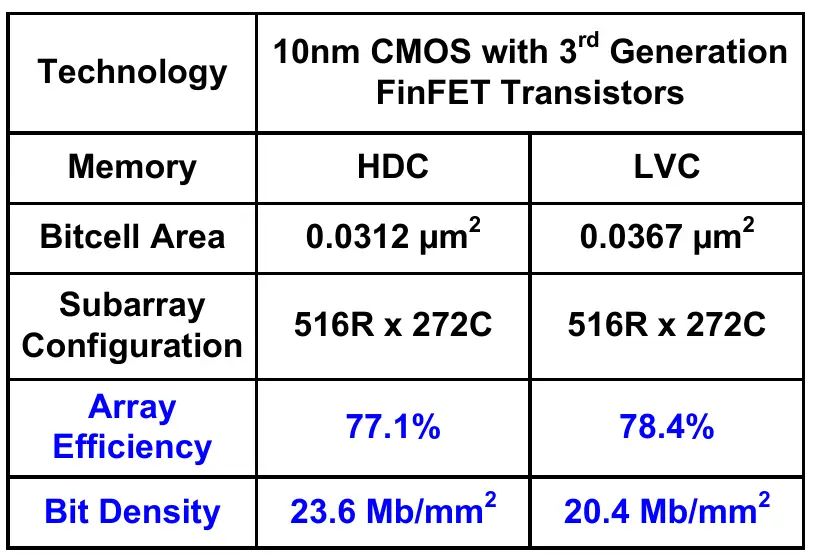
On Intel's 10 nm process you can make SRAM with a density of about 20 megabit/mm². [1] Older processes are much worse (<5 megabit/mm²). [2] A current-gen DRAM package achieves about 170 megabit/mm² (but that's two dies, probably stacked). This article [3] cites 8 Gb on 77 mm² on a 21 nm process, giving 105 megabit/mm², and 148 megabit/mm² for the DDR5 version with a die size of 54 mm². The same article shows a Samsung part with around 200 megabit/mm² density.

So even if you were to manufacture SRAM on Intel's ultra-expensive 10 nm logic process, you'd need a massive amount of silicon for the same capacity.

[1] https://fuse.wikichip.org/wp-content/uploads/2017/12/isscc-2... [2] https://d3i71xaburhd42.cloudfront.net/f20203949a744276e338d6... [3] https://www.anandtech.com/show/13999/sk-hynix-details-its-dd...
Re:DDR5 Memory Specification Released by vitus on Thursday July 16, 2020 @09:58PM (#23866173)
Totally makes sense that you wouldn't get the same capacity from the same silicon, or even close, given that SRAM uses far more transistors per cell.

But if you have issues scaling DRAM, and different scaling limits on transistor count / SRAM, it makes sense (to me at least) to start considering SRAM as an option (e.g. for lower latency, faster speeds, higher bandwidth transfers, etc). Just because you can't achieve the same capacity today doesn't mean there's no merit to it -- HDDs vs SSDs from a decade ago feels like the obvious comparison.

Supposedly [1] TSMC's 5nm process yields 256Mb on a 5.376mm² die, at roughly ~50Mb/mm², which would translate to a 3.5Gb die of the same size as the SK Hynix chip. Sure, that's no 16Gb die, but you could easily make 32GB sticks (assuming that you could just combine these chips in the same way as in DDR4).

I guess there's also a barrier to entry in that you'd also either need new hardware to deal with "SRAM sticks", or some sort of compatibility layer (a controller that implements the DDRx signaling logic, perhaps).

[1] https://www.anandtech.com/show/15219/early-tsmc-5nm-test-chi...

Re:DDR5 Memory Specification Released by g8oz on Friday July 17, 2020 @10:52AM (#23871143)
Forgive my naivete but: 20 megabit/mm^2 for SRAM...a 1u rack is 600mm X 914mm = 548,400mm^2. Multiply that by 20 megabits and that is about 70 Gigabytes. Does that mean in theory we could build a rackmount server with an external L1 cache of 70 Gigabytes? The cost would be horrendous but I'm sure there is a scenario where it could make sense.
Re:DDR5 Memory Specification Released by opwieurposiu on Friday July 17, 2020 @11:18AM (#23871452)
This would require an impractical amount of wires. For an 8 core, 64 bit cpu with differential signaling would need something like 8(64+64)2 = 2048 wires, and the length of the wires would mean the latency would be much worse then an on-die cache.
Re:DDR5 Memory Specification Released by ComputerGuru on Thursday July 16, 2020 @11:26PM (#23866663)
No, I believe SRAM actually has the edge in that department, and by a fair margin too. The d in DRAM is for dynamic as contrasted with S for static. DRAM need to be constantly read and refreshed (the timings) while SRAM doesn't and that comes with a pretty big hit to energy consumption. As soon as you add DRAM to an embedded project, the thermal/power envelop increases.

Of course that all depends on the generation of tech and only applies in an apples to apples scenario.

Re:DDR5 Memory Specification Released by wtallis on Thursday July 16, 2020 @06:12PM (#23864416)
> NAND benefits from innovations in the CPU lithography space since it's essentially all transistor based.

It's really not, especially in the 3D NAND flash era where only one manufacturer is still using a floating gate cell. It's so thoroughly not transistor based that the Chinese upstart's claim to fame is that they fabricate the transistors on an entirely different wafer from the memory cells, and glue them together later.

It's best to think of NAND, DRAM and logic as three separate categories that each require a very different mix of tools in the fab, especially on the back-end. (But you won't be finding EUV or quad-patterning in the front-end of a NAND fab, either.)

Re:DDR5 Memory Specification Released by derefr on Thursday July 16, 2020 @04:01PM (#23863218)
If that's the only reason, then you'd think companies like Apple with dedicated fab timeshare could cut costs by printing their own RAM chips, rather than buying them. And It's not like DRAM contains any complex IP they'd need to license—if you can lay out a CPU, you can lay out RAM.
Re:DDR5 Memory Specification Released by psurge on Thursday July 16, 2020 @04:13PM (#23863339)
My understanding is that DRAM processes are sufficiently different from logic processes that they tend to get dedicated fabs. So then companies like Apple would have to buy fab timeshare from RAM manufacturers that have no incentive (as far as I can see) to let them produce DRAM for less than whatever the bulk pricing is.
Re:DDR5 Memory Specification Released by derefr on Thursday July 16, 2020 @05:13PM (#23863877)
What's the reason, then, that anyone with the capital to do so (again, e.g. Apple) doesn't just build a RAM fab, to both get cheap RAM for themselves, and join the cabal selling marked-up RAM to others?

Seems like RAM manufacturing is like building a casino: expensive to do, but basically a sure bet.

Re:DDR5 Memory Specification Released by wtallis on Thursday July 16, 2020 @06:23PM (#23864534)
The problem is that you need to have $10+B to throw at the problem after you license patents from the incumbents, and even then you'll end up being behind them technologically by the time your fab is up and running, so your marginal costs won't be appreciably better than contracting with the existing manufacturers for their more advanced memory.

You could theoretically spend several times more than that to try to get ahead over the course of two or three generations, but for that kind of money you could just as easily secure some very preferential pricing from one or more of the incumbents, thereby ensuring that everyone else trying to put a lot of RAM into a PC has to pay more.

The most viable path to establishing a new leading-edge competitor in this space is for a government to throw lots of money at the problem, knowing that it'll be years at best before it produces anything competitive, but having the advantage of being able to more or less ignore IP issues and having a potential demand far higher than any one memory customer can produce on its own. China is doing this for the NAND market, too.

Re:DDR5 Memory Specification Released by fulafel on Friday July 17, 2020 @12:53AM (#23867173)
There would be a lot of candidate oligopoly markets to attack if Apple got into that business with its war chest. A risk with the DRAM plan is that they could succeed in lowering prices but the costs would be unpredictable and they would then take a very long time to break even, givn the new lower margins, and would have to become a semi house that makes chips for other customers (to get required volume to break even), taking away focus from their consumer product business.
Re:DDR5 Memory Specification Released by xbmcuser on Friday July 17, 2020 @01:52AM (#23867498)
Apple probably will in the future when it is no longer able to squeeze margins from other expensive parts. It invested in the screen manufacturing now has moved to producing it own processors looking at the next most expensive part it is a likely move. Ram chip and flash drives if you are large buyer you might look at producing your own. If they are able to use all the capacity of a fab they might look at doing so. Or like they did with sharp invest in a company that runs a fab for using majority of the production.
Re:DDR5 Memory Specification Released by baybal2 on Thursday July 16, 2020 @04:33PM (#23863527)
Yes
Re:DDR5 Memory Specification Released by grandinj on Thursday July 16, 2020 @04:11PM (#23863317)
The IP is mostly in the production process, not the circuit itself. They need to get (relative to logic chips) very low failure rates to turn a profit, which requires very extensive tuning of the manufacturing process.
Re:DDR5 Memory Specification Released by LargoLasskhyfv on Saturday July 18, 2020 @05:18AM (#23880151)
Re:DDR5 Memory Specification Released by markandrewj on Thursday July 16, 2020 @05:04PM (#23863795)
This is why even though memory was becoming dirt cheap, prices started to spike in the last few years. There are also less manufactures now as a result of buyouts and mergers.
Re:DDR5 Memory Specification Released by azinman2 on Thursday July 16, 2020 @03:16PM (#23862721)
Greed to me is a funny word here. If illegal antitrust actions are occurring, well that’s obviously bad for the consumer and market, but you say greed as if DRAM makers owe something to the public? They’re a technology business who exist to make money by definition. It’s not a non-profit.
Re:DDR5 Memory Specification Released by jeffbee on Thursday July 16, 2020 @03:18PM (#23862738)
That hasn't been the history of the business. DRAM makers are state-sponsored strategic enterprises which do not act according to rational economic theories.
Re:DDR5 Memory Specification Released by black_puppydog on Thursday July 16, 2020 @03:24PM (#23862811)
Exactly. Compare that to privately held corporations, which would never think to illegally keep prices up through collaboration, just because they can reasonably expect to get away with it. /s
Re:DDR5 Memory Specification Released by rimjongun on Thursday July 16, 2020 @03:40PM (#23863010)
So it’s either or? Both can’t be right? Geez. Straw man much?
Re:DDR5 Memory Specification Released by black_puppydog on Thursday July 16, 2020 @03:47PM (#23863085)
well you can either be state-sponsored or not. if GP is bringing up state-sponsoring as a supposed source of irrationality then yeah I'm assuming that they presume privately held corporations would do better.

that being said, I do admit my post was sarcastic, but it also did mention what the problem here is (besides a much broader discussion about captialism) which is that they can rationally expect to get away with this. State-sponsored ones because their interests are the national interest (to an extent) and privately held ones because they're usually able to effectively capture their regulators.