So even if you were to manufacture SRAM on Intel's ultra-expensive 10 nm logic process, you'd need a massive amount of silicon for the same capacity.
[1] https://fuse.wikichip.org/wp-content/uploads/2017/12/isscc-2... [2] https://d3i71xaburhd42.cloudfront.net/f20203949a744276e338d6... [3] https://www.anandtech.com/show/13999/sk-hynix-details-its-dd...
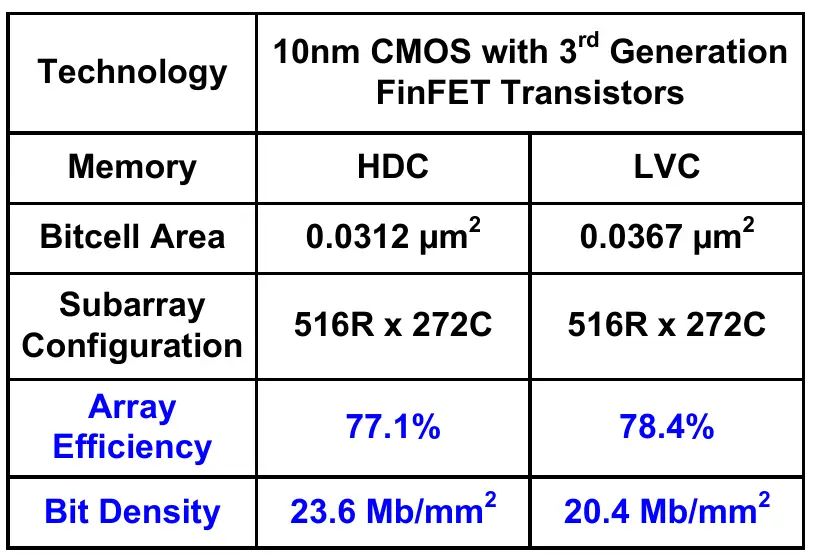

But if you have issues scaling DRAM, and different scaling limits on transistor count / SRAM, it makes sense (to me at least) to start considering SRAM as an option (e.g. for lower latency, faster speeds, higher bandwidth transfers, etc). Just because you can't achieve the same capacity today doesn't mean there's no merit to it -- HDDs vs SSDs from a decade ago feels like the obvious comparison.
Supposedly [1] TSMC's 5nm process yields 256Mb on a 5.376mm² die, at roughly ~50Mb/mm², which would translate to a 3.5Gb die of the same size as the SK Hynix chip. Sure, that's no 16Gb die, but you could easily make 32GB sticks (assuming that you could just combine these chips in the same way as in DDR4).
I guess there's also a barrier to entry in that you'd also either need new hardware to deal with "SRAM sticks", or some sort of compatibility layer (a controller that implements the DDRx signaling logic, perhaps).
[1] https://www.anandtech.com/show/15219/early-tsmc-5nm-test-chi...
Of course that all depends on the generation of tech and only applies in an apples to apples scenario.
Sure, you have to sacrifice more transistors for the same capacity, but newer processes can fit more on the chip, right? I recall from computer architecture classes that the benefit of DRAM is the ability to use fewer transistors, but if transistors are cheap...
(I'm sure I'm missing something here. Power consumption / heat generation? I also never really understood why SRAM continues to be so expensive, when it seems like it would obviously benefit from smaller processes.)