Dead people don't spread the disease. And less symptomatic strains of the virus are likely to go unnoticed and therefore spread more rapidly.
I've seen some epidemiologist say that SARS-CoV-2 is expected to turn less severe and become endemic, causing common colds like the other 4 coronaviruses.
It seems that you can catch Coronavirus from people who died with it.
https://www.google.com/amp/s/www.livescience.com/amp/covid-1...
With the likes of Ebola, cultural practices such as washing the dead pose a significant risk of transmission.
https://www.nhs.uk/conditions/ebola/ https://www.nationalgeographic.com/news/2015/01/150130-ebola...
It's more the "they don't go to the grocery store" thing.
Covid-19 really does a pretty good job in this regard already: being infectious before symptoms begin, and taking weeks to either kill or resolve.
Very little would be gained, relatively, from the sort of changes Ebola & Marburg went through.
We also need to consider how people react to being infected with Covid-19: With the disease being universally known, what are the chances of a typical patient infecting additional people if you add another week at the back end of their infection? Chances are, they are in isolation from the second week on. Any contacts they keep having (with family, housemates, or medical personnel, say) will either be infected by week 3, or proven to be rather skilful at avoiding infection.
From my understanding. A decrease of the virulence is the most likely outcome, however it's also possible (just not as likely) that a future strain could be both more deadly and have R0 > 1 (with R0 obviously depending of how we behave). We probably will not have a worse wave in the future but we should think about how to prepare for it.
That's a very important point and one that makes me agree with you in that it'll probably won't happen. This is because in most cases a virus reduces its R0 when its deadliness increases.
What I'm trying to point out is that "unlikely" is not impossible and since the stakes are high we should at least think seriously how likely the other possibility is.
For example we could think that for a virus like SARS-CoV-2 with asymptomatic contagion it's possible to think that a more deadly strain could maintain an R0 above 1 (because people pass it before becoming very ill). I talked more about this in https://news.ycombinator.com/item?id=23025899 to which I received a very thoughtful answer.
Again that does not mean that it will happen just that it could, and I believe we should encourage an informed discussion about this possibility
just as with any evolutionary process when the environment rewards a kind of behavior that behavior will become preponderant.
in this case even though it is far more likely that the virus would become less dangerous that idea gets less exposure, people will more likely read the scarier news.
This is no truer than the quote about "each deadliner than the other". In fact many virii mutate continuously, c.f. the flu shot you need to get every year because there are always new strains.
It seems currently that SARS-CoV-2 is not doing this. But the science is still new and we just don't know.
However, it is mutating slowly.
From what I've heard, NY stain seems to have come from Europe. I've not seen anything about the CA and WA strains.
I know three people who have had it and since recovered. One wasn’t bad enough to seek help until day 12, one was sick with weakness and respiratory symptoms after 5-7 days of exposure, and the other was hospitalized within 48 hours of exposure.
None had the typical underlying conditions yakked about by commentators.
https://upload.wikimedia.org/wikipedia/commons/9/9a/1918_spa...
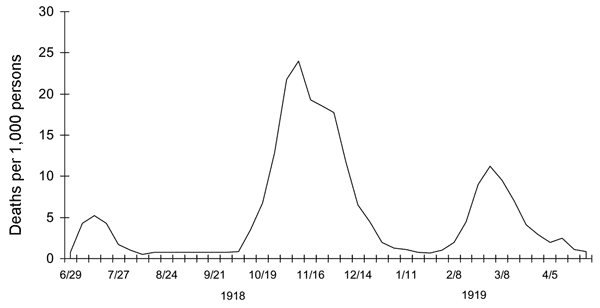
This may mean that it continues to plague humanity seasonally as do Influenza, Rhinovirus, etc., and it may also make a universal vaccine less likely.
Just need to give it a few million years or so.
From all that I've read and heard from virologist this is highly unlikely to happen. The way I understand it is that once a virus has jumped from animals to humans its virulence and danger will decrease continuously. A very simple explanation goes like this: the virus most lethal in the beginning because the human immune system is "naive" regarding that specific virus because it has not been exposed to it. For example, Prof. Drosten said in one of his podcasts that he could imagine you'd get Covid a second time after 2-3 years. But then it will be very mild, like a any normal cold.
So the biggest worries shouldn't be mutations of the SARS-2 virus but the next deadly bug crossing the animal-human barrier, e.g. a new influence virus breed in live stock somewhere.