I'm curious how your experience as a passenger sounds so different from mine.
Bonus for when you press the steward summons button and an angry balding German steward (who nonetheless has a ponytail) turns up half an hour later and demands to know what you want, and when you say "water, please", asks angrily "You vant vasser?!" like you just asked to bone his Mum.
Lucky passenger, disobeying a crew member is illegal in the United States. United would've just pulled another Dr. Dao.
Honestly I thought cattle class on the Lufthansa A380 was quite a step up from the domestic long haul offerings. The A380 runs higher humidity and is significantly quieter (inside and out) than many of its contemporaries. The leg room wasn't spectacular, but that's true of most carriers.
The food on Lufthansa, even on the short segments like FRA-CDG, puts anything you'd find on a domestic carrier to shame. United in particular has utterly revolting food.
Some carriers (Etihad, Emirates, Singapore Airlines) have very impressive FC setups on the A380, with other aircraft having a stripped down/smaller version.
For me it’s a shame we are seeing a decline of these planes. I loathe to think the industry is going to go back to less leg room, more seats and feeling like cattle.
Also, the Wolf of Wall Street Emirates style is significantly shorter (they cut all the scenes with extensive hookers and cocaine) and when Margot Robbie walks out nude they cropped the image and zoomed in on her face only, albeit with extensive pixellation.
But hey, at least Emirates will never tell you that you've had too much to drink, unlike Singapore Airlines.
We're a bit worried that he may end up being too big for it. That, and keeping them entertained for two long flights.
Yeah, LH is awful at boarding, especially in airports without the automated gates like TXL (the airport being a gigantic bag of hurt nonetheless)
For companies like Lufthansa, SAS and others - premium economy is closer to what Business Class used to be 20 years ago. You get an amenity kit, better food selection with real cutlery, nicer pillow and duvet, and a much nicer seat - usually in a 2-2-2 configuration.
The differences I've mainly noticed in premium economy are: electrical outlets, nicer in-flight entertainment, more legroom/better reclining, nicer head cushion, closer to the front (if that's a benefit) and that's about it. Amusingly, I've found on Delta the "premium economy" section occasionally extends slightly outside, e.x. the electrical outlets and better in-flight entertainment (but not the legroom) aren't only for premium economy but also 2 or 3 rows of normal seats beyond. Which is a little strange, since I would think Delta would use the opportunity to present that as an upgrade (paid, or free as a goodwill gesture) but I've only ever seen them labeled and sold as normal seats.
Both carriers in the process of upgrading their seats in business class and adding a true premium economy product, not what delta calls comfort plus, which is really just more leg room at the front of the economy cabin. The true premium economy product is much closer to the premium economy that has been available on other carriers (emirates, cathay pacific, etc...) for a while and has better seats, food is served on plates, etc... It's not to far off from what one might get in a domestic first class.
Agreed that a lot of airlines off an "economy plus" which is basically slightly faster boarding and slightly more legroom and that this isn't worth paying the extra for.
Neither of these statements is true.
My Emirates experience of the A380 was incredible vs a decidedly crappy experience in a Qantas A380.
The former made me love the A380, top of the list. The latter made me hate it.
Love that plane technically though. Smooth. Relaxed. Quiet. Relatively spacious.
The amount of helium/hydrogen necessary to lift a small apartment is immense. Then, if you are going to spend day in the air, all the water. It would almost certainly easier/cheaper/cleaner to provide a similar service inside a jet for a few hours than inside a blimp for a few days. So if you cannot afford the jet today, you wouldn't afford the blimp either.
A couple months ago I took a train from Tokyo to Fukuoka (around 600 miles driving distance). The train took 5 hours station to station -- I was staying near Shinagawa station so walked into the station 15 minutes before departure, and walked out of Hakata station in downtown Fukuoka 5 hours after departure.
If I flew from Haneda, it would have been a 2 hour flight, plus 45 minutes to get to the airport 45 minutes before the flight and 30 minutes from Fukuoka airport to Hakata, or about 4 hours total. Add about 45 minutes if flying out of Narita since it's farther from downtown.
But the train is around twice as expensive.
NYC to India makes no sense in this context since a train is never going to feasible for trans ocean transport. You may as well mention the 250,000 mile route to the moon.
https://blogs.scientificamerican.com/guest-blog/helium-hokum...
That's a multiplier of 7.2, though the shorter the flight the more pronounced an airship's time to reach cruising speed and come back down from cruising speed will factor into the overall ratio. And this assumes we can't make airships go faster than the Hindenburg (is 155mph/300km/h unreasonable?).
[1] https://en.wikipedia.org/wiki/Airbus_A380#Specifications [2] https://www.airships.net/hindenburg/size-speed/
Or maybe just complementary? E.g. long routes handled by airplanes, "medium" routes handled by airships/blimps, and the rest handled by trains/bus/whatever?
While I doubt they will ever be a primary transportation medium, I wonder if there would be enough demand for a cruise-ship-style airship to be commercially viable; I for one would absolutely love to spend a month on a luxury cruise around the world, landing every other day without the limitations of only seaside locations.
That's amazing
The distribution of pax and baggage are chosen so as ensure its within the range. IOW, they don't book Row 1 then 2 then 3, etc, — sold seats are sprinkled across the aircraft as it's filled.
I've been told when the flight attendants are moving forward and back with the beverage service you can watch the trim wheel turn as the autopilot maintains correct AOA.
https://www.indiatoday.in/india/story/asaram-bapu-rape-accus...
Maybe it'd be possible to revisit nuclear powered aircraft? Modern, intrinsically safe reactors powering turboshaft engines could keep a ponderous flying platform aloft for months at a time.
At the price you'd have to pay for day or two blimp ride, you'd probably be able to fly first or business class. Would you rather sit in a 500mph plane for 7 hours in a business class seat (which folds out into a bed), or ride in a 100mph blimp for 35 hours, even if you can walk around?
The Hindenburg carried 50 - 70 passengers with a crew of 40 - 60. Even if it's cut in half, that's an awfully high passenger to crew ratio (an airliner has a ratio of around 20 - 30 passengers per crew member). Even if fuel costs are minimal, you're sitting in an expensive aircraft for a day or so -- the airship may cost a fraction of the price of an airplane, but it travels at a fraction of the speed.
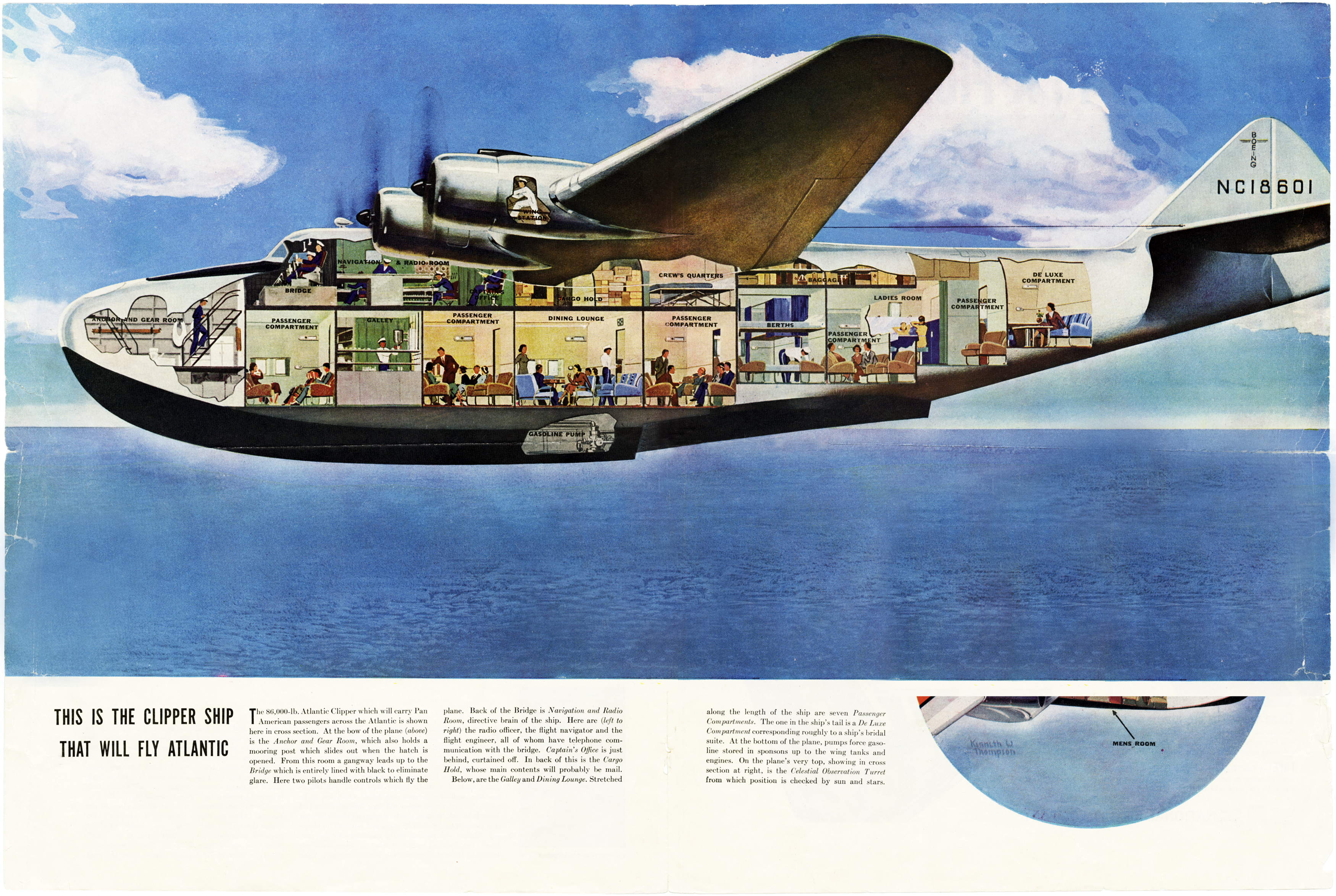
...or 24 hours on a slow blimp with a bed, the ability to walk around, and social areas. Kind of like a cruise ship in the sky.
So I compared to the Hindenburg. He can already get the "cruise ship in the sky" experience in an A380 in business class where he can find spacious seats that lay into a bed, private suites, a bar, showers, etc. But it's not cheap in an airplane, and won't be cheap in an airship.
The 350 and the 777x may rank alongside. The 787 is only good in superior classes.
The 380 is by far the smoothest, quietest experience in the air for >10h flights.
A380 -> A330/A340 (on account of the 2-4-2 arrangement) -> 767 -> 777 for me.
I've been on both the -900 and -1000 variants, and they are just amazingly quiet.
http://www.rodbearden.com/Av13/Speyer/Boeing%20747-200%20D-A...
I'm surprised that Lufthansa would just donate them such a complete looking aircraft though. Apparently the 747-200 was still in production until 1991, and Lufthansa donated it in early 2002. They were in regular passenger use until 2016 and there are still a handful being used as cargo jets - and Lufthansa had an air cargo subsidiary that used 747-200s at the time.
Well, now you've convinced me to go to the Technik Museum. The Henry Ford Museum was an institution of my childhood and one of the things everyone we knew enjoyed when they visited the area.
They have both the Concorde and the Concordski -- the Russian Tupolev 144.
In between those two is the Hockenheimring, with F1 will be in July this year, and the very pretty university town of Heidelberg.
Also, most airlines are now buying 787s and A350s instead of 777s.
IMO even on the lower deck the A380 is the quietest jetliner I've been on. The last 747 I was on (United) still had the old, comfy, interior. The 787 may have the benefits of a quieter, more humid cabin but the slimline seats and tighter seat pitch made it a much less pleasant experience for me (United was among the worst of the bunch).
~14 long haul flights (13+ hours) per year I used to buy from them, gone - because they screwed up the seats.
Idiots.
How does increased cabin pressure make for increased comfort? Once your ears equalize, the only difference should be less oxygen available, which I’d think would make you feel better (albeit stupider).
I cherish those hours very much, and often look forward to them.
What about air travel prevents you from entertaining yourself?
Discomfort and being surrounded by total strangers.
So that leaves me with phone on which I want to preserve battery because adventures don't usually happen in concrete jungles of the cities, quite in contrary in fact. And usually crappy entertainment system, with really bad provided headphones (they don't block the engine noise very well so movies are sometimes hard to follow... I wish optional EN subtitles would be standard everywhere). I can handle it, I don't get bored with myself easily and usually carry a book on travels (migrating to kindle soon). But fun? Nah, that really ain't the word I would use.
It seems there are quite a few uber-rich people here that don't mind shelling out 500-2000$ on top of basic ticket for some additional comfort for 10-15 hours. I am not one of those, and neither is most of the population. I mean, I traveled in India for months, in buses where seat spacing caused me to be in embryonal position for 12+ hours, without possibility to stand up or stretch. So I can very easily handle one trip in plane. Unless it would be my minute income or less, I would rather put those money into improving the life of somebody poor but smart & hard working (plenty of those folks out there). You just need to find them and give it to them directly, no greedy middle-men.
I totally get what you’re saying, but unfortunately it just doesn’t work so well for me. I don’t have enough room to comfortably use a laptop. I have to play T-Rex to use the keyboard.
Movies and TV shows can be good for a while. I usually watch a few hours on a flight, but that only works for so long. Imagine spending an entire day in a movie theater, except the chair is sized for kids and the screen is tiny and you have to hold it up.
Reading is similar. It would be great, but the general discomfort makes it hard to focus long enough.
Were I flying in business or first class, I imagine it would be totally different.
Note that my experience in comparing the A380 to the 787 is on USA - AUS flights, so your mileage may vary on shorter flights, but on longer flights it's a godsend.
E: I also have way fewer issues with my stomach/gut on the 787.
https://www.telegraph.co.uk/travel/travel-truths/which-passe...
The big differentiator is what you want to pay for. Even on a 787, 777, A350 if you choose first or business class, you can really be comfortable. On the other hand, I would bet that even with large blimps, the blimp companies would try to cram as many people as possible into it and would quickly approach the cramped experience you currently have in airplanes.
Obviously you’re still in a somewhat space constrained metal tube up in the air but air travel can be made pretty comfortable if money isn’t a big deal.
Just curious, why do you think they are disappearing? I thought they still have lower cost/passenger, especially for long haul?
Up to very recently the economics of air-travel dictated that long flights (e.g. USA to Europe)be on planes as big as possible and this plus other reasons meant flights to Paris are available from big cities like New York but not small to moderate metro areas like Raleigh, NC.
With new high efficiency jets, you can have 100ish person long flight service to a large city from a region like Raleigh that could never support the economics of a massive 300-400 person A380.
0. https://www.britishairways.com/en-gb/information/about-ba/fl...
This is pretty noticeable on Airbus side for single aisles: the A321 used to be little more than an anecdote, now Airbus is ramping up the A321NEO to be about a third of its entire A320NEO family production (anticipating upsizing in the order book).
On the wide-body side many 747 have been replaced by 777-300ER, A350-900 and 787-9. Quite the downsizing. 787-9, A350-900 and 787-10 are raking in orders. Meanwhile the A380 is dying, the 747-8 is all but dead (though the 747-8F is still there). The 777-9 order book is a caricature of that of the A380 (Emirates + some anecdotes, even more so with Etihad likely to cancel). A350-1000 and 777-8 sales are underwhelming to say the least (although the latter will become a tremendous freighter).
That is the hub and spoke model requires the airport to have bursts of busy times as everyone tries to reach their plane at once. With smaller planes you can spread thing out more.
But one of the reasons BA run so many flights (10?) a day is so that customers have choice and flexibility - it's not unknown for people to book business or first class seats on multiple flights in the same day so they can fly earlier if their schedule allows
They're catering to the people traveling business class who want flexibility and it seems to work for them - they run something like 86 biz class seats and only 140ish economy on some flights
Here on the west coast there is a packed to the gills flight almost every hour from LA to Houston, and more than one airline servicing the route as well.
To quote Boeing president of marketing Randy Tinseth:
> We don’t see significant demand for passenger 747-8s or A380s
The last major order for the 747-8 (28 aircraft) was in 2016 and 2014 for the A380 (13 aircraft). Enough to keep production alive for another few years, but after that it is unclear. And even then many of those are for cargo/freight, not people.
[1] https://web.archive.org/web/20121011082258/http://www.boeing...
But it seems likely they will be the end of the line.
Double deckers are very efficient by design, but the newest airliners are nearly as efficient as (or even more efficient than) an A380.
1. It takes a long time to load that many people, so it only makes sense on long routes.
2. You need special facilities at the airport: bigger taxiways, special gates, large waiting areas, extra customs officials. This cuts into the profits.
3. Since there are so few routes, you won't have many 380s, but you still need a set of pilots trained on them, plus a reserve in case people get sick, can't make it to the airport, etc. That reserve crew isn't shared with your other smaller aircraft, so it's an additional expense. The same thing goes for maintenance.
4. Much of the theoretical fuel and maintenance economies of scale you get from flying a larger aircraft are lost with four engines instead of two.
EDIT: interesting link, that contradicts some of what I say above: https://leehamnews.com/2015/12/11/bjorns-corner-twins-or-qua...
Thus, twin engines have to have basically 100% reserve, while the 4 engines only need to have 33% reserve (to make up for one engine failing).
I believe that the ratio of hub and spoke routes vs point to point routes will dynamically shift in response to demand and to external factors like laws, fuel prices, aircraft efficiency, etc.
The hub and spoke model is usually the more compelling economic model to serve many low demand cities by pooling passengers as well as for routing flexibility. Hub and spoke will never truly be replaced.
Whereas point to point is more efficient for high demand city pairs. Modern composite material ( fuel efficient ) aircraft also make it feasible to fly segments with lower load factors, up to a point, so you don’t need to fill up a plane to make a route viable, making it possible to bypass hubs. Even then you would never fly point to point from say Des Moines to Asheville NC. You might fly to a non hub airport like RDU, but if enough flights end up at RDU it becomes a de facto regional hub like CLT.
Depending on the demand patterns of flight routes, airlines can reconfigure routes to fly to hubs or point to point or a mix of both, whichever maximizes profit, so it’s not an either-or.
Of course this depends on the destination. Even tiny airports often have point to point trips to Las Vegas on dirt cheap airlines because that is a popular destination.
Used to be you needed the redundancy of four power plants to provide the needed nines to cross the ocean and still ensure (well, meet the statistic standard) that you could make land with one engine out.
The reliability of the modern turbofans allow the big twins to take almost the same transoceanic flight path as the 4-engine planes. Considering the complexity and cost of running 4 engines vs 2, it's a no-brainer to give up a few percentage points on ETE for a massive cost savings.
(me: licensed aircraft dispatcher)
TLDR: There's a ~20 year lead time on a radical new plane design. The A380 is designed for an airline industry dominated by 'hub-and-spoke' airlines (where a large plane can make efficient use of expensive landing slots at busy airports), while the 787 Dreamliner is designed for an airline industry dominated by 'point-to-point' airlines (where a small plane can avoid the busy airport and expensive landing slot by serving smaller airports).
20 years after they were both conceived of, it's looking like the hub-and-spoke model is the future.
Oh, there's still some demand for such a plane, and some routes are busy enough to benefit from it. But if there isn't enough demand to keep the production lines open, the production lines get closed, leaving existing operators high and dry. That fact makes operators nervous to place orders, which is of course a vicious cycle.
That seems like a typo. Did you mean the point-to-point is the future?
Bear in mind also that the author of that video is a 21-year-old college student who is an enthusiast -- not that that should lessen the weight of the facts presented, but merely that its conclusion may not be the authoritative airline industry view from a grizzled veteran that some might perceive it to be. There's plenty of room for debate there.
Point-to-point was actually the past, and hub-and-spoke became dominant for many reasons, and now fuel-efficient long-range aircraft makes it possible to shift some routes back to point-to-point, so it does appear to be on an uptrend. What's old is new again.
Any categorical claim that point-to-point is the future has to be examined critically. My belief is that neither will be the exclusive routing model -- it will all be determined by the economics and constraints of flying in the future, and no one can predict that. There are operations research people at airlines that tune models for optimal routing based on various conditions, and when the environment changes, the optimum shifts as well and the airline will have to shift with it.
The only true double-deckers are the 747 and the A380. Some other wide-bodies have been configured with a galley below the passenger deck, so flight crew have stairs but not passengers.
Maybe there's a variant with lavatories below deck? If so, it's not common.
The A350-900ULR is used by Singapore Airlines on the Singapore - New York flight that clocks 18 hours and a half. To be able to fly that far it needs to be light on payload: few passengers, no cargo. So there's some empty space in there...
I was always kind of secretly hoping large blimps would return. And we'd get to choose between 7 hours in a tiny metal tube with the seat-back of the person in front resting on your knees, or 24 hours on a slow blimp with a bed, the ability to walk around, and social areas. Kind of like a cruise ship in the sky.
An A380 feels kind of like Concord in that it really touched the imagination. I still hope to have a shower at 40,000 feet before they're retired completely.