For instance, only 4% of global oil output is used in plastics. The vast majority is used in transportation and heating. Plastics, unlike transportation fuels, can also be recycled.
It's not oil or no oil. It's putting in place the systems and policies to responsibly end our reliance on oil and coal before we cause even more damage to our climate.
IPCC made a report on what that would entail stating basically that even with an overnight abolishment it cannot be reached. But that if we assume it feasible to use afforestation and other techniques to extract CO2 from the atmosphere in the future we might have chance to reach that target for 2100 given we stop using fossil fuels by 2030.
Given the scale of the transition necessary, overnight or 11-years is more or less the same time frame
Edit: Great TED-talk on the scale of what’s needed https://youtu.be/E0W1ZZYIV8o
First, that attitude makes you, your family, and your friends more susceptible to propaganda from pro-fossil fuel interests. You're more apt to believe crazy stuff like we'd have to stop using plastic or that nuclear would have to also go away. You're more apt to doubt the science behind climate change. You're more apt to be mislead on the economics or feasibility of renewables.
Second, that attitude makes you think we're not in a rush, so we can afford to wait until things are figured out more. It makes you think that we have to figure out storage for wind and solar and airplanes, even though we don't have to worry about that until we reach much higher levels of penetration than we currently have (and we're already making good progress nonetheless). It makes you think that we'd fall into chaos if we use less natural gas and oil, even though it's going to be a gradual transition and will be replaced with equal or better alternatives.
Unfortunately, because of previous neutral attitudes like yours, we're now in a goddamn race for our lives as the nightmares of climate change are starting to happen (how many Americans died in Puerto Rico? California's wildfires? etc.). Nature doesn't give a fuck. It's too late to be neutral anymore.
So from one Texas energy worker to another, I beg you to stop being neutral. Unlike most other people, you actually have domain expertise to have a substantial impact fighting climate change. Remaining neutral when you work in energy is just making everyone else's lives worse.
Graph: https://www.ipcc.ch/site/assets/uploads/sites/2/2018/10/SPM3...
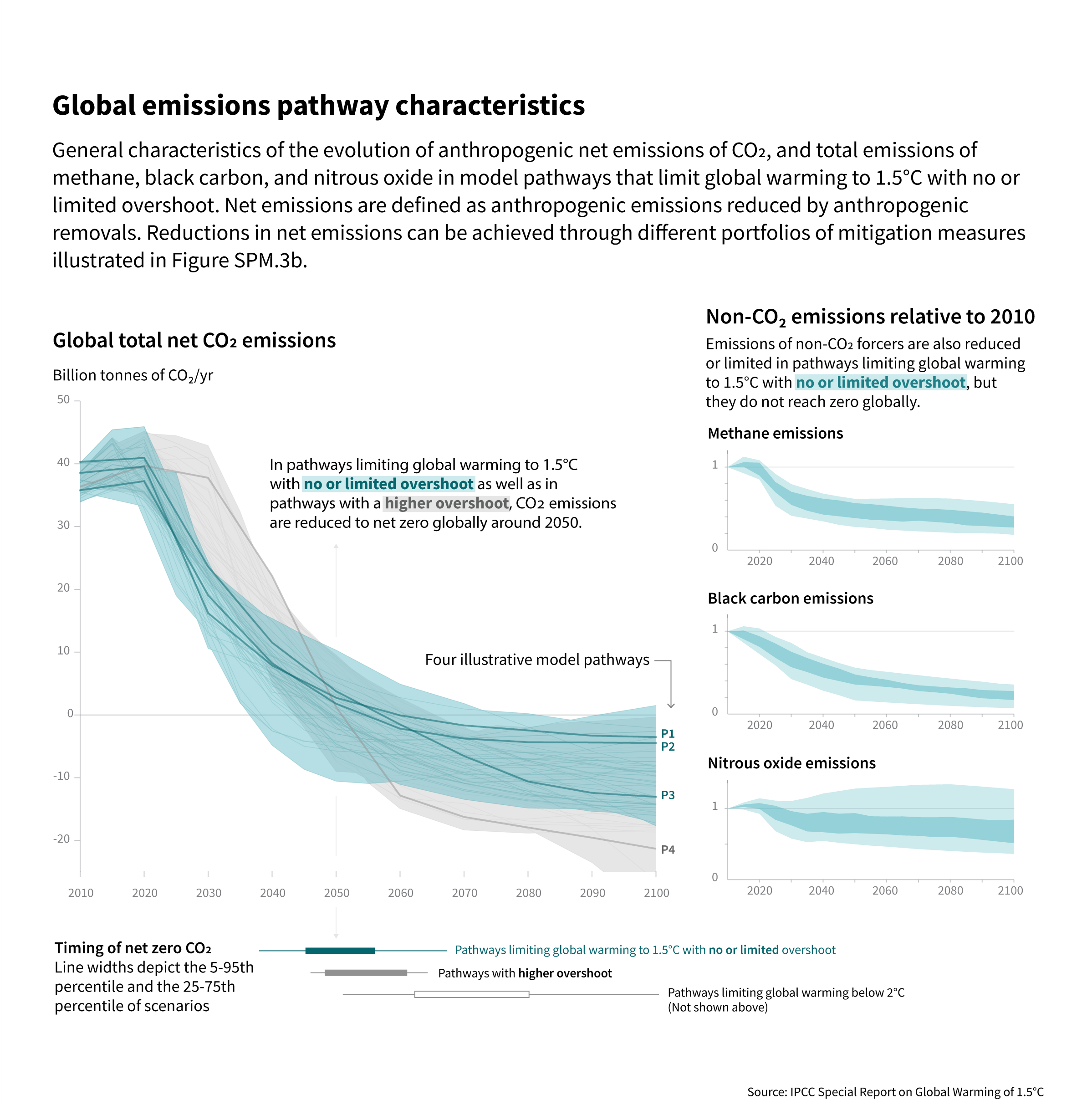
Report: https://www.ipcc.ch/sr15/
News: https://www.nytimes.com/2018/10/07/climate/ipcc-climate-repo...
This is the carbon emission reduction curve we have to hit if we want to hit our Paris Agreement targets. That's a pretty steep drop off if you ask me, and certainly falls into the category of a "race for your lives".
Do you disagree? Please provide sources that we aren't in such a rush to curtail fossil emissions (because there's mountains of science saying we are).
> It gives you the appearance of a paranoid alarmist.
How can I be paranoid if the science backs me up? However, I do think being an alarmist is appropriate for the situation. If that graph isn't a mash-the-big-red-button moment, I don't know what would be.
But, you may say, a lot of people will die from climate change. (And a lot definitely die from pollution.) A lot die from malaria, too, but we don't have a "race for our lives" on that one. Cynically, most people don't consider a bunch of other people dying as a "race for our lives".
(We did more or less have a "race for our lives" on AIDS, though. It seems that we start to care when it's hitting closer to home, and we think that it could be us. That's the problem with your argument. You haven't shown people enough evidence that they think it will be them dying, so they don't think it's "a race for our lives".)
Going above Paris gets into the "there be dragons" realm of human survival. The Pentagon is predicting mass migrations, wars, famine, and economic implosion[1]. I feel like that certainly constitutes "race for our lives" level of rhetoric.
Usually, when someone balks at strong rhetoric on climate change they are (1) unaware of the scale and severity of the problem or (2) don't see those affected as within their "our" definition (e.g. it will happen to other people, not my people). The former is slowly being solved through increased education and awareness, the later will likely always be present due to human tribalism and racism.
As far as the malaria theory, it's a very different strategy when you are actively causing the problem you are trying to solve. It's as if we are repeatedly shooting ourselves in the foot, then some of us say we should stop, then you say why are you so focused on the foot-shooting vs cancer killing us. One is an immediately addressable problem caused by ourselves, one is a natural threat that is not under our direct and immediate control (thus takes much longer to understand and solve).
[1]: https://www.nytimes.com/2014/10/14/us/pentagon-says-global-w...
If it's a thousand (or maybe even a million), we're already there just with air pollution. Forget CO2, particulates are already that level of catastrophe.
For just CO2 or global warming, there are projections (or, less charitably, guesses) about how much CO2 will lead to how much warming, which will lead to how many deaths. Pick your level of what constitutes a catastrophe to you, and then pick which projections you find most believable. For actual answers rather than projections, we'll have to wait until after it happens (at which point it's a bit late to try to do anything about it).
But my point was, there's different levels that are "catastrophic", depending on your definition of catastrophe. There is no one answer to the question.
Knufen minimized diafygi's position (acting extreme, paranoid alarmist). So now I want to know what Knufen considers worth his/her concern.
But if you insist on getting Knufen's definition of catastrophe, you should also get diafygi's, since diafygi posted the claim that we're arguing about in this sub-thread.
diafygi wrote:
"we're now in a goddamn race for our lives as the nightmares of climate change are starting to happen"
"Catastrophe" is a suboptimal word choice.
What would you suggest?
Minor inconvenience, regrettable circumstances, potential nuisance, that gosh darn weather? Other?
--
SME diafygi, who has skin in the game, who completely rearranged his life to match his beliefs, posted very personal views. For his troubles, Knufen mocked him, thereby minimizing the circumstances, thereby proving diafygi's larger point.
The world's burning. And you're fussing over adjectives. More distraction. Again, proving diafygi's larger point.
Please. Continue.
Do you refuse to fly if you are "against fossil fuels"? What makes you against fossil fuels vs being neutral if you have a stance where you believe externalities should be taxed but that outright bans are too destructive?
I consider pro carbon-tax to be a neutral position. I consider "anti fossil fuels" a position of wanting to ban it regardless of externalities being priced in.
>First, that attitude makes you, your family, and your friends more susceptible to propaganda from pro-fossil fuel interests.
No, being incapable of critical thought makes you susceptible to propaganda.
> Do you refuse to fly if you are "against fossil fuels"?
This is a false equivalence. Being an fossil consumer is very very different from directly working in the fossil industry. Consumers will use whatever is most convenient or available. It's up to the industry to come up with feasible alternatives, and air travel will be some of the last fossil usage to transition. You picked the hardest end of the scale to setup a straw man. Why not ask "Do you ask your utility if there's a 100% clean energy option?" That's on the lower end of the energy transition difficulty curve for consumers, but it's still not relevant to the argument I was making (working in the old energy industry).
> What makes you against fossil fuels vs being neutral if you have a stance where you believe externalities should be taxed but that outright bans are too destructive? I consider pro carbon-tax to be a neutral position. I consider "anti fossil fuels" a position of wanting to ban it regardless of externalities being priced in.
It seems you and I have wildly different opinions about what constitutes neutral vs anti, and I worry that your definition is mostly informed by pro-fossil interests. Anti-fossil people aren't zealots or a cult. I'm only anti-fossil because of the reason you stated for being neutral: externalities are not being priced in. If they were, I wouldn't be anti-fossil.
Millions of other workers in clean energy and climate science have the same attitude as me. We're only in this fight because fossil fuels are killing people, so we're stepping up to help stop that. If fossil fuels weren't so destructive (e.g. carbon taxes offset the damages), we could all go do something else.
> No, being incapable of critical thought makes you susceptible to propaganda.
I seems like this is another argument assuming anti-fossil people are zealots incapable of critical thought. Having a position on a topic does not mean you have stopped thinking critically. Often, it means you have already thought critically and have decided on your opinion, and that you simply haven't come across a convincing enough argument to move you away from your current position.
I'm anti-fossil because I've reached the conclusion that fossil fuels are becoming more and more destructive for society, so we should make strides to curtail their usage. There's totally a chance that something could come along to alter my conclusion, but it hasn't happened yet.
This resonates with me. I was an activist for ~10 years (for a different issue). Me and every activist I met stepped up because of the need (vs innate interest). Personally, I would have rather been doing pretty much anything else.
Thank you for stepping up.
Because the status quo is that fossil fuels are allowed without the externalities being taxed. A position that moves towards less fossil fuel use is anti-fossil fuel, although less so than one that desires an outright ban.
how many Americans died in Puerto Rico?
The existence of category 4/5 hurricanes in 1900 can't really be used to deny global warming if that's what you're after.
Anecdotal weather-related disasters aren't an argument for climate change, let alone hydrocarbon-based energy generation having a negative net effect on humanity.
can pretty much expect something completely biased coming, but will wait and see.
> "being neutral about fossil fuels is just as bad as being pro fossil fuels"
Yup, here is you sure are about to spout off nothing but propaganda now.
> "nuclear would have to also go away"
liberals hate nuclear. In fact one of the primary purposes of the Simpsons was to raise awareness (propaganda) about how bad nuclear is.
> "we're now in a goddamn race for our lives as the nightmares of climate "
no we are not. 8.2 feet by the end of 2100 is it? the end of the ice age saw sea levels rise almost a thousand feet. Australia use to be connected to Papua New Guinea. its not ideal, but its not a race for our lives nightmare. I have pretty bad nightmares. The vast majority of all human beings will have died of old age by then. Open google maps, look outside your city limits. Earth is alive. This is not ideal, but saying things like race for our lives nightmare only makes it hard to take you seriously.
> "how many Americans died in Puerto Rico? California's wildfires?"
California has ALWAYS HAD WILDFIRES. Red Wood trees have EVOLVED to only be able to reproduce with them - so they kinda probably happened. a lot. In fact, the west is so dry, its the only place on the planet cactus evolved. its that dry. it always has been that dry.
> "It's too late to be neutral anymore."
Again alarmest attitude. but not surprised coming from someone who's job depends upon it.
> "Unlike most other people, you actually have domain expertise"
Then maybe you should respect that they have opinions founded in fact, instead of assuming they must be crazy-brainwashed for not believing what you believe.
Beauty is in the eye of the beholder though. I remember people complaining about 2 massive cooling towers in the centre of Sheffield being torn down.
I'd be interested in what wind turbines say to you that lead you to call them ugly.
It depends on the density. Once they clutter everything visible below 100 ft, it's pretty hard to see beauty: https://www.pentaxforums.com/forums/12-post-your-photos/2128...
I did a google image search for that location and the other images didn't seem so bad (to me).
Is the uglyness an inherent feature of the scale. Or a feature of poor design?
Some appear to have white nacelles and black towers.
I volunteered at Audubon for years. Love both birds and windmills.
Watching humans take an entire mountain down rock-by-rock is a humbling experience.
Not permanent. They can be reclaimed, but that usually doesn't happen for many years until after the end of life for the mine.
The tar sands come to mind. The entire forest above the sands is literally scraped off the face of the earth, the sands removed, the oil removed from the sands, and then everything aside from the oil is left behind in huge swaths of desolate waste.
Lee Foote, a University of Alberta wetlands ecologist who has worked with the tar sands industry and advised the Alberta government on wetland reclamation policies, agrees that reclamation has so far been done more for public show than to create viable ecosystems.
“The mindset is to throw big dollars at engineering designer wetlands that are green but not nearly as functional as what was there in the past,” says Foote. “The main aim is to get the social license that is needed for these companies to continue operating.”
-- https://e360.yale.edu/features/on_ravaged_tar_sands_lands_bi...
One county in my state even bothers with monitoring, enforcement. Not a single issued citation (fine) was ever collected (during the study period).
Maddening.
Now back to your statement. Do you retract your claim of desolation? Or can you provide any evidence to support your position. Please do not reference palm oil in relation to the tar sands. No palm trees grow in Fort Mac.
Second, HN guidelines say that one should not accuse someone else of trolling. It almost never leads to a decent discussion.
I think mining is a necessity to exploit all natural resource opportunities, very similar to how I would view solar and wind installations being built in "nice" areas like off the coast of Massachusetts.
https://www.bloomberg.com/news/articles/2018-11-30/germany-c...
I'm not looking for an answer to this question, as I don't own any coal mines or coal power plants. Just expressing general dissatisfaction with humanity's destructive-but-convenient habits.
Yes, but not for electricity. There isn't a way to make steel at any scale without using coking coal in the furnaces.
Here's a 2013 article about making steel without coal: https://www.scientificamerican.com/article/cleaner-cheaper-w...
And something from 2018: https://www.technologyreview.com/s/611961/this-mit-spinout-c...
Not proven at scale yet, but it appears to be more promising than many other unsolved climate problems.
Also, natural gas is already being used at scale to make steel, not a complete replacement of coal, but a big reduction.
At least for Germany (as mentioned by GP), that business will not be around for much longer. Steel from China and India simply is too cheap compared with domestic production. Probably once these two countries get too expensive production will shift over to Africa...
I've never understood the argument that since [bad thing] happens, [more bad things] are justified. But judge, since nature kills humans all the time you can't possibly charge me with murder...
Aren’t humans a part of that nature? Isn’t that what makes us destructive?
Maybe my point is not clear. I’m trying to say that even if we have a choice (or an illusion of it), our nature (and nature itself) has and will drive us to do destructive things.
I’m not suggesting we give up all hope, but it is important to recognize that the beauty of an everlasting mountain is definitely a concept invented by man.
Also, I'm sure you can make find some negatives in the lithium / PV / wind industries which are so vehemently pushed forward around here.
Changing the argument to the damage caused by lithium mines is just a distraction. My argument isn't against coal, it's against unnecessary evils. It would take a mighty strong mind to honestly argue that solar and wind power is more evil than coal.
I'm going to bow out of this argument now as I'm not actually looking to have my opinion changed to a more pro-coal stance in 2018.
this is the hypocrisy that gets me. christian stewardship should be at the forefront of environmentalism, culture wars be damned, not being dragged along gnawing and gnashing.
edit: hypocisy infects all of us, but christian hypocrisy really burns. rather than stiving for betterment while tolerating imperfection, as jesus taught, the general pretense is to cast a blind eye to all kinds of moral failings while acting as if everything is rosy. it's like sitting on a high horse covered in poop.
There’s no room for stewardship in any real sense. It’s cash in before it gets shut down.
> ...stiving for betterment while tolerating imperfection, as jesus taught...
And on a particular point, Jesus never taught that in those words. It might be a fair inference and application, but "how would Jesus vote" is a tricky argument to make. Especially considering that the U.S. has a representative democracy and not a direct democracy. Would Jesus vote for candidate A who favors a carbon tax and opposes ICE? Or candidate B who opposes late term abortion and wants better support for adoptive parents?
Well, that might be the options in the Democrat primary, but what about the Republican positions?
i grew up in both the evangelical and catholic traditions. there were some great people, but the hypocrisy of the many was unbearable.
I'm ok with American extraction because I think it's preferable to the two other options I see: 1. keep giving mountains of money to horrific regimes like Saudi Arabia and Russia or 2. halt the global economy until renewables are to scale.
Here’s some background: https://www.houstonchronicle.com/business/energy/article/Ref...
Ubtil 2016, it was illegal to export American crude. So the idea that West Texas Intermediate Crude is being exported because refineries can’t handle it is false, unless we are talking about the past two years: in 2014, where did all of that crude go? It was being refined.
As the US is a net petroleum exporter, the idea that “blood oil” is a significant part of the American fuel supply is false. Canada exports dramatically more oil to the US than Saudi Arabia. The main reason that West Texas Intermediate trades at a discount wasn’t because of refining capacity, but because of the lack of pipelines to move the stuff.
https://en.m.wikipedia.org/wiki/Petroleum_refining_in_the_Un...
I am not pro or anti gas, oil, or wind. The primary difference is that wind is linked to the grid. Its not a package available for export. Oil and gas are chemically stable (roughly speaking, non-degrading) liquids that can be transferred anywhere. This makes fossil fuels ideal for export where wind is not, but damn there is a lot of investment in wind energy generation.
As an additional matter of perspective I live very close to one of the largest oil refineries in the world, which is really close to one of the largest petroleum export harbors in the world. I am currently living in Kuwait. I really don't see anything here that would classify as a petroleum culture.
Of course we won't.
We will run out of oil that is worth extracting, because the cost to extract the next unit will exceed the value provided.
> people are only able to consume it at a measurable declining pace
The pace of global oil consumption has been increasing for a long time, other than a brief period of decline in the late 1970s to early 1980s.
> I bet demand will almost completely fall off long before we get anywhere close to running out.
Over the long term, consumption is going up as are real prices (though the price trend is noisier than consumption.) There's not really consistent with demand declining at all, much ledd heading to the point of completely falling off.
Instead, it shows demand increasing faster than supply.
* https://www.weforum.org/agenda/2015/07/the-surprising-declin...
* http://www.energytrendsinsider.com/2014/07/10/world-sets-new...
https://www.nbcnews.com/business/energy/fracking-boom-waste-...
The entire area smells like a diesel truck stop.
Natural gas is so plentiful that spot prices at the West Texas hub turned negative last month. In general they're trading at about half the Louisiana hub.
>One option for Permian operators with too much gas is to light it on fire, a practice known as flaring. Flaring levels reached record highs in the Permian last quarter, when companies burned an average of 407 million cubic feet a day, according to analysis of public data compiled by Rystad Energy, an energy consulting firm.
>The resulting greenhouse-gas emissions are equivalent to the daily exhaust emitted by about 2.7 million cars, according to estimates from the World Bank and Environmental Protection Agency.
>Texas has thus far allowed companies to flare freely. As of the end of November, state regulators hadn't denied a single permit request in more than five years, records show. But flaring isn’t always an option. Companies might not have the needed equipment set up in areas affected by pipeline outages. They also might have to pay landowners royalty payments for the gas they burn. And flaring gas on the spot means drillers miss out on more valuable products that come out of the ground with it, such as ethane, propane and butane, which are often processed out later.
What is worse than burning off fuel / wasting the energy and releasing the carbon? Releasing the methane directly which has a GHG effect 15-35 times worse than C02.
Oh, so you are going to legislate that all of the gas is captured, transported and moved to market and then used in all instances? Now your legislation just got SUPER expensive and SUPER complicated. And/or a bunch of rigs would just not be built, given that in so many instances gases are co-existing with the liquid which is the target resource.
Realistically, legislating a carbon tax and a removal of direct and indirect subsidies would not just be significantly cheaper, but also much more simple and way more politically palatable. (but as we can see, still very difficult and non-trivial).
Yeah, that's a feature not a bug. Carbon-taxing the methane flaring would be a decent compromise to start with though, but I'm not sure whether it would be pricey enough to make a difference and (as you point out) it's quite easy to evade when flaring gas at the point of production.
It's also a strangely non-joined-up market when one set of people are performing fracking specifically to get at the gas and another set of people are flaring it as a worthless byproduct. Perhaps there should be a moratorium on gas exploration until it's not worthless?
(A key point to remember in exploration: just because it's there doesn't mean it has to be extracted now. Obviously the individual firm is going to want to do it immediately, but for the planet as a whole or even the individual extracting country the priority is not the same)
You know, it sounds scary, but there are more than 1 billion cars in the world[1], so it's a bit of a drop in the bucket. Still a shame to be so wasteful though.
1. https://www.wardsauto.com/news-analysis/world-vehicle-popula...
I'm guessing you added this to avoid inevitable flames.
I don't think its hypocritical though. We all live in a world where fossil fuels are dominant. Its reasonable to fight to lower emissions while still emitting yourself (within reason).
If you make it so that only the whitest of the white says anything, no one will.
On TV here comes another car commercial. The disconnect is amazing. This shit needs to stop TODAY, if there's to be any hope of stopping or even slowing the catastrophe already in motion. But "good people" are not getting it. Certain other people work overtime to make sure they don't get it. And of course cutting them in on the spoils (a.k.a. "issuing them a paycheck") raises their mental barriers against getting it. Insert Upton Sinclair quote here.... "It is difficult to get a man to understand bla bla bla."
The minute good people realize they're screwing over other good people, they might actually find it unpalatable to do the work (or buy the product). Either that or they're not such good people. But they don't always have a choice, right? At least that's what good people say who want to absolve good people. Gotta pay the rent, right? Well that's what my landlord says anyway. Gotta keep driving to work to pay the rent, right? Well that's what 80% of Houstonians and 85% of Detroiters say... but 70% of Portlanders agree too. (Everybody's a liberal as long as it doesn't mean getting off your ass.) Maybe people just naturally exploit and screw each other to profit themselves, and all morality is just an idealistic and optimistic overlay. Maybe people in general just aren't that "good." Maybe it'll be better after a bunch of us die the hell off. I need a drink.
Most of my friends are in their late 20s/early 30s though, so maybe that makes a difference. I could see older folks who grew up when oil was king maybe being opposed to solar/wind. But even then, now that I think about it, one of my friend's grandparents (who are from West Texas) were very thankful for the wind industry and the money it brought to their town (it got brought up because we made a remark about how there seemed to be endless wind turbines in every direction on the drive through W Texas to visit them).
I just browsed through a few polls and based on them, it seems you must be really unlucky to encounter so many people unwilling to discuss renewables. According to these polls [1][2][3][4], 80%+ of Texans support renewable/clean energy.
I'd be interested to hear more about what types of conversations you try to have and who (age range, industry) you interact with when you find these people. It surprises me that this has been your experience, especially in Austin of all places.
1: https://www.citizen.org/may-11-texas-poll-shows-citizens-wan...
2: https://www.wsj.com/articles/which-state-is-a-big-renewable-...
3: https://www.texastribune.org/2016/05/04/survey-texans-suppor...
4: https://www.nytimes.com/2017/06/06/climate/renewable-energy-...
Not sure what point I’m trying to make here, just adding more context. Reality is that while many Texans may answer a survey asking if we should move away from fossil fuel dependence in a positive way, for most conservatives in the state I’d be surprised if it was anywhere near their chief concern when voting and would likely actively vote against it if the platform they are voting for meets their primary concerns. Thankfully, their chief concern is usually money/economy and Texas is a state that can be that can be very effective at migrating to energy alternatives in an economically beneficial way thanks to 300+ days of sunlight a year in most regions and large flat windy expanse from central Texas to Big Bend and up the padhandle.
Would just add that there is another level of complexity here. While fracking and the shale revolution do present a huge environmental problem, it’s advancement in the last 5-10 years does provide the US an extremely valuable foreign policy tool in removing the necessity of energy reliance on the Middle East whenever we want. I hope the state continues to move forward with renewables but fossil fuels, specifically in the Permian basin, is here to stay for a long time even if the state goes 100% renewable. It’s now a national security and economic priority in an age when American/Middle East relations are waning and American retrenchment from traditional allies is increasing.
It’s interesting to see this in the Texas Tribune.
From time to time I have reason to drive through or fly over (I know, hypocrite) West Texas, and passing through the oil fields one can literally watch the world burn. It’s unreal.
Edit: Just a note on the people in the energy industry. They’re good people on balance. I might have come across as incidentally disparaging people in the energy industry. I have many friends and family of friends that have spent their entire career in the industry. It’s like Silicon Valley and tech’s problems. NYC and the financial crisis. Economic and financial incentives supported by cultural norms. In Silicon Valley the confidence that technology will improve our future means sometimes it is developed without pause for impact. In Texas a strong Christian ethos encourages a certain view of “stewardship” of the earth that does not mesh well with the constantly evolving culture of environmentalism. But as people they’re good people.