Graph: https://www.ipcc.ch/site/assets/uploads/sites/2/2018/10/SPM3...
Report: https://www.ipcc.ch/sr15/
News: https://www.nytimes.com/2018/10/07/climate/ipcc-climate-repo...
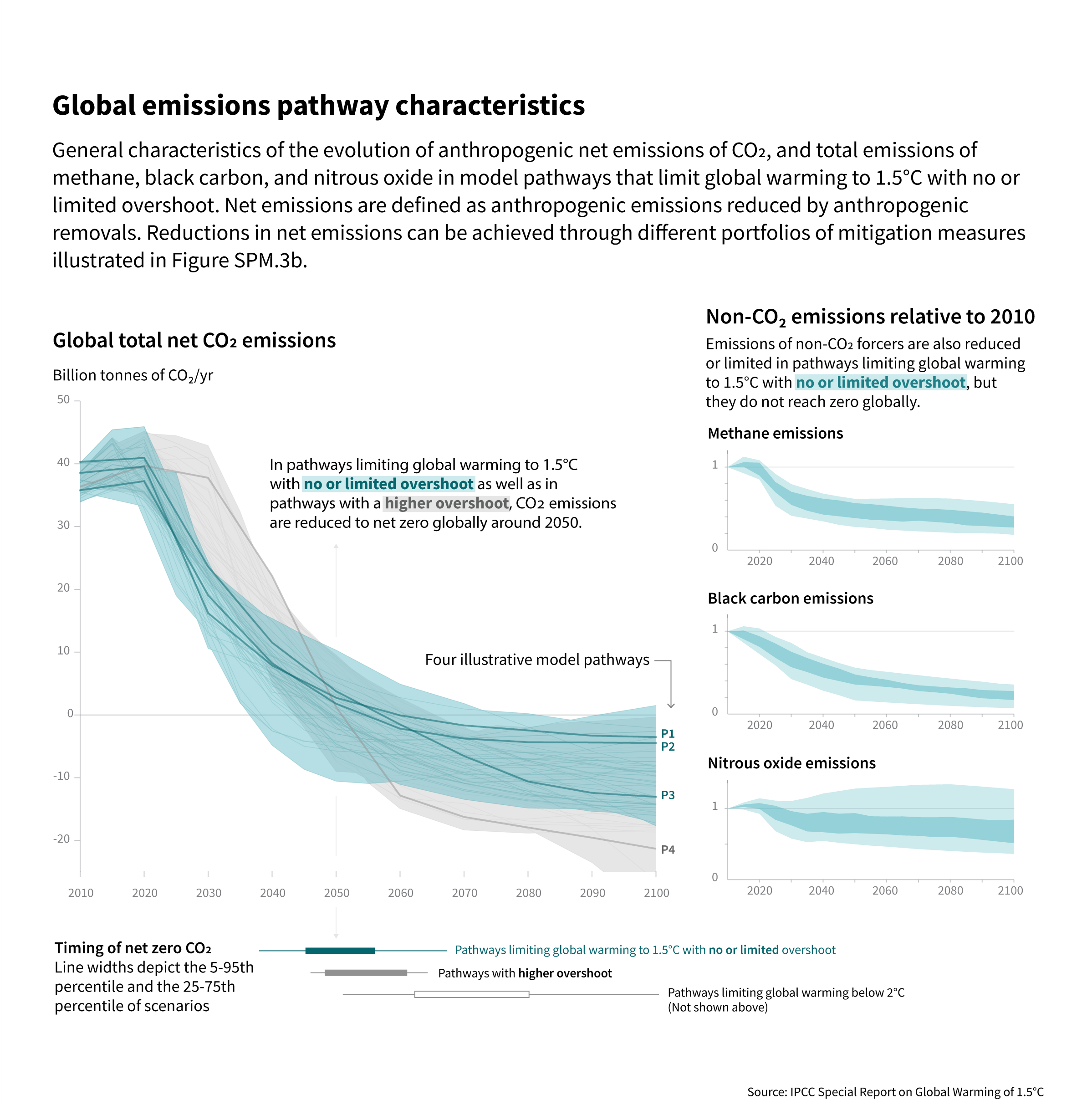
This is the carbon emission reduction curve we have to hit if we want to hit our Paris Agreement targets. That's a pretty steep drop off if you ask me, and certainly falls into the category of a "race for your lives".
Do you disagree? Please provide sources that we aren't in such a rush to curtail fossil emissions (because there's mountains of science saying we are).
> It gives you the appearance of a paranoid alarmist.
How can I be paranoid if the science backs me up? However, I do think being an alarmist is appropriate for the situation. If that graph isn't a mash-the-big-red-button moment, I don't know what would be.
But, you may say, a lot of people will die from climate change. (And a lot definitely die from pollution.) A lot die from malaria, too, but we don't have a "race for our lives" on that one. Cynically, most people don't consider a bunch of other people dying as a "race for our lives".
(We did more or less have a "race for our lives" on AIDS, though. It seems that we start to care when it's hitting closer to home, and we think that it could be us. That's the problem with your argument. You haven't shown people enough evidence that they think it will be them dying, so they don't think it's "a race for our lives".)
Going above Paris gets into the "there be dragons" realm of human survival. The Pentagon is predicting mass migrations, wars, famine, and economic implosion[1]. I feel like that certainly constitutes "race for our lives" level of rhetoric.
Usually, when someone balks at strong rhetoric on climate change they are (1) unaware of the scale and severity of the problem or (2) don't see those affected as within their "our" definition (e.g. it will happen to other people, not my people). The former is slowly being solved through increased education and awareness, the later will likely always be present due to human tribalism and racism.
As far as the malaria theory, it's a very different strategy when you are actively causing the problem you are trying to solve. It's as if we are repeatedly shooting ourselves in the foot, then some of us say we should stop, then you say why are you so focused on the foot-shooting vs cancer killing us. One is an immediately addressable problem caused by ourselves, one is a natural threat that is not under our direct and immediate control (thus takes much longer to understand and solve).
[1]: https://www.nytimes.com/2014/10/14/us/pentagon-says-global-w...
If it's a thousand (or maybe even a million), we're already there just with air pollution. Forget CO2, particulates are already that level of catastrophe.
For just CO2 or global warming, there are projections (or, less charitably, guesses) about how much CO2 will lead to how much warming, which will lead to how many deaths. Pick your level of what constitutes a catastrophe to you, and then pick which projections you find most believable. For actual answers rather than projections, we'll have to wait until after it happens (at which point it's a bit late to try to do anything about it).
But my point was, there's different levels that are "catastrophic", depending on your definition of catastrophe. There is no one answer to the question.
Knufen minimized diafygi's position (acting extreme, paranoid alarmist). So now I want to know what Knufen considers worth his/her concern.
But if you insist on getting Knufen's definition of catastrophe, you should also get diafygi's, since diafygi posted the claim that we're arguing about in this sub-thread.
diafygi wrote:
"we're now in a goddamn race for our lives as the nightmares of climate change are starting to happen"
"Catastrophe" is a suboptimal word choice.
What would you suggest?
Minor inconvenience, regrettable circumstances, potential nuisance, that gosh darn weather? Other?
--
SME diafygi, who has skin in the game, who completely rearranged his life to match his beliefs, posted very personal views. For his troubles, Knufen mocked him, thereby minimizing the circumstances, thereby proving diafygi's larger point.
The world's burning. And you're fussing over adjectives. More distraction. Again, proving diafygi's larger point.
Please. Continue.