The problem is that almost everything Space Shuttle could do, could have been done more effectively by a classic modular spacecraft and a large rocket. Even more, Space Shuttle was fairly limited and inflexible in its capabilities due to its complex in-orbit thermodynamics, monolithic design and available delta-v. Jack of all trades, master of none.
Don't get me wrong, the Shuttle was a great engineering achievement and a great pride point for any American. But it's also a huge waste of resources, which resulted from enormously inflated requirements, particularly military ones. Buran was the same. It's better not to repeat such mistakes.
> That kind of world leading, "best at any cost" mentality is what made the US so technologically dominant globally from the 1950s until recently.
And left it without modular space stations, in this particular case. (and many more)
It still managed to do some pretty spectacular things no one else had ever done. I think that's worth something. I think the people who gave their lives thought that was worth something. I think they would rather the program be remembered for its triumphs than its failures.
There were risk takers, now they are protecting their ability to pay for 2 kids to go to Ivy League. Who can blame them?
The shuttle was absolutely designed to "put basic stuff in space". By being partially reusable it was meant to be cheaper than all other "expendable" US rockets and replace them all even even for simple satellite launches.
The fact that the original goals couldn't be met was only made clear after the Challenger disaster.
Also context, consider cost complexity: manned space flight >> space flight >> aerospace >> automotive.
Each increase in risk implies considerably more expense, and the difference between space flight that includes humans, and flight that doesn't is quite massive. They are different programs entirely.
So if you're putting something in space with 'humans going along' - it will always be way more expensive, no matter what.
The shuttle was supposed to be cheaper than multiple manned rockets, but not cheaper than regular satellite launches.
So for putting out complex things like Hubble, or 'fixing it' 'retrofitting' etc. - the Shuttle might make sense.
But it was never going to be cheaper than regular rockets for putting relatively straightforward satellites in space.
Fixing Hubble was one of the most complex operations the Shuttle ever did. Although only the shuttle could do things like repair and retrieval, the large majority of the satellites that ever entered the Shuttle cargo bay were simply launched and released.
More specifically, of the 105 satellites the Shuttle interacted with, only 4 were repaired-and-redeployed (including Hubble) and only 5 were recovered back to Earth.
http://rammb.cira.colostate.edu/dev/hillger/Shuttle-related....
> The shuttle was supposed to be cheaper than multiple manned rockets, but not cheaper than regular satellite launches.
Do you have cites to support this? It's not consistent with my impression of the expectations for the Shuttle when it first started flying. Your other comments here give the strong impression that you are arguing based on your intuitive knowledge of spaceflight costs that no reasonable person could have thought launching dumb satellites on the Shuttle would have been cost effective. However, I think that's hindsight, and in fact many people at the time expected the Shuttle to cheaply deploy basic satellites, and that this was part of its official mandate. Indeed, Wikipedia says
> the plan was for all future U.S. space launches—space station, Air Force, commercial satellites, and scientific research—to use only the space shuttle. Most other expendable boosters would be phased out.
https://en.wikipedia.org/wiki/Space_Shuttle_design_process
EDIT: And from another link in this thread (written at the time):
> NASA plans to terminate all throw-away rocket launches as soon as the shuttle is working.
http://www.iasa-intl.com/folders/shuttle/GoodbyeColumbia.htm...
https://www.americaspace.com/2018/12/09/dying-all-tensed-up-...
Say what? I didn't know they had interns up there.
There's also "Space Shuttle Decision, 1965-1972 (History of the Space Shuttle, Volume 1", but I think Volume 2 is far more interesting from an engineering point of view.
This isn’t how it was sold to the public.
> I interned on the the space station
Thank you. Without the ISS, we wouldn’t have SpaceX.
Manned space flight is known to be way more expensive than cheap, rocket satellite launches. There never was a comparison.
The Shuttle was going to be cheaper than manned rockets, and frankly, probably was. I can't imagine who much it would cost to put up a manned rocket to do some of the retrofitting of Hubble, for example. I don't even think their is proper vehicles for that in existence! So it would be out of the question in terms of cost.
The shuttle did mostly what it was supposed to, it just got old. And there is the space station to do science.
Soyuz + any international heavy launch candidate duplicates the Shuttle’s capabilities at a fraction of the cost.
Thats how we ended up with thee uterly insane SLS, Orion, Gateway architecture.
1. https://en.wikipedia.org/wiki/Space_Shuttle#Re-entry_and_lan...
It only became official after the Challenger disaster, but it was quite clear to everyone who followed the project even before the first shuttle launched.
http://www.iasa-intl.com/folders/shuttle/GoodbyeColumbia.htm...
> And, according to The Washington Monthly's sources, flying the shuttle will cost more, not less, than flying those old disposable rockets.
It is explained in the sections titled "Economy at any Cost" and "Turn Down the Volume".
The main argument, which was shown to be correct, is that NASA inflated the launch volume in order to amortized their huge fixed costs on an unrealistic number of flights.
The recommendations and conclusions sections is a relatively short and easy read. I get the impression (though it could be my bias) that it is written skeptically.
It withstood the test of time.
* But they developed lots of cool tech is not a good defense. Failing to deliver did not bring the tech. It was inevitable.
* But there were missions that only Shuttle could do is not right either when you think it over.
I can think of two admittedly unlikely mission profiles that only STS or Buran could have pulled off:
* Recovering a satellite already in orbit safely back to Earth.
* Orbital bombing. While you could launch an orbital missile platform, it would have a predictable enough orbit to be vulnerable to ASAT. You would have to execute multiple burns for evasive maneuvers and that’s easier with a manned spacecraft. This, specifically, was the capability the Soviets feared enough to design Buran. This is also a violation of international law, not that such things matter in a scenario where you are dropping hydrogen bombs from orbit.
Shuttle was used for recovery only four times. It would have been cheaper to ditch all those satellites and build and send new ones compared to recovering them.
> Orbital bombing
ICBM's do it better.
I didn't say it was a valuable use case, nor did I say you were recovering your own satellites.
> ICBM's do it better.
ICBM's follow a predictable ballistic trajectory and are more vulnerable to countermeasures. Again, this might not be a good use case, but it is one.
In the words of cosmonaut Oleg Kotov: "We had no civilian tasks for Buran and the military ones were no longer needed. It was originally designed as a military system for weapon delivery, maybe even nuclear weapons. The American shuttle also has military uses....A shuttle is particularly useful for this because it can change its orbit and trajectory – so an attack from it is almost impossible to protect against." Source: https://www.newscientist.com/article/dn20664-cosmonaut-sovie...
Mass is mass. It’s a perfectly fair comparison. If we were talking about people, sure, that would be unfair.
I'm not disagreeing with the Falcon 9 being incredibly cheap, and the SpaceShuttle being outrageously expensive - I agree with both statements. I just think the direct price comparison is bad.
Most of the Shuttle’s payloads were aggregates of smaller payloads. For big stuff, sure, the Shuttle retains its mantle. But it simply wasn’t launching that much big stuff.
Just most parts of the ISS
Without the shuttle we couldn’t have the ISS, MIR wasn’t much larger than Skylab.
https://i.stack.imgur.com/v13FW.jpg

The Shuttle is what allowed us to launch a station the size of the ISS and construct it in orbit.
So to a first approximation the ISS could have been over 2000 tons if NASA had just stuck with and scaled up the Saturn V architecture, which history has shown was both more capable and cheaper.
So no, the Shuttle isn't what allowed us to construct the ISS. Except in the narrow sense that the better launch vehicle had been cancelled, so it was the only project left to do the job.
1. https://en.wikipedia.org/wiki/Assembly_of_the_International_...
We have no way to do any major service to the ISS now without the shuttle and the ISS retrofit was the main reason for the deferral in the Shuttles retirement.
By comparison the Saturn V has a 140 ton mass to LEO, 7x what the Proton-K could carry, and more importantly could have carried modules double the diameter of what the shuttle could put into LEO.
The unique selling point of the shuttle was the ability to return payloads from orbit to the ground for servicing, but as it turns out that was much more expensive than having a cheaper launcher and just launching another module.
Let's not draw the wrong conclusions from history. The shuttle was a failed launch system by any reasonable criteria. History has shown that plain old boring boosters were the right choice. The Soviets/Russians have been able to launch things to the ISS after the US lost its wings.
The only reason we have "no way to do any major service to the ISS" is not because the shuttle was so great, but because it was a dead end. The US has had to play catch-up with the COTS program with SpaceX et al.
MIR wasn’t only 4 times smaller than the ISS in terms of tonnage but it’s design was the same as the Salyut and Skylab the ISS was the first thing we can say we actually constructed in orbit.
The only thing that could have been somewhat complicated without Shuttle capabilities was returning the Mir solar panels, for detailed analysis of their faster-than-expected degradation.
https://www.americaspace.com/2012/12/20/what-do-mirs-solar-a...
That payload is small enough that it could have been put on a reentry capsule if it wasn't for the Space Shuttle.
[1] https://en.m.wikipedia.org/wiki/Heavy-lift_launch_vehicle
Most ISS components were less than the Falcon 9's capacity. Given Falcon 9 launches payloads an order of magnitude cheaper (cost per kg) than the Shuttle did, cost savings would almost certainly be realized. The remaining payloads would be more expensive to launch on other platforms, but that extra cost for a few projects is outweighed by the savings across the bulk of what the Shuttle did.
For heavy-lift launches, Titan IV and Proton beat it. For manned launches, Soyuz beat it. Today, Falcon 9 and Falcon Heavy are better options, though they are built (in part) on the lessons of the Shuttle.
I want to see the attempt of building the ISS with a Falcon 9. Some assembly launches would be within lift capacity (especially on the expendable configuration). Some payloads would actually fit in the fairing. But when you have it in orbit - what then? The Space Shuttle not only lifted the modules into space, it berthed them to the station, and carried the crew together with the payload to execute the assembly operations and be able to react in time.
As much as I agree that the Space Shuttle was way too expensive, it was irreplaceable for building the ISS, and had it existed back then, the Falcon 9 wouldn't have changed that.
Plus, since this seems to get forgotten a lot, size matters. I find the best size comparison between the ISS and MIR is with the Space Shuttle attached: ISS [1] vs Mir [2].
[1] https://www.nasa.gov/sites/default/files/styles/full_width_f...

[2] https://apod.nasa.gov/apod/image/0210/shuttlemir_nasa_big.jp...
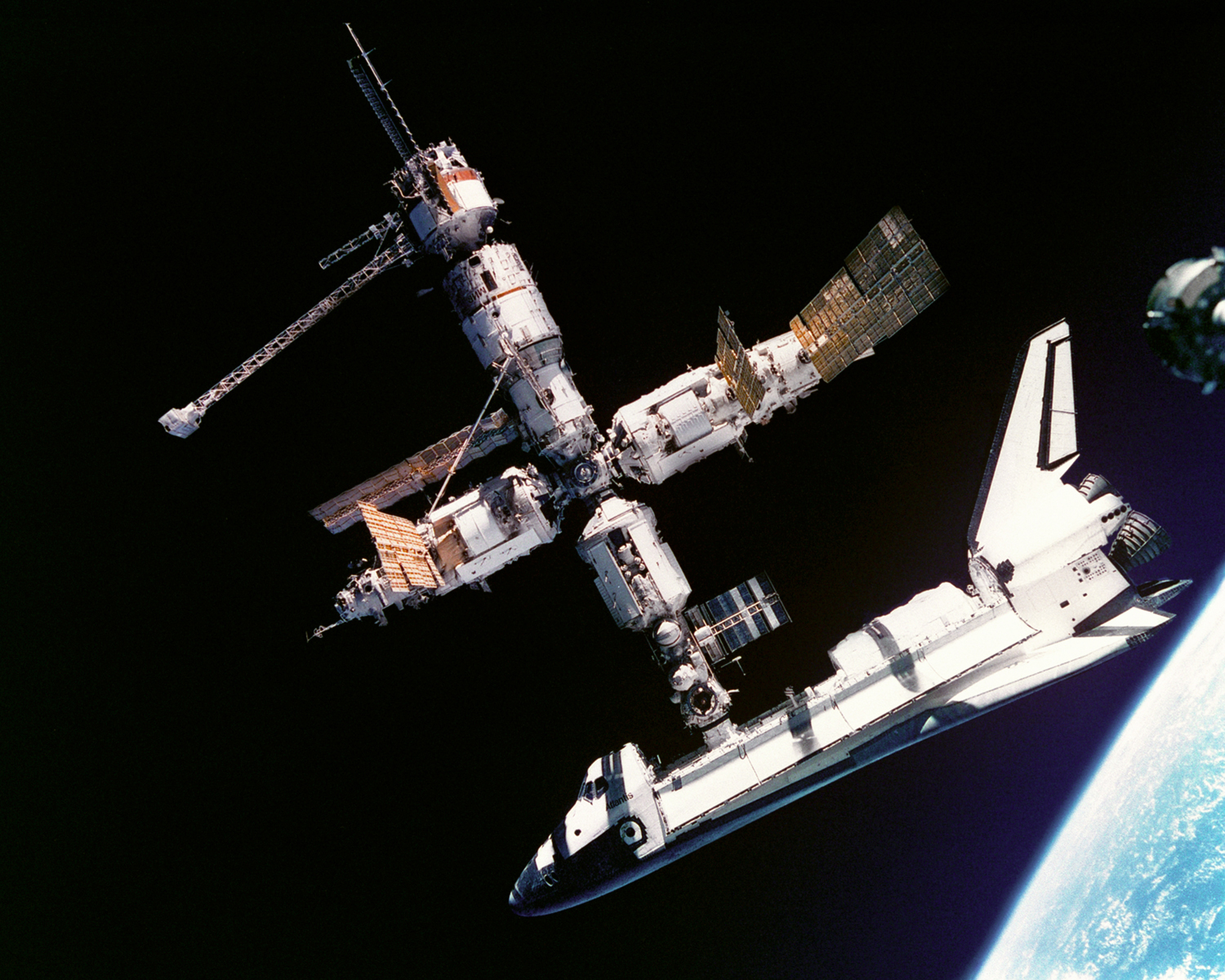
Sure, you might need some such platform to construct something in orbit. That's basically a space forklift with thrusters.
It isn't an argument for Space Shuttle system as a whole, i.e. propulsion system, heat shield, solid rocket boosters & external tank, being needed.
For what it cost to launch the shuttle such a platform could have been entirely expendable with astronauts returning in capsules, and they'd still have saved money, and been able to take up 3-4x the amount of cargo up on each trip.
If you're talking about the one aiming to be best in the field to describe how good it is performing, you usually don't compare it to the broken clock of the group.
It's a fair comparison if the real product of the space shuttle program is compared with the real product of the Falcon Heavy program.
Comparing what the space shuttle could hypothetically have been with what Falcon Heavy actually is would not be a fair comparison.
They are totally different configs, for totally different purposes.
It's like comparing a drone to a jet or to a cargo plane.
For every “send things to the ISS” and “put thing in orbit” mission, the two are directly comparable. The Space Shuttle simply wasn’t using its maximum capacity that often for big packages. The Space Shuttle was a boondoggle.
For crew launches, the per-person cost of the Shuttle still compares unfavourably to SpaceX’s projected crew launch costs. But projected isn’t actual, so we’ll let the Shuttle keep its spot for now.
(Special repair projects and ISS boosting are two things the Shuttle can do that SpaceX currently cannot.)
That alone puts it in a completely different category than Falcon.
FYI many (most?) drone missions that the US does right now would not be carried out by manned aircraft for a whole host of reasons.
Making a manned, multi-purpose vehicle like the Shuttle really starts to get expensive when you just want to launch a big satellite. Sure, they perform a bunch of science up there but that's as secondary goal to getting the main payload into orbit. The Shuttle had good goals in mind but turns out its just cheaper in the long run to make something that won't last more than one launch.
What sounds like a more attractive option, owning and operating a semi to make round-trip deliveries cross country where the driver goes sight-seeing along the way or to buy and ship a shipping container that makes a one-way trip?
This is simply not a true statement.
Not trying to say Space Shuttle wasn't extremely expensive, but comparing two different things isn't exactly fair.
When you talk about launch costs, you care about the cost to get “the stuff you really want in orbit”.
The formal term for that stuff is “payload”. So cost per kg of payload is the relevant figure of merit.
The mass of the space shuttle is not payload. It is a means of delivering payload. As such, you do not get credit or establish launch efficiency by launching it.
It is not inefficiency to launch without carrying the space shuttle; just the opposite.
There are much more efficient systems for only carrying stuff into space and dropping it there. The Space Shuttle example makes no sense if this is what you care about.
I don't know about the Dragon, but, like before, if the Dragon's weight is the thing you really want out of the atmosphere, then yes, but if you only care about the supplies inside, then no.
>And even then, it's apples to oranges, because Space Shuttle was a manned spacecraft which brings millions other requirements into place.
What requirements? But yes, it's fair to break out "human" vs "inanimate" kg of payload. Do SpaceX products for carrying humans perform poorly when comparing to alternate ways of launching human payloads? Do SpaceX products for carrying inanimate matter perform poorly when compared to the same?
Absolutely not. Which makes it ever weirder to bring up Space Shuttle.
Incremental cost of each Shuttle flight was $18,000 per kg to LEO (see https://en.wikipedia.org/wiki/Criticism_of_the_Space_Shuttle...). Price per KG of a FH launch is about $1411 to LEO https://en.wikipedia.org/wiki/Falcon_Heavy.
So on incremental costs its about 12 times cheaper per kg to LEO
Or if you think thats still not fair, and want to treat the shuttle orbiter itself as payload - a bit abstract, but lets go with it - the shuttle launch comes out as about $4400 per kg of orbiter-and-payload, so Falcon Heavy is still 3 times cheaper than that.
edit: And its still not really a fair comparison because Shuttle could do more and carried people etc. But there it is.
Space Shuttle was a spacecraft that was much more capable than coupling on 2nd stage. So of course the price point per cargo carried is completely different. It doesn't make any sense to compare it that way. What you can compare is the price of the rocket launch and complete payload delivered to orbit, and that includes the vehicle.
If you only care about economics for satellite launches for example, then yeah, it is much cheaper. But so are many other systems, so why pick Space Shuttle for comparison?
"The original plan, ridiculous as it was in hindsight, was for STS to be the sole US launcher of all payloads.
However, after the loss of the Orbiter Challenger only seconds into mission STS-51-L, US policy was changed to only allow the Shuttle to launch scientific and military payloads that required human presence. This destroyed any economic rationale for making STS self supporting or a revenue generator.
The first 4 missions were test flights, so omitting them, you can see that 11 of the 21 "operational" missions before the policy change carried commercial satellite payloads, often multiple, up to 3 comsats per mission. A total of 18 commercial satellites were deployed from the Shuttle. "
https://space.stackexchange.com/a/10352
The original purpose of the Space Shuttle was to be a highly reusable launch system to make frequent launches (including commercial and govt satellites and space probes) with minimal refurbishment time/cost. That sounds an awful lot like SpaceX's current goals, doesn't it?
Yes it had some mission profiles that the current SpaceX fleet can't do (large extended-duration crew missions in LEO, orbiting laboratory, Hubble repair) but there are also profiles that SpaceX can do that Shuttle could not (anything that involves stage 2 going beyond LEO).
https://en.wikipedia.org/wiki/List_of_Space_Shuttle_missions...
Edit:
"The original plan, ridiculous as it was in hindsight, was for STS to be the sole US launcher of all payloads.
However, after the loss of the Orbiter Challenger only seconds into mission STS-51-L, US policy was changed to only allow the Shuttle to launch scientific and military payloads that required human presence. This destroyed any economic rationale for making STS self supporting or a revenue generator.
The first 4 missions were test flights, so omitting them, you can see that 11 of the 21 "operational" missions before the policy change carried commercial satellite payloads, often multiple, up to 3 comsats per mission. A total of 18 commercial satellites were deployed from the Shuttle. "
https://space.stackexchange.com/a/10352
SpaceX also does cargo missions to the space station (crew happening next year) which is probably a better $/kg comparison to the space shuttle for some missions:
https://en.wikipedia.org/wiki/Commercial_Resupply_Services#S...
Sure the Shuttle had unique capabilities and the Falcon rockets aren't better in all ways, but the Shuttle was originally supposed to be a cheap and reusable way for the US to do the majority of its space launches and that turned out to not be its strong suit.
edit: I think thats based on programme lifetime costs, if you look at incremental costs per launch its about 12 times cheaper -see https://news.ycombinator.com/item?id=18706930
edit: OK maybe not the best two things to compare (although the original vision for the space shuttle was that it would launch all US payloads, due to projected re-usability). But FH is still way cheaper than any contemporary competitors, see https://news.ycombinator.com/item?id=18706762
edit: I've been looking at old pics of the space shuttle and lamenting that its the only thing we've ever put into space that actually looked like a proper spaceship. https://www.bbc.co.uk/news/av/science-environment-13719297/u...