Most ISS components were less than the Falcon 9's capacity. Given Falcon 9 launches payloads an order of magnitude cheaper (cost per kg) than the Shuttle did, cost savings would almost certainly be realized. The remaining payloads would be more expensive to launch on other platforms, but that extra cost for a few projects is outweighed by the savings across the bulk of what the Shuttle did.
For heavy-lift launches, Titan IV and Proton beat it. For manned launches, Soyuz beat it. Today, Falcon 9 and Falcon Heavy are better options, though they are built (in part) on the lessons of the Shuttle.
I want to see the attempt of building the ISS with a Falcon 9. Some assembly launches would be within lift capacity (especially on the expendable configuration). Some payloads would actually fit in the fairing. But when you have it in orbit - what then? The Space Shuttle not only lifted the modules into space, it berthed them to the station, and carried the crew together with the payload to execute the assembly operations and be able to react in time.
As much as I agree that the Space Shuttle was way too expensive, it was irreplaceable for building the ISS, and had it existed back then, the Falcon 9 wouldn't have changed that.
Plus, since this seems to get forgotten a lot, size matters. I find the best size comparison between the ISS and MIR is with the Space Shuttle attached: ISS [1] vs Mir [2].
[1] https://www.nasa.gov/sites/default/files/styles/full_width_f...

[2] https://apod.nasa.gov/apod/image/0210/shuttlemir_nasa_big.jp...
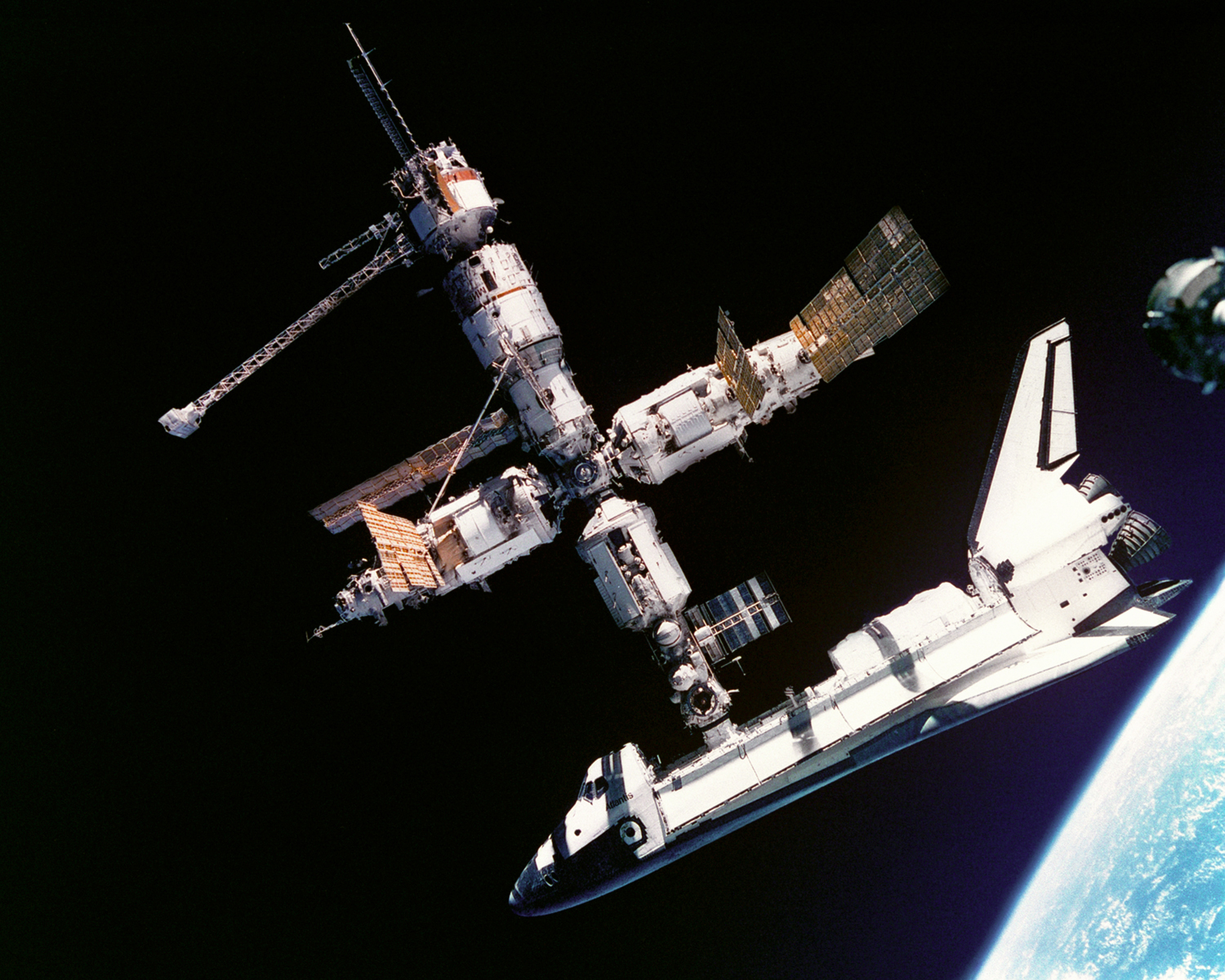
Sure, you might need some such platform to construct something in orbit. That's basically a space forklift with thrusters.
It isn't an argument for Space Shuttle system as a whole, i.e. propulsion system, heat shield, solid rocket boosters & external tank, being needed.
For what it cost to launch the shuttle such a platform could have been entirely expendable with astronauts returning in capsules, and they'd still have saved money, and been able to take up 3-4x the amount of cargo up on each trip.