Any kind of writing system allows this. Translation changes the words, and can change meaning. People can mis-quote. And yes, over time, meanings of words change, as do the cultural contexts from which they came. None of this is unique to emojis.
The truth is that all communication has at least two parties, and there is never a guarantee that the receiver will get the message as intended. Even if you do craft "pixel-perfect" emojis, people still can (and likely will) mis-understand the nuances of your intended message.
Think of the word "gun". The image that entered your mind just now was not a water gun. It was a weapon, the kind of device the gun emoji used to depict and now no longer does.
The people forcing this kind of change want you to associate the concept of a gun with a water gun or other toy, and they think that by changing your though pattern this way, they'll make society safer.
This is terrifying and totalitarian idea. Once you buy into the idea that you can force a change to the language to achieve your desired social aims, there's no intrusion into private life that you will be unable to justify.
Very Orwellian. In 1984, that was the point of Newspeak - to make it impossible to express certain ideas.
I.e., if you choose to mean a handgun when writing a watergun, the emoji’s meaning can change.
Anyone born in the last dozen or so years.
When "pistol" changed to mean "toy gun", it (1) happened in two years and (2) was decided by an oligarchy of actors (and not even the Unicode Consortium oligarchy).
Can you spot the difference?
Granted, I’m assuming historians will use the emoji set at time of writing, but that’s not trivially available.
In the case of emoji, we're aceepting the idea that when I said gun, I in fact did not say gun, I said water gun. You can interpret the water gun as gun or water gun, but really I never said gun
this comment could be interpreted as a threat 50 years down the line, by the change of meaning over time, but any sane person understanding that history and context matter, with knowledge of how it would be interpreted today, would realize its not. But if we applied the same acceptance to text as we do with emoji, the whole thing could be changed such that in both this time, and 50 years from now, it would be interpreted as a threat. The same context argument could apply, but I'm also sure defenders of the change would also not see the need to maintain a log of how things have been changed, as I doubt they care about emoji changes today.
The words themselves aren't simply appearing differently; they're changing, right from under my feet. The only defense is that (afaik) the unicode assortium has not changed yet changed the naming for it (ie CRYING FACE EMOJI), but since no one in practice refers to that definition, its not a useful defense.
Thus, emoji in their current form are highly inappropriate as a medium of communication, except in the very limited use case of short-lived, impermanent, and same-implementation communications.
But since this constraint is not the intention of the unicode consortium, and this is not the intention of the groups/font-creators that support emoji, and this is not a limitation that the general user expects, then this is a very poor design.
Emojis have been accepted as intentionally corruptible communications, but no party involved actually realizes the implications of it. We don't change ascii (ignoring the latter 127 characters, which are open to any interpretation) except by accident and by intentional non-meaningful changes (changing fonts does not change the characters themselves, just their aesthetics [except I guess wingbats]), and everyone would throw a fit if they did, because the notion is absurd
UPDATE posts SET text="I hate brown people" WHERE post_id=17560983
Fonts and rendering and apps will change just like compilers and source and runtimes. aka bit rot.
---
Want to preserve your output? Then print to PDF with embedded fonts. Or use screenshots.
Want to be able to recreate your output? Then treat your content like devs treat their software.
I used to write prepress and print manufacturing software. I also did a tour of duty as our tech writer. Our team's entire publishing workflow got a lot more sane when I treated it like any other dev task.
Make dependencies explicit, use source control, pin down versions of apps, drivers, fonts, OSes, etc (aka colophon).
Our "build servers" even had VMware images, containing our desktop publishing apps, used to automate PostScript, PDF, and web output.
(This is long before Chef & Ansible, CI/CD, etc. Kids today have no idea how good they got it.)
The meaning of the words will change over time, but not the words themselves. So someone who reads it will know what the words written actually were, and just have to lookup any differences in meeting between when the words were written and now.
Imagine for a second if we took Shakespeare and rewrote it with modern day English, and then made the claim the new version is the original Shakespeare... I think we would see the problem with that. But that is what happened with emoji. It isn't that people look back, see as collections of pixels, and realize now those pixels mean water gun while in the past they meant firearm. When they look back, they see water gun.
1. orthography also changes (https://en.wikipedia.org/wiki/Long_s)
2. the purpose of words is to communicate concepts, if the meaning of the word changes the word itself has changed, reducing a word to its mere orthography is nonsensical
Not of things already written down. The long S written in the Constitution is still there. It has not changed, and there would be outrage for anyone to go and change it. Changing the emoji from one meaning to another would be like changing the encoding of utf-8 so that a now means e and e means a, meaning that and and end flips in every utf-8 encoded file that is viewed.
File this away under "myths programmers believe about language," with some bullet points like,
- A word or symbol will always have one meaning.
- Okay, but at least those meanings will stay the same over the next decade.
- The next year?!
Words change meaning because your present-eyes are different from past-eyes.
The gun symbol has changed meaning because your present client is different from past clients.
In my opinion if the people that changed the gun emoji had done it by introducing a new watergun emoji, replaced the gun with watergun on the keyboards, and declined to make their devices capable of emitting the sequence of bytes representing the gun, I would have been fine with that, and for their preening purposes I think that would have been sufficient. I'd consider that annoying and rude, but not malicious. If you have a unicode text file with the gun emoji, and you don't know when it was written, you genuinely can't tell what the author wrote as a symbol, even ignoring all the complexities of language, almost as if the word was blurred, and you can't tell between two possibilities.
I read this as "Emoji is a recycling bin writing system"
So just as a ballet dance, or a particular performance of it, isn't the right medium for world leaders to express international political sentiment, similarly, emoji should not be expected to convey any precise sentiment in critical situations. The author says as much:
>If emoji are to become adequate vehicles for discussing public health, the legal system, and art, their depictions need to be molded by users rather than a handful of software companies.
I don't think anybody is seriously considering the use of emoji in the way in its current mode of usage for communication when precision is needed. In the first place, there is no standard pronunciation of emoji characters, which in itself is sufficent to make their use in formal documents an iffy suggestion. Arguably, if we ever standardize a reading/interpretation of emoji, the concern raised by the author becomes rendered moot and the choice of graphic representation becomes a stylistic one.
When we consider the current imprecise nature of emoji, message corruption due to companies somewhat altering the precise meaning of the emoji become much less significant.
East of Eden's third act is a whole debate about how to interpret "timshel" from the original bible into English, and how those interpretations have warped our thinking.
The kind that gave us this: https://i.imgur.com/pfkBj1D.jpg Edit: Turns out this one's a photoshop


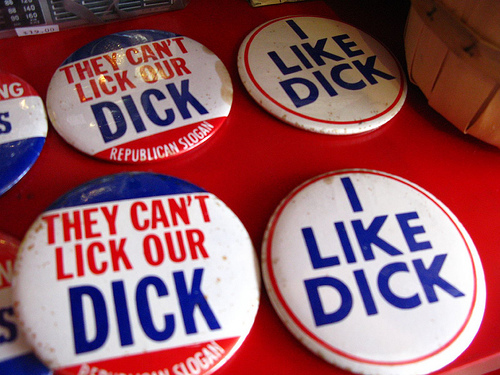
It's still pretty common. Dyck Insurance was just running radio ads a couple years ago with the slogan "Everybody loves Dyck".
Er, this happens all the time, writing or not. So many words in the languages I speak fluently have changed meaning over hundreds of years -- especially in French!
This is not a bad thing, provided the rate of redefinition is low enough and that we record the changes so we can understand older writings.
I wouldn’t worry too much. People will combat this with creative workarounds, such as using the eggplant emoji to represent a penis.
Ever heard of this book called The Bible? People have been changing the meaning of stuff in there for thousands of years.
This is an overblown/not new concern - emojis have always rendered according to the client platform, so you never knew if, for example, your :-D was going to be a big smile or a laugh to the recipient.
From the op:
In his novel The Unbearable Lightness of Being, Milan Kundera linked this kind of forced conformity to a fascist government’s unbounded desire for control, and its efforts to limit expression to kitsch, a cartoonish denial of objective reality
This is also a historical feature of communist governments. All governments, and all societies, in as much as they lose a commitment to individual rights, will tend to grab more and more control in pursuit of difficult goals. It's yet another thing that seems "nice" but which has disturbing implications under the surface for free speech, like Canadian Bill C-16.
    Zen fascists will control you
    100% natural
    You will jog for the master race
    And always wear the happy face
Of course, that doesn't make for a good ingredient in angry epithets.
Corporations certainly have purges. Happens all the time after mergers.
Both are authoritarian political philosophies with a heavy handed approach to economic policies.
Differences come in privatization, immigration, equality of rights, and religious toleration. [1]
Both have extreme takes on ideas falling under the umbrella of socialist thought (hence, Germany's National Socialist Workers party). You can argue 1984 vs Brave New World, but there are certainly common themes.
Both differ significantly from classical liberalism.
[1] http://www.differencebetween.net/miscellaneous/politics/ideo...
No more trash than any other.
Plus... I'm amused at your use of "trash" in that way, given your horror of signifiers changing significance.
> There is plenty of free software that can give you pixel-level control over your output, you don't need to rely on the unicode consortium or any other organization of any kind to determine what you express.
... the whole point of having a writing system is having a standard writing system, at least de facto, and without the Unicode Consortium, there would be some other standards body because that's how computer software works. That other standards body would be worse than the Unicode Consortium by virtue of not being the Unicode Consortium, and therefore being either irrelevant or an agent which destroys cross-platform compatibility.
> No more trash than any other.
This isn't accurate. Writing systems excluding emoji are used to communicate linguistically. Emoji are not a linguistic phenomenon; they have semantics, but they have no syntax or pronunciation. That's why there's so much anxiety about the image a recipient sees matching the image you sent -- nobody cares if they send a message in one font and the recipient views it in a different font, because there is agreement on what an A is, what an f is, etc.
Compare the traditional Chinese character for "come", 來. This is a picture of a stalk of wheat, but people wanted to talk about coming, and they borrowed a word that sounded the same so they could write it down. "Wheat" was originally written this way too, but the concept of coming was so common that "wheat" was driven to a different character, 麥. This all works because the characters are being used to write a language rather than to free-associate based on some pictures which have no specified relationship to each other or anything else. Emoji do not fit in Unicode because they are not part of a writing system. They're a hack for sending image data without having to send the full image over the wire.
All languages are completely dependent on a set of words that have no semantic value at all, like the English word "of". Emoji do not support these, and if they did, they wouldn't be emoji.
I agree regarding the Unicode Consortium, the reason I have that under "good news" is that the publication tools we have now are immensely better than what there was in the past, and we can overcome the limitations of reliance on anyone using existing tools. Even though there is a cost, the cost is lower than ever.
- They changed the gun emoji to be a water gun, which has a totally different meaning. This retroactively changes previous writings, changing their meaning. What kind of writing system allows people to change your words after you've written them? Emoji is a trash writing system and an agent of kipplization.
- Emoji is controlled by corporations that are concerned with maximizing the value of their platforms which will lead them to a PG13, disneyfied, milquetoast worldview.
The good news:
- In the entire human history, it has never been easier to create and publish text, audio, or video works of any kind. The most popular platforms have severe limitations, but it only takes the slightest effort to use other platforms that are uncensored.
- There is plenty of free software that can give you pixel-level control over your output, you don't need to rely on the unicode consortium or any other organization of any kind to determine what you express.