It seems like everyone in this thread is forgetting that the HomePod[0] is a thing. Apple's privacy practices are better than the other listed companies, but they do have a smart speaker just as capable as the others.
It can consistently tell me the weather and set alarms, but it's bad at everything else.
If Apple can make all of that offline, i’d be even more loyal.
We don’t need the stupidity of sending everything you say to cloud and back. Latency just kills it.
Apple is still the most focused company of the big tech giants. They deserve kudos for that.
While the echo will always respond.
If I have a position to contribute it's that those ideas are still out there. Job's greatest gift was his sense of taste. He had refined a sense of good art.
If more management had such sense they would be better patrons feeding good art and killing tasteless hacks projects.
If Jobs had aged, needed reading glasses, and maybe had Parkinson's, would there be more of a push towards making devices easier to use? Would Siri be more functional?
I know Jitterbug exists, but it seems almost insulting. (If anyone has used one and feels otherwise, please share.)
There are accessibility settings on iOS that mitigate every one of those items (and more), and iOS has consistently been one of the most, if not the most, accessible phones out there . What specifically are you looking for?
Thankfully Android allows for alternate launchers, even though some icons are horribly ugly.
Would Apple ever admit to doing something functional-yet-ugly?
The presence of ubiquitous wireless networking (I am lumping cellular wireless and WiFi in together) was the real game changer.
If you are not convinced, try this thought experiment: Imagine yourself in 1998 standing on the street in a major city holding a Palm pilot. It has an SDK, a TCP/IP stack and a POP email client. But no wireless connection.
Now add a wireless connection. Could you tweet or Facebook? Sure, if those things existed then.
Yes, all the technology was there. We had smartphones and they would have continued without the iPhone. The value of the internet in your pocket is too big for the smart phone not to become a huge thing.
Eventually.
But Apple NAILED the UI. They made it so simple that 3 year olds can use the UI and are confused when other computers don’t work through such great touch controls.
How long would we have been stuck with tiny screens (relative to the original iPhone) or giant devices (like the sidekick) to get a decent sized screen?
How long would it have taken to get the App Store? Would we get one? That single innovation (making it trivial for people to find/buy software) has been transformative for our industry.
The iPhone pushed us ahead years. Maybe a decade. We skipped a ton of teething time and got straight to it.
Remember, RIM thought the iPhone demo was faked and impossible. That’s how far ahead Apple was.
>How long would it have taken to get the App Store? That single innovation (making it trivial for people to find/buy software)
Package management was not an Apple innovation, and before iOS 2.0 there were no officially supported native third party applications at all, and the only way power users accomplished this was by installing a package management system based on APT (installer.app/cydia). Jobs believed that web applications with native controls would be all anyone needed with the original iPhone.
So what do they do in iOS 2.0? Give you a crippled, prettier package management solution that requires Apple hardware, and fees, to develop and publish on, and gave the finger to power users.
And I don’t believe Jobs EVER thought that, that was his spin. Everything that has come out since seems to indicate that he knew web apps sucked but that was what they could get out the door fast. The internal APIs didn’t seem to be in a releasable state.
Normal people have never used APT.
I remember how you got software for Palm or WinCE. It was a pain, you had to search the web or buy it boxed. You better not lose that memory card or download file. And since you bought it from tons of places you always had to put your card in.
What I’m talking about is the simplicity end users had never seen on any device (to my knowledge). The store already had your card, just type in your password. It knew what you bought, you could redownload it for free. No sketchy websites. And one central place to search.
That was miles ahead of any other way of buying software.
If you read his biography he had to be convinced to have users create their own apps and install them on the iPhone. He vehemently shot down the idea before he had to be convinced of the idea by Bill Campbell (the coach) when Steve was vacationing in Hawaii.
Read the book and you’ll understand more of the backstory
But it was immediately clear that everyone wanted to program for it. And once they decided to go down that path my impression from articles and interviews is that webapps were something of a stopgap until they could get native code ready to release.
I remember when I got my RAZR, it was the first phone I had that could play video. I was able to watch a 3m cartoon from Boomerang (Tom and Jerry or something like that). The quality was surprisingly good.
It used up 60-70% of my battery and the little phone got very hot.
And that was a $15/month service.
And let’s not formget the mapping ‘services’ that Google and Apple completely killed.
It wasn't the first smartphone. It wasn't the first phone to use a capacitive touch screen. The first iPhone didn't even have the app store - it launched with the 3G a year after the the first iPhone was released, if I remember correctly. At that time, Android and Blackberry both had app stores in the works. They might have released before the iOS App Store - I don't remember.
Anyways, Apple did create a great product that deserves all of the popularity it has but they absolutely did not push us 10 years into the future of computing.
RIM had no incentive, they were trying to lock you into the BB server product and tried to get consumers on it to. The phone was a means to an end.
MS wanted to push Windows. They’d been trying since CE first appeared and it still didn’t take off. As long as Balmer was there why would they do something different? They KEPT DOING IT even with Apple to follow.
Palm was the closest. I guess they might have been my bet. But they were having trouble and had tr legacy of thinking about things the way PalmOS had done things. That might have slowed them down.
Google was just copying RIM. They’d have gone somewhere, but I don’t know it would look anything like today’s smartphones. That may not be a bad thing.
Apple did not move us up just 2 or 3 years. I don’t know how to come up with an exact number, and obviously it’s not something crazy like 20 or 50. But I could see a decade.
How long did it take the rest of the industry to catch up to the Mac from ‘84? How long would it have taken if they didn’t have the Mac to look at?
Paradigm shifts in UIs are hard to predict. Even if you make a good one it can be really hard to break in when something else is successful (even if only adequate).
Apple defined the modern smartphone, and it wasn’t an IBM PC like thing of taking existing parts and just putting them together. It took a ton more work outside the existing molds.
The Amiga was '85. It did take a while for PC-compatibles, of course.
I was thinking of MS world. Windows 3 wasn’t until 1990. You could argue it took until Windows 95 for most everyone to go GUI.
About the only major thing iPhone brought was direct carrier deals from AT&T and Verizon for big data plans.
Also lost the keyboard. (Not the first device to do so either.)
"Chris DeSalvo, who worked alongside Andy Rubin at Danger before joining Google to build its mobile OS, says that the iPhone's announcement forced everyone on his team to realize that they 'are going to have to start over.'
Already in intensive development for two years by 2007, Android was Google's vision for a mobile operating system of the future. Still, in spite of all the work that had already gone into it, the Mountain View company was sure it couldn't carry on along the trajectory it'd been following — the earliest Android devices looked very much like Googlified BlackBerrys — and had to alter its plans to compete with the iPhone's new touch-centric interface. A book excerpt in The Atlantic cites Andy Rubin, who led the early development of Android, as saying "I guess we’re not going to ship that phone," in reference to the Sooner project Google was initially planning to reveal to the world."
https://www.theverge.com/2013/12/20/5229618/android-started-...
Windows, RIM, Nokia, and others had all tried to produce similar devices. They invariably ended up with a clunking mess of buttons and features that appealed to geeks and/or business people, and no one else.
The genius wasn't in putting the parts together - although that was a significant achievement. It was in making a device that was uniquely beautiful, elegantly understated, and so easy to use it could (literally) be picked up by almost anyone.
No other company has ever taken the obsessive interest in design and aesthetics that Apple had under Jobs.
Not even the current Apple, which understands visual presentation, but seems to have prioritised ease-of-manufacture and profit margins over user delight.
Jobs was hardly infallible, but when he had a hit he hit it out of the park.
As for what we don't have - VR, smart home, and health, are all bumping along when they could be soaring.
The other big miss was handing content creation over to YouTube. Apple could easily have set up a content store to match/beat YouTube, as a follow-up to podcasts and the app store.
I have no idea if Jobs even considered any of the above. But Cook doesn't really get content, so Apple are unlikely to win big in these markets now - more likely to offer a not-quite-right product like Watch, which was mildly interesting, but not the game changer it might have been.
It's quite easy to trivialize things in retrospect. But at that time, in that context, that device was pure magic.
It changed so many people's relationship with general computing period.
And like many people pointed out here, it's not about any individual piece, but it's more about how all the individual pieces fit together into one product, and one story that was so different from the prevailing story at the time. It was absolutely the execution that set them apart and moved our industry forward.
I think that the first Android phone that could actually compete with an iPhone must have been the Samsung Galaxy S3, in 2012, 6 years after the release of the original iPhone in 2007.
Apple was way ahead of the competitors back then, they basically set the golden standard for what a smartphone should look like and it took many years for the competition to catch up.
I'm not so sure.
A picture says a thousand words:
https://www.cultofmac.com/145083/what-phones-looked-like-bef...
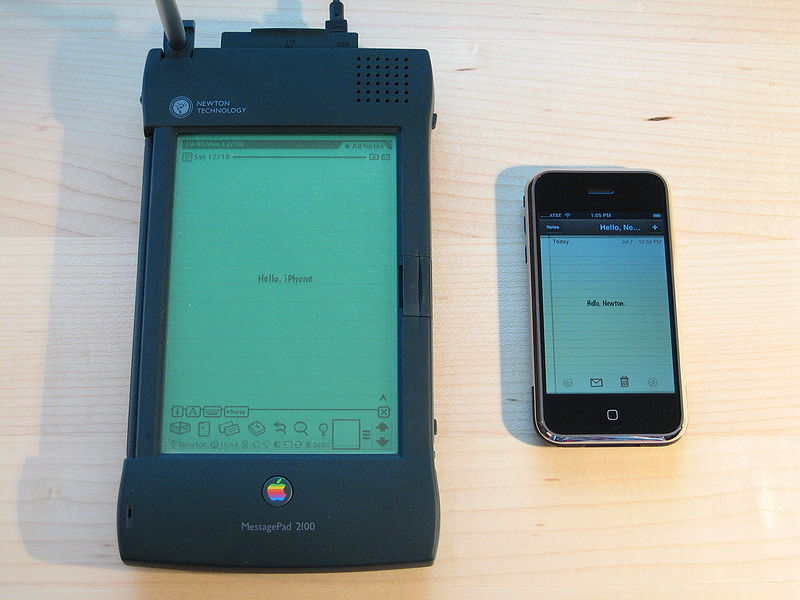
The carriers dictated the phones you could buy (in the US). They dictated the siftware on them. They dictated the interfaces. If they didn’t like a feature hey turned it off. I remember a camera phone that had Bluetooth support for sending files but Verizon turned it off because it competed with their expensive MMS service.
I remember paying $5 for a terrible version of Bejeweled. I remember Sprint wanting to charge me $4 A MONTH to have Tetris on my RAZR.
Android still suffers the crapware and delayed updates. Maybe Google’s latest attempt will finally fix that.
But the iPhone RULED over the cell companies. They did what APPLE wanted because Apple held all the power.
Verizon couldn’t tell you which games you could buy from the App Store. AT&T couldn’t make you use their email client. You never saw a Sprint branded browser or video startup screen. They were largely irrelevant. They were demoted to what they truely are: infrastructure.
Does anyone want to go back to the world where carriers had 100% of the power over phones?
What a difference that made. And I do wonder if anyone else could have ever done that. Apple had the right product at the right time (AT&T losing bad) to get enough leverage to do it.
Palm and Blackberry devices at the time did have AppStores. I was a happy Treo user...and the iPhone didn't have the ability for me to build apps for it. I also used my finger to touch the screen.
What the iPhone didn't have was a physical keyboard. That was the primary design innovation.
You mean like HandNGo (spelling?) that existed several years before the iPhone came out, let alone the iOS App Store? Quite popular with Windows Mobile folks, that was. There were others that I've long since forgotten about, but they existed.

Apple is now fundamentally following the course of milking the last value proposition that they were left with. There is a lot of profit to milk, but long term the industry will leave that value proposition behind and Apple will wind up one of the losers.
We used smartphones in the labs at Motorola when I started working there in 2001. They ran Linux and had all the capabilities you would consider essential to a smartphone, not just the form factor. They were targeted for public sale in 2002 or 2003, if I remember correctly, but got shelved because the dotcom crash caused the networks to delay upgrading their infrastructure (yes, high-speed data networks had been in the works since the 1990s). A smartphone for sale in 2003 would have been absolutely useless. You'll remember that the phone networks could barely handle (or couldn't depending on your viewpoint) the iPhone for the first few years.
I didn't work in the cell phone division so I can't say for sure, but I think that most of the manufacturers let their smartphone development stagnate or stall from the early 2000s until 2006 or 2007, while Apple kept plugging away at it. When they proved that people would buy a smartphone even when their mobile network couldn't handle the traffic, all the manufacturers put effort back into development but by then they were far behind Apple.
So no need to feel bad about it.
Jobs was, for all intents and purposes a phenomenal business person in spite of the fact that many people early in his career didn't see it.
Name a product apple invented that was HUGE? Go ahead and think about that. GUI & Mac was Xerox, the iPhone was Xerox and palm and...
Simply put he was a master at finding good things and refining them into great things.
Lets look at the design side. MacBooks for all their glory are just advanced machining (cnc + automation) put to work at scale (and thats "new" but not groundbreaking). OSX is just *nix with a nice GUI (something open source could learn from).
Jony Ive leaves apple, then I might start to worry.
I hear some version of "He didn't actually invent it" over and over again, and I think it demonstrates a fundamental misunderstanding of what made Jobs a visionary. Before the iPhone, nobody was making anything even remotely as good as the iPhone.
I'm not sure if you mean that as an insult, but honestly it's probably the most important thing he could have done; there's no shortage of good ideas out there, but most of them have terrible execution. Being able to see through that bad execution to the good idea, and imagine a great execution not encumbered by what it had, is a profoundly valuable skill.
LoL what?
Everything that's built with computers can be traced back to the guy who invented the transistor, but that does not mean innovation stopped then.
But that would be silly, because the modern "smartphone" era was absolutely started with the iPhone.
HP OmniGo 700LX, pdQ, and Nokia 9000 Communicator didn't have touchscreens and were like night and day compared to either the Prada or iPhone. You are comparing apples to oranges.
Was it a nice industrial design? Yes. Wasn't very original though (and neither was the iPhone's).
You're also shifting the goalposts - you said smartphone, not "had a touchscreen". It was the first capacitive touchscreen but not even close to the first touchscreen btw. The IBM Simon in 1992 likely takes that win.
What the iPhone did that was innovative was in how it improved upon and combined the technology. It also pushed forward a lot of things in those technologies by several large leaps.
Long story short - the LG Prada is superficially visually similar to an iPhone and, likewise, bringing it up shows a very superficial understanding of the history of the mobile phone space.
Android, Windows phone, and iPhone all added these core features.
[1] The Hiptop used server-side rewriting of web sites to adapt them to its screen. This seems bananas now, but remember, the web was less than a decade old, and the notion of "responsive design" was years in the future. Back then, most other phones were stuck with WML.
Another issue is LG Proda stuck with J2ME instead of offering native apps.
So, the Proda was close, but it really missed the mark. IMO, the fact it took 4 years to after the hardware was possible before the iPHone showed up shows how significant the innovation actually was.
I think open source developers know this but it's not their expertise. What we need is a way to make it easier for people with that expertise to contribute to projects.
Doing a bit of work with GTK I realised just how hard it is to abstract the look/design stuff out, it's very intertwined with the code meaning folks with artistic ability have a steep learning make seemingly minor GUI changes.
This explains why the web looks really good and stuff like electron is attractive.
Every great creator has stood on the shoulders of giants. That doesn't diminish their greatness. I can't think of a single creation in the past 50 years that isn't a pretty direct consequence of the knowledge that preceded it.
The internet is just a bunch of sand, some pieces of metal and wood poles from dead trees?
He had an amazing ability to synergize technologies into products.
Jobs was just the salesman. Those products aren't lost, but they may have had a harder time getting to market without the "visionary" around to hype them up.
Also, does anybody know what cable the longest (number of years) a specific Apple cable/connector has remained compatible with the ever-changing hardware?
I am guessing it is this thing:
https://www.apple.com/shop/product/MK122LL/A/power-adapter-e...
Apple has always had BS connectors, like the Powerbook 5300 (1996)and G3, G4 laptops power connector - an male RCA plug, but the inside contact replace with a 3.5mm headphone plug.
Edit: Ok, fine. I loose sleep wondering what ideas were out there that languished because Jobs wasn't around to see their potential and capitalize on them. The argument "he wasn't that important because he didn't actually invent X" is played out, and it fundamentally misses the point.