This article obliquely mentions the sheep problem but only by saying:
Mr. Jonsson and his volunteers then plant the appropriate species for the plot — birch, Sitka spruce, lodgepole pine, Russian larch or other species. “We’d love to plant aspen,” he said. “But sheep really love aspen.”
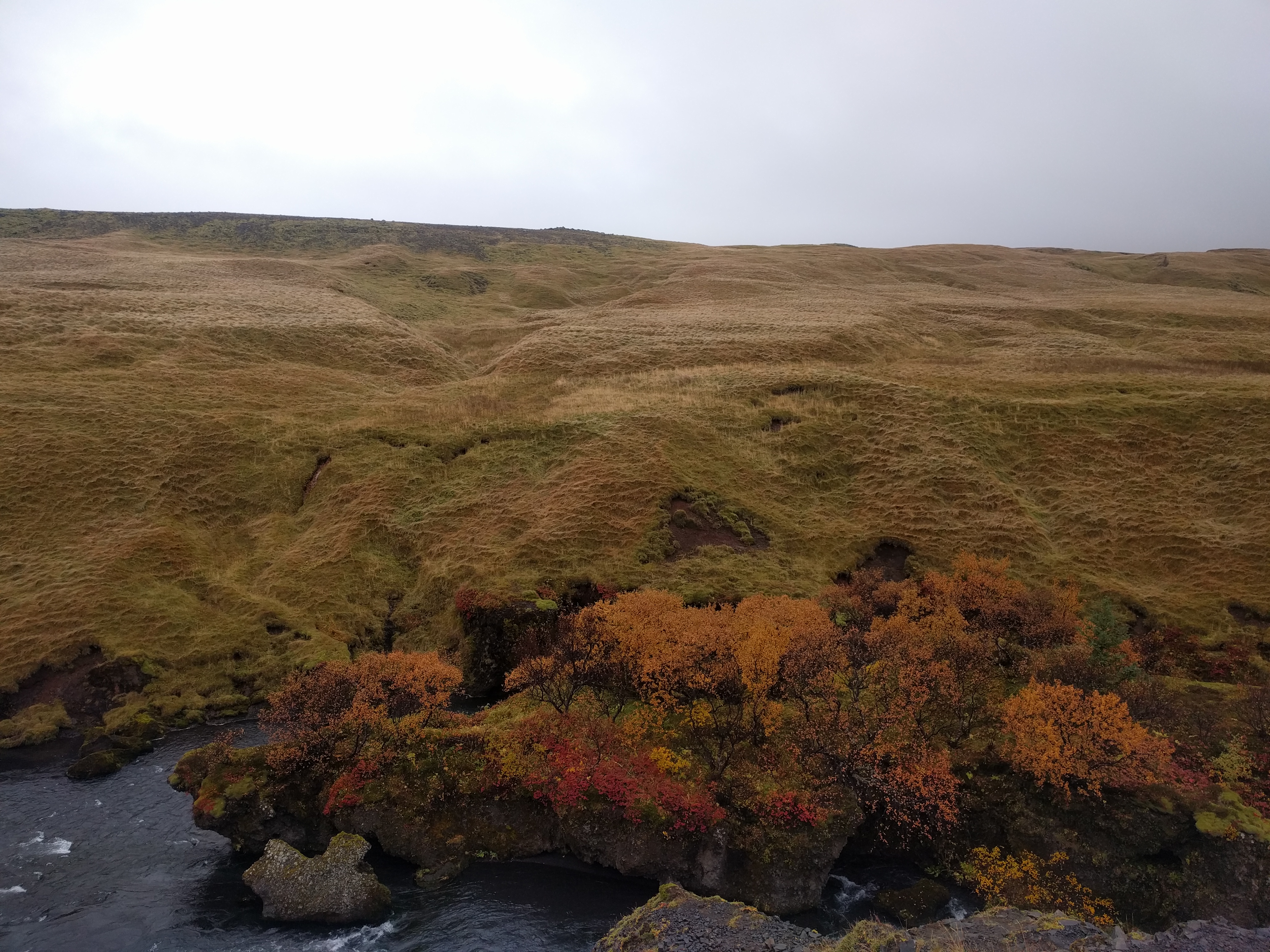
Sheep may love aspen but they will eat all the other trees also. I did not realize this was the main reason there was only grass everywhere until, when up on top of the Skógafoss waterfall, there was this[1] little island in the river covered in a little mini-forest. This rocky island would not be a very good place for trees to grow compared to the nice soil under the grassy fields around it, but since nothing could graze on the island, the trees could grow up.
[1] https://njarboe.com/iceland/IcelandTreeIslandSkogafoss.jpg (The trees on this island are only about 4 feet tall)
It's never remotely recovered, but that process is slowly starting just now. I was trying to find a photo like the one you just posted but couldn't. There's lots of examples like that where the plant biodiversity in an area where the sheep can't get to is night & day compared to the area right next to it where they can.
Which is not to say that those specific trees are old growth forest or anything like that. Icelanders pretty much lived in mud huts until after WWII in large parts of the country. If the sheep didn't get to a place like that some guy would have certainly swam over there to gather firewood. But it'll have been left alone by sheep and man in the last several decades, which as you can see makes a huge difference.
Edit: Here's an even more stunning photo of an island in the middle of a river that because of the depth of the river has been left alone by both man & grazers: http://www.skogur.is/media/frettir-2014/myndasafn-storar/Vid...

The accompanying article (in Icelandic, but it translates ok-ish) says that compared to the land around it it has a lot more biodiversity and a better topsoil, similar to other areas in the country protected from grazers that they've studied: http://www.skogur.is/um-skograekt-rikisins/vidburdir/2014/04...
Src:Allan A. Schoenherr's A Natural History of California
https://en.wikipedia.org/wiki/Gullfoss
Images:
https://www.google.co.in/searchq=gullfoss&tbm=isch
Often when I read about Iceland, it reminds me of the Jules Verne novel "Journey to the Centre of the Earth", which I read as a kid. Good novel.
Update: Checked, that's the name:
https://en.wikipedia.org/wiki/Vatnaj%C3%B6kull
Update 2: There are some interesting points in that Wikipedia article.
[1] https://www.yellowstonepark.com/things-to-do/wolf-reintroduc...
See, for example: https://www.ncbi.nlm.nih.gov/pmc/articles/PMC2870557/
Chart of herd immunity thresholds for some diseases:
https://www-tc.pbs.org/wgbh/nova/assets/img/herd-immunity/im...

Edit: you can actually try to vaccinate the reservoir, however: https://www.ncbi.nlm.nih.gov/pubmed/24523510
It's no longer patented so nothing is stopping you from selling it if you think there's a market.
https://www.yellowstonepark.com/things-to-do/wolf-reintroduc...
https://www.nytimes.com/2014/03/10/opinion/is-the-wolf-a-rea...
http://onlinelibrary.wiley.com/doi/10.1890/14-0712.1/abstrac...
The NY Times opinion piece is clickbaity for its absolutist declaration that the prior studies are untrue, based on one new study.
"But by insisting that wolves fixed a broken Yellowstone, we distract attention from the area’s many other important conservation challenges. The warmest temperatures in 6,000 years are changing forests and grasslands. Fungus and beetle infestations are causing the decline of whitebark pine. Natural gas drilling is affecting the winter ranges of migratory wildlife. To protect cattle from disease, our government agencies still kill many bison that migrate out of the park in search of food. And invasive lake trout may be wreaking more havoc on the ecosystem than was ever caused by the loss of wolves."
Great read, thank you for posting!
Source? It would surprise me to see that many people voluntarily give up their farmland rather than, say, selling it to industrial farmers or real estate developers.
Of course, that is anecdotal, you can read more here: https://www.bostonglobe.com/metro/2013/08/31/new-england-see...
In my area, once you get passed a point south of me, those walls are fewer and fewer. There are areas where it was never farmed and old growth trees still exist.
What is great is you can walk out to places and stand there and be reasonably certain that you're the first human to have ever stood in that spot.
edit: removed link to an article that has been posted several times.
Once you get somewhere more rural/remote, the land is going to have even less value.
Or go walking through the forest, and count how many stone walls you have to clamber over. Every one used to mark the edges of a field or a pasture that was hacked out of the forest, and then was allowed to grow back up when farming the cold, rocky soil of New England was no longer cost-effective.
In VA, many local parks are opened to bow hunting through winter [1] in an effort to control the deer population. Signs posted all over parks to warn users [2].
1- https://www.fairfaxcounty.gov/living/wildlife/archery/archer... 2- http://4.bp.blogspot.com/-bOyirfPSn0g/Vhv3vlBCh0I/AAAAAAAA0Q...

https://en.wikipedia.org/wiki/Helicopter-based_hunting_in_Fi...
The people decided it was better to live with mountain lions instead of killing them off in 1990, after we killed off the grizzly and the wolf in the state. http://leginfo.legislature.ca.gov/faces/billNavClient.xhtml?...
Mountain lions (at least the ones evolved when we hunted them for the last 12,000 years) are much less hazardous to humans than grizzlies or wolf packs.
https://www.nytimes.com/2015/03/08/nyregion/that-howling-jus...
This limits hunting to public lands, of which, there might be 2-3 within an hour drive of the city. So no matter how much the hunters kill, they aren't likely to effect the populations in the surrounding suburbs.
There are more hunting spots in the rural areas, but those areas are also populated by natural hunters, like wild dogs and large cats.
It makes me very sad to go south and see the huge numbers of roadkills on the side of the highway. Where I'm from, we try real hard to inflate the deer population, since the winters and the coydogs keep the population down so much that the hunting isn't real easy.
http://www.pgc.pa.gov/hunttrap/hunting/harvestdataandmaps/pa...
There's a parallel with the charge that the "Drug Free School Zone" laws discriminate against minority communities because everywhere you go in cities, you're within 1000 feet of a school.
If you're not allowing hunting on your property, it would also be good (albeit expensive) to fence it, so deer cannot easily move through, to reduce their available forage.
Fewer hunters, less land where hunting is permitted (small farms).
Back to the tree side of the story - I'm in NW Montana where trees are like weeds. In the spring I could find 1-2 fir tree seedlings per square inch and sometimes 4-5 in an inch! Despite having quite a few deer, forests are thick. I should rent some sheep to keep down the "weeds" we call trees.
And there are no trees to speak of. That could either be because of the harsh winds on this almost-westernmost point of Ireland, or (never thought of this until now) it could be the sheep.
The government pays people 50 pounds per sheep per annum, so people just let their sheep roam forever, unshorn, spray-painted with each owner's distinct colors.
(Disclaimer: probably ignorant observations from an outsider, taking a couple of our girls to the world-class Irish music camp they hold each year.)
However, it's fenced in by old stone walls, and I was dismayed to see someone had driven a tractor through said wall the last time I visited and there were at least a couple sheep munching away in there.
The problem doesn't seem to be the lobbyist but some strange lack of fundamental laws, if the government can be coerced into allowing this to happen by industry.
Unless you're saying the farm industrying (with grazing animals) controls a massive amount of land? They say only 1% is tree covered, I can't imagine they own such a large amount that they can't find any significant amounts of land to plant trees...
So for example, if you buy a farm and put a fence around it I'm still free to walk across your property to get to where I'm going, because farms are intended for farming, and as long as I'm not unduly interrupting that you have no standing to stop me. I can also set up a tent overnight on your farm as long as I don't unduly bother you, i.e. set it up too close to your house, I need to pick up all my trash etc.
Now, back to your question. During the summer the sheep wander around and graze on any grass they can find, and due to precedence going back to colonization (where everyone who mattered was sheep farmer anyway) if you'd like them not to do that it's your responsibility to set up a fence around your property, and of course the sheep are likely to start eating there first since sheep are lazy and go for the easy pickings first.
But this only applies to sheep, not e.g. cows, and that's entirely to do with ongoing lobbying not just by the farming industry, but people in rural areas that hold disproportionate sway in parliament.
There are successful reforestation efforts going on in Iceland, but most of these are in park-like areas near municipalities. There's not enough money being spent on this to fence wast swaths of land.
But yes, you could of course buy land, fence it off, and start planting trees on it. But that's expensive and not very lucrative, so very few farmers are doing that to make money.
There are big national parks, but they're almost all in areas that would be the last to regain any topsoil, i.e. in the highlands around glaciers.
https://www.ted.com/talks/allan_savory_how_to_green_the_worl...
Not sure if that would apply to Iceland, but it seems reasonable for someone to try it.
This is the case in at least Norway as well - it's certainly not unique to Iceland. Though I assume environmental effect of it in Iceland is compounded by the climate.
Much of that isn't deposited but fixed from the air by plants which then decay in place, though the freshly-arrived material often provides vital micronutrients -- itself a problem in Australia where the lack of geological activity means that there is very little of these materials, limiting ag productivity.
In regions with harsh climates and short growing seasons (e.g., Iceland), there's little time for soil-forming processes to set hold, and the slight progress made can be undone quickly. Even in places that appear full of life, conditions may remove soil or nutrients, e.g., tropical rainforest.
If I think of things that may bring doom to humans, I tend to think a lot about dirt and bugs and plankton and algae.
It's an exception and not the rule, as you're saying, but I know of at least a few spots in the Rocky Mountains in the US where farmed cattle graze openly and property owners have to let them. The ones I'm thinking of I think became that way because it was a permanent condition of the sale of the property in smaller parcels (i.e. the original owner parceled it up for cabins but retained grazing rights in perpetuity). But it's in areas where they actually want to keep vegetation in check to mitigate forest fires.
Did you know, for example, that grazing rights aren't something that is available on the "open market", are specifically attached to piece of private property, and are generally transferred (and inherited) along with it? That the IRS considers grazing rights such an integral part of the valuation of a ranch that they are subject to estate taxes?
Here's a simple introduction: http://www.thetribunepapers.com/2014/05/19/grazing-rights-st...
And some legal theory: https://journals.uair.arizona.edu/index.php/jrm/article/view...
And a recent update in central case that's been ongoing for decades, alternating between many (mostly Nevada district court) decisions favoring the ranchers, and many (mostly California circuit court) reversals: https://www.fseee.org/2017/03/08/nevada-rancher-hage-loses-i...
This is unsettled law, and calling it "an effing joke" doesn't do it justice. You are welcome to disagree with the ranchers' arguments, but if you care about truth, fairness, accuracy, and respect, I don't think you should call it a joke, at least until you've looked at the situation more closely.
Whether or not grazing fees count as private property is actually irrelevant. He lost his grazing rights by refusing to pay for them. If he had kept paying, and actually challenged the seizure and sued, that would be an interesting case, but he did not.
There are interesting argument here, but Bundy is not the one making them. He doesn't even acknowledge the authority of the federal government, and instead fell into the crazy Sovereign citizen crowd.
(Also, even if grazing land is considered private property, the federal government could seize the land: https://www.fws.gov/refuges/realty/faq.html )
I've read the filings for Hage, but I'm not as familiar with the details of of the Bundy case. So I presume you are right, that their behavior seems indefensible, but I also presume that "the choice of starting point" has a large effect on the narrative. I'd wager that the Bundy's feel the story starts somewhere earlier, in a way that makes their response seem more reasonable. Here's an update from a couple months ago on the upcoming 3rd retrial of the defendants there: http://www.azcentral.com/story/news/local/arizona-investigat...
I think the tendency so far for juries to repeatedly fail to return guilty verdicts is a pretty good defense of the "unsettled law" theory. Or worse, as the mother/wife in the first video linked suggests, maybe it's a sign that the government treats the legal system itself as part of the punishment rather than a dispassionate means of adjudication. The narrative that actually interests me is most is the extreme conflict between the district and circuit courts. Nominally, they are both "federal" courts, but at least in the Western US, the local district courts are all about states rights and the San Francisco based circuit courts tend to lean heavily in the opposite direction.
I wasn't there, and haven't read the court records, so I don't know what happened in the courtroom, much less what happened in the real world. My guess would be that unsettled law was not a reason for the (lack of) verdict, but that it goes a long way to explain how the situation came about. I'd also guess that they story being reported in the media misses a lot of important details.
The video interview with Carol Bundy in the earlier link I gave you describes a different view of the situation. I don't have specific reason to trust her, but I think she comes across as fairly trustworthy. In her view, they were terrorized by corrupt government officials who brazenly lied about what happened. This clearly isn't the whole story, but might explain why they get the popular support the do.
It also might be relevant that there are several ongoing parallel cases that involve the BLM and FBI agents. The BLM agent in charge of the Bundy ranch raid was found guilty of "ethical misconduct" with regard to Burning Man[3], then later sacked after another OIG investigation cited him for "official misconduct"[4].
The FBI agent who fired two of the first shots in the killing of Lavoy Finicum was indicted for obstruction of justice by claiming he had not fired his gun.[5] The camera video filmed by a passenger in Finicum's car tell at different story than most of the media coverage[6]. I think it's worth watching, at least to see the other side of the story.
But as I said, I haven't been following the details of the Bundy case. Maybe they did things that are horribly wrong. I don't assume, though, that hearing the national news coverage gives me insight into what actually happened. So I'll ask you instead: If these are open and shut cases, why is it so hard for the federal government to get the verdicts they are seeking? Separately, thank you for participating civilly in a discussion even though we seem to disagree.
[1] http://thehill.com/homenews/news/347611-cliven-bundy-followe...
[2] http://www.oregonlive.com/oregon-standoff/2017/06/fbi_agents...
[3] https://www.doioig.gov/reports/investigation-ethical-miscond...
[4] http://www.sltrib.com/news/environment/2017/09/25/interior-b...
[5] http://reason.com/blog/2017/06/29/fbi-agent-indicted-for-lyi...
To date, 2 of the 19 people arrested have been found not guilty on all counts by the courts. 2 (Scott Drexler and Eric Parker) were found not guilty on most charges, but the jury was unable to reach a decision of some of the charges, and so they are being retried. Note that all of the charges carry a penalty of at least 5 years in prison, so both of them can still face decades in prison if found guilty on the remaining charges. 2 have been found guilty in court, 2 plead guilty.
Gregory Burleson sentenced to 68 years. Todd Engel was found guilty of obstruction of justice and interstate travel in aid of extortion, sentencing pending but he faces up to 30 years. Gerald "Jerry" DeLemus plead guilty, sentenced to 7 years. Peter Santilli pled guilty to conspiracy to injure or impede federal officers, sentencing coming next year.
Cliven Bundy, Ammon Bundy, Ryan Bundy, and Ryan Payne, the ringleaders of the whole standoff, start trial Oct 30th.
Possibly, although not intentionally. I read the links I sent you for the first time yesterday, and think I summarized them reasonably. Other articles make claims that I think are compatible: http://www.hcn.org/articles/cliven-bundy-why-the-bundy-crowd.... Clearly there are other points of view, many from more reputable sources, although I'm not sure if their reputation means they are less biased, or just differently biased. Some of those reputable sources point out that Burleson's conviction may have been an outlier, since in addition to his overt racism, as a former FBI informant the jury may have been particularly less sympathetic.
Ironically, Burleson's conviction was obtained in part through footage provided by a fake documentary team that was actually the FBI: https://theintercept.com/2017/05/16/the-bizarre-story-behind.... That article claims that as of May there have actually been 7 acquittals vs 6 convictions, but I didn't track down whether that had changed. I think we should ignore the number of those who "plead guilty", since that's often a tactical decision rather than an actual admission of guilt.
My point though is not that there have not been eventual convictions (I appreciate the details) but that the path to getting them seems to involve more hung juries and retrials than one would expect for an "open and shut" case. My larger point is that there is extreme antagonism between certain Western district court judges and the federal government, with the San Francisco 7th Circuit siding fairly consistently with the Feds and reversing local decisions. Judge Jones's Finding of Fact for the Hage trial (decision overturned by the Circuit) is long and dense, but a surprisingly fun read and a good introduction to the debate regarding Western water rights: http://www.inversecondemnation.com/files/usa-v-hage-findings....
I thought that Jones's Finding was extremely well argued, but the 9th Circuit disagreed and vacated and overturned his decision: https://cdn.ca9.uscourts.gov/datastore/opinions/2016/01/15/1.... To my reading, the Circuit willfully misinterpreted Jones's reasing, and then burnt the straw man. The Circuit also took the unusual step of declaring Jones to be too biased against the federal government to be involved in any subsequent proceedings. Locally, many think this the greater example of judicial bias: https://sparkstrib.com/2016/09/15/one-persons-bias-is-anothe....
I'll bow out now, but will happily read any further responses you have or links you think I should look it.
I guess Iceland needs to compensate sheep farming for a few years, so the trees grow. But even then, sheep will eat any new saplings, meaning humans will have to be involved "forever."
I left about an acre without being tilled for 3 years and now they are more than 1000 saplings--wind did it's magic from trees 50+ yards away. I am going to fertilize about 100 of them and keep it as it is. In 10 years, I'll no longer need to buy firewood, which is a way better return financially for that particular plot. Not to mention the environmental side benefits.
Sheep will definitely prevent reforestation, although they are less likely than goats to harm saplings of a certain size.
Sheep run free-range around the entire island, if you'd like to grow something that sheep like to eat you need to fence it in. It's not like pretty much anywhere else in the western world where people who own grazing animals need to fence them in.
Thus the sheep range far and wide and destroy Iceland's native low-lying forests. Iceland's native crooked birch hasn't developed resistance to grazing animals as mainland trees had to do, the sheep love to nibble at them and eat the seedlings.
The native trees and other native vegetation are generally much hardier than the foreign plants. But since the forestry service has lost the battle with the farming lobby they're desperately trying to introduce some trees that the sheep won't eat.
Reforesting the country is largely being done through subsidies to farmers, who aren't concerned with topsoil preservation beyond maintaining the desolate landscape they inherited, but they are interested in the eventual promise of a commercial forest on their land.
Which is something to keep in mind when reading articles like these and wondering "why don't they...", usually the answer is that they're planting in a field that's going to be full of grazing animals, and there's no way the forestry service is going to win that battle anytime soon, or that they're not really aiming to restore the topsoil per-se, but to do that as a side-effect of commercial logging.
This page has some more details: http://www.skogur.is/english/forestry-in-a-treeless-land/