News for hackers. Stuff that matters.
Re:What happens after a defendant is found not guilty by rea... by mabbo on Wednesday September 27, 2017 @04:23PM (#15351936)
There was a very high profile case in Ontario over a decade ago. Basically, the man went into an absolute psychotic state on the travelling bus and cut the head off a stranger while everyone else on the bus ran for their lives.

A decade later, he's been released- under a lot of conditions and on a lot of medication, but people are very upset that he'd ever be free at all. In interviews, he's a very interesting person. "Regret" and "shame" aren't strong enough words.

It's a hard debate- if he was not guilty due to a medical condition, then he was not found guilty and shouldn't be in prison, certainly. But he did cut a guy's head off. Would you want to live next to the guy who did that while not in control of himself?

It's the extreme end of the situation, to be certain, but extremes are a great place to examine any system.

https://en.wikipedia.org/wiki/Killing_of_Tim_McLean

Re:What happens after a defendant is found not guilty by rea... by seiferteric on Wednesday September 27, 2017 @04:32PM (#15352016)
It is interesting because different people and different countries seem to have different ideas about he purpose of the the justice system. Punishment/retribution, correction/rehabilitation, or protecting the public. Someone like this may not be guilty due to insanity, but still be a danger to the public for example.
Re:What happens after a defendant is found not guilty by rea... by JumpCrisscross on Wednesday September 27, 2017 @04:55PM (#15352260)
I believe violent versus non-violent crimes should be treated distinctly in terms of evaluating (a) rehabilitation and (b) future offense odds. For non-violent crime, I think rehabilitation is the answer. For violent crime, I'm more comfortable with a model that involves sequestration, i.e. keeping the offender separate from society until their risk of re-offending falls suitably low.
Re:What happens after a defendant is found not guilty by rea... by jrochkind1 on Wednesday September 27, 2017 @05:09PM (#15352376)
I'm not sure prison is likely to lower anyone's risk of re-offending, alas.
Re:What happens after a defendant is found not guilty by rea... by elevensies on Wednesday September 27, 2017 @05:23PM (#15352477)
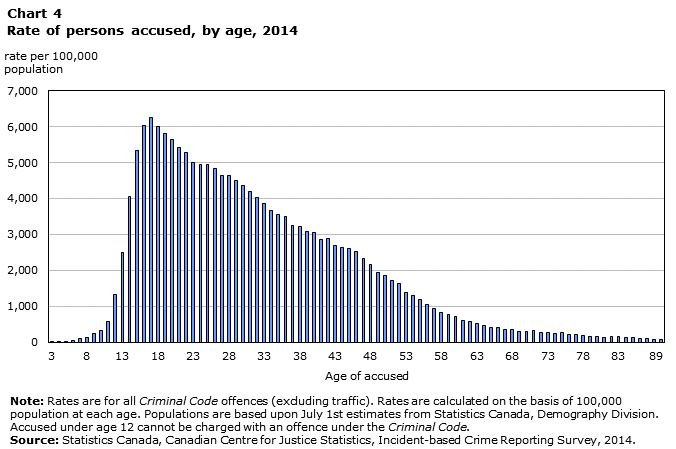
It may lower everyone's risk of re-offending by making them older when they get out: https://www.statcan.gc.ca/pub/85-002-x/2016001/article/14309... (via https://www.statcan.gc.ca/pub/85-002-x/2016001/article/14309... )

Although I guess it would make more sense to be looking at a chart of 2nd offences.

Re:What happens after a defendant is found not guilty by rea... by JumpCrisscross on Wednesday September 27, 2017 @05:49PM (#15352648)
This is what I was getting at. Keep them sequestered until they’re statistically unlikely to cause further harm. This doesn’t work if you’re locking up pot smokers. It does if you limit long-term prison sentences to violent offenders (and maybe corruption).
Re:What happens after a defendant is found not guilty by rea... by nybblet on Wednesday September 27, 2017 @05:11PM (#15352388)
The comment is not saying that prison will lower the risk of re-offending, but that it will lower the risk of impacting other people until the risk of re-offending falls suitably low (e.g. due to other means like treatment).
Re:What happens after a defendant is found not guilty by rea... by alkonaut on Wednesday September 27, 2017 @04:38PM (#15352073)
Well the purpose is of course all those things.

Someone locked up for insanity wouldn't be released while they are still a danger to the public. But anyone imprisoned for a violent crime might be released while still a very clear danger to society, even murderers and similar. Time limited sentences work that way.

Re:What happens after a defendant is found not guilty by rea... by kelnos on Wednesday September 27, 2017 @05:52PM (#15352673)
The thing that I worry about in these cases is the lack of "enforceability" of treatment. If keeping the person in control of themselves (such that they don't become violent again) means they need to be on medication for the rest of their lives, how do we ensure (post-release) that they'll always be on their meds?

I know of people on various medications for psychiatric reasons that have (against their doctor's recommendation) gone off their meds because they didn't like the side-effects. That might be fine (if unfortunate/difficult) for a mental illness that doesn't drive the sufferer to violence, but in the case where it does, how can you responsibly release someone if you don't have a mechanism to ensure they stay on their medication?

Re:What happens after a defendant is found not guilty by rea... by lazyasciiart on Wednesday September 27, 2017 @06:27PM (#15352910)
Mechanisms to enforce medication usage in the community do exist, usually by in-person visits to supervise taking medication. One such program is the "Assertive Community Treatment" model that exists in a couple different places in the US, here's a report from the King County (WA) group: http://www.kingcounty.gov/~/media/health/mentalHealth/Docume...

I think the actual 'enforcement' in the way you are thinking would be backed up with some kind of court ruling that they were required to take the medication, I'm not so sure how that angle would work.

Re:What happens after a defendant is found not guilty by rea... by DanBC on Thursday September 28, 2017 @04:09AM (#15355575)
In England you have a "community treatment order". These are meant to reduce the numbers of hospitalisations of people with severe and enduring mental illness, by ensuring medication is taken.

They don't seem to work in that sense. There doesn't seem to have been a reduction in hospital use in that group.

English MH treatment is very different to the US though.

Re:What happens after a defendant is found not guilty by rea... by dsego on Thursday September 28, 2017 @01:20AM (#15354837)
Monthly injections, and if you don't show up, they call the cops. Also, once somebody has a history, it's easy to send them back to the institution.
Re:What happens after a defendant is found not guilty by rea... by nerfhammer on Wednesday September 27, 2017 @06:03PM (#15352749)
Would their doctor or pharmacist have to also take up the role of sort of parole officers?
Re:What happens after a defendant is found not guilty by rea... by IncRnd on Wednesday September 27, 2017 @05:39PM (#15352581)
I absolutely agree.

My understanding is that prisons are said to have four purposes: deterrence, incapacitation, retribution, and rehabilitation.

However, in the absence of having prisons a society would likely create prisons to protect the people of society. My conclusion is that prisons are meant to protect the populace with those other reasons being secondary based upon cultural mores.

Re:What happens after a defendant is found not guilty by rea... by LeifCarrotson on Wednesday September 27, 2017 @09:00PM (#15353678)
> would likely create prisons to protect the people

How would prisons protect people? By deterring the people who might endanger them, by removing the capacity of people who do cause harm to cause more harm, by punishing those people, and by rehabilitating them into society.

The reasons aren't secondary or primary. They're different sides of the same coin, just stated from different perspectives: how to deal with the problem of crime vs. how to protect society from criminals.

Re:What happens after a defendant is found not guilty by rea... by joecool1029 on Wednesday September 27, 2017 @04:25PM (#15351952)
>A decade later, he's been released- under a lot of conditions and on a lot of medication

No, he's been given an 'absolute discharge'. There are no legal obligations for him.

Re:What happens after a defendant is found not guilty by rea... by mabbo on Wednesday September 27, 2017 @04:47PM (#15352173)
Seriously? Wow I did not know he'd gotten that far. I mean, part of me thinks "good for him" for overcoming serious mental illness. The other part worries.
Re:What happens after a defendant is found not guilty by rea... by alkonaut on Wednesday September 27, 2017 @04:34PM (#15352037)
> But he did cut a guy's head off. Would you want to live next to the guy who did that while not in control of himself?

Well, if he is considered sane by trustworthy professionals, then why not?

I can't see how it's different to live next to someone who is cured after 10 years of treatment, as opposed to say someone who was in prison for 10 years for the same crime (Where I live this would likely be considered more severe than the normal 12 years out after 9 though). Probably 18 or life, where "life" is often at least 18.

I'd prefer not to live next to that person, but there isn't really much I can do about living next to an ex convict, or in this case an ex- mental patient?

Re:What happens after a defendant is found not guilty by rea... by KekDemaga on Wednesday September 27, 2017 @05:13PM (#15352411)
>Well, if he is considered sane by trustworthy professionals, then why not?

Psychology as a science is remarkable in its inability to make accurate predictions. I'd ask those professionals be criminally liable if their assessment proves inaccurate.

Re:What happens after a defendant is found not guilty by rea... by alkonaut on Wednesday September 27, 2017 @05:29PM (#15352512)
Someone decided the person was insane to begin with. If we could trust them to lock them up we need to trust them to release them too.

Now, this is a nearly non existent problem isn't it? For major crimes, being locked up in psychiatric care is a longer, or indefinite sentence, than would be served in prison (this varies between countries of course).

Re:What happens after a defendant is found not guilty by rea... by AnimalMuppet on Wednesday September 27, 2017 @05:33PM (#15352540)
> If we could trust them to lock them up we need to trust them to release them too.

This guy was getting locked up no matter what. The only question was, was he getting locked up in a prison or in a psych ward? So do we trust psychiatry enough to say "lock him up here rather than there"? Sure.

Do we trust them enough to say "It's safe to release him now"? That's a harder question.

Re:What happens after a defendant is found not guilty by rea... by kelnos on Wednesday September 27, 2017 @06:00PM (#15352724)
An interesting point (raised by the article) is the term of imprisonment. If he hadn't gotten NGRI, but had gone to jail, and it wasn't a life-without-parole sentence, he would have been released eventually.

In the involuntary commitment case, is it reasonable to hold a person longer than what the equivalent prison sentence would be, even if the person is still considered mentally ill after the equivalent time?

Re:What happens after a defendant is found not guilty by rea... by DanBC on Thursday September 28, 2017 @04:19AM (#15355605)
> In the involuntary commitment case, is it reasonable to hold a person longer than what the equivalent prison sentence would be, even if the person is still considered mentally ill after the equivalent time?

In England a prisoner who becomes mentally ill and is sent to hospital will be kept in hospital until they are well. The legal powers to send them to hospital and keep them there are listed in the Mental Health Act. People are detained under section of the MHA - commonly known as sectioned.

When a prisoner detained under section is in hospital and their prison sentence ends their section is converted to a different one, which allows treatment to continue.

Re:What happens after a defendant is found not guilty by rea... by alkonaut on Wednesday September 27, 2017 @06:08PM (#15352781)
I can only answer that for law where I live (Sweden) - the answer is a clear yes. Not only is it possible but it's likely/common.
Re:What happens after a defendant is found not guilty by rea... by IncRnd on Wednesday September 27, 2017 @05:46PM (#15352631)
> If we could trust them to lock them up we need to trust them to release them too.

That's not true. Doctors didn't make a decision to lock up the individual.

It's much easier to say that someone who executed other people is crazy than it is to say that person's craziness and tendencies toward evil have been cured.

Re:What happens after a defendant is found not guilty by rea... by alkonaut on Wednesday September 27, 2017 @06:05PM (#15352762)
Doctors decided the person was clinically insane.

Yes it's hard to say someone is sane, and also rare. Which is why this is such a small problem - people aren't often declared sane and released if they committed serious crimes.

> It's much easier to say that someone who executed other people is crazy than it is to say that person's craziness and tendencies toward evil have been cured.

No. It's literally the exact same evaluation. The reason it feels easier is because the stakes seem lower. Lock someone in prison or hospital? Big deal? When releasing, it's a risk assessment too. But the evaluation is exactly the same.

Re:What happens after a defendant is found not guilty by rea... by IncRnd on Wednesday September 27, 2017 @06:33PM (#15352946)
> Yes it's hard to say someone is sane, and also rare.

> No. It's literally the exact same evaluation. The reason it feels easier is because the stakes seem lower. Lock someone in prison or hospital? Big deal? When releasing, it's a risk assessment too. But the evaluation is exactly the same.

You said I was wrong, and then wrote text that supported my comment.

It doesn't matter if the evaluation is the same. The state of sanity differs from the state of insanity, yet not showing insanity is different from showing sanity. There are true-positives, true-negatives, false-positives, and false-negatives.

Re:What happens after a defendant is found not guilty by rea... by alkonaut on Thursday September 28, 2017 @02:26AM (#15355082)
I'm not saying you are wrong but I'm saying that an evaluation of someones sanity is the same whether they are stepping in through the door of a locked facility, or stepping out. It's not harder to do after than before - it's just more important to get right. You can call that "harder" but the evaluation is basically the same.

> showing insanity is different from showing sanity. There are true-positives, true-negatives, false-positives, and false-negatives.

Right. And a false positive might send someone to this facility instead of prison while a true negative might let someone out while dangerous.

Re:What happens after a defendant is found not guilty by rea... by ska on Wednesday September 27, 2017 @05:17PM (#15352433)

   I'd ask those professionals be criminally liable if their assessment proves inaccurate.
You mean like we do for DA's, parole boards, expert (court) testimony, etc. ?
Re:What happens after a defendant is found not guilty by rea... by KekDemaga on Wednesday September 27, 2017 @05:31PM (#15352524)
Parole boards don't claim that empirically speaking the person to be released will never re-offend only that they have met the legal standards previously outlined for parole.

Similarly a DA only attempts to prove to a jury that a defendant is guilty and it us their job to argue as much.

If an expert witness claims something that is untrue he would be subject to perjury.

Re:What happens after a defendant is found not guilty by rea... by belorn on Wednesday September 27, 2017 @05:44PM (#15352610)
Technically, isn't that because anything else would practically impossible and yet we want to have concept like limited jail time and ex-prisoners who live non-criminal lives. In order to allow for such concept, we also allow a less than perfect results from DA's, parole boards, and courts.

If we want to have concept like people being cured of medical conditions, then we must also accept that doctors will make imperfect distinction between healthy and sick.

The question society must make is how far we can accept that mistakes happen, and what safe guards we impose to handle the situations when someone fails.

Re:What happens after a defendant is found not guilty by rea... by alkonaut on Wednesday September 27, 2017 @06:13PM (#15352807)
Doctors who claim someone id safe enough to release after treatment don't claim the person can't reoffend either. They say it's unlikely enough that it's not worth spending tax money holding them.

Obviously if someone is found lying they should be held responsible - but the released person reoffending does not make the evaluation willfully dishonest.

Re:What happens after a defendant is found not guilty by rea... by ska on Friday September 29, 2017 @07:49AM (#15364453)
Precisely
Re:What happens after a defendant is found not guilty by rea... by kelnos on Wednesday September 27, 2017 @05:57PM (#15352701)
> I'd ask those professionals be criminally liable if their assessment proves inaccurate.

If that became the case, no one would be released, ever.

Re:What happens after a defendant is found not guilty by rea... by xxxdarrenxxx on Wednesday September 27, 2017 @05:54PM (#15352688)
There are multiple factors at hand.

For example, soldiers kill people, because it's "war" or they have "orders" or it's "the just way to deal with things".

If they'd kill the same person on the streets as a civilian, everyone would be disgusted and angry. Yet for it's former reason people feel the need to give medals and applaud.

You should think about this really hard for a second.

Our minds are not entirely our own, and simple cognitive pushes here and there can change our entire perspective just like that, while OBJECTIVELY it's still a dead human in this particular example.

With that said, one should not seek black and white answers in this concept. Mentall illnesses and for that matter the law system are dynamic and constantly in motion.

Re:What happens after a defendant is found not guilty by rea... by DanBC on Thursday September 28, 2017 @04:22AM (#15355614)
It's reasonably easy to say whether someone is currently experiencing psychosis or not, or is currently experiencing hypomania.

It's much harder to tell whether a person will offend again, and there are severe consequences if that person does offend again, so professionals are risk averse.

Re:What happens after a defendant is found not guilty by rea... by alkonaut on Thursday September 28, 2017 @04:34AM (#15355646)
> It's reasonably easy to say whether someone is currently experiencing psychosis or not, or is currently experiencing hypomania.

Right. But this often takes place several months or years after the crime was committed. So might still be difficult.

> It's much harder to tell whether a person will offend again, and there are severe consequences if that person does offend again

Yes, someone might get hurt. So yes, risk aversion involved. But also: there are severe consequences for the opposite too. Remember this is a person that is not guilty (responsible) for a crime, that is kept locked up.

Re:What happens after a defendant is found not guilty by rea... by IncRnd on Wednesday September 27, 2017 @05:45PM (#15352619)
The doctors are likely professionals, but why do you believe the doctors are trustworthy professionals?

There is science, and there is Science.

Re:What happens after a defendant is found not guilty by rea... by alkonaut on Wednesday September 27, 2017 @06:16PM (#15352831)
Not sure what we are discussing - if doctors can decide someone as being disturbed and dangerous then they by definition can also decide that they are not.

Now, this is obviously a hard and delicate problem when it comes to the releasing part of the equation.

But the argument that they are either incapable or untrustworthy to make the judgment doesn't fly - why were they capable and trustworthy when locking someone up then?

Re:What happens after a defendant is found not guilty by rea... by IncRnd on Wednesday September 27, 2017 @06:38PM (#15352977)
> why were they capable and trustworthy when locking someone up then?

1) The person would have been locked up whether found sane or insane. The only different was location.

2) You are admitting facts not in evidence, when you assume that the doctors were capable and trustworthy when determining the insanity. There is science and there is Science.

Re:What happens after a defendant is found not guilty by rea... by alkonaut on Thursday September 28, 2017 @02:32AM (#15355117)
> The person would have been locked up whether found sane or insane. The only different was location.

Right. Which is why that decision is done with lower stakes. But

> You are admitting facts not in evidence, when you assume that the doctors were capable and trustworthy when determining the insanity.

All I'm saying is that regardless of how accurate and trustworthy they are, if we trust them do do A we better trust them when doing B, even if the stakes and risk of mistakes are higher.

I can't see any other solution, do you? The only theoretically possible solution would be to lock people up for life if found insane - but I don't think that's a viable approach.

Re:What happens after a defendant is found not guilty by rea... by BearGoesChirp on Wednesday September 27, 2017 @05:27PM (#15352504)
Where is the difference between 'I choose to do it' and 'I couldn't choose not to do it'? A lot of perceived differences between these I've seen others mention is based on free will, which is something science isn't sure even exists.
Re:What happens after a defendant is found not guilty by rea... by occamrazor on Wednesday September 27, 2017 @05:43PM (#15352605)
If free will does not exist, then also the prosecutors, judges and jury are not free, and there is no point deciding what they _should_ do. Hence it is safe to choose policies based on the assumption that free will exists.
Re:What happens after a defendant is found not guilty by rea... by ThrustVectoring on Wednesday September 27, 2017 @08:51PM (#15353640)
I categorize "free will" like tort law, not like physics. When you have "free will" for a choice, you're in a situation where you are able to commit a tort or a crime in the eyes of society.

Like, do people have free will while they are sleepwalking? Science doesn't have a good answer, but people have successfully been acquitted of crimes they claimed they committed while asleep. It's far easier to answer questions about free will when you think of it in legal terms, and it matches up pretty well with your intuitions about things.

Re:What happens after a defendant is found not guilty by rea... by Sangermaine on Wednesday September 27, 2017 @05:43PM (#15352594)
If you're responding to the parent's situation where someone causes violence due to mental issues leading to a loss of control, the latter may be treatable and curable, after which the threat is gone if the person, absent the mental issues that caused the loss of control, doesn't want to harm people. The former was a choice that may be made again, so is therefore always a threat even if they truly repent and are sorry for their choice.
Re:What happens after a defendant is found not guilty by rea... by BearGoesChirp on Thursday September 28, 2017 @09:34AM (#15356987)
So, for example, should pedophiles who abuse not be guilty of a crime and instead just be chemically castrated, because without the desire they wouldn't have wanted to harm a child? Consider many places involuntarily commit such individuals into psychiatric wards, though normally only after the prison sentence has been served.
Re:What happens after a defendant is found not guilty by rea... by derekp7 on Wednesday September 27, 2017 @07:52PM (#15353402)
So basically the same thing if someone had a stroke violent seizure while at a restaurant, while cutting a steak, and accidentally stabbed the waiter in the heart killing him. In that case, a brain defect caused the person to kill the victim, yet in no way should he be held criminally responsible.
Re:What happens after a defendant is found not guilty by rea... by dragonwriter on Wednesday September 27, 2017 @05:50PM (#15352654)
> which is something science isn't sure even exists.

“Free will” isn't something “science isn't sure even exists”, it is instead fundamentally incompatible with the model of reality which is required by science.

Re:What happens after a defendant is found not guilty by rea... by BearGoesChirp on Thursday September 28, 2017 @09:35AM (#15356994)
I was trying to avoid going on too strong, but free will does seem akin to magic or miracles given our current scientific understanding.
Re:What happens after a defendant is found not guilty by rea... by snuxoll on Wednesday September 27, 2017 @04:30PM (#15351995)
Is he being monitored to ensure he stays on his regimen of medication? Is he having regular psychiatric evaluations, and has a psychiatrist deemed him NOT a threat to himself and others? If YES to ALL of the above, I have no problem with it. After a period of being monitored then remove the restrictions.

This is one of the biggest issues we have in this country, our prison system is used to make up for a lack of mental health care.

Re:What happens after a defendant is found not guilty by rea... by dpatrick86 on Wednesday September 27, 2017 @04:36PM (#15352057)
Interesting hypothetical: maybe the state should pay someone with an open mind (like you) handsomely to have him as a new roommate and keep an eye on him.
Re:What happens after a defendant is found not guilty by rea... by KGIII on Wednesday September 27, 2017 @04:56PM (#15352269)
I'd be interested in doing something like that. I'm not sure that they'd let me, as I have firearms in the home, though they are secured in safes and the ammunition is secured in different safes,

I'd not want more money than it costs for upkeep and I'll not be a physical caretaker - I don't wash asses. Still, I've got plenty to keep someone occupied and they'd have to be alone when I travel. I guess I'd want to be pretty selective, the person(s) would have to be interesting and intelligent.

I'm not sure if the missus would be happy about it, but she might be. She used to work with the mentally ill.

Re:What happens after a defendant is found not guilty by rea... by fao_ on Wednesday September 27, 2017 @04:50PM (#15352200)
There's a difference between walking past someone in the street, and being in a scenario where they hypothetically have access to you 24/7
Re:What happens after a defendant is found not guilty by rea... by snuxoll on Wednesday September 27, 2017 @05:01PM (#15352312)
If I was still single and childless I'd do it. Wouldn't even need to be "handsomely", just enough to cover expenses.
Re:What happens after a defendant is found not guilty by rea... by downandout on Wednesday September 27, 2017 @06:59PM (#15353125)
From an article about his release [1]:

"... we have to be respectful of people who disagree with the decision on that basis, but recognize that we've made a decision as a civilized country that we don't punish people who really didn't know what they were doing at the time of the offence, and really didn't know that they were doing something wrong, and that's a very, very small subset of people..."

In the US, our insanity defense laws are setup to maintain the appearance that we are a civilized country during the court phase - and then after the case vanishes from the headlines, we become savages that lock these people in padded rooms, often until they die. Canada actually is a civilized country that is willing to abide by the spirit of such laws, even when the outcome is controversial.

I'm an American, but I find myself cringing more and more when I say that these days.

[1] http://www.cbc.ca/news/canada/manitoba/vince-li-discharge-1....

Re:What happens after a defendant is found not guilty by rea... by lloydde on Wednesday September 27, 2017 @04:38PM (#15352078)
> There was a very high profile case in Ontario over a decade ago.

Manitoba, not Ontario. I remember my shock of this happening in Western Canada where I was at the time.

Re:What happens after a defendant is found not guilty by rea... by belorn on Wednesday September 27, 2017 @05:21PM (#15352463)
> Would you want to live next to the guy who did that while not in control of himself?

I would prefer to not live next to anyone who if they got the wrong medical condition, the wrong combination of drugs or medical procedure, or wrong parasite, could go on a rampage and kill someone. The question is if that is possible, or if its just part of human biology that medical with the wrong set of circumstances there will be a fringe possibility that people do things which they otherwise would not.

Re:What happens after a defendant is found not guilty by rea... by erikbye on Wednesday September 27, 2017 @05:38PM (#15352576)
> Would you want to live next to the guy who did that while not in control of himself?

Perhaps there is a combined higher probability that one of your other neighbors will one day snap and go crazy than the medicated/or rehabilitated one doing so again. Unless you're not worried about that, but rather your "sensibilities are offended" by his action. Well, in that case, "the devil you know..."

Re:What happens after a defendant is found not guilty by rea... by cscheid on Wednesday September 27, 2017 @04:48PM (#15352177)
> It's the extreme end of the situation, to be certain, but extremes are a great place to examine any system.

Although there's some dissent, in law the typical expression you hear is the opposite: https://en.wikipedia.org/wiki/Hard_cases_make_bad_law

Re:What happens after a defendant is found not guilty by rea... by kelnos on Wednesday September 27, 2017 @06:03PM (#15352748)
I think that's a good point. We shouldn't judge a process based on the rare, outlying cases. We can't expect all of law to be perfect and do the right thing every time. Certainly there are levels of incorrectness that we don't want to live with, but we should expect that sometimes a guilty person will go free. And personally I would much rather a guilty person go free than an innocent person be imprisoned or executed.
Re:What happens after a defendant is found not guilty by rea... by turbulents on Wednesday September 27, 2017 @05:07PM (#15352365)
The converse (bad law makes hard cases) resonates more with me--glad it's mentioned in the article.
Re:What happens after a defendant is found not guilty by rea... by gyeonggi on Wednesday September 27, 2017 @04:37PM (#15352066)
Not Ontario, the case was in Manitoba.
Re:What happens after a defendant is found not guilty by rea... by mabbo on Thursday September 28, 2017 @02:07AM (#15355015)
My mistake! I was going off memory (and later added the wiki article).