News for hackers. Stuff that matters.
Re:What happens after a defendant is found not guilty by rea... by seiferteric on Wednesday September 27, 2017 @04:32PM (#15352016)
It is interesting because different people and different countries seem to have different ideas about he purpose of the the justice system. Punishment/retribution, correction/rehabilitation, or protecting the public. Someone like this may not be guilty due to insanity, but still be a danger to the public for example.
Re:What happens after a defendant is found not guilty by rea... by JumpCrisscross on Wednesday September 27, 2017 @04:55PM (#15352260)
I believe violent versus non-violent crimes should be treated distinctly in terms of evaluating (a) rehabilitation and (b) future offense odds. For non-violent crime, I think rehabilitation is the answer. For violent crime, I'm more comfortable with a model that involves sequestration, i.e. keeping the offender separate from society until their risk of re-offending falls suitably low.
Re:What happens after a defendant is found not guilty by rea... by jrochkind1 on Wednesday September 27, 2017 @05:09PM (#15352376)
I'm not sure prison is likely to lower anyone's risk of re-offending, alas.
Re:What happens after a defendant is found not guilty by rea... by elevensies on Wednesday September 27, 2017 @05:23PM (#15352477)
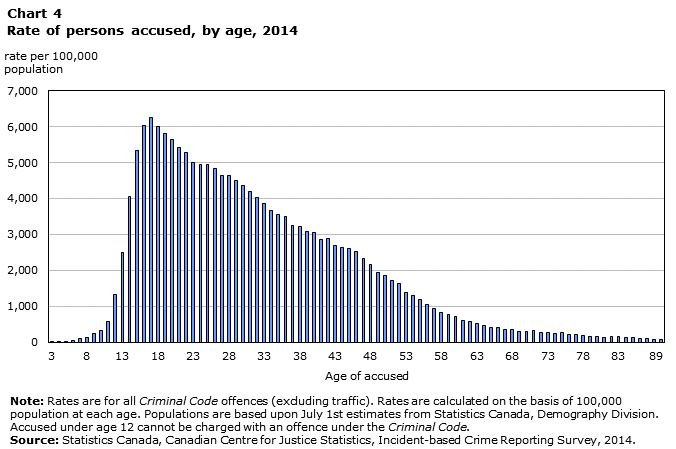
It may lower everyone's risk of re-offending by making them older when they get out: https://www.statcan.gc.ca/pub/85-002-x/2016001/article/14309... (via https://www.statcan.gc.ca/pub/85-002-x/2016001/article/14309... )

Although I guess it would make more sense to be looking at a chart of 2nd offences.

Re:What happens after a defendant is found not guilty by rea... by JumpCrisscross on Wednesday September 27, 2017 @05:49PM (#15352648)
This is what I was getting at. Keep them sequestered until they’re statistically unlikely to cause further harm. This doesn’t work if you’re locking up pot smokers. It does if you limit long-term prison sentences to violent offenders (and maybe corruption).
Re:What happens after a defendant is found not guilty by rea... by nybblet on Wednesday September 27, 2017 @05:11PM (#15352388)
The comment is not saying that prison will lower the risk of re-offending, but that it will lower the risk of impacting other people until the risk of re-offending falls suitably low (e.g. due to other means like treatment).
Re:What happens after a defendant is found not guilty by rea... by alkonaut on Wednesday September 27, 2017 @04:38PM (#15352073)
Well the purpose is of course all those things.

Someone locked up for insanity wouldn't be released while they are still a danger to the public. But anyone imprisoned for a violent crime might be released while still a very clear danger to society, even murderers and similar. Time limited sentences work that way.

Re:What happens after a defendant is found not guilty by rea... by kelnos on Wednesday September 27, 2017 @05:52PM (#15352673)
The thing that I worry about in these cases is the lack of "enforceability" of treatment. If keeping the person in control of themselves (such that they don't become violent again) means they need to be on medication for the rest of their lives, how do we ensure (post-release) that they'll always be on their meds?

I know of people on various medications for psychiatric reasons that have (against their doctor's recommendation) gone off their meds because they didn't like the side-effects. That might be fine (if unfortunate/difficult) for a mental illness that doesn't drive the sufferer to violence, but in the case where it does, how can you responsibly release someone if you don't have a mechanism to ensure they stay on their medication?

Re:What happens after a defendant is found not guilty by rea... by lazyasciiart on Wednesday September 27, 2017 @06:27PM (#15352910)
Mechanisms to enforce medication usage in the community do exist, usually by in-person visits to supervise taking medication. One such program is the "Assertive Community Treatment" model that exists in a couple different places in the US, here's a report from the King County (WA) group: http://www.kingcounty.gov/~/media/health/mentalHealth/Docume...

I think the actual 'enforcement' in the way you are thinking would be backed up with some kind of court ruling that they were required to take the medication, I'm not so sure how that angle would work.

Re:What happens after a defendant is found not guilty by rea... by DanBC on Thursday September 28, 2017 @04:09AM (#15355575)
In England you have a "community treatment order". These are meant to reduce the numbers of hospitalisations of people with severe and enduring mental illness, by ensuring medication is taken.

They don't seem to work in that sense. There doesn't seem to have been a reduction in hospital use in that group.

English MH treatment is very different to the US though.

Re:What happens after a defendant is found not guilty by rea... by dsego on Thursday September 28, 2017 @01:20AM (#15354837)
Monthly injections, and if you don't show up, they call the cops. Also, once somebody has a history, it's easy to send them back to the institution.
Re:What happens after a defendant is found not guilty by rea... by nerfhammer on Wednesday September 27, 2017 @06:03PM (#15352749)
Would their doctor or pharmacist have to also take up the role of sort of parole officers?
Re:What happens after a defendant is found not guilty by rea... by IncRnd on Wednesday September 27, 2017 @05:39PM (#15352581)
I absolutely agree.

My understanding is that prisons are said to have four purposes: deterrence, incapacitation, retribution, and rehabilitation.

However, in the absence of having prisons a society would likely create prisons to protect the people of society. My conclusion is that prisons are meant to protect the populace with those other reasons being secondary based upon cultural mores.

Re:What happens after a defendant is found not guilty by rea... by LeifCarrotson on Wednesday September 27, 2017 @09:00PM (#15353678)
> would likely create prisons to protect the people

How would prisons protect people? By deterring the people who might endanger them, by removing the capacity of people who do cause harm to cause more harm, by punishing those people, and by rehabilitating them into society.

The reasons aren't secondary or primary. They're different sides of the same coin, just stated from different perspectives: how to deal with the problem of crime vs. how to protect society from criminals.