News for hackers. Stuff that matters.
Re:NASA admits it doesn’t have the funding to land humans on... by FiatLuxDave on Thursday July 13, 2017 @10:15AM (#14761405)
I had a conversation a few years ago with Buzz Aldrin. He was talking about his idea for a Mars Cycler which would travel continuously between Earth and Mars. I told him that I thought it was a great idea (especially as it would be investing in 'permanent' space infrastructure instead of a single-shot mission) but that I thought it was unlikely that the government would allocate enough resources to build it. He seemed very disappointed with me, as if by making a realistic assessment of today's politics that I was voting in that way. I'm all for spending money in Chryse Planitia instead of Helmand province. So is almost everyone I know. But I feel like the chance of the US government actually funding something serious in space is pretty much nil. And I have no idea how to go about changing that.
Re:NASA admits it doesn’t have the funding to land humans on... by mannigfaltig on Thursday July 13, 2017 @11:08AM (#14761895)
I have trouble understanding the enthusiasm about space. Space hostile and empty. Why not simply send space probes and rovers at a fraction of the cost and spend the money more wisely, for example in projects which research aging, cancer, overpopulation and disaster management in face of global warming. Why do we need to make the exception for space and get drunk with nostalgia and romantic ideas of exploration, when the rest of science is usually about sobriety and utility. Where is the sober calculation that space exploration is more effective than other ways of spending research funds?
Re:NASA admits it doesn’t have the funding to land humans on... by tynpeddler on Thursday July 13, 2017 @11:30AM (#14762110)
Space probes may be cheap but they are slooooowwww. Most of the research done by spirit, opportunity and curiosity could have been done by a trained astronaut in an afternoon. As an example, in its 2623 day mission, spirit traveled less than 5 miles. Rovers are great for low budget exploration, but if you want to kick things into high gear, there's no substitution for trained humans.

Some of you may be thinking, 'Hold on a second, if you took the money for manned exploration and poured that all in to rovers, surely you would get even more science done than humans could possibly do!" Perhaps, but I would argue that the research done to support the manned exploration should be counted in the scientific haul. Meaning that currently, for ten billion dollars, we could shoot rovers to every corner of the solar system using current rocket technology. But if we spent that ten billion dollars sending people to mars, we would have to develop new rockets, new infrastructure, new habitation technologies, cosmic radiation shields and much more. All that technology, plus the knowledge we gain on mars would be more valuable than simply sending rovers all over the solar system, partially because all that new technology would probably make it easier to later send rovers all over the solar system.

In addition to the above, there is also the massive pr power of putting people on mars. Everyone in the world knows Neil Armstrong, but no one cares much about luna 2.

Re:NASA admits it doesn’t have the funding to land humans on... by valuearb on Thursday July 13, 2017 @11:41AM (#14762215)
NASAs manned space efforts have devolved into a scam to divert funds into the state of Alabama. It literally can't build any manned space systems unless they are gold plated and cost 20 times what they should.
Re:NASA admits it doesn’t have the funding to land humans on... by nathancahill on Thursday July 13, 2017 @12:20PM (#14762588)
The gold plating is for radiation shielding in space. It reflects more infrared radiation than other materials.
Re:NASA admits it doesn’t have the funding to land humans on... by sgt101 on Thursday July 13, 2017 @01:54PM (#14763509)
I thought it was to prevent corrosion in leo.. I understood that the upper atmosphere's interaction with high energy radiation creates a corona of ionized gas around the earth which is extremely eager to combine/corrode any material it makes contact with.
Re:NASA admits it doesn’t have the funding to land humans on... by aubiematt on Thursday July 13, 2017 @02:22PM (#14763810)
The question should be, would you rather your tax dollars go towards a War machine? Or supporting the move of intelligent people to 3rd world Alabama to hopefully balance out the crazies and racists?
Re:NASA admits it doesn’t have the funding to land humans on... by valuearb on Thursday July 13, 2017 @07:21PM (#14766145)
I'd rather NASA cancel the SLS instead of spend $2B per launch, when they can then go ahead and contract with SpaceX and Blue Origin to launch similar vehicles for less than $200M per launch.
Re:NASA admits it doesn’t have the funding to land humans on... by thearn4 on Thursday July 13, 2017 @01:04PM (#14762988)
i.e. what is sometimes called the "Alabama Space Mafia".
Re:NASA admits it doesn’t have the funding to land humans on... by SkyLX on Thursday July 13, 2017 @12:25PM (#14762620)
Cite some sources for your claims dude.
Re:NASA admits it doesn’t have the funding to land humans on... by mikeytown2 on Thursday July 13, 2017 @12:41PM (#14762777)
The SLS rocket is crazy expensive. It's known as the Senate Launch System because of all the pork. https://www.google.com/amp/s/www.theverge.com/platform/amp/2...
Re:NASA admits it doesn’t have the funding to land humans on... by codys on Thursday July 13, 2017 @03:04PM (#14764174)
> Space probes may be cheap but they are slooooowwww

If we spent as much on a space probe (or probes) as on a manned mission, I imagine there would be enough weight capacity to make the unmanned rover (or rovers) faster, if that was considered worthwhile.

Also consider that the total distance traveled by a unmanned rover over the course of the mission already exceeds that of manned missions. Wikipedia links to a nice chart from NASA [1].

Distance traveled and speed to travel that distance isn't necessarily connected to the value of a rover.

As to "all that new technology [we gain from manned exploration] would probably make it easier to later send rovers all over the solar system", frankly, we could just develop the new tech for unmanned exploration directly. Manned missions primarily serve as PR, except when we actually need careful manipulation, like repairing the Hubble, something that has almost continuously been pushed off to the point where it likely makes sense just to replace it.

1: https://en.wikipedia.org/wiki/Lunar_Roving_Vehicle#/media/Fi...

Re:NASA admits it doesn’t have the funding to land humans on... by jldugger on Thursday July 13, 2017 @11:40AM (#14762204)
> Rovers are great for low budget exploration, but if you want to kick things into high gear, there's no substitution for trained humans.

But how many rovers can you get for the price of one round trip space party?

Re:NASA admits it doesn’t have the funding to land humans on... by codys on Thursday July 13, 2017 @03:32PM (#14764422)
It's fairly hard to figure this out. What follows is a really bad comparison between Apollo & Curiosity, which completely ignores tech advancement, the difference between a moon flight and a mars flight, the length of time for each mission, the amount of data collected, and a whole lot of other stuff.

The cost of Apollo program in 1973 was reported as ~$25 billion. In 2016 dollars, ~$135 billion. The Apollo program made 6 manned landings (I'm going to ignore non-landing missions as we're talking about rovers & consider them part of the development cost for the program).

The curiosity mission was reported as costing $2.5 billion in 2011 ($2.6 billion in 2016 dollars).

So with some really bad math (as noted earlier):

- dollars per manned moon mission = 135/6 = 22.5 billion

- dollars per unmanned mars mission = 2.6 billion

- For the cost of 1 manned moon mission, we could have ~8 (22.5/2.6) unmanned mars missions.

Re:NASA admits it doesn’t have the funding to land humans on... by c22 on Thursday July 13, 2017 @11:51AM (#14762308)
Everyone remembers Pathfinder but no one cares much about Eugene Cernan.
Re:NASA admits it doesn’t have the funding to land humans on... by greeneggs on Thursday July 13, 2017 @03:27PM (#14764380)
There is no better time for manned space exploration than now. Certainly within 100 years and possibly within decades, robots will be better than humans in nearly every aspect of space exploration. I think the proponents of manned space exploration see their window closing, and are getting a bit desperate.

If we want NASA's research to have benefits to broader society, it would be best to redirect it all toward robotics and artificial intelligence. This would give the most scientific benefits as well as long-term engineering benefits.

Currently, the money being spent on manned space exploration has negligible side benefits. A lot of it is being spent on old technologies, like non-reusable rockets that are too expensive to fly.

Re:NASA admits it doesn’t have the funding to land humans on... by njarboe on Thursday July 13, 2017 @12:12PM (#14762523)
"Space hostile and empty."

This is a feature, not a bug. There is a small fraction of humanity that has the desire to do very hard and physically dangerous things. Another fraction who greatly enjoy empty spaces and prefer having great influence over the culture they live in. On Earth, very hard and dangerous can be found, but the activities are either recreational (mountaineering) or involve hurting other people (military, criminal life). Physical empty spaces are still around on Earth, but culturally empty spaces are gone. All land on Earth is either claimed by nation states or must remain unsettled by treaty (Antarctica). Have a small sub-set of humans desiring to leave the over-crowded tribe and cross that river, ocean, or desert for the chance to start their own tribe/civilization is probably necessary for evolutionary survival of the species.

Complaining about the waste in NASA's budget for human exploration, that I can understand, as they have not really advanced that cause since the moon shot. But to dismiss real human exploration all together ("drunk with nostalgia and romantic ideas of exploration"), when a certain fraction of people need it for a fulfilled life, seems closed minded. Maybe a crack will form if you read this. With a world GDP of about 80 trillion dollars/year a few billion/year of public funds for human space flight does not seem unreasonable.

Re:NASA admits it doesn’t have the funding to land humans on... by kitsunesoba on Thursday July 13, 2017 @12:46PM (#14762821)
Well said. Humanity hasn't had a true new open frontier in quite some time, and the negative effects of such are beginning to surface. It's an important component of a healthy civilization that's simply absent right now. Our restless have nowhere to go.

And yes, surely we have enough people and resources to swing large-scale space operations alongside what we already do.

Re:NASA admits it doesn’t have the funding to land humans on... by javajosh on Thursday July 13, 2017 @02:11PM (#14763704)
Maybe Musk and Bezos can live in a biosphere bubble on the asteroid belt maintained by an army of their (wholly-owned) mining robots. But Mars is a bad joke. It's deep in a gravity well and is a gigantic, cold Sahara dessert without breathable air.

If physicists and engineers can come up with a massless drive and potent, safe energy to drive it (e.g. EmDrive powered by fusion) we cold probably send missions back and forth to nearby stars - a worthy goal. But even then it will be expensive and time-dilation will ensure that whatever glory the explorers get will be amongst strangers. And it seems incredibly unlikely that we'll find any planet sufficiently close to Earth to be worth colonizing!

Now, if someone invents a unique, valuable zero- or micro-gravity industrial process then look out! Space will get real sexy real fast.

Re:NASA admits it doesn’t have the funding to land humans on... by njarboe on Thursday July 13, 2017 @02:24PM (#14763829)
Most inventions are serendipitous accidents. To find valuable things that can only happen in zero or micro gravity will probably require lots of people existing and experimenting in that environment.
Re:NASA admits it doesn’t have the funding to land humans on... by javajosh on Thursday July 13, 2017 @04:16PM (#14764782)
On it's face, that's not a terrible argument. But consider the "bet" you are making: spend like $1T on a habitable structure large enough for a good community, and then ~1B per year to operate it, in the hopes of "serendipity".

How many materials scientists (and their families) would want to live in orbit, or on the moon, in harsh, cramped conditions, with limited tools and resources?

Re:NASA admits it doesn’t have the funding to land humans on... by EliRivers on Thursday July 13, 2017 @02:45PM (#14763979)
culturally empty spaces are gone

You've never been to my home town :p

Re:NASA admits it doesn’t have the funding to land humans on... by kbyatnal on Thursday July 13, 2017 @11:23AM (#14762050)
Do you have any idea how many of our modern technologies were developed as a direct result of the space program? New technologies were needed to go into space and many of them have become essential for our lives.

MRI, LEDs, Anti-Icing Systems, Artificial Limbs, Land Mine Removal, Firefighter Gear, Water Purification, Pollution Remediation, etc etc...the list goes on and on. Studies estimate a $7-$14 return on investment for every $1 of NASA expenditure.

Source:

https://spinoff.nasa.gov/Spinoff2008/tech_benefits.html

Re:NASA admits it doesn’t have the funding to land humans on... by valuearb on Thursday July 13, 2017 @11:45AM (#14762259)
Wow, you are saying if you take a massive pile of money to hire a bunch of the smartest engineers away from private companies and pay them to solve problems, they'll do it?

And if NASA didn't exist, and these engineers instead worked for less bureaucratic, more entrepreneurial businesses, they'd invent nothing?

Re:NASA admits it doesn’t have the funding to land humans on... by 0xffff2 on Thursday July 13, 2017 @11:53AM (#14762328)
Anecdotally, my group at NASA has seen several of our smartest engineers leave for the private sector in the last couple of years. They are all making heaps more money, but not one of them is doing the kind of innovative research that we do at NASA.
Re:NASA admits it doesn’t have the funding to land humans on... by valuearb on Thursday July 13, 2017 @07:18PM (#14766118)
Please name any innovative research NASA is currently doing that will lower the cost of manned space travel. They are wasting $20B+ building a non-reusable launch system based on 1970s technology.

The future of space flight has to be cost effective. It almost certainly requires re-usabilty. Nowadays, SpaceX and Blue Origin are doing far more important research and actual development than NASA is. Thank you NASA for all the core technologies you've developed. But now that you have become hostage to congress and massive pork spending, and focused on creating massively uneconomic systems like the SLS, please get out of the way.

Re:NASA admits it doesn’t have the funding to land humans on... by valuearb on Thursday July 13, 2017 @11:59AM (#14762399)
Yea, their research will now actually ship.
Re:NASA admits it doesn’t have the funding to land humans on... by sqeaky on Thursday July 13, 2017 @02:17PM (#14763759)
NASA is obligated to share their work with Americans. Many products ship with tech NASA invented that probably would not have been shared if a private enterprise came up with it.
Re:NASA admits it doesn’t have the funding to land humans on... by valuearb on Thursday July 13, 2017 @07:15PM (#14766102)
Are you joking? The only point of doing private sector research is to build something out of it. We receive those advances as new products.

And NASA doesn't gift it's advances to americans, it shares technologies with private companies that share them in the exact same way. You and I still had to pay for our Tang, it was never free.

NASA is a huge inefficient bureaucracy hamstrung by a fickle and corrupt congress. As brilliant as it's engineers are, and they are very brilliant, their projects are extremely fragile, often getting canceled or not funded for ridiculous reasons, or having ridiculous conditions applied to them that slow development (such as parting work out to the less qualified across many congressional districts).

The largest project NASA is investing most of it's resources in is the SLS. It's not revolutionary. It's not a significant advance. It's just a large launch system that's mostly re-using old technologies. It does nothing to lower launch costs. It does nothing to advance re-usablity. It's not a solution to making deep space manned space exploration economically viable.

Any engineers who work on the SLS are engineers denied to SpaceX, Blue Origin, ULA, Sierra Nevada, or a dozen more cost-efficient space launch companies. NASA's competition for engineers raises engineering costs for everyone else. It's wasteful investment in a pork barrel project like SLS diverts revenues that could fund far more efficient launch systems at private companies, and give NASA far more manned launch capacity and much sooner.

Right now engineers at private companies are doing far more to advance economically viable space travel than NASA. Let's thank NASA for the Saturn program, but realize that everything they've done since has been hugely wasteful of resources and detrimental to advancing the cause of space travel.

Re:NASA admits it doesn’t have the funding to land humans on... by sqeaky on Friday July 14, 2017 @12:08PM (#14770881)
Tang isn't a NASA invention, it was invented by Kraft. It tastes terrible and no one bought it until NASA used it[0].

But lets run with that. If NASA had invented they wouldn't manufacture and give it away, they would give away the recipe and entrepreneuring businesses could make it to sell if they wanted.

This is exactly what happened with Memory Foam. A NASA contractor invented it as part of the contract so they couldn't keep it secret[1] and it worked its way into a ton of products.

I think you are correct that SLS is not ideal. But I don't think that is really applicable, their inefficiency as business is perhaps understandable because they are not a business. They take their direction from Congress and congress told them to make a ship out of parts they had laying around and that was the SLS.

If we wanted to look at their other missions, they have landed several things on mars and orbited distant planets. Feats no private enterprise has done (yet). All the research from that is available amateur astronomers routinely use to discover new things, like exoplanets in old data.

Designs for things they made like their rocket motors is made available, and that is how Space-X started, by looking at NASA plans for their rockets and picking and choosing the parts they thought most practical.

[0]: https://en.wikipedia.org/wiki/Tang_(drink) [1]: https://en.wikipedia.org/wiki/Memory_foam

Re:NASA admits it doesn’t have the funding to land humans on... by valuearb on Friday July 14, 2017 @07:04PM (#14773909)
Again, the inventor of memory foam isn't going to hide it, they are going to create products out of it or license it. So the idea that NASA "shares" is immaterial.

Calling the SLS "not ideal" is like saying a Tsunami will get you wet.

SpaceX benefited as much from NASA as NASA benefited from the Nazis, and as the Nazi's benefited from Goddard. Research marches on.

But currently the most important R&D in the space business is being done by SpaceX. The only way space travel becomes economically viable is through re-usablity, which NASA has not made any credible attempts at solving.

And NASA isn't inefficient because it's not a business. It's inefficient because it's being used to distribute pork barrel spending to specific congressional districts. If the most efficient way to build the SLS was to build it in Puerto Rico, it would never happen because Puerto Rico doesn't have any congressional votes. Instead NASA is forced to break up projects across a massive number of congressional districts and do each sub-task in the most costly way possible so the sub contractors in those districts get a big taste of excess profits to spread around the district.

Re:NASA admits it doesn’t have the funding to land humans on... by fsloth on Thursday July 13, 2017 @11:55AM (#14762347)
The inventions did not arise merely from the minds of the engineers but of the problem constraints placed upon them. Space research has been beneficial for technological development because of the exotic problems which have created solutions with wide applicability.

This is not to say they would have not arisen through land based research but invention needs inspiration as well, not just financial incentives.

Re:NASA admits it doesn’t have the funding to land humans on... by soperj on Thursday July 13, 2017 @12:48PM (#14762832)
Where are the brightest minds of our generation now? What are they working on? Most are trying come up with better ways for you to click on advertisements.
Re:NASA admits it doesn’t have the funding to land humans on... by bencollier49 on Thursday July 13, 2017 @02:25PM (#14763836)
Well, one would imagine that they would instead be employed in finding new and more effective ways of making people click on adverts.
Re:NASA admits it doesn’t have the funding to land humans on... by gorkonsine on Thursday July 13, 2017 @04:03PM (#14764672)
Or in finding new and effective ways of selling shares of companies for profit.

What's important is that these jobs (finance and advertising) are more valuable work to society than scientific research, as reflected in the pay differential.

Re:NASA admits it doesn’t have the funding to land humans on... by arcbyte on Thursday July 13, 2017 @11:59AM (#14762397)
> hire a bunch of the smartest engineers away from private companies

There would be no hiring away. That's not how the government works. They'd contract the private companies the engineers already work at.

Re:NASA admits it doesn’t have the funding to land humans on... by valuearb on Thursday July 13, 2017 @07:20PM (#14766137)
If NASA hires a bunch of private companies to build the subsystems for the SLS, they are hiring engineers away from Blue Origin, SpaceX, ULA, etc. Those engineers may not work for NASA, or have worked at SpaceX, etc, but it's the same end.

And the SLS is a boondoggle, so the efforts of those engineers will be totally wasted.

Re:NASA admits it doesn’t have the funding to land humans on... by paulcole on Thursday July 13, 2017 @11:28AM (#14762096)
Everything from watchmaking to watch repair!
Re:NASA admits it doesn’t have the funding to land humans on... by Quarrelsome on Thursday July 13, 2017 @11:11AM (#14761933)
because space is more than us and it isn't us. It gives us a non-nation based activity to pursue that is greater than the whole of earth. It represents new frontier, new resources and ways of thinking that transcend this planet. It is a form of evolution and of freedom that isn't shackled so much by our self-made problems of earth. There are new mistakes to make and that's super appealing.
Re:NASA admits it doesn’t have the funding to land humans on... by zatkin on Thursday July 13, 2017 @11:13AM (#14761959)
We can't even cope with the environmental issues that we have on our own planet, so we avoid that and instead look to plaguing the rest of the solar system and beyond? Good grief.
Re:NASA admits it doesn’t have the funding to land humans on... by marvin on Thursday July 13, 2017 @11:23AM (#14762041)
You could have said the same thing about literally any exploratory initiative since humans first started using tools 50 000 years ago. Spending some tiny portion of resources expanding the scope of human presence does not preclude attacking more immediate challenges.
Re:NASA admits it doesn’t have the funding to land humans on... by simonh on Thursday July 13, 2017 @12:06PM (#14762464)
Are you suggesting that not going to Mars will solve all our environmental problems? This isn't an either-or question.

If we really wanted to, there's no reason we couldn't do both and they're is a blocking issue for the other and some of the technology and science for both are complementary (planetary science, solar and battery technology, environmental control, automation).

Re:NASA admits it doesn’t have the funding to land humans on... by HarkMamilton on Thursday July 13, 2017 @11:19AM (#14762004)
Environmentalism isn't an excuse to give up on every other aspiration humanity might hold.
Re:NASA admits it doesn’t have the funding to land humans on... by justinator on Thursday July 13, 2017 @11:45AM (#14762264)
I personally would vote in favor of putting space exploration on hold until we get a handle on the quickly accelerating environmental disaster we humans have set up that seems that it may just wipe ourselves out.

Personally.

One needs beauty in the world, yes, but one also needs to breathe.

Re:NASA admits it doesn’t have the funding to land humans on... by CydeWeys on Thursday July 13, 2017 @12:13PM (#14762531)
This doesn't make any sense though, as there's no reason they should be exclusive priorities. I, personally, would vote in favor of putting many things on hold until we increase humanity's resilience to catastrophic events by settling on other planets, but I recognize that priorities aren't mutually exclusive.

Anyway, what's the point of focusing all efforts on Earth if human civilization is going to die out here anyway? That's the path we're currently on, and stopping space exploration isn't going to magically fix that. Wanting other baskets for the egg of human civilization is just pragmatism.

Re:NASA admits it doesn’t have the funding to land humans on... by HarkMamilton on Thursday July 13, 2017 @12:02PM (#14762433)
Environmentalists will never be satisfied. There is always something to improve.

If humanity dies or goes pre-industrial because someone engineered a supervirus and we refused to put effort into space travel, all our conservation efforts won't really matter much.

Re:NASA admits it doesn’t have the funding to land humans on... by scythe on Thursday July 13, 2017 @12:50PM (#14762850)
Yeah, we're going to plague a bunch of inanimate objects, and defile the sanctity of the asteroid belt. It amuses me that "atheists" have decided life itself is a plague threatening some great holy Natural-Universe. Your distaste for the people around you is showing.

Dunno if you've heard, but this Universe is condemned. In about a hundred trillion years it'll run out of hydrogen and burn out. Might as well enjoy it while we can.

Re:NASA admits it doesn’t have the funding to land humans on... by CydeWeys on Thursday July 13, 2017 @12:10PM (#14762502)
It's not the technology to tackle environmental issues that is lacking, it's the political will. Not going to space doesn't magically solve the problem of entrenched carbon-emitting interests having the power to block a short-term mandatory transition to renewable energy.

Given that, it absolutely makes sense to colonize space, as Mars can't be ruined in the same way that we're ruining Earth, and the petroleum mining industry won't be coming along for the ride.

Re:NASA admits it doesn’t have the funding to land humans on... by thebooktocome on Thursday July 13, 2017 @11:48AM (#14762289)
What if space based Earth science is what it takes to solve our environmental issues? Sagan's Blue Marble has done more for environmental preservation than decades of armchair environmental activism.
Re:NASA admits it doesn’t have the funding to land humans on... by TaylorAlexander on Thursday July 13, 2017 @11:45AM (#14762261)
We learned a whole lot about the greenhouse effect by studying Venus...
Re:NASA admits it doesn’t have the funding to land humans on... by digikata on Thursday July 13, 2017 @12:26PM (#14762633)
Research is needed, it's hard to predict, and Development for space forces the movement of practical, envelope pushing movement of research and theory into at some hard problem solving in ways that just more research doesn't accomplish.

For example:

https://en.wikipedia.org/wiki/Timeline_of_solar_cells

Space isn't solely responsible for solar cells, but I can't help but note these entries in the timeline.

1950s - Bell Labs produce solar cells for space activities.

1954 - On April 25, 1954, Bell Labs announces the invention of the first practical silicon solar cell

1958 - T. Mandelkorn, U.S. Signal Corps Laboratories, creates n-on-p silicon solar cells, which are more resistant to radiation damage and are better suited for space. Hoffman Electronics creates 9% efficient solar cells. Vanguard I, the first solar powered satellite, was launched with a 0.1W, 100 cm² solar panel.

Would the solar cell technology we enjoy today have developed as quickly or at all with that little extra push of space investment to move it along? Would the research ever have ended up as practical without hard engineering problems to solve along the way?

I think you'll find similar connections for fuel cells, and battery tech. You see metals research now which is applicable for the space application first, but the engineering knowledge will likely get re-applied in more expanded mundane applications in due time...

Re:NASA admits it doesn’t have the funding to land humans on... by skummetmaelk on Thursday July 13, 2017 @11:42AM (#14762220)
Good grief Columbus, you aren't even competent enough to round the Cape. Why would you go west?!
Re:NASA admits it doesn’t have the funding to land humans on... by njarboe on Thursday July 13, 2017 @09:49PM (#14766823)
People who view humanity as a plague upon the Earth definitely won't want us spreading elsewhere.
Re:NASA admits it doesn’t have the funding to land humans on... by HarkMamilton on Thursday July 13, 2017 @12:06PM (#14762469)
Humanity is at an incredibly high extinction risk. We have all sorts of incredible new technologies that could, at the very least, knock us back to pre-industrial society. They might just kill us outright.

We've already used all the easily accessible high-energy fuels, so if our current industrial society falls apart, we will probably never build another one.

If we don't get to space now, we will probably never get to space. Then it's only a matter of time until we get hit by an asteroid.

Or we'll just get killed by an engineered supervirus and skip the whole pre-industrial decay phase.

Going into space is our insurance policy.

Re:NASA admits it doesn’t have the funding to land humans on... by bluGill on Thursday July 13, 2017 @12:54PM (#14762886)
Insurance against what? Lets assume a self supporting mars colony today, and that the asteroid hits earth tomorrow making humans extinct. Will the mars colony get off mars in time to avoid their asteroid? It seems to me that we need to get to a few earth like planets before we can assume survival.
Re:NASA admits it doesn’t have the funding to land humans on... by HarkMamilton on Thursday July 13, 2017 @01:10PM (#14763043)
Sure, so we'd better get started.
Re:NASA admits it doesn’t have the funding to land humans on... by ythn on Thursday July 13, 2017 @01:06PM (#14763003)
The assumption is that we will somehow "terraform" Mars so that it will be earthlike before Earth is destroyed.
Re:NASA admits it doesn’t have the funding to land humans on... by srtjstjsj on Thursday July 13, 2017 @01:15PM (#14763088)
why would martian life survive the destruction of earth from extraplanetary impact, which would affect martian orbit?
Re:NASA admits it doesn’t have the funding to land humans on... by freeflight on Thursday July 13, 2017 @02:11PM (#14763699)
Mars is only the spearhead for further stellar and maybe even interstellar colonization, after all, we gotta start somewhere don't we? Once we manage to do Mars, by gaining knowledge, developing technologies and maybe even discovering new resources, we can hedge humanities survival further by applying this experience to colonizing other places in space.
Re:NASA admits it doesn’t have the funding to land humans on... by AshleyGrant on Thursday July 13, 2017 @04:51PM (#14765103)
How would that affect Mars's orbit? The remains of the Earth will keep on orbiting the Sun.
Re:NASA admits it doesn’t have the funding to land humans on... by solarengineer on Thursday July 13, 2017 @01:48PM (#14763452)
Indeed. We'd have to start somewhere, though.
Re:NASA admits it doesn’t have the funding to land humans on... by njarboe on Thursday July 13, 2017 @12:18PM (#14762576)
There is still an amazing amount of coal in the ground. Check out the Powder River Basin in the US which, for one example.
Re:NASA admits it doesn’t have the funding to land humans on... by eropple on Thursday July 13, 2017 @12:50PM (#14762847)
There's a lot of it there, but it's hard to extract without modern technology. There's a little peat (arguably the most accessible type of high-energy fuel) left in the British Isles and Finland, but coal is requiring progressively more and more modern effort to extract.
Re:NASA admits it doesn’t have the funding to land humans on... by Spellman on Thursday July 13, 2017 @12:48PM (#14762835)
While true, it's also crazy expensive to extract.
Re:NASA admits it doesn’t have the funding to land humans on... by njarboe on Thursday July 13, 2017 @01:07PM (#14763017)
Not really. Wikipedia says that the USGS extimates that "At a price of $60/ton, roughly half (48%) of the coal is economic to produce." Current prices are near $10 a ton so only highly mechanized shallow strip mining techniques are profitable. Coal is about as valuable as other bulk earth products like sand and gravel. 19th century techniques could easily mine most of this coal. It is shipping, not extraction, that determines the price of coal at a given point on Earth. Civilization might need to restart near the mines, but there are still many of those places left.

Oil on the other hand. That might be a problem.

Re:NASA admits it doesn’t have the funding to land humans on... by AndrewKemendo on Thursday July 13, 2017 @01:41PM (#14763388)
It might sound trite, but the character from the Matrix played by Hugo Weaving related the Human Species to a virus. I think it's actually a startlingly accurate definition if you look at how we consume and expand, without finding a homeostatic symbiosis with the other forms of the environment.

It's in our nature to slash and burn and expand and grow, part of our DNA. Space tells people that they can continue being who they are, biologically, if you just find another world to find or build resources on. We want to be free to consume all we want, but want none of the costs or consequences.

Re:NASA admits it doesn’t have the funding to land humans on... by Eerie on Thursday July 13, 2017 @11:19AM (#14762007)
>Space hostile

Earth is hostile, too. A large part of human civilization is dedicated to making Earth more hospitable for humanity than it is in its natural state. We can do the same for space.

>Space empty

Only in a sense that a large container with a single fist-sized diamond is empty. It is empty on average. It contains an incredible amount of resources. Our solar system could easily house trillions of people (in O'Neill cylinders).

>for example in projects which research aging, cancer, overpopulation and disaster management in face of global warming

We already spend much more on these, than on space research.

Re:NASA admits it doesn’t have the funding to land humans on... by TaylorAlexander on Thursday July 13, 2017 @11:44AM (#14762253)
Space is empty?

I don't understand. In practice we have explored space to see new worlds. Things are far apart but there's lots of stuff in space.

Re:NASA admits it doesn’t have the funding to land humans on... by ptero on Thursday July 13, 2017 @12:35PM (#14762715)
Part of the reason is the same desire to see what is at the other side that pushed seafarers, voyagers and adventurers for ages to travel across hostile oceans, mountains and deserts.

It is not that we "need to get drunk .. with romantic ideas of exploration" as a society; but as individuals enough of us do anyway. I personally see it as a good thing. We do need to watch the costs, which is why my hopes are with the industry or eccentric [bm]illionaires, not NASA which became very bureaucratic and risk averse.

Re:NASA admits it doesn’t have the funding to land humans on... by nunobrito on Thursday July 13, 2017 @01:24PM (#14763192)
I happen to be Portuguese (land of pioneer seafarer) so had a chance to live with these legends in popular stories. There were other empires with better ship technology and huge fleets in place (e.g. China) and back in Europe one could find countries with better economical conditions to pioneer into the unknown seas (Genovese, Castillians, French, ..).

Yet, it was a tiny land on that corner of Europe which did the initial jump into the unknown.

Not just jumping, they crossed the whole of Africa using tiny boats and bargaining food at each stop. They succeeded because there was no other option. If the Portuguese crown were to make money, it had to risk doing what the others wouldn't.

500 years later. The US rulers don't see yet the money aspect in Mars, not even at the moon. But there is another "crown" already aiming for the moon, the Chinese: https://en.wikipedia.org/wiki/Chinese_large_modular_space_st...

It's going to be interesting. Let's see if a human can finally reach the moon.

Re:NASA admits it doesn’t have the funding to land humans on... by acjohnson55 on Thursday July 13, 2017 @12:07PM (#14762479)
Most people felt the same way about the Atlantic Ocean.
Re:NASA admits it doesn’t have the funding to land humans on... by cannonpr on Thursday July 13, 2017 @11:21AM (#14762028)
Do you want to build a safer basket ? Or invest in two baskets and split your eggs ? To some extent that is one argument, however space research in it's own right has generated a safer basket as well, as most engineering research is highly reusable. A lot of environmental problems for example could be solved via space based power generation that is beamed down.
Re:NASA admits it doesn’t have the funding to land humans on... by sqeaky on Thursday July 13, 2017 @02:15PM (#14763744)
> Space hostile and empty

and we have no guarantee earth won't become that way too.

If the worst should happen we will need to live without Earth or we will stop living. A big rock could come through any day.

Re:NASA admits it doesn’t have the funding to land humans on... by pps43 on Thursday July 13, 2017 @01:48PM (#14763451)
Going to space is disaster management. By the time we find an asteroid that's going to cause another extinction event it will be too late to start space exploration.
Re:NASA admits it doesn’t have the funding to land humans on... by escribmac on Thursday July 13, 2017 @11:16AM (#14761978)
I think that trying to reach difficult goals will spark new innovation. Also, it's not like there's a direct trade off.
Re:NASA admits it doesn’t have the funding to land humans on... by emodendroket on Thursday July 13, 2017 @02:04PM (#14763622)
Science that is "about sobriety and utility" is by its very nature focused on short-term, incremental gains.
Re:NASA admits it doesn’t have the funding to land humans on... by chrismealy on Thursday July 13, 2017 @11:18AM (#14762000)
I don't get it either. When it comes to manned spaceflight rationality goes out the window. Humans living on Mars makes about as much sense as homeopathy. I think it's some kind of nerd religion.
Re:NASA admits it doesn’t have the funding to land humans on... by eduren on Thursday July 13, 2017 @10:47AM (#14761673)
In regards to the cycler idea, he has even acted as a "customer" to a Purdue University team doing a mars feasibility study. They've recently released their report, in which they detail how a cycler might work in comparison to the original SpaceX ITS proposal.

https://engineering.purdue.edu/AAECourses/aae450/2017/spring...

Buzz Aldrin with the team:

https://engineering.purdue.edu/AAECourses/aae450/2017/spring...

Re:NASA admits it doesn’t have the funding to land humans on... by ghostbrainalpha on Thursday July 13, 2017 @01:03PM (#14762978)
NPR had a story this morning about why our budget never REALLY changes. And all the debate about passing this current budget is largely non substantive.

Basically it came down to special interest groups that really determine how our money is spent. If we want to not have 15-20% of the budget going to Helmand province, we have to start working against the lobbyists of private corporations who benefit from that...

Or instead of solving the problem, we could allow military contractors to fleece us for EVEN MORE money for developing Mars travel infrastructure. If we gave them a way to transition to a more profitable business maybe they would voluntarily make the shift.

Re:NASA admits it doesn’t have the funding to land humans on... by stevoo on Thursday July 13, 2017 @10:29AM (#14761515)
Creating interplanetary projects like the one above are extemely expensive. As the ISS showed is that costed !150 billion USD to construct making massive leaps into space should not be burden to a single country. With that the funding would be less, and the return even smaller.

I believe a global space agency should be formed where each country can allocate the money they wish and set goals by panels to the direction that they wish to proceed. ( very hard i can assume ).

That will ease the financial burden of countries and create project on a global scale that will unite the world instead of finding new reasons be patriotic about.

Re:NASA admits it doesn’t have the funding to land humans on... by philipov on Thursday July 13, 2017 @10:32AM (#14761536)
> That will ease the financial burden of countries and create project on a global scale that will unite the world instead of finding new reasons be patriotic about.

Which is the opposite of what world leaders actually want. Jingoism is the name of the game right now.

Re:NASA admits it doesn’t have the funding to land humans on... by specializeded on Thursday July 13, 2017 @11:31AM (#14762121)
Opposite of what lots of us want too, kumbaya circles didn’t fuel the space race!
Re:NASA admits it doesn’t have the funding to land humans on... by criddell on Thursday July 13, 2017 @12:48PM (#14762837)
I think competition might be more effective than cooperation when it comes to space exploration.
Re:NASA admits it doesn’t have the funding to land humans on... by carsongross on Thursday July 13, 2017 @10:44AM (#14761645)
If you'd like to know why NASA is getting less and less funding and can expect this trend to continue, see this chart from Five38/NYT:

https://espnfivethirtyeight.files.wordpress.com/2013/01/16fi...

Re:NASA admits it doesn’t have the funding to land humans on... by LeifCarrotson on Thursday July 13, 2017 @10:56AM (#14761776)
Here's the article from which that graphic is sourced:

http://fivethirtyeight.com/features/what-is-driving-growth-i...

I'm shocked that they are so brazen as to frame one of the categories as "entitlement spending". The neutral terms for the contents of this category are Medicare and Medicaid, pensions, retirement benefits, Social Security, welfare, and unemployment. You can also call them health insurance, retirement insurance, and unemployment insurance.

Technically, retirement benefits are things to which retirees are entitled to. Workers took lower-paying government jobs after weighing the value of the salary now against the value of the promised pensions later, or contributed to Social Security (not so much a choice by individuals, but a choice by the government of the past) which allows them to take the benefits of the program now. This is the literal meaning of the word "entitle", not the pejorative that it's become.

As far as health care and welfare go, I would argue that simply being human in a wealthy, modern society ought to entitle people to the right not die on the streets of preventable causes. I don't regret my tax dollars going to those causes, except insofar as they exceed actually providing health care and instead enrich the bureaucracy and megacorporations that are paid to provide it.

Re:NASA admits it doesn’t have the funding to land humans on... by gnaritas on Thursday July 13, 2017 @11:09AM (#14761904)
> I'm shocked that they are so brazen as to frame one of the categories as "entitlement spending".

What's wrong with calling them that, those are entitlements.

> Technically, retirement benefits are things to which retirees are entitled to.

Which is why they're called entitlements.

> This is the literal meaning of the word "entitle", not the pejorative that it's become.

It's only a pejorative to some and those same people think liberal is a pejorative. Nothing remotely wrong with the word entitlements, it's not pejorative to anyone who understand what the word actually means.

Re:NASA admits it doesn’t have the funding to land humans on... by dnadler on Thursday July 13, 2017 @11:05AM (#14761870)
"Entitlement spending" is a fairly common term used to describe government spending that benefits the people directly. I've seen it used in all kinds of places. I haven't heard it used in a derogatory way, though maybe I just haven't noticed.
Re:NASA admits it doesn’t have the funding to land humans on... by thebooktocome on Thursday July 13, 2017 @11:58AM (#14762381)
It is very frequently used as a derogatory term on conservative radio and television shows.
Re:NASA admits it doesn’t have the funding to land humans on... by angersock on Thursday July 13, 2017 @11:32AM (#14762123)
"Entitlements" is a technical term that's been used for quite some time (including the usage of the word in the original Social Security Act).

There's plenty of cases of speech manipulation, but this isn't one of them.

Re:NASA admits it doesn’t have the funding to land humans on... by euyyn on Thursday July 13, 2017 @11:06AM (#14761876)
Maybe "they" aren't brazen, and just use the word to mean "things people are actually entitled to"?
Re:NASA admits it doesn’t have the funding to land humans on... by cbr on Thursday July 13, 2017 @11:06AM (#14761874)
They're using "entitlement" as in "things people are entitled to".
Re:NASA admits it doesn’t have the funding to land humans on... by nql on Thursday July 13, 2017 @05:32PM (#14765440)
Even rich societies require some function which controls the population. The more you shield people from natural forces, the more you will stress the system as impact of those forces builds up.
Re:NASA admits it doesn’t have the funding to land humans on... by msinclair on Thursday July 13, 2017 @11:07AM (#14761891)
Entitlement: the amount to which a person has a right

Not to be confused with the other definition which has negative connotations.

Re:NASA admits it doesn’t have the funding to land humans on... by valuearb on Thursday July 13, 2017 @11:47AM (#14762276)
Don't forget that their entitlements promise them much more than their contributions could ever pay for.
Re:NASA admits it doesn’t have the funding to land humans on... by kodis on Thursday July 13, 2017 @12:06PM (#14762473)
I don't think that it's correct to say that NASA is getting less and less funding. At least according to the data on Wikipedia, NASA's budget has been between $15B and $20B per year in inflation adjusted dollars for the last few decades, and so increasing a bit most years to account for inflation.

The only budget metric that has been dropping has been NASA's percentage of the federal budget, and that's more due to the huge growth in federal spending rather than any decrease in the amount of funds that NASA has available.

Re:NASA admits it doesn’t have the funding to land humans on... by nicwolff on Thursday July 13, 2017 @11:58AM (#14762385)
What a terrible chart. By overlaying rather than stacking the areas it looks like almost all federal expenditures are now "entitlements"! Here's a stacked area graph since 1962, which makes clear that we've basically traded military spending for health care for old and disabled people:

http://www.painting-with-numbers.com/download/document/184/1...
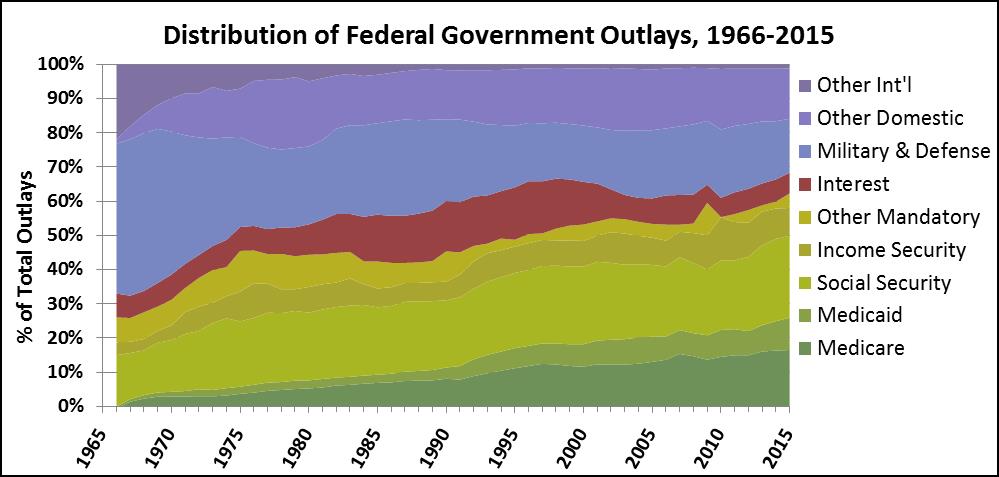
Re:NASA admits it doesn’t have the funding to land humans on... by carsongross on Thursday July 13, 2017 @12:18PM (#14762572)
But most federal outlays are entitlements. Breaking it out by entitlement type doesn't change that fact. Military spending presumably includes space/rocket related R&D.

And the total as a percentage of GDP has gone up extensively, which a stacked graph doesn't show.

Re:NASA admits it doesn’t have the funding to land humans on... by kuschku on Thursday July 13, 2017 @11:10AM (#14761924)
And the issue with this is the health care system, where the private companies get all the healthy individuals who can pay premiums, but the government has to pay the bill for those who can’t.

Single Payer would be less expensive than this.

Re:NASA admits it doesn’t have the funding to land humans on... by abecedarius on Thursday July 13, 2017 @02:53PM (#14764058)
I can see both sides of that conversation. Yes, pessimism is realistic, but also that judgement contributes to that reality. It's a self-fulfilling prophecy. The equilibrium can flip quickly after some unforeseen development shakes us out of it. Aldrin lived through such a flip -- I think it's hard to appreciate now how amazing aerospace developments were in the 50s/60s when the work was a societal priority.

Kickstarter solved a kind of similar problem for entrepreneurs, where it used to be too hard to surface the hidden demand for a product. There must be something we could do about testing/exposing the support a political idea might have past the "activation energy" needed to roll into a different equilibrium. A simple poll isn't enough.

Re:NASA admits it doesn’t have the funding to land humans on... by chha on Thursday July 13, 2017 @10:42AM (#14761624)
But hasn't this generally been an issue since Apollo?

Great Ideas(TM) emerge and people get enthusiastic about them, but fail to realize that the cost makes them difficult to carry out as intended. The Great Idea is then either watered down (Skylab, Space Shuttle) or comes to an abrupt halt due to lack of funding or for political reasons (Space Station Freedom, Constellation).

I'm getting more and more convinced that it will take autocratic nations looking for prestige, or commercial companies offering cheap and exotic tourist flights for humans to get back to the moon. The US doesn't have the political strength or stability to plan such a mission at the moment, and keep it going for the ~10ish years it takes.

Re:NASA admits it doesn’t have the funding to land humans on... by lfowles on Thursday July 13, 2017 @12:57PM (#14762915)
Speaking of Great Space Ideas(TM) that I was incredibly excited about in highschool, whatever happened to space elevator research?
Re:NASA admits it doesn’t have the funding to land humans on... by sametmax on Thursday July 13, 2017 @10:32AM (#14761539)
Right now Mars doesn't have any resource with crave enough to justify this enormous cost. If suddenly we discover that there is something we can get money from, and not just knowledge, you'll get investers.
Re:NASA admits it doesn’t have the funding to land humans on... by eduren on Thursday July 13, 2017 @11:03AM (#14761850)
One "resource" that might justify a human presence on Mars is its relatively weak gravity well. Combine that with fuel production, and you are looking at Mars being the gas station to the solar system.

There are certainly places in the solar system that do have valuable resources and the fuel to trawl around the asteroid belt would be a lot cheaper if it could be lifted from Mars rather than Earth.

Not saying it will happen anytime soon, but that may be what the future holds.

Re:NASA admits it doesn’t have the funding to land humans on... by arethuza on Thursday July 13, 2017 @11:49AM (#14762297)
So Mars might be the Saudi Arabia of the 22nd century?
Re:NASA admits it doesn’t have the funding to land humans on... by fancy_pantser on Thursday July 13, 2017 @02:09PM (#14763685)
Arrakis might be a more direct comparison!
Re:NASA admits it doesn’t have the funding to land humans on... by arethuza on Thursday July 13, 2017 @03:45PM (#14764521)
Who controls Mars controls the Solar System?
Re:NASA admits it doesn’t have the funding to land humans on... by bdamm on Thursday July 13, 2017 @12:43PM (#14762792)
There are near earth asteroids that are better fuel stops than Mars. That's the better mission IMHO.
Re:NASA admits it doesn’t have the funding to land humans on... by maze-le on Thursday July 13, 2017 @10:39AM (#14761591)
Martian soil contains non-neglible amounts of phosphates[0]. Phosphorus is highly important for the production of fertilizers and gets increasingly rare here on earth[1]. It wouldn't suprise me if 150 years from now, phosphates are imported from martian soil.

[0]: https://phys.org/news/2013-09-phosphate-soluble-mars.html

[1]: http://onlinelibrary.wiley.com/doi/10.1002/jsfa.4650/full

Re:NASA admits it doesn’t have the funding to land humans on... by maxerickson on Thursday July 13, 2017 @10:52AM (#14761735)
The easily available deposits on Earth are expected to last longer than 150 years. It's unlikely to be worth the delta-v to bring it here from Mars before known deposits are exhausted.

Even after that I expect deep sea mining or direct extraction from seawater to be more viable than interplanetary shipping.

Re:NASA admits it doesn’t have the funding to land humans on... by bluGill on Thursday July 13, 2017 @12:59PM (#14762934)
I expect that sewage treatment to fertilizer will solve the problem before we reach that. Our current time where we are not putting manure on all fields is an anomaly in time.
Re:NASA admits it doesn’t have the funding to land humans on... by seanalltogether on Thursday July 13, 2017 @10:50AM (#14761715)
Surely it must be more economical to recover/recycle it from waste?
Re:NASA admits it doesn’t have the funding to land humans on... by LeifCarrotson on Thursday July 13, 2017 @12:01PM (#14762421)
The phosphates are washed off by rainwater and diluted into the watershed (eventually the oceans). In the ocean, it is very slowly converted by bacteria and eventually brought back by geologic processes uplifting sediment. For a while, we could mine the deep ocean floor...which might be comparable to mining on Mars.